
In This Article
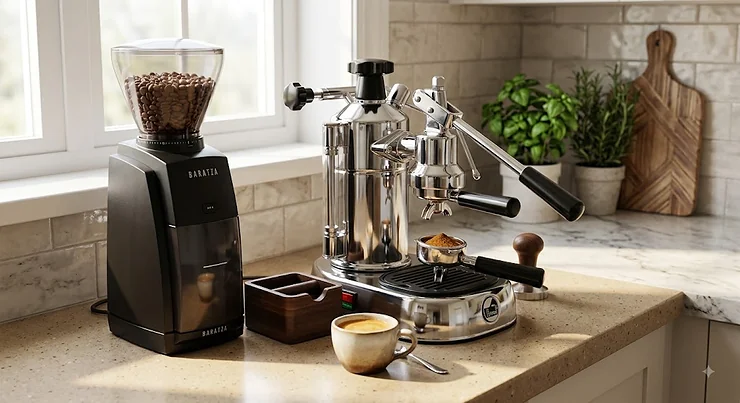
There’s a particular kind of quiet that happens right before a lever machine gives up its shot. The boiler hisses low, the portafilter sits locked and warm, and for a second the whole kitchen holds its breath while a spring does the one job it was built for. That pause is basically the entire pitch for a spring lever espresso machine: no pump humming in the background, no LCD screen counting down a pre-programmed shot, just a compressed spring pushing hot water through coffee at roughly the same pressure a barista in 1950s Milan was chasing by hand.
If you’ve spent any time down the espresso rabbit hole, you already know these machines aren’t the fastest way to a morning cup, and they were never meant to be. What is a spring lever espresso machine, in plain terms? It’s a manual espresso maker where pulling the lever compresses a spring instead of your arm doing the pushing directly — the spring then releases that stored energy at a steady, gently declining pressure, typically landing near the classic 9-bar target most espresso is built around.
This guide walks through seven genuinely available spring lever machines, from a sub-$800 Italian classic to a $15,000 digitally profiled reinvention of the category, with real specs, honest aggregated review sentiment, and the kind of comparative analysis Amazon listings simply don’t provide. We’ll also cover the mechanics, the maintenance reality, and how a spring lever machine stacks up against a direct lever or a modern pump machine — so by the end, you’ll know exactly which one, if any, deserves counter space in your kitchen.
Spring Lever Espresso Machine Review: Quick Comparison
Before diving into full write-ups, here’s the shorthand version. This spring lever espresso machine review focuses on real-world differences that actually change how a machine performs in your kitchen — boiler size, portafilter compatibility, and who each one genuinely suits.
| Machine | Boiler | Portafilter | Best For |
|---|---|---|---|
| La Pavoni Europiccola | 0.8 L brass | 51 mm | First-time lever buyers on a budget |
| La Pavoni Professional PC-16 | 1.6 L brass | 51 mm | Households pulling multiple shots back-to-back |
| La Pavoni Esperto Edotto | 0.8 L copper | 51 mm | Buyers who want faster heat transfer and a design upgrade |
| Ponte Vecchio Lusso | Detached, thermosyphon | 58 mm | Anyone prioritizing shot-to-shot temperature stability |
| Elektra Micro Casa a Leva | 1.5–1.8 L copper | 49 mm | Design-obsessed prosumers ready for a learning curve |
| Olympia Cremina SL | 1.3–1.8 L stainless | 58 mm | Buyers who want the benchmark and can pay for it |
| La Marzocco Leva X1 | Dual PID boilers | 58 mm | Enthusiasts who want data-driven, repeatable lever shots |
A few things jump out here. Notice that portafilter size splits the field almost evenly — the vintage Italian classics use proprietary 51 mm or 49 mm baskets, while the Cremina, Ponte Vecchio, and Leva X1 use the industry-standard 58 mm, which unlocks a much wider world of aftermarket baskets, tampers, and bottomless portafilters. Boiler design tells its own story too: bolt-on groups like the La Pavoni Europiccola heat up fast but drift in temperature shot to shot, while detached, thermosyphon-fed groups like the Ponte Vecchio Lusso trade a slightly longer warm-up for steadier extraction across a session.
💬 Just one click — help others make better buying decisions too! 😊
Top 7 Spring Lever Espresso Machines: Expert Analysis
Here’s the deep dive — seven real, currently available machines spanning entry-level to genuinely aspirational, each evaluated on specs, honest review sentiment, and who should actually buy it.
1. La Pavoni Europiccola — most affordable authentic spring lever
The Europiccola opens most people’s lever journey, and there’s a reason it’s been in continuous production since 1968. Its 0.8-liter (27-ounce) solid brass boiler is small by design, which means it heats in roughly 8 to 15 minutes but only carries enough water for about 4 to 8 shots before you have to power down, vent pressure, and refill.
That boiler feeds a bolted-on brew group with a 51 mm portafilter — smaller than the 58 mm commercial standard, which does narrow your basket and tamper options, though a dedicated aftermarket exists specifically for La Pavoni’s footprint. Based on the spec comparison against every other machine here, the Europiccola’s appeal isn’t raw performance; it’s that it delivers a genuinely traditional spring piston pull at the lowest real entry price in the category, without a single corner cut on the mechanism itself.
Reviewers consistently note that the internal thermostat cycling takes some getting used to, and that early shots often run inconsistent until you learn to read the group’s heat by touch rather than a gauge. A common theme in aggregated feedback is appreciation for the compact footprint and worldwide parts availability, balanced against complaints that the small boiler limits back-to-back cappuccino sessions for a full household.
Pros:
- ✅ Best-selling lever machine in the world since 1968
- ✅ Small footprint fits almost any counter
- ✅ Widely available replacement parts and gaskets
Cons:
- ❌ Small boiler limits you to a handful of shots per fill
- ❌ No pressure gauge, so beginners brew somewhat blind
Expect to pay in the $450–$750 range depending on finish and retailer; check current price before buying, since lever-machine pricing shifts with import costs. For the money, it remains the most honest way to try a real spring piston espresso machine for home use.
2. La Pavoni Professional PC-16 — biggest boiler in the Europiccola family
Take the Europiccola’s mechanism and roughly double the boiler, and you get the Professional PC-16. Its 1.6-liter (38-ounce) nickel-plated brass boiler holds enough water for up to sixteen 2-ounce shots per fill, and it adds a mounted manometer — a visible pressure gauge most entry-level lever machines skip entirely.
What most buyers overlook about this model is that the gauge doesn’t change the brewing physics at all; the spring, the piston, and the extraction pressure are functionally identical to the Europiccola. What it changes is feedback. Instead of guessing when the boiler has cycled to brewing temperature, you can watch the needle settle into the 0.6–1 bar range the manual recommends, which measurably shortens the learning curve for new lever owners.
Aggregated reviewer sentiment frames this as the practical choice for households of three or more, or anyone who regularly hosts and doesn’t want to babysit a refill every four cups. The tradeoff is a heavier, taller unit that eats more vertical clearance under wall cabinets — worth measuring before you buy.
Pros:
- ✅ Doubles the Europiccola’s shot capacity per fill
- ✅ Built-in pressure gauge speeds up the learning curve
- ✅ Dual frothing system handles cappuccino duty well
Cons:
- ❌ Taller footprint may not clear low cabinets
- ❌ Extra capacity is wasted on solo, one-cup mornings
Pricing typically lands in the $550–$850 range; at the time of research, this puts it only modestly above the Europiccola for meaningfully more capacity and visibility into your brew.
3. La Pavoni Esperto Edotto — copper boiler upgrade few buyers know about
This is the lesser-known variant in the La Pavoni lineup, and it deserves more attention than it gets. Every other current Europiccola and Professional model uses a brass boiler; the Esperto Edotto swaps in copper, which conducts heat noticeably faster than brass and, historically, is what many vintage lever purists consider the “correct” material for classic Italian machines.
Here’s what the spec sheet won’t tell you, but the physics does: copper’s higher thermal conductivity means the boiler reaches brewing temperature a bit quicker and recovers heat faster between shots, which matters more than it sounds like on a machine with an already-small water capacity. The mechanism, brew group, and portafilter size are otherwise shared with the standard Europiccola line, so this is very much an evolutionary upgrade rather than a different machine.
Because it’s a newer addition to the catalog, aggregated long-term review data is thinner than for the decades-old Europiccola — a case where honesty means saying plainly that we have strong material-science reasoning and early buyer enthusiasm, but not yet the multi-year track record of its siblings.
Pros:
- ✅ Copper boiler heats and recovers faster than brass
- ✅ Shares the proven Europiccola brew mechanism
- ✅ Distinctive finish stands out from chrome-only competitors
Cons:
- ❌ Copper needs more attentive descaling over time
- ❌ Fewer long-term owner reports than the classic Europiccola
Budget around $850–$1,050 for this one; it’s a legitimate middle ground between the entry-level Europiccola and true mid-tier machines.
4. Ponte Vecchio Lusso — thermosyphon-stabilized group for steadier shots
Ponte Vecchio has built residential lever machines in Italy since 1999, and the Lusso’s defining engineering choice separates it from every vintage-style competitor on this list: the grouphead isn’t bolted directly to the boiler. Instead, two thermosyphon tubes circulate hot water between boiler and group, which independent testers at Home-Barista’s lever machine comparison found produces meaningfully more temperature-stable shots across a session than bolt-on designs.
Based on that spec comparison, the tradeoff is straightforward — machines with the group bolted straight to the boiler, like the Europiccola or Elektra, reach brewing readiness faster (the Europiccola in about 8 minutes versus roughly 12 for a bolted Elektra), but their group temperature drifts more as the boiler cycles. The Lusso takes longer to stabilize but holds that stability better once you’re actually pulling shots back-to-back, which matters most if you’re making drinks for more than one person.
Reviewer sentiment on enthusiast forums consistently calls out the Lusso’s included dual-spout portafilter and pressure gauge as generous inclusions at its price point, while noting that as a smaller boutique brand, its long-term reliability data comes from a narrower pool of owners than La Pavoni’s decades of production.
Pros:
- ✅ Thermosyphon design improves shot-to-shot temperature stability
- ✅ 58 mm portafilter unlocks wider accessory compatibility
- ✅ Comes with a pressure gauge and dual-spout portafilter included
Cons:
- ❌ Longer warm-up time than bolt-on group machines
- ❌ Smaller brand means fewer independent long-term reviews
Look for pricing in the $1,000–$1,300 range for the single-group version; the two-group model runs higher and suits anyone entertaining regularly.
5. Elektra Micro Casa a Leva — Art Deco icon with a brass piston
First introduced in 1962 and essentially unchanged since, the Micro Casa a Leva is as much a design object as it is a coffee maker — its chrome dome isn’t decorative flourish, it’s the actual boiler housing, and it doubles as a passive cup warmer while it’s at it. Underneath the theatrics sits a genuinely serious 1.5- to 1.8-liter copper boiler and a 49 mm group head that produces notably concentrated shots.
What most buyers overlook about this model is the piston material. Where many mid-range lever machines use plastic pistons in the group that can turn brittle and crack under repeated heat cycling, the Micro Casa a Leva uses a brass piston housing two piston gaskets — a build choice that costs more up front but avoids a common failure point down the line. Reviewers at CoffeeGeek and EspressoVS both frame it as prosumer-grade, explicitly not recommended as a first machine, but an excellent step up for someone who already understands lever technique.
Aggregated feedback is consistent on two fronts: the design draws genuine admiration (it’s shown up in design exhibitions and coffee-table books), and the learning curve is real. New owners report needing several weeks of daily practice before shots stop feeling like a coin flip.
Pros:
- ✅ Brass piston resists the cracking common in plastic pistons
- ✅ Chrome dome doubles as a passive cup warmer
- ✅ Enduring Art Deco design with a devoted following
Cons:
- ❌ Steep learning curve not ideal for a first lever machine
- ❌ 49 mm portafilter limits basket and accessory options
Expect around $1,700–$2,300 depending on the copper-and-brass or chrome-and-brass finish you choose — the copper version generally sits at the top of that range.
6. Olympia Cremina SL — Swiss-built benchmark for spring lever craftsmanship
If there’s a machine other lever owners quietly measure themselves against, it’s this one. The Cremina SL — where SL stands for Spring Lever — updates Olympia Express’s original direct-lever Cremina with a redesigned brew group built around a compression spring, a rare engineering move Olympia notes hadn’t been done on a compact machine of this size before.
Here’s what the spec comparison reveals that marketing copy won’t: the standard Cremina is a direct lever, meaning you personally hold and control pressure throughout the shot, while the SL variant uses a spring to standardize that pressure automatically — making it noticeably more forgiving for repeatable results without years of technique refinement. It also uses a 58 mm portafilter, the only vintage-styled machine on this list besides the Ponte Vecchio to do so, which opens up the entire modern aftermarket of baskets and bottomless portafilters.
Aggregated owner sentiment, drawn from Olympia’s own customer testimonials and independent coffee-equipment reviewers, repeatedly uses words like “unbeatable” and describes decades of trouble-free daily use. The consistent knock is a genuinely long heat-up — 10 to 12 minutes on the 110V version — and a price that puts it firmly in aspirational territory.
Pros:
- ✅ Compression-spring group gives consistent, repeatable pressure
- ✅ 58 mm portafilter for the widest accessory compatibility here
- ✅ Decades-long reliability reports from long-term owners
Cons:
- ❌ Long 10–12 minute heat-up before your first shot
- ❌ Price puts it out of reach for casual buyers
Budget around $3,800–$4,200; check current price directly with an authorized dealer, since this is a lower-volume, higher-craftsmanship machine with less price competition than mass-market models.
7. La Marzocco Leva X1 — digital pressure profiling meets a mechanical spring
The Leva X1 is the argument that spring lever machines still have room to evolve. It pairs a genuinely mechanical spring-and-piston brew system with separate, PID-controlled brew and steam boilers (1.3 liters and 3.5 liters respectively) and a live digital display that graphs pressure on the puck in real time, alongside pre-infusion and extraction timing.
Based on the spec comparison, this solves the single biggest weakness shared by every other machine on this list: temperature drift. Bolt-on and even thermosyphon groups still cycle in temperature as their single boiler works through a session; La Marzocco’s dual-boiler PID setup keeps brew and steam temperature independently stable. The other genuinely novel feature is adjustable spring pre-load — unlike the fixed-tension springs in every classic Italian lever, you can actually tune how much resistance and peak pressure the Leva X1 generates, then save and overlay up to four past shot curves per group to refine your technique with real data instead of muscle memory.
Industry coverage from Daily Coffee News frames it explicitly as a home machine, though at roughly 150 pounds and requiring a 220V outlet, it blurs into commercial territory — something to weigh seriously against your kitchen’s electrical setup before falling for the pressure-curve graphics.
Pros:
- ✅ Adjustable spring pre-load lets you tune your own pressure profile
- ✅ Dual PID boilers eliminate the temperature drift lever machines are known for
- ✅ Digital shot-curve logging turns technique into repeatable data
Cons:
- ❌ Price starts around $15,000, placing it in a different league entirely
- ❌ 150-lb weight and 220V requirement demand real installation planning
This is the machine for someone who has already lived with a classic spring lever and wants the ritual back with modern consistency layered on top — a genuinely different buyer than everyone else on this list.
✨ Don’t Miss These Exclusive Deals!
🔍 Take your home espresso setup to the next level with these carefully selected lever machines. Click on any highlighted model to check current pricing and availability. These machines will help you pull the kind of authentic, café-quality shots your household will genuinely look forward to every morning!
What Is a Spring Lever Espresso Machine?
A spring lever espresso machine is a manual espresso maker in which pulling the lever compresses an internal spring, which then releases stored energy to push hot water through the coffee puck at a gradually declining pressure, typically peaking near the traditional 9-bar espresso standard. This distinguishes it from direct lever machines, where the user’s arm alone controls pressure throughout the shot.
That declining pressure curve isn’t a limitation — it’s arguably the whole point. As covered in the technical history of the espresso machine’s lever era, Achille Gaggia’s 1947 spring-lever patent was the design that first pushed brewing pressure from roughly 1.5–2 bar up into the 8–10 bar range that made crema possible in the first place, laying the groundwork for the espresso we recognize today. Every machine on this list, in one form or another, is a direct descendant of that patent.
Where machines diverge is in how faithfully — or how far — they build on that original idea. The La Pavoni Europiccola keeps the mechanism almost exactly as Gaggia-era engineering intended, while the La Marzocco Leva X1 keeps the spring but wraps it in modern boiler control and digital feedback most 1950s baristas couldn’t have imagined.
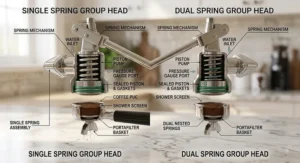
How the Spring Piston Mechanism Works, and Why 9-Bar Spring Pressure Matters
The Spring Piston Mechanism, Step by Step
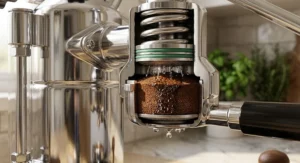
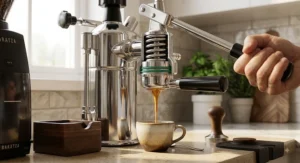
Lifting the lever on any of these machines draws water into a brewing cylinder and compresses a coil spring above a piston. Releasing the lever lets that spring expand, driving the piston down and forcing hot water through the compacted coffee grounds. The stiffer the spring, the higher the peak pressure it can generate — which historically is exactly how manufacturers pushed brewing pressure higher through the 1940s and ’50s, moving from steam-only machines toward the piston lever design that made proper crema possible.
Because a spring’s force follows Hooke’s law, the pressure it applies isn’t flat — it starts higher, right after you release the lever, and tapers as the spring extends toward its resting length. That’s a fundamentally different pressure curve than a modern pump, which tries to hold a fixed pressure for the whole shot.
Understanding 9-Bar Spring Pressure Espresso
The widely cited “9 bar” espresso standard actually comes from the Specialty Coffee Association’s classic definition of the beverage — roughly 7 to 9 grams of ground coffee, water at 92–95°C, forced through the puck under about 9 to 10 bar of pressure. Spring lever machines were the design that originally hit those numbers reliably, and they remain one of the few consumer categories where you can watch that principle play out mechanically instead of trusting a fixed pump setting.
What most buyers overlook here is that a spring lever’s declining pressure profile — high at the start, tapering by the end — is increasingly viewed by researchers as advantageous rather than merely a quirk of the mechanism. A mathematical modeling study of espresso extraction published in the journal Matter found that brewing variables like flow rate and pressure profile meaningfully affect extraction consistency, reinforcing why baristas have prized the lever’s natural taper for decades: it front-loads pressure when the puck resists most and eases off as channels open, which can reduce the risk of over-extraction later in the shot.
Spring Lever vs Direct Lever Espresso: What’s the Real Difference
This is the single most common point of confusion for first-time buyers, so it’s worth spelling out plainly. In a direct lever machine — think the Flair or Cafelat Robot — your arm applies force to the piston in real time, for the entire shot. You control the exact pressure curve, moment to moment, which means total creative freedom but also total responsibility; an inconsistent pull produces an inconsistent shot.
A spring lever machine, by contrast, only asks you to compress the spring and release it. From that point on, the spring — not your arm — determines the pressure curve, and it does so the same way every single time, assuming the spring hasn’t fatigued. Based on the spec comparison across both categories, direct levers reward experienced users chasing a specific, repeatable pressure profile they’ve dialed in themselves, while spring levers reward consistency-seekers who want that profile handled automatically.
There’s a real accessibility argument here too. Reviewers testing both formats consistently describe spring levers as more forgiving for beginners precisely because the pressure decline is baked into the hardware rather than dependent on technique. That’s a meaningful practical distinction if you’re choosing your first-ever manual machine rather than your fifth.
Traditional Italian Lever Machine History: From Gaggia to Today
Every machine reviewed above traces back to a specific moment: Achille Gaggia’s 1947 lever-piston patent, which replaced pure steam-driven brewing with a mechanical piston capable of much higher pressure. Before that, Angelo Moriondo’s 1884 steam apparatus and later Luigi Bezzera’s 1901 single-serve design had already established the basic idea of forcing hot water through coffee under pressure, but neither could reach the 8–10 bar range that produces crema.
As Perfect Daily Grind’s history of the espresso machine documents, Gaggia’s piston-lever breakthrough is literally where the phrase “pulling a shot” comes from — baristas physically pulled a lever to force water through the grounds, and the resulting coffee was so much richer that Gaggia reportedly called it “caffè crema” because it produced its own foam. That golden era of traditional Italian lever machines lasted through the 1950s, until Faema’s E-61 pump-driven design in 1961 began pulling the commercial market toward automation.
What’s genuinely interesting is that the lever format never actually disappeared from home and prosumer use — it just split into the spring and direct lever branches this guide covers, both of which are still in active, small-batch production by Italian, Swiss, and now even American-designed manufacturers nearly 80 years after Gaggia’s original patent.
Who Should Buy a Spring Lever Espresso Machine
Spring Piston Espresso Machine for Home Use: The Daily Ritual
If you’re picturing a spring piston espresso machine for home use fitting neatly into a rushed weekday routine, recalibrate that expectation first. A realistic session runs 10 to 15 minutes from cold boiler to finished shot, and that’s before you factor in dialing in grind size, dose, and tamp pressure — variables a pump machine’s fixed settings partly abstract away from you.
Consider a retired couple who drinks two cappuccinos most mornings and treats brewing as part of the ritual rather than an obstacle to it. A La Pavoni Europiccola or Ponte Vecchio Lusso fits that household well: modest daily volume, genuine appreciation for the process, and no pressure to serve six people before work. Compare that with a family of four who wants espresso on tap every morning before school runs — there, the extra capacity of a La Pavoni Professional PC-16 or the temperature consistency of the Ponte Vecchio Lusso matters considerably more.
Spring Lever Machine for Home Barista: Skill Level and Commitment
A spring lever machine for home barista use rewards a specific kind of buyer: someone who wants to learn the craft, not just consume the result. If you’re coming from a fully automatic pod machine, expect a genuine adjustment period — reviewers across every machine in this guide mention a learning curve measured in weeks, not days, before shots stop feeling inconsistent.
That said, the skill ceiling here is part of the appeal for the right buyer. A home barista who’s already comfortable dialing in a grinder and reading extraction color will likely gravitate toward the Elektra Micro Casa a Leva or Olympia Cremina SL, both of which reward technique with genuinely excellent results, while someone earlier in their journey is better served starting with the more forgiving, lower-stakes La Pavoni Europiccola.
Practical Usage Guide: Setup, Preheating, and Maintenance
Getting a spring lever machine from box to first shot involves more ritual than plugging in a pod machine, but it’s not complicated once you’ve done it a few times.
First-use setup: Fill the boiler to its marked sight-glass line using the included funnel, never overfilling, then lock in the portafilter — empty, without coffee — during the initial heat-up so the group head warms alongside the boiler. Most machines need 8 to 15 minutes to reach brewing temperature depending on boiler size and material, with copper boilers like the Elektra Micro Casa a Leva and La Pavoni Esperto Edotto generally heating a touch faster than brass equivalents.
Preheating your gear: Before your actual shot, run a “dry” pull with an empty, dry basket locked in, then let the portafilter sit against the hot group for a minute or two. Skipping this step is the single most common reason first-time lever shots come out under-extracted and thin — the metal simply hasn’t absorbed enough heat yet.
The first 30 days: Expect inconsistency early on. Track your dose, grind size, and how long you hold the lever at the top before releasing (pre-infusion), and adjust one variable at a time. A common early mistake is chasing grind size alone when the real issue is an unheated portafilter or an under-filled boiler.
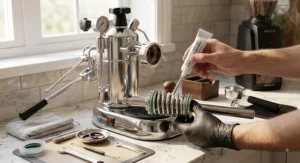
Ongoing maintenance: Descale according to your local water hardness — more frequently if you’re not using filtered water — and replace the group gasket annually on heavily used machines, since a worn gasket is the most common cause of pressure leaks in every machine reviewed here. Copper boilers in particular benefit from more attentive descaling than brass, given their faster mineral buildup under repeated heat cycling.
How to Choose a Spring Lever Espresso Machine
- Decide your daily shot volume first. A 0.8-liter boiler like the La Pavoni Europiccola suits one or two people; anything beyond that, look toward the 1.6-liter La Pavoni Professional PC-16 or a two-group Ponte Vecchio.
- Check portafilter size before anything else. 58 mm machines like the Olympia Cremina SL and Ponte Vecchio Lusso unlock the widest aftermarket; 51 mm and 49 mm classics trade that flexibility for authentic vintage engineering.
- Weigh bolt-on versus thermosyphon groups. Bolt-on designs heat faster but drift more in temperature; thermosyphon designs like the Lusso take longer to stabilize but hold that stability better across multiple shots.
- Be honest about your experience level. First-time lever buyers generally do better starting with a forgiving, well-documented classic rather than jumping straight to a steep-learning-curve machine like the Elektra.
- Factor in real total cost, not just the machine. Budget for a quality grinder, a scale, and eventual gasket replacements — none of which show up in the sticker price.
- Consider your electrical and counter setup. Most machines run on standard 110V, but flagship options like the La Marzocco Leva X1 require 220V and significant counter depth.
- Read aggregated review sentiment, not just star ratings. A 4.5-star average tells you less than recurring specific complaints or praise across dozens of independent owners.
Common Mistakes When Buying a Spring Lever Espresso Machine
The most frequent mistake is buying based purely on aesthetics — and to be fair, these machines are genuinely beautiful, so it’s an understandable trap. But a stunning Elektra sitting unused because its learning curve outpaced a buyer’s patience helps no one. Match the machine to your actual willingness to practice, not just your Pinterest board.
A second common misstep is underestimating boiler-refill frequency. Buyers coming from pod or pump machines often don’t realize a small-boiler lever machine may need refilling mid-session if they’re serving more than two or three drinks, and end up frustrated by a limitation that was clearly documented in the specs all along.
Finally, plenty of buyers skip budgeting for a capable grinder. A lever machine’s declining pressure profile is genuinely more forgiving of grind inconsistency than a fixed-pressure pump, but pairing a $2,000 Elektra with a blade grinder still wastes most of what the machine is capable of.
Features That Actually Matter (And Those That Don’t)
Actually matters: boiler material and size, portafilter diameter, and whether the group is bolted or thermosyphon-fed — these three specs predict more about daily experience than almost anything else on a spec sheet. A pressure gauge matters too, but mainly as a learning aid rather than a performance upgrade; the La Pavoni Europiccola and La Pavoni Professional PC-16 share an identical brewing mechanism, and the gauge on the Professional simply makes that mechanism’s behavior visible.
Doesn’t matter as much as marketing suggests: wattage claims beyond a certain threshold. Every machine in this guide runs somewhere between 800 and 1,200 watts, and none of that differential meaningfully changes shot quality — it mostly affects how fast the boiler initially heats. Similarly, cosmetic finish options (chrome versus copper versus brass housing) affect price and aesthetics far more than they affect what ends up in your cup, with the notable exception of an actual copper boiler, where the material genuinely does improve heat transfer.
Benefits vs Traditional Pump Espresso Machines
| Factor | Spring Lever Machines | Traditional Pump Machines |
|---|---|---|
| Pressure profile | Naturally declining, spring-driven | Typically fixed at 9 bar throughout |
| Learning curve | Moderate to steep | Generally shorter |
| Moving parts | Few — mechanically simple | More — pump, solenoids, electronics |
| Best For | Enthusiasts who value the ritual and tactile control | Buyers who want speed and consistency with less technique |
The moving-parts comparison deserves emphasis: fewer components generally means fewer things to eventually fail, which is a large part of why decades-old Olympia Cremina and La Pavoni Europiccola units are still functioning daily in enthusiast kitchens. That said, a pump machine’s fixed pressure removes a variable that spring lever owners spend months learning to manage, which is exactly why so many reviewers frame these two categories as suited to genuinely different personalities rather than one simply being “better” than the other.
Long-Term Cost & Maintenance
Sticker price is only part of the ownership story. Beyond the machine itself, budget for a proper grinder — arguably more important to shot quality than the espresso machine itself — plus an annual group gasket, occasional portafilter basket replacements, and descaling supplies matched to your local water hardness. None of the seven machines above require the electronics repairs that eventually hit pump machines with solenoid valves and circuit boards, which is a real long-term cost advantage of mechanical simplicity.
Electrical safety is worth a genuine mention here too, since every machine in this guide is a high-wattage countertop appliance running near water. The U.S. Consumer Product Safety Commission’s home electrical safety guidance recommends GFCI-protected outlets for kitchen counters specifically, and it’s a sensible baseline for any lever machine’s permanent home, especially copper-boiler models that involve more frequent hands-on descaling near the machine’s electrical components.
| Cost Category | Typical Range | Frequency |
|---|---|---|
| Machine (budget tier) | $450–$1,050 | One-time |
| Machine (mid tier) | $1,000–$2,300 | One-time |
| Machine (premium tier) | $3,800–$15,000+ | One-time |
| Group gasket replacement | Modest, low-cost part | Annually for heavy use |
| Descaling supplies | Inexpensive, ongoing | Every 1–3 months |
Looking at the table above, the widest cost gap by far sits between the mid tier and premium tier — largely explained by the jump from vintage-mechanism machines to the Olympia Cremina SL‘s Swiss build quality and the La Marzocco Leva X1‘s digital PID system. Budget-conscious buyers get genuinely authentic spring lever espresso for well under $1,000, while the premium tier is really selling refinement and consistency on top of a mechanism the budget machines already deliver honestly.
✨ Ready to Start Your Lever Espresso Journey?
☕ Whether you’re drawn to the affordable La Pavoni Europiccola or the data-driven La Marzocco Leva X1, there’s a spring lever espresso machine built for your budget and skill level. Check current pricing on the model that fits your kitchen and start pulling shots the traditional way!
FAQ
❓ Is a spring lever espresso machine good for beginners?
❓ How is a spring lever different from a direct lever espresso machine?
❓ What pressure do spring lever machines actually reach?
❓ Do spring lever espresso machines need a special grinder?
❓ How long do spring lever espresso machines typically last?
Conclusion
Choosing among these seven machines really comes down to matching mechanism to mindset. If you want the most honest, affordable entry into real spring piston brewing, the La Pavoni Europiccola remains the obvious starting point nearly six decades after its debut. If temperature stability across a session matters more to you than nostalgia, the Ponte Vecchio Lusso‘s thermosyphon design earns its higher price. And if you’ve already lived with a classic lever and want that same tactile ritual paired with modern data and consistency, the La Marzocco Leva X1 represents where the category is headed next.
What ties all seven together is something no pump machine, however well-engineered, quite replicates: a direct mechanical connection between your hand and the pressure hitting the coffee. That connection is exactly what Amazon listings can’t convey through specs alone, and exactly why lever machines have held a devoted following for nearly 80 years running. Whichever tier fits your budget, you’re buying into a genuinely different way of making coffee — one worth the learning curve it asks of you.
Recommended for You
- Lever vs Semi Automatic Espresso Machine: 7 Real Picks (2026)
- Manual Lever Espresso Machine: 7 Best Picks for 2026
- Is Jura Worth the Price in 2026? 7 Models, Honest Verdict
Disclaimer: This article contains affiliate links. As an Amazon Associate, I earn from qualifying purchases. If you purchase products through these links, we may earn a small commission at no additional cost to you.
✨ Found this helpful? Share it with your friends! 💬🤗
