
In This Article
A Nespresso Original machine is a compact capsule espresso maker. It uses a 19-bar pump to push hot water through a sealed aluminium capsule, producing a 1.35 oz espresso or a 3.75 oz lungo in about 30 seconds. It takes Original Line capsules only, not the bigger Vertuo pods. The system dates back to the 1970s Nestlé invention that became Nespresso.
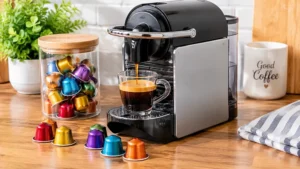
Here’s the funny part. In 2026 the marketing money is flowing to the Vertuo line, with its big-cup pitch and celebrity campaigns. Meanwhile the Original line sits quietly on millions of counters, doing the one thing espresso drinkers actually care about: making a small, dense, crema-topped shot with the push of one button.
That’s the appeal. No barcodes, no spinning capsules, no guessing. Press, wait half a minute, sip. Prices run from about the cost of a nice dinner out to the cost of a decent laptop, so the real question is which model deserves your counter space.
This guide compares seven real Original Line machines, from an affordable Nespresso Original machine for tiny kitchens to a latte-art-capable premium pick. It rests on published specs, patterns in aggregated retailer reviews, and honest spec-versus-reality analysis. It is not based on our own lab testing. Price ranges are approximate, reflect listings at the time of research (November 2026), and move constantly.
Quick Comparison: Seven Original Machines at a Glance
| Machine | Water Tank | Milk System | Approx. Price Range | Best For |
|---|---|---|---|---|
| Essenza Mini | 20.3 oz | None built in | $150-$200 | Tiny kitchens, straight espresso |
| Pixie | 24 oz | None built in | $180-$230 | Daily espresso, easy cleanup |
| CitiZ | ~34 oz | None built in | $200-$280 | Bigger households |
| CitiZ & Milk | ~35 oz | Bundled frother | $350-$400 | Occasional lattes |
| Lattissima One | ~34 oz | Built-in, one-touch | $280-$430 | One-touch cappuccinos |
| Creatista Plus | ~50 oz | Automatic steam wand | $550-$650 | Latte-art fans |
| Gran Lattissima | ~34 oz | Built-in, nine drinks | $450-$500 | Daily milk-drink households |
Look at the pattern: brewing hardware barely changes across the line, but price roughly triples once milk handling enters the picture. If you drink straight espresso, the Essenza Mini and Pixie deliver nearly everything the pricier machines do. If milk drinks are your daily ritual, the Lattissima One is the cheapest way to automate them, while the Creatista Plus is the only one that lets you actually steam milk like a barista.
💬 Just one click — help others make better buying decisions too!😊
Top 7 Nespresso Original machine Options: Expert Analysis
Seven machines, three price tiers. Every spec below comes with a “so what?” attached, because a number without meaning is just trivia.
1. Essenza Mini — smallest footprint in the lineup
The Essenza Mini is what an espresso machine looks like on a strict diet. At about 4.3 inches wide, it slips between a toaster and a kettle without anyone noticing. Its 19-bar pump heats up in roughly 25-30 seconds, and the 20.3 oz tank yields about four to five lungos. For one drinker, that means refilling every couple of days.
Here’s the catch. The used-capsule bin holds only five or six pods, so emptying it becomes a habit. For a solo espresso drinker, it’s the most honest answer to “I want an affordable Nespresso Original machine,” and it’s one of the best compact pod machines around. Tom’s Guide singles out its size and wallet-friendly price while noting the lack of a descale reminder.
Reviewers consistently praise the size and ease of use. Common complaints include the small rear-mounted tank, a louder-than-expected pump, and occasional reports of leaks or inconsistent shots.
Pros:
- ✅ Genuinely tiny footprint
- ✅ One-touch, two-size simplicity
- ✅ Low entry price
Cons:
- ❌ Small tank needs frequent refills
- ❌ No descaling indicator
Price: roughly $150-$200. Verdict: unbeatable for space-starved kitchens.
2. Pixie — bigger tank, same tiny body
The Pixie proves you can add capacity without adding bulk. Its transparent 24 oz tank glows red when water runs low, so you aren’t left guessing mid-brew. It weighs roughly six and a half pounds, and the folding drip tray makes room for tall glasses.
The capsule bin holds around ten used pods, nearly double the Essenza Mini‘s. In practice you’ll empty it every other day rather than every day. Built to the same 19-bar standard, it delivers the same espresso, with a slightly sturdier daily-driver feel and a nicer glance at the tank.
Retailer pages show ratings around 4.7 out of 5 across hundreds of reviews, with praise for fast heat-up, easy cleanup, and a small footprint. Critics call it not especially sturdy and mention some pump noise. One long-form reviewer found the water tank fiddly to seat.
Pros:
- ✅ Clear tank with low-water glow
- ✅ Roomier used-capsule bin
- ✅ Folding tray fits tall cups
Cons:
- ❌ Plasticky build for the money
- ❌ Capsule insertion feels slightly awkward
Price: roughly $180-$230. Verdict: the sweet spot for most single-drinker households.
3. CitiZ — the biggest tank in the Original lineup
The CitiZ is the line’s retro-modern show pony, and its roughly 34 oz tank is the largest of the espresso-only models. That means days between refills for a couple. At about 7.5 pounds and 1260 watts, it feels more like furniture than a gadget.
Brewing is almost identical to the cheaper models, with two programmable sizes, quick heat-up, and the same 19-bar pump. You’re paying for tank capacity, a taller cup clearance, and a handsomer shell. If your counter has room, that’s worth something.
Aggregated reviews are generous. Two outlets both rate it 4.5 out of 5, though they flag costs relative to near-twins and the absence of a descaling light. Some reviewers say it’s loud for its size.
Pros:
- ✅ Largest tank among espresso-only models
- ✅ Handsome, sturdy-feeling design
- ✅ Programmable cup volumes
Cons:
- ❌ Pricier than near-identical brewers
- ❌ Louder than expected
Price: roughly $200-$280. Verdict: worth it for two-person households.
4. CitiZ & Milk — frother included, no extra shopping
The CitiZ & Milk bundles a separate frother with the machine, so your first latte needs nothing else. The tank grows to about 35 oz, which suits households pouring several drinks daily.
Treat the frother as a small bonus, not a barista upgrade. Tom’s Guide liked how easy the combo is and called the build plasticky, while another review warns the frother takes practice. If you only want milk twice a week, a standalone frother paired with a cheaper brewer might be the smarter spend.
Based on the spec comparison, the real value here is convenience: one box, one purchase, one cabinet. If lattes are daily, jump to the Lattissima One.
Pros:
- ✅ Frother bundled in the box
- ✅ Large tank for multi-cup mornings
- ✅ Easy two-button operation
Cons:
- ❌ Plasticky feel against the price
- ❌ Frother has a short learning curve
Price: roughly $350-$400. Verdict: reasonable convenience, not a bargain.
5. Lattissima One — one-touch milk drinks on a modest footprint
The Lattissima One automates the whole cappuccino ritual. Pour milk into the attached container, press a button, and the machine pulls espresso and froths milk in one sequence. Its recipes cover espresso macchiato, cappuccino, and latte macchiato.
Tom’s Guide calls it the cheapest in its range but notes the milk texture can’t be adjusted, and the milk container and used-capsule bin are small. Walmart shows around 4.2 out of 5 across roughly 150 ratings. Fans praise easy operation and froth. Critics mention cleaning chores, noise, and occasional reliability complaints.
Here’s the honest trade-off: the convenience comes with a cleaning ritual. After milk drinks, you rinse the container, which adds time.
Pros:
- ✅ Automatic one-touch milk drinks
- ✅ Large water tank
- ✅ Cheapest milk-ready model in range
Cons:
- ❌ Fixed milk texture, small container
- ❌ Cleaning needed after milk use
Price: roughly $280-$430. Verdict: best for daily cappuccino fans who hate steam wands.
6. Creatista Plus — the only barista-style steam wand
The Creatista Plus swaps automatic milk containers for a hands-on-but-automated steam wand. Pick one of eight textures and eleven temperatures, drop the stainless jug under the wand, and walk away. That’s how you get actual microfoam and a shot at latte art.
The numbers back it up: a 3-second heat-up for coffee, a roughly 50 oz (1.5 L) tank, and a bin for around a dozen used capsules. It brews only Original capsules. One European retailer’s expert gave it high marks for foam quality and compact size.
One owner reported steam-wand trouble after about a year, a reminder that complex mechanisms have more to fail. Other reviewers call it one of the easiest milk systems to clean thanks to its self-cleaning cycle.
Pros:
- ✅ Real steam wand with adjustable texture
- ✅ Huge tank, minimal refills
- ✅ Self-cleaning steam cycle
Cons:
- ❌ Highest price in this lineup
- ❌ Some durability complaints reported
Price: roughly $550-$650. Verdict: worth it only if milk quality truly matters.
7. Gran Lattissima — nine one-touch drinks for milk devotees
The Gran Lattissima is the Lattissima One‘s bigger sibling, with nine one-touch recipes and a removable milk container that stores in the fridge between uses. Setup includes a water-hardness test, and the glass touch panel looks premium.
That fridge-friendly container is the quiet hero. Milk stays chilled, and you simply slot it back in. Review data I could verify is thinner for this model, so treat aggregator scores as directional. The consistent pattern: it’s great if you drink milk-based coffees daily and overkill if you don’t.
Based on spec comparison, it adds recipes and convenience over the Lattissima One but not extra tank capacity.
Pros:
- ✅ Nine one-touch recipes
- ✅ Fridge-storable milk container
- ✅ Water-hardness setup built in
Cons:
- ❌ Costs far more than espresso-only models
- ❌ Little extra tank capacity
Price: roughly $450-$500. Verdict: for committed milk-drink households only.
Your First 30 Days: A Practical Setup and Care Guide
Amazon listings rarely tell you what to do after unboxing, so here’s the short version.
Day one: prime it properly
Fill the tank with fresh water, place a cup under the spout, and run a lungo button cycle to rinse. Set the water-hardness level if your model asks for one. Warm water in the tank sometimes helps with temperature consistency.
Week one: learn your cup size
Most Original models let you reprogram volumes by holding the button during a brew. Check the manual for your model. Pre-warm your cup with a quick hot-water cycle if you like espresso hot.
Month one: set the descaling rhythm
Even with filtered water, expect to descale roughly every three to six months. Descaling takes about ten minutes. On the Pixie, the routine involves holding both buttons for five seconds, then letting the solution run through. Put a calendar reminder in, because the Essenza Mini won’t remind you.
Common first-month mistakes
- Leaving the tank empty and running the pump dry
- Never emptying the capsule bin
- Skipping the rinse after a long idle spell
- Forgetting to wipe the drip tray
Real-World Scenarios: Which Machine for Which Life
The college student in a studio apartment
Counter space is tiny, the budget is thinner, and lattes are rare. The Essenza Mini fits a windowsill, and a separate hand frother handles occasional milk. Total spend stays low.
The couple with a busy weekday routine
Two cappuccinos before 8 a.m., every day. The Lattissima One or Gran Lattissima saves five minutes of fiddling per drink, which adds up to roughly a full workday of saved time over a year. The milk cleanup is the price.
The home barista who misses the café
Latte art, adjustable foam, and steam control. The Creatista Plus is the only machine here built for that. Expect to spend a weekend learning to pour hearts.
The small-household traditionalist
One espresso after lunch, nothing fancy. The Pixie hits the ideal balance of size, capacity, and cost.
Problem → Solution: Fixing Common Nespresso Original Annoyances
Problem: The tank empties too fast. Choose a bigger-tank model such as the CitiZ, or just top off each morning.
Problem: The machine is louder than expected. Several reviewers flag pump noise on small models. Place it on a rubber mat, and don’t run it next to a sleeping baby.
Problem: Lukewarm shots. Pre-warm the cup and run a rinse cycle first. Warm tank water also helps on models like the Essenza Mini.
Problem: Milk cleanup feels like a chore. The Lattissima One requires rinsing after milk drinks. If that sounds exhausting, go espresso-only and add a standalone frother.
Problem: The capsule bin keeps filling. The Essenza Mini‘s bin holds five or six pods, so favor a Pixie or CitiZ if you drink three or more cups a day.
How to Choose a Nespresso Original machine
- Measure your counter. A machine you can’t fit is a machine you won’t use. The Essenza Mini and Pixie are around 4.3-4.4 inches wide.
- Decide on milk. Straight espresso drinkers should skip every milk-equipped model.
- Pick a tank size. Solo drinkers can live with 20-24 oz. Couples benefit from 34 oz or more.
- Check cup clearance. Tall mugs need folding trays or removable supports.
- Count your daily cups. Three or more? Prioritize capsule bin capacity.
- Set a realistic budget. Include capsules, descaler, and maybe a frother.
- Be honest about cleaning. Milk systems demand daily attention.
Pump Pressure Explained: What 19 Bars Really Buys You
Every current Original machine advertises the same 19-bar pump pressure, from the Essenza Mini to the Creatista Plus. So pump pressure is not a differentiator. It’s a baseline.
Why 19, when espresso theory says about 9 bars at the puck is plenty? One reviewer notes that 9 bars is enough for real espresso, so 19 gives headroom for the resistance of a sealed capsule. In other words, the number is a safety margin, not a quality promise.
What actually shapes your cup is water temperature, capsule freshness, and cup volume. If a retailer pitches higher pump pressure as a reason to spend more, politely ignore them. Across the Original line, this is a solved problem.
Practical takeaway: don’t pay extra for pump pressure marketing. Spend on tank size, build quality, or milk handling instead.
Espresso-Style Capsules: Genuine, Compatible, and What Actually Fits
Original capsules pack roughly 5-7 grams of ground coffee and yield either a 40 ml espresso or a 110 ml lungo. Nespresso’s own patents began expiring around 2012, which opened the door to third-party espresso-style capsules, including aluminium, plastic, and refillable types.
Genuine vs compatible
Genuine pods guarantee fit and a tuned blend. Compatible capsules can cost less and offer wider flavor ranges, though quality, piercing fit, and recycling options vary. If you go compatible, buy a small sampler first and check your warranty terms.
What doesn’t fit
Vertuo capsules are a different, barcode-driven system and won’t work in any Original machine. Grab the wrong box and you’ve wasted money. Always check the label for “Original Line.”
Reusable capsules
A refillable pod lets you load your own grind, which is cheaper per cup but fussier. For most people, a sampler pack of espresso-style capsules is the easiest way to find a favorite.
Affordable Nespresso Original machine Math: Long-Term Cost and Value
Machine price is only the down payment. Capsules are the real subscription. Illustratively, at around $1 per capsule, two drinks a day costs roughly $730 a year. The machine you pick barely moves that number, so choose based on convenience rather than chasing a rock-bottom price.
| Tier | Machines | Typical Price Range | What You’re Paying For | Best For |
|---|---|---|---|---|
| Budget | Essenza Mini, Pixie | $150-$230 | Compact espresso, simplicity | Solo drinkers |
| Mid-range | CitiZ, CitiZ & Milk, Lattissima One | $200-$430 | Bigger tanks, milk convenience | Households of two |
| Premium | Gran Lattissima, Creatista Plus | $450-$650 | Milk automation, steam wand | Daily milk-drink fans |
The table shows that the jump from budget to mid-range buys tank size and convenience, while premium buys milk quality and recipe variety. For espresso-only drinkers, the budget tier gives about 95 percent of the experience. The honest ROI question is whether you’ll actually use the milk functions every day.
Budget Original Capsule Machine: Features That Matter (And Those That Don’t)
A budget Original capsule machine should nail three things: reliable heating, easy cleanup, and enough tank for your routine.
Features that matter
- Tank capacity and how easy it is to remove
- Cup clearance for your favorite mug
- Programmable cup volumes so every shot is consistent
- Auto shut-off, typically around nine minutes
Features that don’t
- Color options (cute, but irrelevant to taste)
- Extra recipe counts you’ll never press
- Marketing claims about pump pressure, since all share 19 bars
Common buying mistakes
Buying a milk machine you’ll never clean. Ordering Vertuo capsules by accident. Skipping descaler. Ignoring noise reports. Treating a bundle’s “free” capsules as the main value. A good budget Original capsule machine is boring on purpose.
Compact Pod Machines for Small Kitchens and Small Households
Space is the quiet decider. Among compact pod machines, the Essenza Mini and Pixie are both about 4.3-4.4 inches wide. That’s narrow enough to tuck beside a toaster. The CitiZ is chunkier and fits better in kitchens with breathing room.
Practical placement tips
- Check cable length: the Pixie has roughly a 2.6 ft cord, while the CitiZ has about 3.6 ft.
- Leave rear clearance for tank removal.
- Don’t share a single outlet circuit with a toaster and kettle at the same time. At 1160-1260 watts, these machines draw real power.
Who benefits most
Dorm rooms, studio apartments, RVs, and office desks all favor compact pod machines. If you live somewhere with limited counter, tank capacity matters less than total footprint. Refilling a small tank is annoying. Losing a whole shelf is worse.
Nespresso Original machine vs Vertuo and Traditional Espresso Machines
| Feature | Original | Vertuo | Traditional Espresso Machine | Best For |
|---|---|---|---|---|
| Brewing method | 19-bar pump, espresso and lungo | Spinning capsules with barcodes | Manual grind-and-tamp | Original: quick espresso |
| Cup sizes | Small (espresso, lungo) | Five sizes up to large coffee | Fully adjustable | Vertuo: bigger mugs |
| Capsule variety | Wide, plus third-party | Narrower, proprietary | Any beans | Traditional: tinkerers |
| Skill needed | Almost none | Almost none | High | Original: beginners |
The Original line wins on simplicity, capsule choice, and espresso concentration. Vertuo wins if you want mug-sized coffee, and a traditional machine wins if you love the craft. For quick, consistent espresso, a Nespresso Original machine remains the easiest option.
🔍 Ready to Shop Smarter?
Click any highlighted product name to check current pricing and availability. Pick the machine that fits your counter, your cups, and your coffee habits!
Capsule Recycling and Sourcing: Using Original Pods Responsibly
Each aluminium capsule weighs about a gram, and recycling aluminium uses as little as 5 percent of the energy needed to make it from ore. Nespresso offers free recycling bags, and one bag holds up to 200 Original capsules. In the US, you can mail it back or drop it at a UPS Store. Capsules don’t need rinsing first.
Reality check: global recycling rates remain a weak spot, with one figure putting recycled capsules at under a quarter of the total. Nespresso says it has capacity to recycle all of them, so the bottleneck is customers actually returning the bags. Make it a habit and put the bag next to the machine.
On sourcing, Nespresso’s coffee supply chain works with the Rainforest Alliance on sustainable-farming standards. If recycling is a priority, consider compostable options where available.
FAQ
❓ What is the cheapest Nespresso Original machine to buy?
❓ Can Vertuo capsules work in an Original machine?
❓ Are compatible espresso-style capsules safe for my machine?
❓ How often should I descale a Nespresso Original machine?
❓ Does a Nespresso Original machine make regular drip-style coffee?
Conclusion
Here’s the short version. If you want an affordable Nespresso Original machine for straight espresso, start with the Essenza Mini or the Pixie. If you share the machine with someone, the CitiZ adds tank capacity. If milk drinks are your thing, the Lattissima One is the budget path, the Gran Lattissima is the daily-driver, and the Creatista Plus is the enthusiast’s toy.
Remember what the data says. Every model uses the same 19-bar pump, so pump pressure isn’t the differentiator. Tank size, footprint, milk handling, and cleaning effort are. Capsule costs will outweigh machine price within a year or two, so choose the model that you’ll actually use every day.
✨ Ready to Upgrade Your Mornings?
🔍 Pick the machine that matches your counter and your coffee habits, then click any highlighted product name to check current pricing and availability. Your next great espresso is about thirty seconds away!
Recommended for You
- Nespresso Vertuo Machine For Pod Variety: 7 Best Picks 2026
- Compact Nespresso Vertuo Machine For Small Counters: 7 Best Buys 2026
- Nespresso Vertuo Machine For Milk Frothing: 7 Best Picks 2026
Disclaimer: This article contains affiliate links. As an Amazon Associate, I earn from qualifying purchases. If you purchase products through these links, we may earn a small commission at no additional cost to you.
✨ Found this helpful? Share it with your friends! 💬🤗
