
In This Article
A Nespresso Original machine for small kitchens is a compact, capsule-based espresso maker that runs on Nespresso Original pods and a 19-bar pump while staying narrow enough for tight counters. Most models in this class measure roughly 4 to 6 inches wide and brew espresso and lungo with almost no learning curve.
Counter space is the most expensive real estate in a small kitchen. The toaster, the cutting board, the dish rack and your sanity all compete for the same three square feet. So when you shop for a compact Nespresso Original machine, the question isn’t only “does it make good coffee?” It’s “what does it evict?”
The good news is that Nespresso’s capsule system and company history include some of the slimmest espresso makers you can buy. A few are barely wider than a loaf of bread. Others add milk frothing without swallowing the whole counter.
This guide ranks seven real machines by what matters in a cramped space: depth, width, height, tank size, milk capability and long-term cost. It makes no claim of hands-on testing. Instead it pulls together published specifications, professional reviews and recurring owner feedback, then adds plain-English analysis of what the numbers mean.
You’ll also find apartment layouts, maintenance habits and the buying mistakes that trip people up. Prices below are ranges only, and they move constantly, so check current price before you buy.
Quick Comparison: Which Compact Nespresso Original Machine Fits Your Counter?
Here’s the fast version. Dimensions are approximate published figures in width × depth × height, and they vary slightly by manufacturer (Breville, De’Longhi and Krups all build versions), so confirm them on the listing you’re buying.
| Machine | Approx. Size (W × D × H) | Water Tank | Best For |
|---|---|---|---|
| Nespresso Essenza Mini | 4.3 × 12.8 × 8.1 in | About 0.6 L | Tightest counters, 1–2 coffees a day |
| Nespresso Inissia | 4.7 × 12.6 × 9.0 in | About 0.7 L | Slim budget pick with a bigger tank |
| Nespresso Pixie | 4.4 × 12.8 × 9.3 in | Mid-size | Sturdier build in a slim body |
| Nespresso CitiZ Platinum | 5.1 × 15.3 × 10.9 in | 1 L | Fewer refills, metal-side look |
| Nespresso CitiZ Platinum & Milk | About 8.7 × 15.3 × 10.9 in | 1 L | Cappuccinos with a built-in frother |
| Nespresso Lattissima One | 6.1 × 12.8 × 10.5 in | 1 L | One-button milk drinks |
| Nespresso Creatista Plus | About 7 × 16 × 12 in | About 1.5 L | Latte art and manual steaming |
Look at the width column first. The Nespresso Essenza Mini and Nespresso Pixie are the slimmest, while the Nespresso Lattissima One and Nespresso Creatista Plus trade slim machine design for milk features. Depth is the quiet troublemaker, because nearly every machine here runs 12 to 16 inches front to back. Measure your counter’s depth before you fall for a narrow front. If milk drinks matter, the Nespresso CitiZ Platinum & Milk is the widest of the truly compact group, yet still far smaller than a full espresso setup with a separate grinder.
💬 Just one click — help others make better buying decisions too!😊
Top 7 Compact Nespresso Original Machines for Small Kitchens: Expert Analysis
1. Nespresso Essenza Mini — narrowest body in the lineup
At roughly 4.3 inches across, the Nespresso Essenza Mini is narrower than most bread loaves. That makes it the purest small-footprint Original capsule maker in Nespresso’s range.
Published specs put it near 4.3 × 12.8 × 8.1 inches, with a 0.6-liter tank, a 19-bar pump and a heat-up time of about 25 to 30 seconds. In practice, that low profile slides under most wall cabinets, and the tank covers about 15 espressos or five lungos before a refill. Tom’s Guide notes that taller cups only fit with the drip tray removed, and that there’s no descale reminder.
Based on the spec comparison, this suits one- or two-coffee households that value countertop space over capacity. Heavy users will find the small used-capsule bin (roughly five to six pods) a chore.
Reviewers consistently praise the speed and size and describe it as quieter than the Inissia. Recurring complaints involve the plastic build and the compact bin.
Pros:
- ✅ Smallest footprint in the Original range
- ✅ Heats up in roughly half a minute
- ✅ Quieter than older compact models
Cons:
- ❌ Small tank and used-capsule bin
- ❌ No descale alert; plastic feels basic
Price: around $150–$200 depending on maker and color. It’s the strongest value per inch of counter here.

2. Nespresso Inissia — roomier tank in a still-slim body
The Nespresso Inissia takes the Mini’s formula and adds breathing room. It’s a little wider and taller, so the tank and capsule bin grow with it.
Specs land around 4.7 × 12.6 × 9.0 inches, with a tank near 23.7 ounces (about 0.7 liters) and a used-capsule bin that holds around 11 pods. Heat-up is about 25 seconds. Translated: you’ll refill and empty less often than with the Mini, which matters if two people share the machine.
One availability note. Some retailers and reviewers describe the Nespresso Inissia as being phased out in favor of the Essenza Mini, so stock varies. Check current availability before planning around it.
Owner and reviewer feedback highlights the larger tank and bin, but also notes that it’s noisier than newer models, feels light, and lacks a low-water indicator. If you can spare the extra inch of width, it’s a sensible budget pick for a compact Nespresso Original machine.
Pros:
- ✅ Larger tank and capsule bin than the Mini
- ✅ Quick 25-second warm-up
- ✅ Often priced below newer models
Cons:
- ❌ Louder than newer compact machines
- ❌ Plastic body; availability can be spotty
Price: roughly $100–$150 where still stocked. Good value if your counter allows it.
3. Nespresso Pixie — metal side plates, still slim
The standout here is sturdiness. Where the Mini is all plastic, the Nespresso Pixie brings metal side plates and a metal lever, so it feels like an appliance rather than a gadget.
Tom’s Guide lists it at about 12.8 × 9.3 × 4.4 inches and 6.6 pounds, with Original capsules, a removable reservoir and no milk frother. That extra heft helps in daily use: the machine stays put when you lock a capsule in, instead of sliding around the counter.
For anyone who wants a slim machine design with a more premium feel, this is the logical step up from the Mini. It also suits people who plan to keep a machine for years rather than replace it.
Comparison guides generally rank it a little louder than the Mini but better built, and reviewers keep returning to that sense of solidity. No automatic capsule detection is a minor omission at this level.
Pros:
- ✅ Metal sides and lever feel durable
- ✅ Narrow front, about 4.4 inches wide
- ✅ Simple one-touch espresso and lungo
Cons:
- ❌ Slightly taller and heavier than the Mini
- ❌ No milk frother or descale reminder
Price: around $160–$220. Worth it if build quality beats saving a few dollars.
4. Nespresso CitiZ Platinum — 1-liter tank in a 5-inch body
The Nespresso CitiZ Platinum solves the biggest annoyance of ultra-compact machines: constant refilling. A 1-liter tank means you can brew roughly 25 espressos before topping up.
Nespresso’s listings show about 5.1 × 15.3 × 10.9 inches and roughly 4 kilograms, with stainless-steel or anodised aluminium sides and a used-capsule bin around 9–12 pods. Tom’s Guide praises the balanced extraction and the two drip-tray heights, which handle both espresso cups and taller mugs. The cost of all this is depth, so check the 15-inch figure against your counter.
Expert Reviews calls it small in footprint but tall in stature, with a decent tank that doesn’t crowd the counter. Both outlets note the price as the main downside for what is still a basic machine.
Pros:
- ✅ Big 1-liter tank means fewer refills
- ✅ Two-height drip tray fits more cups
- ✅ Metal-side design looks upscale
Cons:
- ❌ Deeper than the Mini or Pixie
- ❌ Costs more for the same espresso
Price: around $220–$300. A fair value if you hate refilling.
5. Nespresso CitiZ Platinum & Milk — frother integrated into the unit
Cappuccino fans, this is the compromise: the Nespresso CitiZ Platinum & Milk pairs the CitiZ body with an integrated Aeroccino3 frother, so milk drinks don’t require a second gadget cluttering the counter.
Nespresso’s listing gives about 22 × 38.9 × 27.7 centimeters (roughly 8.7 × 15.3 × 10.9 inches), 4.7 kilograms, a 1-liter tank, a 12-capsule bin and a descaling alarm. Notably, the listed cord is only about 22 centimeters long, so plan for an outlet within arm’s reach.
Independent coverage of the combined unit is thinner than for the base CitiZ, so much of the evaluative signal comes from reviews of the base machine and Nespresso’s own descriptions. Verify details on your specific listing.
Based on the specs, it suits someone who drinks lattes most mornings but still wants a compact Nespresso Original machine.
Pros:
- ✅ Frother built into the footprint
- ✅ Descale alarm and 1-liter tank
- ✅ Metal-side build matches base CitiZ
Cons:
- ❌ Widest of the compact picks here
- ❌ Short cord limits placement
Price: a step above the standard CitiZ, roughly $300–$400 depending on bundle. Check current price.
6. Nespresso Lattissima One — one-button milk drinks in a 6-inch body
The headline is convenience: fill the milk jug, press a button, get a cappuccino or latte macchiato. The Nespresso Lattissima One is the entry point to automatic milk in the Original range.
Listings show about 6.1 × 12.8 × 10.5 inches, 9.2 pounds, a 1-liter tank, an 8-capsule bin and a 165-milliliter milk jug. That jug size explains Tom’s Guide’s main caveat: it makes only small milk drinks and can’t dispense hot milk on its own. If you like a big mug of latte, you’ll hit that ceiling fast.
Reviewer feedback splits. Many owners love the one-touch simplicity, while some report frustration with the milk system. As a rule, automatic frothers need more cleaning than a standalone one, so factor that into the counter-and-sink equation.
Pros:
- ✅ True one-touch milk recipes
- ✅ Descaling alert and large tank
- ✅ Only about 6 inches wide
Cons:
- ❌ Small milk jug limits drink size
- ❌ More cleaning than a basic machine
Price: roughly $380–$480. Reasonable if milk drinks are daily.
7. Nespresso Creatista Plus — manual steam wand for latte art
For those who want café technique without a café footprint, the Nespresso Creatista Plus offers a real steam wand and a touch display. It’s the least “compact” machine here, but it replaces a separate frother and a lot of countertop clutter.
Published specs run around 7 × 16 × 12 inches, with a tank near 50 ounces and a 10-capsule bin. Sage lists a 3-second heat-up, eight texture levels and eleven milk temperature settings, plus a stainless milk jug. Reviewers like how easy it is to use. Others report that froth needs fine-tuning and that espresso consistency can disappoint, and Livingetc notes it has been superseded by newer models.
This is for latte-art hobbyists with a slightly bigger counter. For everyone else, it’s overkill.
Pros:
- ✅ Real steam wand with adjustable texture
- ✅ Large tank cuts refilling
- ✅ Stainless design looks premium
Cons:
- ❌ Deepest, bulkiest machine here
- ❌ Frothing takes tuning; costs the most
Price: roughly $500–$800 range. Only worth it if you’ll use the wand.
Top 7 at a Glance: Price Ranges and Reviewer Takeaways
| Machine | Price Range (check current) | Milk Option | Reviewer Takeaway | Best For |
|---|---|---|---|---|
| Nespresso Essenza Mini | ~$150–$200 | Add-on frother | Tiny, fast, plastic build | Studios and tight counters |
| Nespresso Inissia | ~$100–$150 | Add-on frother | Roomier tank, louder | Budget buyers where stocked |
| Nespresso Pixie | ~$160–$220 | Add-on frother | Sturdy, slightly louder | Long-term durability |
| Nespresso CitiZ Platinum | ~$220–$300 | Add-on frother | Balanced extraction, pricey | Fewer refills |
| Nespresso CitiZ Platinum & Milk | ~$300–$400 | Built-in | Thinner independent coverage | Daily cappuccinos |
| Nespresso Lattissima One | ~$380–$480 | Built-in jug | Easy, but small milk batches | Effortless milk drinks |
| Nespresso Creatista Plus | ~$500–$800 | Steam wand | Capable but fussy, bulky | Latte-art hobbyists |
The pattern is clear: price tracks features, not footprint. The Nespresso Essenza Mini gives you the smallest body for the least money, while the Nespresso Creatista Plus costs several times more for capabilities you may never use. If you drink black espresso, anything above the Nespresso CitiZ Platinum is paying for milk you don’t want.
How to Choose a Nespresso Original Machine for Small Kitchens
Choose by depth first, height second and milk needs third, then confirm that tank and capsule-bin sizes match how many cups you actually drink. Here’s the order that saves the most regret:
- Measure depth, not just width. Nearly every machine here runs 12–16 inches front to back, so a narrow front can still stick out past your counter edge.
- Check height under cabinets. Leave room to lift the lid and remove the tank, since the Mini’s tank releases from the back.
- Decide on milk early. None, a separate frother, or built-in each change your footprint and cleaning routine.
- Match tank and bin to daily cups. A 0.6-liter tank suits one or two drinkers; a household of four will be refilling constantly.
- Weigh build material. Plastic keeps cost and weight down, while metal sides add sturdiness and cost.
- Think about noise and heat-up. In an open-plan flat, a quieter machine matters more than a few seconds saved.
- Budget for capsules, not just the machine. Pods are the recurring expense.
Countertop Space: What the Numbers Really Mean
Spec sheets love width, but countertop space gets used up in three dimensions. A machine that’s 4.3 inches wide and 12.8 inches deep claims about 55 square inches of surface, roughly the size of a hardcover book, plus the cup landing zone.
Try the tape test: mark the machine’s footprint on your counter with painter’s tape, then add a cup-sized rectangle in front. Live with it for a day. If it blocks your prep zone, it’s the wrong machine.
Don’t forget the vertical dimension. The Nespresso Essenza Mini stands about 8 inches tall, which tucks under most cabinets. The Nespresso Creatista Plus at roughly 12 inches needs real clearance for the steam wand, and the Nespresso Lattissima One needs room to lift and fill the milk jug.
A short cord matters too. The listed cord on the Nespresso CitiZ Platinum & Milk is only about 22 centimeters, so your outlet location effectively sets where the machine lives. In a small kitchen, that single detail can decide the layout.
Slim Machine Design: Width, Depth and Height Trade-Offs
A slim machine design isn’t free. Every inch you remove from width usually becomes a smaller tank, a smaller used-capsule bin or a plasticky shell.
The Nespresso Essenza Mini is the clearest example. Its narrow body keeps the tank near 0.6 liters, and its bin is small enough that frequent drinkers will empty it often. Real Homes’ spec box confirms the narrow dimension of about 4.3 inches and a weight near 5 pounds. The Nespresso Pixie keeps a similar front width but adds metal sides and some height.
Go slightly wider and the picture changes. The Nespresso CitiZ Platinum sits near 5.1 inches wide yet carries a 1-liter tank, which suits people who value fewer chores over the last half-inch of space. The Nespresso Lattissima One stretches to about 6.1 inches to fit its milk system.
Here’s the practical read: if you drink one or two coffees a day, shrink the machine. If you drink four, widen it a little and enjoy the extra capacity. Either way, the best compact Nespresso Original machine is the one whose compromises you won’t notice.
Apartment Coffee Setups That Actually Work
Apartment coffee setups live or die on routine, not specs. Here are three scenarios with the reasoning behind each pick.
The Studio Renter With a Single Counter Run
Budget is tight, the counter is a 30-something-inch strip, and coffee is a one-cup-a-morning habit. The Nespresso Essenza Mini fits because its tiny body leaves room for a dish rack and a cutting board. Store capsules in a small drawer so the machine stands alone.
The Couple With One Latte Drinker
One partner wants black espresso, the other wants lattes. The Nespresso CitiZ Platinum (with a separate frother) or the Nespresso Lattissima One handles both without a second machine. The bigger tank means fewer refills when two people brew back-to-back.
The Open-Shelf Rental Kitchen
No upper cabinets, lots of visible shelving, and design matters. The Nespresso Pixie or Nespresso CitiZ Platinum looks deliberate on display thanks to metal accents, and the sturdy build holds up to daily use.
In all three cases, keep the machine near an outlet, wipe the drip tray weekly and keep capsules within arm’s reach so the ritual stays easy.
✨ Ready to Reclaim Your Counter?
🔍 Take your apartment coffee setups to the next level with these carefully selected machines. Click on any highlighted product name to check current pricing and availability. A slimmer machine could give you back real countertop space this week!
Setup and Maintenance Guide for Compact Machines
Compact machines are forgiving, but a few habits stretch their lives. These tips come from published manuals and reviews rather than guesswork.
First-use basics. Fill the tank, run a rinse cycle without a capsule, and place the machine where you can reach the tank. For models like the Nespresso Essenza Mini, the tank sits at the back and tilts out, so don’t wedge it against a wall.
Weekly routine. Empty the capsule bin, rinse the drip tray and wipe the capsule area. Smaller bins fill fast, so pair the task with something you already do, like taking out the trash.
Descaling. The Nespresso Essenza Mini has a descaling program that takes about 15 minutes, and Tom’s Guide notes there’s no alert to remind you, so set a calendar reminder. Use Nespresso’s own descaling solution as recommended by reviewers and follow the manual.
Common first-month mistakes:
- Locking in a capsule before waking the machine, which delays the pour
- Using a cup too tall for the drip tray
- Ignoring tank levels until the pump runs dry
- Skipping descaling because nothing warns you
The routine takes five minutes a week. That’s the price of a slim machine design that otherwise runs itself.
Common Problems in Tight Kitchens (and Fixes)
Problem: The counter feels crowded. Move the capsule stash to a drawer or wall-mounted holder, and shift the machine to the corner where its short side faces the cooktop.
Problem: Cups don’t fit. The Nespresso Essenza Mini only takes cups up to about 3.5 inches with its drip tray in place. Remove the tray for taller mugs, or choose a model like the Nespresso CitiZ Platinum with two tray heights.
Problem: You want milk drinks but have no room. Consider the Nespresso CitiZ Platinum & Milk or the Nespresso Lattissima One, which fold frothing into the machine rather than adding a second gadget.
Problem: The bin fills too fast. Small-footprint Original capsule maker models hold few pods. Emptying it each morning prevents overflow, or step up to a roomier model like the Nespresso Inissia.
Problem: Noise in an open-plan flat. Comparison guides rate the Nespresso Essenza Mini quieter than older compact machines. If your sleeping area sits next to the kitchen, that matters.
Nespresso Original vs Vertuo for Small Kitchens
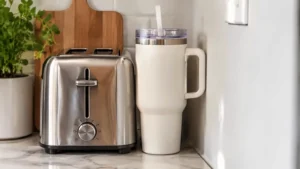
Original machines use smaller pods that brew espresso and lungo. Vertuo machines brew larger cups, use a different capsule system and don’t accept Original pods. For a small kitchen, Original usually wins on size and flexibility.
There’s a fair counterpoint: some Vertuo models are slim too. Real Homes lists the Vertuo Next at about 5.5 inches wide, though it runs nearly 17 inches deep. Vertuo suits you if you drink full mugs of coffee rather than espresso, but you’re locked into Nespresso-brand Vertuo capsules.
| Option | Typical Footprint | Cleanup | Skill Needed | Best For |
|---|---|---|---|---|
| Compact Original machine (e.g., Nespresso Essenza Mini) | Very small | Rinse tray, empty bin | None | Espresso on tight counters |
| Slim Vertuo model | Narrow but deep | Similar | None | Larger mugs |
| Drip coffee maker | Typically wider, carafe adds height | Filter and carafe | None | Big batches |
| Semi-automatic espresso machine | Large with grinder | Portafilter, grinder | Moderate | Hobbyists with space |
Looking at the table, the compact Original machine wins on counter size and ease. A drip maker wins on batch volume, and a semi-automatic wins on control but demands the most space and learning. For a small kitchen focused on espresso and lungo, the Nespresso Pixie, Nespresso Inissia or Nespresso Essenza Mini is hard to beat.
Long-Term Cost: What a Compact Machine Really Costs
The machine is the small expense. The pods are the real running cost.
Published estimates put Original capsules at roughly 70 to 85 cents each when bought direct. At one capsule a day, that’s about $255–$310 a year, and at two a day about $510–$620. Compare that with a hypothetical $6 daily coffee-shop drink, which adds up to around $2,190 a year. At those numbers, a $150–$200 machine is paid back in about 25–33 shop drinks.
One of the genuine advantages of Original machines is pod flexibility. Tom’s Guide tested the CitiZ with both Nespresso and Lavazza capsules, noting that Original line machines accept alternative-brand pods while Vertuo locks you into Nespresso’s own. Compatible capsules can lower the per-cup cost, though quality and fit vary, so check reviews before bulk buying.
Other costs are minor: descaling solution, the occasional replacement tray and your time. Maintenance on a slim machine is quick, and durability varies by build. A metal-sided Nespresso Pixie or Nespresso CitiZ Platinum may outlast an all-plastic Nespresso Essenza Mini in daily use, but that’s inference from construction, not a verified lifespan.
Common Mistakes When Buying a Compact Nespresso Original Machine
Measuring only the front. A 4.7-inch width means little if the machine is 15 inches deep and your counter is 14.
Ignoring cup height. Small drip-tray clearance means mugs can’t fit under the spout.
Buying milk features you won’t use. The Nespresso Creatista Plus is wonderful for steaming, and wasteful if you drink black coffee.
Forgetting capsule cost. A $100 machine that locks you into expensive pods isn’t cheap.
Assuming stock. Models like the Nespresso Inissia may be phased out of some retailers, so confirm availability before committing.
Skipping the cord check. Short cords limit placement, as with the Nespresso CitiZ Platinum & Milk.
Treating all listings as identical. The same Nespresso model can ship under different makers with minor spec differences, so read the spec box on the exact listing.
Features That Actually Matter (And Those That Don’t)
Matter:
- Depth and height. They decide whether the machine fits at all.
- Tank and bin size. They determine how often you do chores.
- A descale alert. Models like the Nespresso Lattissima One include one, while the Nespresso Essenza Mini doesn’t.
- Drip-tray flexibility. It lets you use more cups.
- Cord length. It controls where the machine can live.
Don’t matter much:
- 19-bar pressure. It’s standard across Original machines, so it won’t differentiate them.
- Color options. Nice, but irrelevant to function.
- Extra programmable buttons. Most people stick to espresso and lungo.
- Premium finishing. It’s cosmetic unless you care about aesthetics.
The honest filter: if a feature doesn’t change your daily routine or your counter, it’s marketing.
FAQ
❓ How much counter depth does a compact Nespresso Original machine need?
❓ Can a small-footprint Original capsule maker use third-party pods?
❓ Is a slim Nespresso machine noisy in an apartment?
❓ Do slim Nespresso machines need descaling as often as bigger ones?
❓ Can I make milk drinks with a compact Nespresso Original machine?
Conclusion
The best Nespresso Original machine for small kitchens depends on how you drink coffee, not just how much room you have. For tight counters and one or two cups a day, the Nespresso Essenza Mini is the clear space-saver. If you want a sturdier build, the Nespresso Pixie earns its keep, and if refilling annoys you, the Nespresso CitiZ Platinum offers a 1-liter tank in a slim frame.
For milk lovers, the Nespresso CitiZ Platinum & Milk and Nespresso Lattissima One keep frothing inside the machine. Reserve the Nespresso Creatista Plus for people who truly want a steam wand. The Nespresso Inissia remains a budget option where you can still find it.
Whatever you choose, measure depth, check cup height and budget for capsules. A compact Nespresso Original machine should give you better mornings and more countertop space, not a new problem to solve.
✨ Don’t Let Your Counter Hold You Back!
🔍 Pick the machine that fits your kitchen and your routine. Click any highlighted product name above to check current pricing and availability, and enjoy authentic espresso moments without sacrificing space. ☕
Recommended for You
- Nespresso Original Machine: 7 Best Picks For 2026
- Nespresso Vertuo Machine For Pod Variety: 7 Best Picks 2026
- Compact Nespresso Vertuo Machine For Small Counters: 7 Best Buys 2026
Disclaimer: This article contains affiliate links. As an Amazon Associate, I earn from qualifying purchases. If you purchase products through these links, we may earn a small commission at no additional cost to you.
✨ Found this helpful? Share it with your friends! 💬🤗
