
In This Article
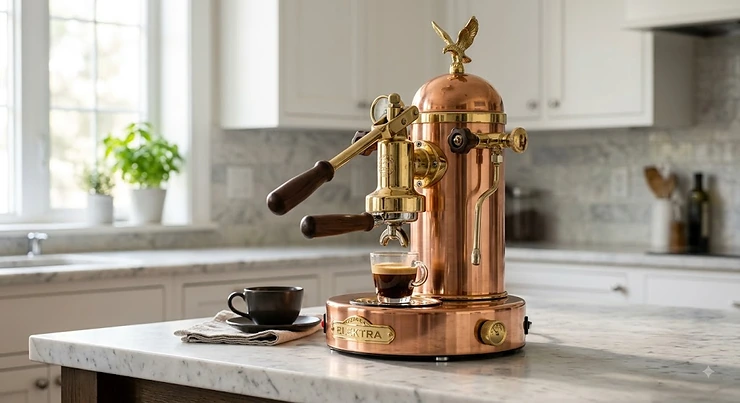
Somewhere between a kitchen appliance and a piece of kinetic sculpture sits the elektra microcasa leva. It doesn’t plug into an app. It doesn’t beep. It just sits there on your counter, chrome gleaming, brass eagle perched on top like it’s guarding something valuable — which, depending on how much you paid, it kind of is. If you’ve spent any time in the deeper corners of the home espresso world, you already know this machine has a cult following that borders on religious devotion. And if you’re new here, you’re probably wondering what could possibly justify strapping a mechanical spring to your morning coffee routine.
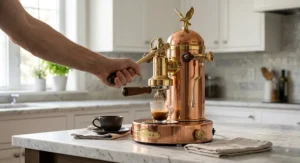
Here’s the honest answer: nothing about a manual lever machine is efficient. It’s slower than a pod machine, harder to learn than a semi-automatic, and less forgiving than a French press. But that’s precisely the point. A spring lever espresso machine trades convenience for control, and for a specific kind of coffee obsessive, that trade is the whole appeal. This guide walks through seven real Italian (and Italian-inspired) lever machines — from the entry-level La Pavoni Europiccola to the elektra microcasa leva itself and beyond — so you can figure out where your budget, patience, and countertop space actually intersect. We’ll cover honest spec breakdowns, aggregated review sentiment, side-by-side comparisons, and the practical stuff nobody puts in a product listing, like what your first month of ownership actually looks like.
Quick Comparison Table
Before diving into the deep end, here’s the scannable version. Every price below is a range gathered from current retailer listings — treat these as ballparks, since availability and finish options shift the number, and you should always check current price before buying.
| Product | Price Range | Boiler Material | Best For |
|---|---|---|---|
| Elektra Microcasa a Leva | $1,650–$1,900 | Chrome-plated brass | Buyers who want the “classic Italian lever” look without going full copper |
| La Pavoni Europiccola | $850–$1,300 | Chrome-plated brass | First-time lever buyers testing the waters |
| La Pavoni Professional/Stradivari | $1,200–$1,600 | Chrome-plated brass, larger boiler | Households that pull more than 2–3 shots per session |
| Elektra Micro Casa S1 (Copper & Brass) | $1,900–$2,300 | Polished copper & brass | Buyers who want the elektra microcasa leva aesthetic turned up a notch |
| Olympia Cremina | $2,800–$3,400 new (vintage $1,500–$2,600) | Stainless steel | Long-haul owners who want a Swiss-built heirloom |
| Olympia Cremina SL | $3,800–$4,500 | Stainless steel | Buyers who want lever ritual without babysitting spring tension by feel |
| Londinium I Compressa | $4,000–$4,600 landed | Copper | Home baristas who want café-grade thermal stability |
Looking at this lineup, the spread is enormous — nearly $3,800 separates the cheapest La Pavoni Europiccola from the Londinium I Compressa, and that gap tracks almost exactly with boiler size, thermal stability, and how much hand-finishing goes into each unit. The elektra microcasa leva sits in a sweet spot: expensive enough to signal serious craftsmanship, but still within reach of someone upgrading from a semi-automatic rather than opening a café. If your budget caps out under $1,000, the Europiccola is really your only entry point on this list.
💬 Just one click — help others make better buying decisions too!😊
Top 7 Italian Lever Espresso Machines: Full elektra microcasa leva Review & Comparison
Manual lever espresso machines are a small, stubborn category, and the same handful of names keep showing up because, frankly, nobody’s really replaced them. Below are seven real machines spanning budget to premium, including the elektra microcasa leva itself, its pricier sibling, its most-discussed rival, and a few machines serious lever enthusiasts eventually graduate toward.
1. Elektra Microcasa a Leva — the iconic eagle-topped Italian lever
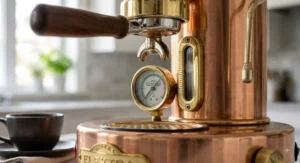
The chrome-and-brass Elektra Microcasa a Leva is arguably the machine that put the “vintage Italian lever” aesthetic on the map outside of Italy, and it’s the reason most people search for this exact model by name. Its 1.8-liter boiler holds enough water for a solid morning’s worth of shots without a refill, and the pressure gauge on the dome — with its green “extract now” zone — turns guesswork into something closer to a checklist. Based on the spec comparison with cheaper levers, that gauge alone saves beginners weeks of trial and error, since you’re not relying purely on lever feel to know when the boiler’s ready.
Elektra has built machines since 1947, and the Microcasa a Leva is essentially their flagship home unit — a genuine spring-piston lever, not the direct-lever style used by some competitors, meaning the spring (not your arm) delivers most of the final brewing pressure. That distinction matters for consistency: once you release the lever, the spring does the same work every time, which is a big part of why this machine is often recommended to people who want repeatable shots without years of lever “feel” training. Reviewers consistently note that the steam wand outperforms unmodified rivals in this price range, producing tighter microfoam with less fuss.
Pros:
- ✅ Pressure gauge takes guesswork out of timing
- ✅ Spring-piston design gives shot-to-shot consistency
- ✅ Strong steam wand performance for milk drinks
Cons:
- ❌ Heavier learning curve than pump-driven machines
- ❌ No PID or digital temperature control
Expect to pay in the $1,650–$1,900 range depending on finish and retailer stock, and given the build quality and resale demand, this is one of the few home espresso machines that holds value rather than depreciating like a typical appliance.
2. La Pavoni Europiccola — the most affordable true lever on the market
If the elektra microcasa leva feels like a stretch, the La Pavoni Europiccola is where most people actually start. It’s a smaller 8-cup boiler than the Elektra, chrome-plated brass construction, and a light that flashes (rather than a pressure gauge) to signal readiness. That’s a meaningful practical difference: what most buyers overlook about this model is that without a manometer, you’re relying entirely on the indicator light and your own sense of timing, which flattens the learning curve in the wrong direction for absolute beginners.
Still, the Europiccola earned its reputation honestly — it’s been in continuous production for decades, and replacement parts are easy to source, which is more than you can say for most 20-year-old kitchen appliances. On paper this means lower long-term ownership risk even though the upfront machine is the cheapest on this list. Aggregated buyer sentiment across major retailers describes the shots as genuinely café-quality once dialed in, though multiple reviewers flag a real adjustment period for anyone coming from a pump machine.
Pros:
- ✅ Lowest price of entry into true lever brewing
- ✅ Decades of parts availability and community knowledge
- ✅ Classic chrome finish matches vintage Italian styling
Cons:
- ❌ No pressure gauge, only a readiness light
- ❌ Smaller 8-cup boiler needs more frequent refills
Pricing generally sits in the $850–$1,300 range depending on finish (chrome, wood handles, or the gauge-equipped special edition), making it the clear budget pick among true Italian levers.
3. La Pavoni Professional / Stradivari — the bigger-boiler upgrade
Step up from the Europiccola and you land on the La Pavoni Professional, sometimes badged as the Stradivari depending on trim. The headline change is boiler capacity — the larger reservoir means you can pull several shots back-to-back for a household of two or three without waiting on a reheat cycle. Reviewers consistently point to the built-in pressure gauge as the single biggest quality-of-life improvement over the entry-level Europiccola, since it reads boiler pressure the same way the elektra microcasa leva’s gauge does.
Here’s what to weigh: the Professional doesn’t fundamentally change the brewing physics versus the Europiccola — you’re still generating extraction pressure by hand, with the spring assisting rather than doing all the work, unlike the Elektra’s fully spring-driven system. That’s a genuine trade-off some buyers miss. If you want the “pull it and feel the shot” experience that lever purists talk about, this is arguably more engaging than the Elektra; if you want consistency without the learning investment, it’s a harder sell at a similar price point.
Pros:
- ✅ Larger boiler supports back-to-back shots
- ✅ Built-in pressure gauge for better timing
- ✅ Wide availability of trims, colors, and finishes
Cons:
- ❌ Direct-lever design demands more technique than spring-piston rivals
- ❌ Pricing overlaps with the higher-spec Elektra Microcasa
Expect a $1,200–$1,600 range depending on finish, which puts it in direct competition with the base elektra microcasa leva chrome model — more on that comparison shortly.
4. Elektra Micro Casa S1 (Copper & Brass) — the elektra microcasa leva turned up a notch
Same internal architecture as the standard Elektra Microcasa a Leva, but finished in polished copper and brass instead of chrome. The Micro Casa S1 is functionally identical in boiler capacity, pressure gauge placement, and lever mechanism — this is purely a materials and finish upgrade, and it’s worth being honest about that rather than pretending the copper somehow brews better coffee. What the spec sheet won’t tell you, but owners note, is that copper does hold and radiate heat slightly differently than chrome-plated brass, though the practical brewing difference is marginal at best.
Where this model earns its premium is aesthetics and hand-finishing time. The copper surface requires more labor to polish and lacquer than a chrome bath, and that shows up directly in the sticker price. Based on the spec comparison, if your priority is display-piece appeal — a machine that looks like a 1950s Italian café artifact rather than a modern chrome appliance — this is the version worth the upcharge.
Pros:
- ✅ Same reliable spring-piston mechanism as the chrome model
- ✅ Distinctive polished copper-and-brass finish
- ✅ Strong resale and collector interest
Cons:
- ❌ Meaningful price premium over the chrome-and-brass version
- ❌ Copper requires more careful cleaning to avoid tarnishing
Typically priced in the $1,900–$2,300 range, this is the machine for buyers who’ve already decided on the elektra microcasa leva and are now just choosing a finish.
5. Olympia Cremina — the Swiss-built heirloom
Switch countries and philosophies with the Olympia Cremina, a machine that’s been in continuous, largely unchanged production since 1967. Where the Elektra and La Pavoni lean into Italian romance, the Cremina leans into Swiss precision — a compact stainless-steel body, a pre-infusion piston system that draws water into the chamber before the main extraction, and a reputation for machines from the 1960s still running daily in owners’ kitchens. Reviewers consistently frame the value proposition here not as convenience, but as longevity: you’re paying for a machine built to outlast you, not to compete on features with a $400 semi-automatic.
Based on the spec comparison, the Cremina’s pre-infusion piston does something the elektra microcasa leva and La Pavoni models don’t do as explicitly — it wets the puck gently before full pressure hits, which tends to produce a more even extraction with fewer channeling issues, especially for less-experienced hands. The trade-off is price and a steeper import/availability curve for U.S. buyers.
Pros:
- ✅ Pre-infusion piston system for gentler extraction
- ✅ Reputation for multi-decade reliability
- ✅ Compact footprint despite premium build
Cons:
- ❌ Highest price bracket on this list for a new unit
- ❌ Limited U.S. dealer network compared to Elektra/La Pavoni
New units generally list in the $2,800–$3,400 range through authorized dealers, while well-kept vintage models trade on the secondary market for $1,500–$2,600 — a genuine option if you’re comfortable buying used.
6. Olympia Cremina SL — spring-loaded group for hands-off consistency
The Cremina SL takes the base Cremina’s Swiss build quality and adds something none of the other machines on this list have: a compression spring built directly into the brewing group. According to the manufacturer, this is the first time a compression-spring brew group has been fitted to a machine this compact, and the practical effect is that the lever moves slowly and steadily upward on its own during extraction rather than requiring the operator to manage pressure by feel throughout the shot.
Here’s what to weigh: this pushes the Cremina SL philosophically closer to the elektra microcasa leva’s spring-piston approach — consistency over hands-on engagement — but at a meaningfully higher price point and with the added heft of Cremina’s stainless construction. For buyers who loved the idea of a lever machine but got frustrated fighting inconsistent shots on a fully manual model, this is the machine built specifically to solve that problem.
Pros:
- ✅ Compression spring group improves shot-to-shot consistency
- ✅ Retains Cremina’s renowned build quality
- ✅ Powder-coated frame resists wear better than raw chrome
Cons:
- ❌ Priciest machine in the entire lineup
- ❌ Overkill for casual, single-shot-a-day drinkers
Pricing typically lands in the $3,800–$4,500 range for U.S. buyers once import costs are factored in, positioning it as a genuine step above even the premium Elektra Micro Casa S1.
7. Londinium I Compressa — the closest thing to a café lever at home
Built in England rather than Italy or Switzerland, the Londinium I Compressa takes a full commercial-grade lever architecture — a copper boiler, variable pre-infusion, and thermal stability engineered for consecutive shots without overheating — and compresses it into a machine designed for home counters. Unlike the elektra microcasa leva or La Pavoni, this model must be plumbed into a mains water line and drain, which is a genuine practical hurdle for apartment dwellers but a non-issue for anyone with a kitchen setup that supports it.
What most buyers overlook about this model is that its variable pre-infusion pressure lets you dial in pressure specifically for lighter or darker roasts — a level of tuning the fixed-pressure Elektra and La Pavoni machines simply don’t offer. Owners on enthusiast forums frequently compare its output favorably to La Marzocco’s semi-professional line, which is a strong claim for a machine sized for a home kitchen.
Pros:
- ✅ Commercial-grade thermal stability for back-to-back shots
- ✅ Variable pre-infusion tunes to roast level
- ✅ Self-serviceable with manufacturer video support
Cons:
- ❌ Requires plumbing — not a countertop plug-and-play unit
- ❌ Highest realistic landed cost on this list
Landed pricing for U.S. buyers generally runs $4,000–$4,600 including import duties, making it a serious investment reserved for buyers who’ve already lived with a simpler lever and want to go further.
Elektra Microcasa Leva vs La Pavoni: Which Italian Lever Wins?
This is the single most common question in lever espresso forums, and for good reason — the elektra microcasa leva and La Pavoni models are the two most accessible entry points into serious lever brewing, and they solve the same problem in genuinely different ways.
| Factor | Elektra Microcasa Leva | La Pavoni Europiccola/Professional |
|---|---|---|
| Group mechanism | Spring-piston (spring does the final push) | Direct lever (your arm provides more of the pressure) |
| Boiler pressure feedback | Gauge in every model | Gauge only on Professional trims |
| Learning curve | Gentler once dialed in | Steeper, but more “hands-on” feel |
| Price range | $1,650–$1,900 | $850–$1,600 |
According to long-running discussions among owners who’ve used both machines side by side, the shot quality is genuinely comparable — nobody credible claims the pricier Elektra brews dramatically better coffee. The real difference is tactile: with the La Pavoni, pressure feeds back through the lever into your hand as you pull, letting experienced users “feel” the extraction in real time, while the elektra microcasa leva‘s spring does that work invisibly once you let go. If you want a machine that teaches you grind, dose, and timing through direct feedback, La Pavoni has the edge; if you want the Elektra’s build quality and gauge-driven consistency, that’s where the extra few hundred dollars goes.
What Is an Italian Spring Lever Espresso Machine?
An Italian spring lever espresso machine is a manual coffee maker that uses a hand-operated lever to compress a spring, which then forces hot water through ground coffee at high pressure. Pulling the lever loads the spring; releasing it drives the shot — no electric pump involved in the actual extraction.
This category traces back to 1947, when Achille Gaggia patented the spring-lever design that replaced earlier steam-pressure machines, standardizing shot size and — almost by accident — producing the crema that defines modern espresso. Italian craftsmanship espresso machines like the elektra microcasa leva descend directly from that lineage: hand-assembled boilers, chromed or copper-finished bodies, and mechanical simplicity that trades automation for tactile control. Unlike pump-driven machines, there’s no motor, no PID board, and often no digital display — just brass, a spring, and whatever pressure a human arm or a coiled spring can generate. That mechanical honesty is exactly why the category still has a devoted following nearly 80 years later.
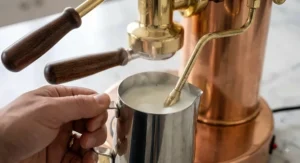
Chrome Espresso Machine Aesthetic: Why Look Matters As Much As The Shot
Let’s be honest about something the spec sheets won’t say outright: a meaningful chunk of the appeal of a chrome espresso machine has nothing to do with the coffee. The elektra microcasa leva, La Pavoni Europiccola, and most machines on this list share that gleaming, retro-futurist look — polished chrome or copper, brass accents, sometimes a hand-finished eagle perched on top — because Italian manufacturers in the 1940s and 50s were building café equipment meant to be seen, not hidden in a back room. Reviewers consistently mention the visual impact of these machines before they mention flavor, and that’s not shallow; it’s the whole design brief working as intended.
Here’s what to weigh: chrome shows fingerprints and water spots more visibly than brushed stainless, and copper finishes require more diligent wiping to avoid tarnish streaks. If you want showroom-shine every morning, budget five extra minutes for a microfiber wipe-down as part of your routine — a small tax on owning something this visually striking.
Becoming a Spring Lever Home Barista: The Learning Curve
Nobody pulls a flawless shot on their first try with a lever machine, and if a listing implies otherwise, be skeptical. Becoming a competent spring lever home barista genuinely takes practice — usually somewhere between two and six weeks of daily use before grind, dose, and timing start clicking into place without conscious thought.
The good news: the elektra microcasa leva’s pressure gauge shortens that curve considerably compared to gauge-free entry machines, because you’re removing one variable (knowing when the boiler is ready) from the equation while you’re still learning the others. What most buyers overlook is that grind consistency matters more here than on pump machines — a burr grinder capable of fine, even espresso grind isn’t optional, it’s the difference between a shot that channels badly and one that extracts evenly. Budget for a quality grinder alongside the machine itself; it’s arguably the more important purchase of the two.
Elektra Microcasa Leva for Home Use: Setting Up Your Countertop Ritual
Bringing an elektra microcasa leva into a home kitchen is less like installing an appliance and more like adopting a small, demanding pet with excellent taste. Here’s what that actually looks like day to day.
First 30 days: Expect a genuine adjustment period. Most owners report their first two weeks producing inconsistent shots — some sour, some bitter — while they calibrate grind size specifically to this machine’s pressure curve. That’s normal, not a defect.
Maintenance rhythm: Descale every 4-6 weeks depending on your local water hardness (harder water demands more frequent attention), wipe the chrome or copper body daily to prevent water-spot buildup, and replace the group gasket roughly once a year with normal daily use — a cheap part that’s easy to source given how long this machine has been in production.
Optimization tricks the listing won’t tell you: Pre-warm your portafilter and cup with hot water from the machine before pulling a shot; the thermal mass of a cold portafilter can noticeably drop your brew temperature on a machine this size. And resist the urge to rush the pressure gauge into the green zone by cranking the heat — patience here directly improves shot quality.
✨ Ready to Bring Home a Slice of Italian Espresso Craft?
🔍 Take your home coffee ritual to the next level with a hand-built lever machine. Click on any highlighted model above to check current pricing and availability, and start pulling shots that taste like they came from a 1960s Milanese café.
Real-World Scenarios: Three Buyers Who Chose a Lever Machine
The design-obsessed apartment dweller. She has a small kitchen, drinks one excellent cappuccino a day, and cares as much about how her counter looks as how her coffee tastes. The La Pavoni Europiccola fits her budget and footprint, and its compact 8-cup boiler is plenty for single-serving use.
The household of coffee drinkers. A couple that each wants two shots most mornings needs a bigger boiler and faster recovery than an entry-level unit provides. The elektra microcasa leva‘s 1.8-liter capacity and pressure gauge make it realistic for back-to-back cappuccinos without a 20-minute wait between them.
The former café owner turned home enthusiast. He’s used commercial equipment for a decade and wants something closer to that experience without renting retail space. The Londinium I Compressa‘s plumbed setup and variable pre-infusion give him the tuning control he’s used to, in a machine sized for his kitchen.
Buyer’s Decision Framework: Which Lever Machine Fits Your Life?
If you’re brewing for one and want the cheapest legitimate entry point, choose the La Pavoni Europiccola, because its smaller boiler and lower price minimize risk while you learn whether lever brewing is actually for you.
If you want the classic elektra microcasa leva look with proven gauge-assisted consistency, choose the Elektra Microcasa a Leva, because the pressure gauge meaningfully shortens the learning curve versus gauge-free rivals.
If you want maximum visual drama for a display kitchen, choose the Elektra Micro Casa S1 in copper and brass, because the finish upgrade is purely aesthetic with zero brewing downside.
If longevity and Swiss engineering matter more to you than price, choose the Olympia Cremina, because its decades-proven pre-infusion piston system is built for owners who plan to keep one machine for life.
If plumbing is available and you want café-grade tuning at home, choose the Londinium I Compressa, because its variable pre-infusion is the only system on this list built for roast-specific adjustment.
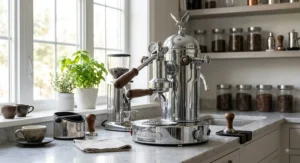
How to Choose an Italian Spring Lever Espresso Machine
- Set a real budget range, not a target price. Given how much finish options swing the final number, decide on a range like $1,000–$2,000 rather than a single figure.
- Decide between spring-piston and direct-lever mechanisms. Spring-piston (Elektra, Cremina SL) favors consistency; direct-lever (base La Pavoni) favors tactile control and a steeper learning curve.
- Check whether you need plumbing or want countertop-only. Only the Londinium models in this category typically require a water line — everything else is plug-and-play.
- Match boiler size to your household’s shot volume. A single daily cappuccino doesn’t need the same capacity as two people drinking two shots each.
- Factor in finish maintenance, not just finish looks. Copper requires more upkeep than chrome; decide honestly whether you’ll actually do that upkeep.
- Research parts availability before buying vintage. La Pavoni and Elektra both have long production runs with accessible parts; lesser-known vintage levers can leave you stranded when a gasket fails.
- Budget for a proper grinder alongside the machine. A mediocre grinder will bottleneck even the best lever machine’s potential.
Common Mistakes When Buying a Manual Lever Espresso Machine
Buyers new to this category tend to repeat the same handful of errors. First, underestimating the learning curve — expecting café-quality shots in week one is the single most common source of buyer’s remorse, and it’s almost always a grind-and-technique issue, not a machine defect. Second, buying based purely on looks without checking boiler capacity against actual household coffee consumption; a stunning machine that requires three refills for four cappuccinos gets old fast. Third, skipping the grinder budget entirely — pairing a $1,800 elektra microcasa leva with a $40 blade grinder wastes most of what the machine is capable of. Finally, some buyers overlook maintenance realities, particularly with copper finishes or hard water areas that demand frequent descaling; factor that ongoing time cost in before you commit.
What to Expect: Real-World Performance
On paper, a spring-piston machine like the elektra microcasa leva delivers pressure in the 8-10 bar range once fully compressed — comparable to commercial pump machines. What that translates to in your cup is a shot with genuine crema, a fuller body than pump-extracted espresso in many tasters’ experience, and noticeably more room for user error to show up in the final result. Reviewers consistently describe the learning process as rewarding specifically because bad shots teach you something a pump machine’s consistency would hide — you’ll know within days whether your grind is too coarse (thin, fast-running shots) or too fine (chokes and drips instead of flowing). Expect your first ten to fifteen shots to be a genuine mixed bag, and expect the machine to reward patience with results that a $300 pump machine simply can’t replicate in terms of tactile satisfaction and crema quality.
Long-Term Cost & Maintenance
Buying a lever machine is a different financial calculation than buying a typical countertop appliance, largely because Italian craftsmanship espresso machines like these are built to be repaired rather than replaced. Group gaskets typically run under $15 and are a DIY swap for anyone reasonably handy; descaling solution costs a few dollars every 4-6 weeks depending on water hardness; and because production runs for models like the La Pavoni Europiccola and elektra microcasa leva have continued for decades, parts scarcity is far less of a concern than with, say, a discontinued electric machine from five years ago. The community forum at Home-Barista is a genuinely useful resource here — decades of owner-documented repairs mean most common failure points already have a known fix.
Where the real cost lands is the upfront purchase and, for premium models like the Cremina SL or Londinium, the import/shipping overhead. But amortized over a machine designed to run for 20-plus years, the annual cost of ownership for something like the elektra microcasa leva often works out lower than replacing a $300 pump machine every three to four years, which is the more realistic lifespan for cheaper electric alternatives.
Benefits vs Traditional Pump-Driven Alternatives
| Factor | Spring Lever Machine (e.g., elektra microcasa leva) | Traditional Pump-Driven Machine |
|---|---|---|
| Pressure source | Mechanical spring/lever | Electric pump |
| Learning curve | Steeper, more tactile | Gentler, more automated |
| Expected lifespan | Often 20+ years with basic maintenance | Typically 3-7 years before major part failure |
| Repairability | High — simple mechanical parts | Lower — electronic components fail unpredictably |
| Typical price range | $850–$4,600 | $150–$2,000 |
The trade-off here is stark: a pump-driven machine gets you consistent shots faster with less skill investment, but according to long-term owner reports, it also tends to reach end-of-life sooner as pumps and solenoids wear out or electronics fail. A spring lever machine asks more of you upfront in exchange for a mechanical simplicity that, historically, keeps machines like the Gaggia-style spring lever design running for generations rather than years.
✨ Don’t Miss These Exclusive Deals!
🔍 Take your home espresso setup to the next level with these carefully selected lever machines. Click on any highlighted item to check current pricing and availability. These machines will help you create authentic Italian-style espresso your family will love!
Frequently Asked Questions
❓ Is the elektra microcasa leva worth the price compared to La Pavoni?
❓ How long does it take to learn a spring lever espresso machine?
❓ Do Italian lever machines need special maintenance?
❓ Can a spring lever machine make cappuccinos, not just espresso?
❓ Is a lever espresso machine good for home use as a beginner?
Conclusion
There’s no version of this article that ends with “just buy the cheapest one” or “just buy the most expensive one,” because a spring lever machine genuinely rewards matching the model to your actual habits, not your aspirational ones. If you drink one cup a day and want the lowest-risk entry point, the La Pavoni Europiccola remains the sensible start. If you want the specific blend of gauge-driven consistency and unmistakable Italian craftsmanship espresso styling that made this category famous, the elektra microcasa leva earns its reputation honestly — it’s not the cheapest option, but it’s rarely the machine buyers regret. And if you’re already past the “will I actually use this” question and chasing café-grade tuning, the Cremina SL and Londinium models are waiting at the top of the range.
What ties every machine on this list together is a shared philosophy: espresso as a skill worth developing, not a button worth pressing. Whichever model you land on, budget real time for the learning curve, pair it with a decent grinder, and treat the first few weeks of inconsistent shots as tuition rather than failure. That’s genuinely part of what you’re paying for.
Recommended for You
- La Pavoni Europiccola Review 2026: 7 Iconic Lever Machines Compared
- 7 Best Spring Lever Espresso Machines to Buy in 2026
- Lever vs Semi Automatic Espresso Machine: 7 Real Picks (2026)
Disclaimer: This article contains affiliate links. As an Amazon Associate, I earn from qualifying purchases. If you purchase products through these links, we may earn a small commission at no additional cost to you.
✨ Found this helpful? Share it with your friends! 💬🤗
