
In This Article
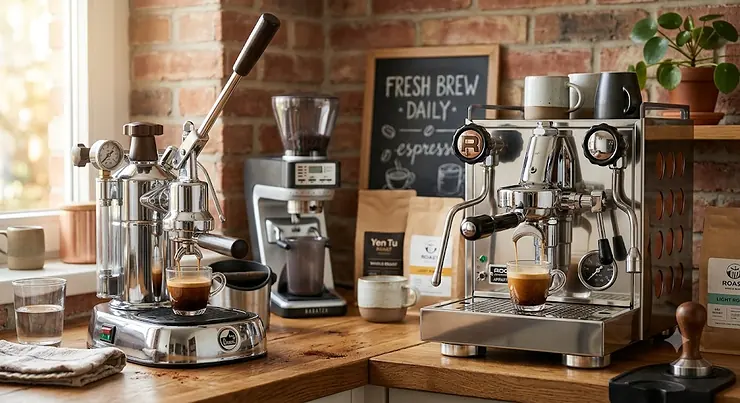
Somewhere around your third week of pulling shots on a pump machine, a strange thought creeps in: what if the machine is doing too much of the thinking for me? That itch is exactly why the lever vs semi automatic espresso machine debate refuses to die. One camp hands you a spring or a set of arms and says “you’re the pump now.” The other camp gives you a motor, a boiler, and a button, and says “focus on the coffee, not the mechanics.” Neither camp is lying. They’re just optimizing for different things.
A lever espresso machine uses your own muscle (or a compressed spring) to force hot water through the coffee puck, no electricity required in most designs. A semi automatic espresso machine uses an electric pump, typically running at a fixed 9 bars, while you still control the grind, dose, and start/stop timing by hand. Both can produce genuinely excellent espresso; the difference is in the workflow, the learning curve, and how much of the brewing philosophy you want strapped to your own forearm.
This guide breaks down seven real, currently sold machines spanning both camps, from a $150 manual gadget to a nearly $1,000 Italian workhorse, with honest analysis of what each one actually delivers. We’ll dig into pressure profiling, taste differences, long-term cost, and the specific buyer each machine suits, so you’re not left guessing which philosophy fits your kitchen counter.
What Is a Lever Espresso Machine?
A lever espresso machine is a device that generates brewing pressure through manual force, either your arms pressing a piston (as with the ROK Espresso GC) or a pre-tensioned spring released by pulling a handle (as with the La Pavoni Europiccola), rather than an electric pump. Baristas have literally called this “pulling a shot” since Achille Gaggia’s 1947 spring-lever design, which required tensioning a spring by hand to drive a piston up to roughly 9 bars of pressure, as Wikipedia’s overview of the E-61 group head explains in more technical detail. That single mechanical idea is still the backbone of every lever espresso machine sold today.
Quick Comparison Table: Lever vs Semi Automatic Espresso Machine
| Machine | Type | Price Range | Best For |
|---|---|---|---|
| ROK Espresso GC | Manual lever | Under $200 | Budget-conscious beginners |
| Flair 58 Pro 2 | Manual lever | $325-$400 range | Pressure-profiling enthusiasts |
| Cafelat Robot Barista | Manual lever | $500-$550 range | Travel and minimalist setups |
| La Pavoni Europiccola | Spring lever w/ boiler | $900-$1,100 range | Collectors and cappuccino lovers |
| Gaggia Classic Pro | Semi automatic | $450-$550 range | Modders and DIY tinkerers |
| Breville Bambino Plus | Semi automatic | Under $500-$620 range | Speed and hands-free milk |
| Rancilio Silvia | Semi automatic | Around $950-$1,050 | Long-term, decade-plus ownership |
Looking at the spread above, the split isn’t really about price — it’s about who’s doing the work. The ROK Espresso GC and Flair 58 Pro 2 put nearly the entire pressure curve in your hands for a fraction of the cost of an electric machine, while the Breville Bambino Plus hands you a stable 9-bar pump and automatic milk texturing so you can focus purely on dialing in grind and dose. The La Pavoni Europiccola and Rancilio Silvia sit at similar premium price points but represent opposite philosophies entirely, one manual and one pump-driven, which is worth sitting with before you assume “expensive” automatically means “easier.”
☕ Ready to pick your side of the lever vs semi automatic espresso machine debate? Scroll down to see exactly how each one pulls a shot.
Top 7 Lever and Semi-Automatic Espresso Machines: Expert Analysis
1. ROK Espresso GC — full manual control for under $200
The standout here is that there’s no boiler, pump, or cord in sight, just a metal frame and two arms that do all the work. Specs-wise, the dual-arm piston generates 5 to 10 bars of pressure depending on how hard you press, and the 50mm portafilter handles a 16-20 gram double dose comfortably. In practice, that pressure range means you’re not locked into a fixed 9 bars the way pump machines are; you can shape a gentler pre-infusion just by easing into the first few seconds of the press. This is the entry point for anyone curious about manual lever espresso pros and cons without committing serious money, and it particularly suits campers, apartment dwellers without much counter space, or coffee geeks who want a backup brewer for power outages. Reviewers across enthusiast sites consistently describe the build quality as “durable and apocalypse-proof,” and a common theme in owner feedback is that the learning curve is real but rewarding, with most people needing several weeks of practice before shots stop running fast or bitter. On the flip side, some reviewers note the plastic tamper that ships in the box is a weak point worth upgrading immediately, and the absence of a pressure gauge on the base model makes it harder to diagnose a bad shot.
Pros:
- ✅ No electricity needed, works anywhere with hot water
- ✅ Full manual pressure control at an entry-level price
- ✅ Ten-year warranty on all metal parts
Cons:
- ❌ No pressure gauge on the standard model
- ❌ Stock plastic tamper is a known weak point
At under $200, the ROK Espresso GC is one of the cheapest legitimate ways into real espresso, and for that price, the value case is hard to argue with.
2. Flair 58 Pro 2 — commercial-size portafilter with a built-in gauge
What immediately sets the Pro 2 apart is the integrated pressure gauge sitting right on the brew head, giving you live feedback as you pull. The 58mm portafilter is the same diameter used in actual café equipment, which means you’re not stuck with proprietary baskets, and the cast aluminum base with a stainless steel brew post keeps the whole rig stable under load. What most buyers overlook about this model is that the gauge isn’t just a gimmick; it’s what turns “pull the lever and hope” into genuine pressure profiling, letting you watch a shot ramp from 2 bars during pre-infusion up toward 9 bars during full extraction. This machine is built for the home barista who has already tried a cheaper manual maker and wants to go deeper into shot-shaping without spending on electricity or a boiler. Aggregated feedback from specialty retailers frequently praises the shot quality relative to price, with several reviewers noting it rivals machines costing twice as much, though the common complaint is that the fully manual workflow (heating water separately, no steam wand) adds real time to your morning routine.
Pros:
- ✅ Integrated pressure gauge for real pressure profiling
- ✅ Commercial 58mm portafilter fits standard baskets
- ✅ No electrical components to eventually fail
Cons:
- ❌ No steam wand, so milk drinks need a separate frother
- ❌ Requires boiling water from a kettle every session
Priced in the $325-$400 range, the Flair 58 Pro 2 is a strong mid-tier pick for anyone serious about manual pressure profiling.
3. Cafelat Robot Barista — dual-arm design with café-format extraction
The headline feature is the deep 58mm basket that doubles as the brew chamber itself, simplifying the water path in a way most manual machines don’t attempt. Technically, it runs 6-9 bars of manual pressure through a 145ml basket that can hold up to 25 grams of coffee, and the dual-arm design distributes load across both shoulders rather than one wrist, which matters more than it sounds like after your tenth shot of the morning. Here’s what to weigh: the Robot Barista’s simplified single-chamber design means fewer parts to seal and maintain long-term compared to piston-style levers, which is a real advantage for anyone who dislikes fiddly gear. It’s best suited to travelers and minimalists who want café-grade shots in a compact footprint that breaks down easily. Reviewers on specialty retail sites report an average rating in the 5-star range across dozens of reviews, with recurring praise for build consistency, though a genuine limitation reviewers flag is that light roasts are noticeably harder to pull well, since the fine grind required makes the manual press physically demanding.
Pros:
- ✅ Deep 58mm basket simplifies the brew chamber design
- ✅ Dual-arm ergonomics reduce strain versus single-lever designs
- ✅ Compact and genuinely travel-friendly
Cons:
- ❌ Light roasts require more physical effort to extract
- ❌ Higher price than comparable manual machines
At roughly $500-$550, the Cafelat Robot Barista sits at the upper end of manual pricing, but the build quality largely justifies it.
4. La Pavoni Europiccola — the classic spring lever with a steam wand
The Europiccola is the rare lever machine that also gives you an onboard boiler and steam wand, so you’re not brewing espresso and frothing milk as two entirely separate errands. The 0.8-liter boiler heats roughly eight cups’ worth of hot water using a brass heating element, and the spring-loaded lever mechanism means you’re compressing a spring rather than pushing your own body weight through the puck. On paper this means less physical strain per shot than a pure manual press, but reviewers note there’s a genuine quirk: trapped air can cause a false pressure reading on heat-up, so you need to purge the steam wand before your first pull. This machine is for the person who wants the ritual and the aesthetics as much as the espresso itself; it’s a design icon with Art Deco styling that’s been in continuous production since 1905. Aggregated review sentiment across coffee gear sites is consistently glowing on flavor and build quality, with owners repeatedly describing the crema as rich and the auto-frother as a nice bonus for cappuccino, though the most common criticism is the steep learning curve and the boiler’s tendency to overheat if you leave it running too long between shots.
Pros:
- ✅ Built-in boiler and steam wand for milk drinks
- ✅ Iconic, Italian-made build with decades of proven reliability
- ✅ Spring mechanism reduces physical effort versus pure lever presses
Cons:
- ❌ Steep learning curve with a real risk of overheating
- ❌ Small 0.8L boiler limits back-to-back drink volume
Sitting around $900-$1,100, the La Pavoni Europiccola is a premium buy, but it’s the only machine on this list combining lever brewing with onboard steam.
5. Gaggia Classic Pro — the modder’s favorite semi automatic
The 58mm commercial portafilter is the headline spec, the same diameter used in machines costing five times as much, meaning every aftermarket basket you’d want fits without adaptation. It runs a 15-bar pump regulated by an over-pressure valve, and the 3-way solenoid valve vents pressure from the puck after each shot so you’re not fighting a soggy mess during cleanup. What most buyers overlook is that the stock over-pressure valve ships set too high for optimal extraction; adjusting it down to 9 bars is a free, ten-minute mod that meaningfully improves shot quality, and it’s the first thing the enthusiast community recommends. This machine is built for the DIY-minded buyer who actually wants a project, someone willing to add a PID controller or bottomless portafilter over time rather than buying a machine that’s already “finished.” Aggregated reviews across major retailers cluster around 4.5 stars from thousands of verified buyers, with the recurring praise being the all-metal, user-serviceable build, while the honest downside reviewers flag is the lack of factory PID temperature control, meaning you’ll need to learn temperature surfing or budget for an aftermarket kit.
Pros:
- ✅ Commercial 58mm group head with a huge aftermarket ecosystem
- ✅ Fully user-serviceable, all-metal construction
- ✅ Free OPV mod meaningfully improves stock extraction
Cons:
- ❌ No factory PID, so temperature surfing is required
- ❌ Single boiler makes back-to-back milk drinks slow
Priced around $450-$550, the Gaggia Classic Pro is arguably the best semi automatic starting point for anyone who wants to grow into the hobby.
6. Breville Bambino Plus — fastest heat-up in its price class
The standout feature is the ThermoJet heating system, which reaches brewing temperature in roughly 3 seconds instead of the 15-20 minutes a traditional boiler needs. It applies 2-4 bars of pressure for the first few seconds as a pre-infusion stage before ramping to a full 9 bars, which is a feature more commonly found on machines costing several times its price, and it noticeably reduces channeling on medium roasts. Based on the spec comparison with other semi automatic machines at this price, the Bambino Plus trades some long-term serviceability (its thermocoil isn’t rebuildable) for genuinely faster mornings and a hands-free automatic milk-frothing wand with temperature and texture presets. It’s the clear pick for someone in a small kitchen who wants café-quality microfoam without learning steam wand technique, or anyone who’s tired of waiting on a cold machine before their first cup. Aggregated Amazon review data shows over 2,600 ratings averaging around 4.1 stars, and a recurring theme in reviews is praise for the automatic milk system rivaling barista-trained results, while the honest complaint is that the 54mm portafilter has a smaller aftermarket accessory ecosystem than 58mm machines.
Pros:
- ✅ Roughly 3-second heat-up versus 15+ minutes on boiler machines
- ✅ Automatic milk texturing with temperature and texture presets
- ✅ Genuinely compact footprint for small kitchens
Cons:
- ❌ Smaller 54mm portafilter limits aftermarket accessories
- ❌ Non-rebuildable thermocoil caps long-term serviceability
At around $500-$620 (frequently discounted closer to $400), the Breville Bambino Plus is the fastest, most beginner-friendly semi automatic on this list.
7. Rancilio Silvia — the decade-plus workhorse
The defining spec is the 58mm brass group head paired with a 2-liter internal reservoir, both built to the kind of commercial standard you rarely see under $1,000. The vibratory pump delivers a stable 9 bars once the boiler is heat-soaked, and the all-metal, stainless steel chassis is why so many owners report a decade or more of daily use without major repairs. What the spec sheet won’t tell you, but reviewers note repeatedly, is that Silvia ships without a factory PID, so brew temperature fluctuates with the boiler’s heating cycle and you’ll need to learn temperature surfing, timing your shot pull to when the heating element cycles off, for consistent results. This machine is built for the buyer who wants a genuinely serviceable, long-haul semi automatic and is willing to trade push-button convenience for durability and a proper commercial workflow; it’s less compelling if stock pre-infusion or a brew pressure gauge matters to you, since competitors at similar prices now include those. Aggregated reviewer sentiment consistently highlights steam power that punches above its single-boiler class, capable of texturing milk in around 20 seconds, while the honest limitation is that milk-heavy households will spend real time waiting between brew mode and steam mode on a single boiler.
Pros:
- ✅ Commercial 58mm brass group with proven decade-plus durability
- ✅ Steam power that outperforms its single-boiler class
- ✅ Enormous parts and accessory ecosystem
Cons:
- ❌ No factory PID, requiring temperature surfing technique
- ❌ Single boiler makes milk and brew mode-switching slow
At roughly $950-$1,050, the Rancilio Silvia is a premium, buy-it-for-life semi automatic pick for patient, serious home baristas.
Top 7 Machines: Full Spec Comparison
| Machine | Portafilter | Pressure | Steam Wand | Best For |
|---|---|---|---|---|
| ROK Espresso GC | 50mm | 5-10 bar manual | No | Budget beginners |
| Flair 58 Pro 2 | 58mm | Manual + gauge | No | Pressure profiling fans |
| Cafelat Robot Barista | 58mm | 6-9 bar manual | No | Travel and minimalists |
| La Pavoni Europiccola | Proprietary | Spring lever, ~9 bar | Yes | Cappuccino lovers |
| Gaggia Classic Pro | 58mm | 9 bar (OPV modded) | Yes | Modders and tinkerers |
| Breville Bambino Plus | 54mm | 9 bar, pre-infusion | Yes (auto) | Speed and convenience |
| Rancilio Silvia | 58mm | 9 bar | Yes | Long-term durability |
The pattern that jumps out is that every 58mm machine here, lever or semi automatic, gives you access to the same commercial-grade basket ecosystem, so upgrading your extraction later doesn’t mean replacing the whole machine. If steam is non-negotiable for your morning routine, that narrows the field fast: only the La Pavoni Europiccola, Gaggia Classic Pro, Breville Bambino Plus, and Rancilio Silvia can texture milk at all, while the purely manual ROK, Flair, and Cafelat Robot assume you’re either drinking straight shots or frothing separately.
Manual Lever Espresso: Pros and Cons Explained
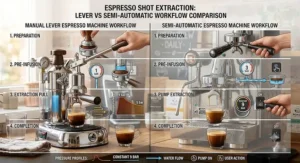
Weighing manual lever espresso pros and cons honestly means admitting upfront that neither side of this argument is objectively “better,” just better suited to different people. On the pro side, lever machines like the ROK Espresso GC and Flair 58 Pro 2 give you continuous, real-time control over pressure throughout the entire shot, not just a fixed 9-bar constant, which lets you shape a gentle pre-infusion or a fast, aggressive pull depending on the bean. They’re also mechanically simple, with far fewer parts that can fail compared to a pump, boiler, and solenoid valve, and most run entirely without electricity, a genuine advantage for travel, camping, or a power outage.
On the con side, that same manual control demands a real skill investment; expect several weeks of inconsistent shots before your technique settles. Physical fatigue is a factor too, especially with fine grinds on machines like the Cafelat Robot Barista, and most lever machines skip milk steaming entirely, meaning cappuccino drinkers need a separate frother. The honest verdict: lever machines reward patience with a level of control pump machines simply can’t replicate, but they ask more of the operator on every single shot.
Why Choose a Lever Espresso Machine?
The case for why choose lever espresso machine designs usually comes down to one word: intimacy. Reviewers who own both lever and pump machines consistently describe the lever experience as more tactile and more educational, since you can feel exactly how much resistance the puck is offering and adjust your press in real time. Based on the spec comparison across our seven picks, lever machines like the Flair 58 Pro 2 also tend to cost less upfront than comparable pump machines with similar build quality, since you’re not paying for a motor, boiler, or electronics.
There’s also a durability argument worth taking seriously: a machine like the ROK Espresso GC has almost nothing that can electrically fail, which is part of why it carries a ten-year warranty on metal parts. If you’re the type of person who enjoys understanding exactly how your tools work, rather than treating them as sealed black boxes, a lever machine turns every morning into a small, repeatable craft exercise instead of a button press.
Is a Lever Espresso Machine Better Than Electric?
Whether a lever espresso machine is better than electric really depends on what “better” means to you, and reviewers are split for good reason. For raw extraction quality in skilled hands, lever machines like the La Pavoni Europiccola can absolutely match or exceed electric semi automatics like the Breville Bambino Plus, because manual pressure profiling lets you avoid channeling that a fixed 9-bar pump can’t dodge. For consistency and convenience, though, electric machines win clearly; the Bambino Plus‘s 3-second heat-up and stable pump pressure remove several variables that lever brewers have to manage by feel every single time.
Here’s what to weigh: if you already own a decent grinder and enjoy the process as much as the drink, a lever machine’s ceiling is genuinely higher because you control more variables. If you want repeatable shots on a rushed weekday morning, an electric semi automatic like the Gaggia Classic Pro or Rancilio Silvia removes the pressure-shaping guesswork so you can focus purely on grind and dose.
Manual Espresso vs Automatic: Which Tastes Better?
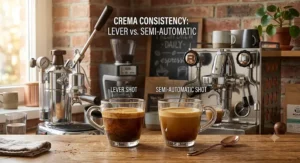
The manual espresso vs automatic which tastes better question doesn’t have a universal answer, and honestly, that’s the most useful thing we can tell you. In blind comparisons referenced across enthusiast review sites, a well-dialed-in shot from the Flair 58 Pro 2 and a well-dialed-in shot from the Rancilio Silvia are often indistinguishable to casual drinkers, because both hit roughly 9 bars of peak pressure and similar extraction yields when operated correctly. What actually drives flavor differences more than the lever-vs-pump question is grind consistency, bean freshness, and water temperature stability, variables that apply equally to both machine types.
Where taste differences do show up: lever machines with true pressure profiling, like the Flair 58 Pro 2 and Cafelat Robot Barista, let skilled users craft a gentler pre-infusion that can produce noticeably sweeter, less bitter shots on tricky light-roast beans. Meanwhile, semi automatics with factory pre-infusion, like the Breville Bambino Plus, get you most of that benefit automatically, without requiring the technique to pull it off by hand.
Espresso Pressure Profiling: The Manual Advantage
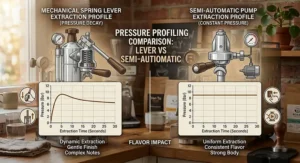
Espresso pressure profiling manual control is the single biggest technical argument in favor of lever machines, and it’s worth understanding what it actually means. Standard pump machines apply a near-constant 9 bars throughout the shot, a target formalized in the Specialty Coffee Association’s published equipment standards for semi-automatic and automatic machines. A lever machine, by contrast, lets you vary pressure continuously: start soft during pre-infusion to saturate the puck evenly, ramp up gradually for the main extraction, and even taper off at the end to avoid pulling harsh, over-extracted compounds in the final drops.
What most buyers overlook about this feature is that pressure profiling isn’t just a party trick; it’s a genuine tool for correcting problem beans. The Flair 58 Pro 2‘s integrated gauge is specifically built for this, letting you watch the curve in real time and adjust your press accordingly. On machines like the Cafelat Robot Barista, the deep basket and dual-arm design make it easier to sustain a controlled press through the whole shot. If pressure profiling matters to you, prioritize a machine with a visible gauge; brewing blind, without pressure feedback, makes profiling mostly guesswork.
Hands-On Espresso Brewing: A Practical Usage Guide
Hands-on espresso brewing rewards a consistent routine, and getting your first 30 days right matters more than the machine you bought. Start by heating your kettle water to roughly 195-205°F, since both lever and semi automatic machines need water in that band for proper extraction; too cool and shots run sour, too hot and they turn bitter. Dose your portafilter to the machine’s rated capacity (16-20 grams for a ROK Espresso GC, up to 25 grams for a Cafelat Robot Barista), distribute the grounds evenly with a quick stir to avoid clumping, and tamp level rather than at an angle.
For lever machines specifically, pre-infuse by applying gentle pressure for 6-10 seconds before committing to the full press; this saturates the puck and meaningfully reduces channeling. For semi automatics like the Gaggia Classic Pro, flush a short blank shot through the group head before locking in your portafilter, which stabilizes brew temperature and prevents your first real shot from running too hot. The most common first-month mistake across both machine types is grinding too coarse out of impatience with slow shots; resist the urge, since a properly fine grind combined with correct technique is what actually produces crema, not a coarser, faster-flowing puck.
The Espresso Brewing Philosophy: Craft vs Convenience
Every espresso brewing philosophy ultimately sits somewhere on a spectrum between craft and convenience, and matching your machine to your actual daily life matters more than matching it to your aspirational self. Consider a college student commuting to campus with a shared kitchen and 15 minutes before class; the Breville Bambino Plus‘s 3-second heat-up and one-touch milk system fit that reality far better than a lever machine requiring a kettle, a purge routine, and undivided attention. Now consider a retired home barista with a dedicated coffee corner and genuine curiosity about extraction science; the La Pavoni Europiccola or Flair 58 Pro 2 turn that free time into a satisfying, repeatable ritual rather than a chore.
A third profile worth naming: the apartment-dwelling minimalist who travels frequently and wants café-quality espresso without a permanent kitchen commitment. The Cafelat Robot Barista or ROK Espresso GC pack down small, need no outlet, and survive a suitcase far better than any electric machine on this list. None of these philosophies is more “authentic” than another; they’re simply optimized for different mornings.
Problem → Solution: Common Espresso Brewing Mistakes Fixed
Even good machines produce bad shots when a handful of recurring problems go uncorrected, so here’s a quick troubleshooting rundown.
Problem: Shots run too fast and taste sour. This almost always means your grind is too coarse for the machine’s pressure. Tighten the grind gradually and retest; on lever machines like the Flair 58 Pro 2, also check that your pre-infusion phase is actually saturating the puck before the full press.
Problem: Shots run too slow and taste bitter or burnt. Coarsen the grind slightly, and on semi automatics like the Gaggia Classic Pro, confirm your over-pressure valve hasn’t drifted above the standard 9 bars, which over-extracts fine grinds fast.
Problem: Inconsistent shot-to-shot temperature. On single-boiler machines like the Rancilio Silvia, this is a classic temperature-surfing issue; flush a short blank before each shot to reset the group head temperature, or budget for an aftermarket PID kit.
Problem: Weak or absent crema. Check bean freshness first (beans older than four weeks lose crema-producing CO2), then confirm your tamp is level and your dose matches the basket’s rated capacity.
Problem: Physical fatigue on manual machines. If pulling shots on the Cafelat Robot Barista or ROK Espresso GC leaves your arms tired, coarsen your grind slightly to reduce resistance, and switch which arm leads the press to distribute the effort.
How to Choose Between Lever and Semi Automatic
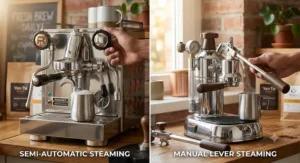
Choosing between a lever and semi automatic espresso machine gets much easier once you rank these factors honestly:
- Time available each morning. If you’re routinely rushed, an electric semi automatic like the Breville Bambino Plus removes several manual steps that a lever machine can’t skip.
- Physical comfort with repetitive pressing. Lever machines like the ROK Espresso GC demand real forearm effort on every shot; if that’s a dealbreaker, lean electric.
- Interest in pressure profiling. If shaping the extraction curve genuinely excites you, a gauge-equipped lever like the Flair 58 Pro 2 delivers control no fixed-pressure pump can match.
- Milk drink frequency. If lattes and cappuccinos are a daily habit, prioritize a steam wand; the Rancilio Silvia and Breville Bambino Plus both handle this well, while pure lever machines generally don’t.
- Budget for the full setup. Remember that most machines here need a separate grinder costing $150-$300, regardless of lever or electric.
- Tolerance for a learning curve. Semi automatics without a factory PID, like the Gaggia Classic Pro and Rancilio Silvia, still require some technique; lever machines require more.
- Long-term serviceability priorities. All-metal, boiler-based machines like the Rancilio Silvia tend to outlast thermocoil-based designs like the Breville Bambino Plus by a wide margin.
Long-Term Cost & Maintenance
Total cost of ownership rarely ends at the sticker price, so it’s worth running the numbers honestly. A ROK Espresso GC has essentially no ongoing electrical maintenance costs beyond an occasional gasket, since there’s no boiler or pump to service, making it one of the cheapest machines here to own for a decade. The Gaggia Classic Pro sits in the middle: its all-metal, user-serviceable design keeps repair costs low, but budget $25-$50 a year for descaling solution and occasional gasket replacement, plus another $100-$150 if you eventually add a PID kit.
Electric machines with sealed components carry a different risk profile. The Breville Bambino Plus‘s ThermoJet thermocoil isn’t rebuildable, and reviewers estimate a realistic 4-5 year lifespan under heavy daily use before replacement becomes the only option, which changes the effective cost-per-year math compared to a boiler-based machine like the Rancilio Silvia, whose brass boiler and stainless chassis routinely outlast a decade of daily service. Across every machine on this list, remember that the grinder is typically the second-largest ongoing investment, and a cheap grinder will bottleneck even the best espresso machine’s output.
Features That Actually Matter (And Those That Don’t)
Marketing copy loves big numbers, but not every spec translates to better coffee. A 15-bar or 20-bar pump rating, which shows up on machines like the Gaggia Classic Pro, sounds impressive, but the actual brewing pressure is regulated down to roughly 9 bars regardless; the higher number just means the pump has more headroom, not that your shots will taste different. What actually matters far more is portafilter size and basket quality: the 58mm commercial standard shared by the Flair 58 Pro 2, Gaggia Classic Pro, and Rancilio Silvia gives you access to precision aftermarket baskets that meaningfully improve extraction evenness, something a proprietary 54mm basket like the Breville Bambino Plus‘s can’t match as easily.
Pre-infusion is another feature that genuinely matters; both the Bambino Plus‘s automatic pre-infusion and a lever machine’s manual pre-infusion phase reduce channeling and produce sweeter shots. On the “doesn’t matter much” side: fancy digital displays and app connectivity look nice in marketing photos but rarely improve what ends up in your cup compared to a solid group head, consistent temperature, and a good grinder.
Price Range & Value Analysis
| Tier | Machine | Price Range | Value Verdict |
|---|---|---|---|
| Budget | ROK Espresso GC | Under $200 | Best entry point, minimal risk |
| Budget-Mid | Gaggia Classic Pro | $450-$550 range | Best long-term upgrade platform |
| Mid | Flair 58 Pro 2 | $325-$400 range | Best pressure-profiling value |
| Mid | Breville Bambino Plus | $500-$620 range | Best speed-to-shot value |
| Mid-Premium | Cafelat Robot Barista | $500-$550 range | Best travel-friendly build |
| Premium | Rancilio Silvia | $950-$1,050 range | Best decade-plus durability |
| Premium | La Pavoni Europiccola | $900-$1,100 range | Best all-in-one lever ritual |
Looking at value rather than just price, the ROK Espresso GC and Gaggia Classic Pro deliver the most espresso quality per dollar spent, while the Rancilio Silvia and La Pavoni Europiccola justify their premium pricing through sheer longevity and, in the Europiccola’s case, an integrated steam wand you’d otherwise pay extra for. Buyers chasing pure pressure-profiling value should note that the Flair 58 Pro 2 undercuts the Cafelat Robot Barista by roughly $150-$200 while offering comparable manual control.
📬 Still deciding? Bookmark this comparison and revisit it once you’ve settled on a grinder — the machine choice gets much easier from there.
Frequently Asked Questions
❓ Does a lever espresso machine need electricity?
❓ Is a semi automatic espresso machine harder to use than a lever?
❓ Can lever espresso machines make lattes and cappuccinos?
❓ How long do semi automatic espresso machines typically last?
❓ Do I need a separate grinder for a lever espresso machine?
Conclusion
There’s no single winner in the lever vs semi automatic espresso machine debate, and honestly, anyone promising you one is oversimplifying. What the research does make clear is that your daily routine should drive the decision more than the spec sheet. If mornings are rushed and milk drinks are a daily habit, the Breville Bambino Plus or Gaggia Classic Pro remove friction without sacrificing real quality. If you want the deepest possible control over pressure and don’t mind the learning curve, the Flair 58 Pro 2 or ROK Espresso GC turn every shot into a hands-on craft exercise. And if you want both the ritual and the steam wand in one classic package, the La Pavoni Europiccola remains a genuinely singular option.
Whichever direction you lean, remember that the machine is only half the equation; a good grinder and fresh beans will move your shot quality more than almost any spec difference between these seven picks. Start with honest self-assessment about how much hands-on effort you actually want each morning, and the right machine tends to reveal itself.
For a broader look at how caffeine fits into a daily routine once you’ve settled on your machine, the FDA’s consumer guidance on caffeine puts roughly 400 milligrams a day as a reasonable ceiling for most healthy adults, with sensitivity varying by individual factors like body weight and medication use, which is worth a glance if you’re about to start pulling multiple shots a day.
✨ Which one matched your morning routine? Save this comparison so you can revisit it before you buy!
Recommended for You
- Manual Lever Espresso Machine: 7 Best Picks for 2026
- Is Jura Worth the Price in 2026? 7 Models, Honest Verdict
- Jura S8 vs Z10: 7 Real Differences That Justify $1,000 (2026)
Disclaimer: This article contains affiliate links. As an Amazon Associate, I earn from qualifying purchases. If you purchase products through these links, we may earn a small commission at no additional cost to you.
✨ Found this helpful? Share it with your friends! 💬🤗
