
In This Article
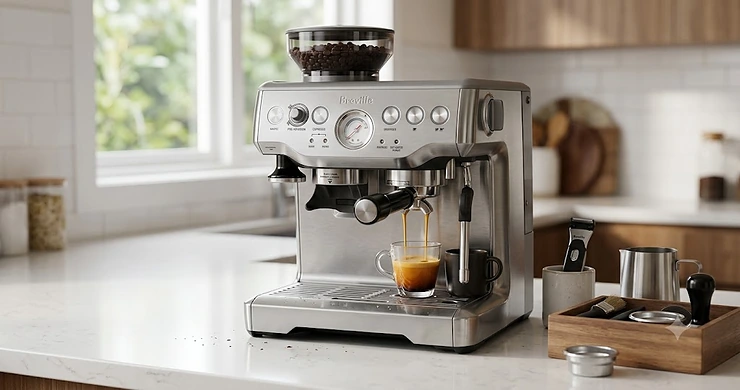
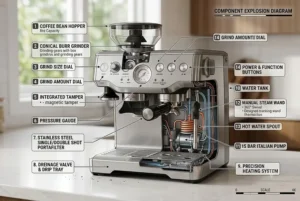
If you’ve priced out a daily latte habit lately, you already know why home espresso machines are having a moment. The breville barista express has been the default answer to “which one should I buy” for almost a decade, and it’s still one of the best-selling machines in its category on Amazon. It bundles a conical burr grinder, a 15-bar pump, and a manual steam wand into one countertop unit, so you can go from whole beans to a finished espresso in under a minute.
But “popular” and “right for you” aren’t the same thing. The Barista Express has a real learning curve, it isn’t the only all-in-one option at its price, and a couple of its closest competitors will outperform it on a specific feature you might care about more than convenience. This guide breaks down where it earns its reputation, where it doesn’t, and which six alternatives are worth cross-shopping before you commit $500-$700 to a coffee maker.
We’ll cover dose control grinding, how the Barista Express stacks up against the Barista Pro, and what current owners actually say after a few months of daily use — not just the spec sheet.
Quick Comparison Table
| Machine | Grinder | Price Range | Best For |
|---|---|---|---|
| Breville Barista Express | Built-in conical burr | $500-$690 range | First-time buyers who want one box that does everything |
| Breville Barista Pro | Built-in conical burr | $580-$680 range | Anyone who hates waiting — 3-second heat-up |
| Breville Bambino Plus | Built-in conical burr | $400-$500 range | Small kitchens, tight counters |
| De’Longhi La Specialista Arte Evo | Built-in conical burr | $400-$700 range | Buyers who also want cold brew on demand |
| Gaggia Classic Pro | None (BYO grinder) | $450-$500 range | Manual-control enthusiasts on a budget |
| Rancilio Silvia | None (BYO grinder) | $700-$900 range | Steam power and durability over convenience |
| Casabrews 5700GenSE / 5700 Pro | Built-in conical burr | Under $300 range | Budget-conscious beginners |
Looking at the table, the real fork in the road isn’t Breville vs. everyone else — it’s grinder-included vs. bring-your-own-grinder. The Gaggia and the Silvia cost less (or comparably) up front, but you have to add $100-$150 for a decent burr grinder, which puts their real-world cost closer to the Breville and De’Longhi machines. If counter space and simplicity matter more to you than ultimate shot quality, the all-in-one machines win; if you’re chasing café-level extraction and don’t mind two appliances instead of one, the Gaggia or Silvia plus a separate grinder is the stronger long-term setup.
💬 Just one click — help others make better buying decisions too!😊
✨ Don’t Miss These Exclusive Deals!
🔍 Take your home coffee setup to the next level with the machines below. Click through to check current pricing and availability before you decide — espresso machine prices move around a lot during sales events. ☕
Top 7 Espresso Machines: How They Compare to the Barista Express
1. Breville Barista Express (BES870XL)
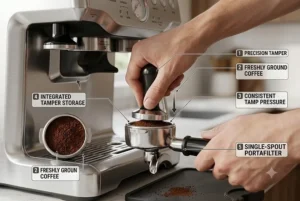
The original all-in-one that built Breville’s reputation in this category, and the machine most people mean when they search “espresso machine with grinder.” Its standout feature is dose control grinding: the integrated conical burr grinder grinds directly into the portafilter, so there’s no separate grinder cluttering your counter and no guessing on dose.
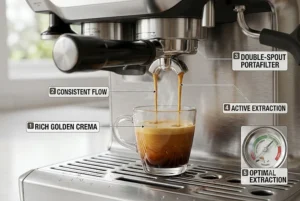
The 15-bar pump and low-pressure pre-infusion step gradually ramp up pressure at the start of the shot, which — in practice — means a more even extraction and less of the harsh, sour pulls beginners often get on cheaper pump machines. The PID temperature control keeps water at a stable temperature across the shot, which matters more than people expect; temperature swings are one of the most common causes of inconsistent espresso.
Owner feedback on Amazon is consistently strong on flavor and ease of upgrade-from-drip, with the most common complaints centered on the learning curve for dialing in grind size and the cleaning routine. This isn’t a machine you can ignore for two weeks; the grinder and group head both need regular attention.
Pros: Built-in grinder removes a whole separate purchase; strong pre-infusion for balanced shots; large community of tutorials and mods online.
Cons: Steeper learning curve than fully automatic machines; plastic-heavy build compared to the Gaggia or Silvia.
Price & verdict: Around $500-$690 depending on sales. Still the benchmark for “one box, does it all” — just budget time to learn it.
2. Breville Barista Pro (BES878BSS)
The Barista Pro is the Barista Express’s faster sibling. The headline upgrade is the ThermoJet heating system, which gets to brew temperature in about 3 seconds instead of the roughly 30-60 seconds the Express’s thermocoil needs. If you make more than one drink in a morning, or someone in the house wants a quick espresso before work, that difference adds up fast.
It also swaps the Express’s analog dial for a digital LCD interface that walks you through grinding and extraction in real time, which is genuinely useful for beginners trying to learn what “pre-infusion” or “extraction” actually looks like as it’s happening. Functionally, the grinder, portafilter size (54mm), and steam wand are very similar to the Express.
This is the one to research carefully if you’re choosing between breville barista express vs barista pro: the Pro costs more, but the speed and interface upgrades are real, not just marketing.
Pros: Dramatically faster heat-up; clearer digital interface for beginners; same proven grind-and-brew formula.
Cons: Roughly $80-$150 more than the Express; ThermoJet has a smaller, more vocal repair community than the Express’s older thermocoil design.
Price & verdict: Around $580-$680 range. Worth the upgrade if speed and a guided interface matter to you.
3. Breville Bambino Plus (BES500BSS)
The Bambino Plus is Breville’s answer to “I don’t have counter space for a Barista Express.” It’s noticeably smaller, but it keeps the 54mm portafilter, dose-control grinding, and the same fast ThermoJet heating from the Barista Pro — at a meaningfully lower price.
The trade-off is the steam wand: it’s automatic rather than fully manual, which is more convenient for cappuccino/latte drinkers who don’t want to learn hand-texturing, but offers less control for anyone trying to do serious latte art. The 1/2-lb bean hopper and smaller water tank mean more frequent refilling if you’re brewing multiple drinks back to back.
Pros: Same fast heat-up as the Pro at a lower cost; genuinely compact footprint; automatic milk texturing is easy for beginners.
Cons: Less manual control over milk texture; smaller hopper and tank mean more frequent refills.
Price & verdict: Around $400-$500 range. The best pick here if kitchen space or budget is the deciding factor.
4. De’Longhi La Specialista Arte Evo (EC9255M)
De’Longhi’s direct competitor to the Barista line adds one feature none of the Breville machines have: built-in cold brew, using De’Longhi’s own cold-extraction process that produces a cold brew in under five minutes instead of the usual 12-24 hour steep.
It also has a visible pressure gauge on the front panel — something the Barista Express only shows via app or not at all — which gives you live feedback on whether your grind is too fine (over-pressurized) or too coarse (under-pressurized) as the shot pulls. The grinder offers 8 settings, fewer than Breville’s, which limits how finely you can dial in unusual beans.
Pros: Only machine on this list with built-in cold brew; visible pressure gauge aids dialing-in; compact, retro-styled body.
Cons: Fewer grind settings than Breville’s machines; smaller bean hopper (about 8.8 oz) than the Barista Express.
Price & verdict: Around $400-$700 range depending on the model and sale timing. The pick if cold brew matters to your daily routine.
5. Gaggia Classic Pro
The Gaggia Classic Pro takes a completely different approach: no built-in grinder at all. What you get instead is genuinely commercial-grade hardware — a 58mm portafilter (the same size used on actual café equipment), a solid brass boiler and group head, and a 3-way solenoid valve that gives you a dry, clean puck after every shot instead of a soggy mess.
Because it skips the grinder, you’ll need to budget separately for one — a Baratza Encore or similar runs $100-$150 — which puts the real total cost closer to $550-$650. In exchange, you get access to the entire aftermarket world of precision baskets (VST, IMS) and bottomless portafilters that the proprietary 51mm/54mm baskets on all-in-one machines can’t use.
Pros: Commercial 58mm portafilter compatible with precision aftermarket baskets; brass boiler for thermal stability; large modding community.
Cons: No grinder, so add $100+ to the real cost; single boiler means waiting between brewing and steaming.
Price & verdict: Around $450-$500 range for the machine alone. Best for buyers who already own (or plan to buy) a separate burr grinder and want manual control.
6. Rancilio Silvia
The Silvia has been in continuous production since the late 1990s, and it’s the machine most often cited by enthusiasts as the entry point into “serious” home espresso. Like the Gaggia, it skips the grinder entirely and focuses on commercial-grade components: an iron frame, stainless panels, a large single brass boiler, and an articulating steam wand that consistently gets praised for steam power well beyond what you’d expect from a single-boiler design.
It’s also the most expensive machine on this list, and the price gap over the Gaggia is hard to justify on pure shot quality alone — most of what you’re paying for is build quality and steaming performance for milk drinks. The newer Silvia Pro X adds dual boilers and a digital display, but at a price that moves it into prosumer territory entirely.
Pros: Exceptional steam power for a single boiler; built to last decades with basic maintenance; huge online support community.
ons: No grinder; significantly pricier than the Gaggia for a similar core experience; heavy (around 16+ lbs).
Price & verdict: Around $700-$900 range for the standard Silvia. Choose this over the Gaggia if milk-based drinks are your main use case and you want maximum durability.
7.Casabrews 5700GenSE / 5700 Pro
If everything above feels like more machine — and more money — than you need, the Casabrews lineup is the budget all-in-one option, undercutting the Barista Express by hundreds of dollars while still including a conical burr grinder, a 58mm portafilter, and a milk frother steam wand.
It won’t match the Breville machines on build quality or grind consistency — reviewers consistently note the steam wand and grinder are noticeably less refined — but for someone deciding whether they even like making espresso at home before investing $500+, it removes a lot of the financial risk.
Pros: Built-in grinder and steam wand at well under half the Barista Express’s price; large water tank reduces refills; LCD display on some models.
Cons: Grind consistency and steam power trail the Breville and Gaggia machines noticeably; shorter track record than the established brands here.
Price & verdict: Under $300 range. The right call for testing the waters before committing to a pricier machine.
Practical Usage Guide: Getting the Most From Your First Month
Whichever machine you land on, the first 30 days determine whether you stick with home espresso or give up and go back to drip coffee. A few things make the biggest difference:
Use fresh, whole beans, and grind right before brewing. Pre-ground coffee starts losing aromatic compounds within minutes. If you’re not buying a machine with a built-in grinder, this step alone is worth more than any other upgrade.
Don’t skip the descale schedule. Every machine on this list needs descaling every 1-3 months depending on your water hardness — skipping it is the single most common cause of slow extraction and pump failure down the line. Most manufacturers, including Breville, sell their own descaling solution, but a basic citric-acid solution works on nearly all of them.
Dial in your grind before blaming the machine. The most common first-month frustration is a sour, fast shot or a bitter, slow one — almost always a grind-size problem, not a machine problem. Adjust in small increments and re-test rather than swinging the dial wildly.
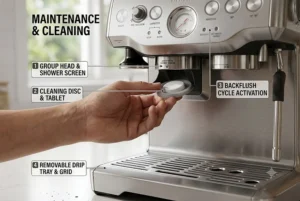
Backflush portafilter-based machines weekly. On the Gaggia, Silvia, and the Breville machines, a weekly backflush with water (or a cleaning tablet) keeps oils from building up in the group head, which otherwise turns into stale, muddy-tasting shots over a few weeks.
Buyer’s Decision Framework
Rather than scrolling back through all seven, use this quick filter:
- If you’ve never used an espresso machine before → choose Breville Barista Express or Casabrews 5700GenSE, since both walk you through the process with guided feedback.
- If you make multiple drinks every morning → choose Breville Barista Pro or Bambino Plus for the fast ThermoJet heat-up.
- If you want maximum shot quality and don’t mind a second appliance → choose Gaggia Classic Pro or Rancilio Silvia with a separate grinder.
- If milk drinks (lattes, cappuccinos) are your main use case → choose Rancilio Silvia for steam power, or Bambino Plus for hands-free convenience.
- If you’re not sure you’ll stick with it → choose Casabrews and reassess in six months.
Breville Barista Express vs. Barista Pro: Which Should You Actually Buy
This is the single most-searched comparison in this category, and the honest answer is: it depends on how much you value speed. Both machines share the same grinder, the same 54mm portafilter, and a nearly identical pre-infusion process, so shot quality at the cup is closer than the price difference might suggest.
The Pro’s real advantage is the ThermoJet heating system, which gets to brew temperature in seconds rather than closer to a minute. If you’re making one drink and have time to wait, that difference barely matters. If you’re making espresso for two people before work, it’s the difference between everyone having coffee or one person waiting around.
The Pro’s digital LCD interface is also a genuine beginner advantage — it shows you grinding and extraction progress in a way the Express’s analog controls don’t. If you’re brand-new to espresso and want visual feedback while you learn, that’s worth factoring in alongside the price gap.
Common Mistakes When Buying a Semi-Automatic Espresso Machine
Buying based on price alone, then needing a grinder anyway. The Gaggia and Silvia look cheaper on paper than the Breville machines, but once you add a $100-$150 grinder, the total cost is often similar or higher.
Ignoring portafilter size. A 58mm commercial portafilter (Gaggia, Silvia) opens up a huge aftermarket of precision baskets; the proprietary 51mm/54mm baskets on all-in-one machines limit your upgrade path.
Skipping descaling until something breaks. This is the most preventable and most common cause of early pump or boiler failure across every brand on this list.
Underestimating counter space and clearance. Several of these machines need a few extra inches above the unit to fill the water tank or bean hopper from the top — measure your cabinet clearance before ordering, not after.
Long-Term Cost & Maintenance
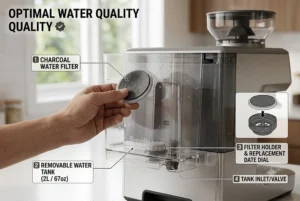
Sticker price is only part of the equation. Across a 3-5 year ownership window, expect to also budget for: descaling solution (roughly $10-$15 every couple of months), occasional gasket and seal replacements on the group head (cheap parts, but routine on Gaggia/Silvia-style machines), and a water filter if your machine uses one, like the Barista Express’s standard cartridge.
Grinder-included machines (Breville, De’Longhi, Casabrews) save you the upfront cost of a separate grinder, but when that built-in grinder eventually needs service or replacement, it usually means sending in the whole machine. Separate-grinder setups (Gaggia, Silvia) let you replace or upgrade the grinder independently, which can extend the useful life of your overall setup.
Conical Burr Grinders vs. Other Grind Methods
A quick note on terminology you’ll see throughout these listings: a conical burr grinder uses two cone-shaped, ridged burrs to crush beans into a uniform particle size, which is what produces consistent espresso extraction. This is different from a blade grinder, which chops beans unevenly and is not suitable for espresso — a distinction worth knowing if you’re cross-shopping cheaper machines that advertise “built-in grinder” without specifying the type. You can read more about how burr grinding affects extraction on Wikipedia’s espresso entry.
FAQ
❓ Is the breville barista express worth it in 2026?
❓ Breville Barista Express vs Barista Pro — what's the real difference?
❓ How is the breville barista express grinder quality compared to a standalone grinder?
❓ What does dose control grinding actually mean?
❓ Do I need a separate grinder with a conical burr grinder machine like this one?
Conclusion
The breville barista express earns its reputation honestly: it’s still one of the most complete all-in-one espresso setups under $700, and for a first machine, the integrated dose-control grinder removes a real barrier to entry. But “best-seller” doesn’t mean “only good option.” If speed matters more than price, the Barista Pro is worth the upgrade. If your counter is small, the Bambino Plus gets you almost the same experience in a smaller footprint. And if you’re chasing genuinely better shot quality and don’t mind owning two appliances instead of one, the Gaggia Classic Pro or Rancilio Silvia paired with a dedicated grinder will outperform any all-in-one machine on this list.
There’s no universally “best” choice here — only the best match for your kitchen, your budget, and how much you want to learn. Whichever you land on, the difference between a mediocre shot and a great one usually comes down to fresh beans, a dialed-in grind, and a little patience in the first few weeks.
✨ Don’t Miss These Exclusive Deals!
🔍 Ready to upgrade your morning coffee? Check current pricing on the machines above — espresso machine deals shift often around major sales events, so it’s worth comparing before you buy. ☕
Recommended for You
- Best Espresso Machine Under 500: 7 Tested Picks for 2026
- Breville Bambino vs Gaggia Classic Pro: 7 Picks for 2026
- Breville Bambino Review 2026: Is It Worth It? 7 Picks Compared
Disclaimer: This article contains affiliate links. As an Amazon Associate, I earn from qualifying purchases. If you purchase products through these links, we may earn a small commission at no additional cost to you.
✨ Found this helpful? Share it with your friends! 💬🤗
