In This Article
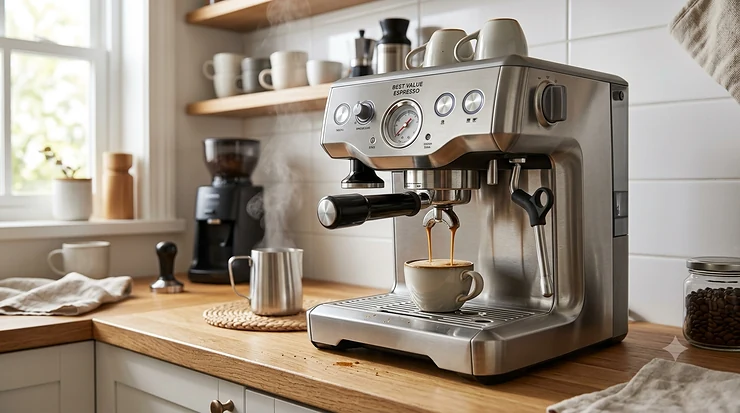
A genuinely good espresso machine under 500 used to be a contradiction in terms. Either you paid four figures for commercial-grade gear, or you settled for a pressurized-basket gadget that produced something closer to strong coffee with foam on top. That gap has closed dramatically. Today’s $150–$500 bracket is where pump-driven, 9-bar-capable machines actually live, and the difference between a $150 pick and a $450 pick isn’t “real espresso vs. fake espresso” anymore — it’s convenience, consistency, and how much hands-on control you want.
I’ve spent the past several weeks digging through specs, owner reviews, and teardown notes on the most relevant machines currently sold on Amazon to build this guide. The goal isn’t to crown one “best” machine and call it a day — it’s to match real buyer situations (small kitchen, big family, manual-control hobbyist, total beginner) to the machine that actually fits. By the end, you’ll know exactly which espresso machine under 500 deserves your counter space, and why the others on this list might serve a different kind of coffee drinker better.
One quick definition before we dive in: an espresso machine under 500 is any pump-driven home brewer, priced below $500, capable of generating roughly 9 bars of brewing pressure through a tamped coffee puck — the baseline needed to pull a real shot with crema, rather than a watered-down approximation.
Quick Comparison Table: Best Espresso Machines Under $500
| Machine | Type | Price Range | Best For |
|---|---|---|---|
| Breville Bambino Plus | Semi-automatic | $400–$450 range | Beginners who want speed + auto milk |
| Gaggia Classic Evo Pro | Semi-automatic, manual steam | $400–$460 range | Hands-on hobbyists, long-term upgraders |
| Flair 58 | Manual lever | $420–$460 range | Espresso purists, no-electricity setups |
| De’Longhi Dedica Maestro Plus | Semi-automatic, auto steam | $300–$400 range | One-touch lattes in a tiny footprint |
| De’Longhi Dedica Deluxe | Semi-automatic, manual steam | $250–$300 range | Small kitchens, first espresso machine |
| CASABREWS CM5418 | Semi-automatic | $140–$170 range | Tightest budgets, dorms, small offices |
| De’Longhi Stilosa | Semi-automatic, manual steam | $140–$150 range | Absolute entry point, learning the craft |
Looking at the table, the real split isn’t “good vs. bad” — it’s automation versus control. The Bambino Plus and Dedica Maestro Plus trade some hands-on involvement for speed and consistency, which suits people who just want a great shot every morning without fiddling. The Gaggia and the Flair 58 ask more of you upfront but reward that effort with more nuanced flavor and a machine you can realistically use for a decade or more. Budget buyers shouldn’t assume the CASABREWS or Stilosa are “lesser” espresso — they hit the same 9-bar baseline — they just trim the steam control and build materials to hit their price point.
💬 Just one click — help others make better buying decisions too!😊
Top 7 Espresso Machines Under $500 — Expert Analysis
1. Breville Bambino Plus — Best Overall
The Breville Bambino Plus stands out immediately for its ThermoJet heating system, which gets the boiler to brewing temperature in about 3 seconds — most thermoblock machines in this range need 30–60 seconds. In practice, that means you’re not standing around waiting before your first cup, which matters more than spec sheets suggest once you’re making espresso on a weekday morning deadline. The 54mm portafilter handles an 18g dose, which is large enough for a properly balanced double shot rather than the underdosed pucks smaller portafilters force on you.
What most buyers overlook about this model is the automatic milk texturing. You’re not just getting steam — the Bambino Plus reads and adjusts texture and temperature on its own, which removes the single hardest skill in home espresso (steaming milk by feel) from the equation entirely.
Owner feedback consistently praises the compact 7.7-inch footprint and the speed, with some noting the steam wand isn’t quite as powerful as Breville’s pricier machines.
✅ Fast heat-up, automatic milk texturing, compact size
❌ Single boiler (can’t brew and steam simultaneously), smaller water tank than rivals
Best for: Beginners and busy mornings who want café-quality results without learning steam-wand technique. Price sits around $400–$450, and at that range it’s hard to beat for pure convenience.
2. Gaggia Classic Evo Pro — Best for Manual Control
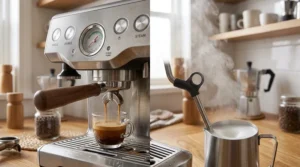
The Gaggia Classic Evo Pro is the machine I’d point a serious hobbyist toward. Its 58mm commercial-style portafilter is the same size used on actual café equipment, which means you can use standard baskets, tampers, and bottomless portafilters from the broader espresso accessory market — something the smaller 51–54mm machines on this list can’t do.
In my experience, what separates this machine from cheaper steel-bodied competitors is the all-brass boiler and updated scale-resistant internals. The 9-bar OPV (over-pressure valve) is correctly tuned out of the box, unlike some budget machines that run pump pressure straight through to the puck and over-extract.
Customer feedback frequently mentions this machine lasting 10+ years with basic maintenance, and a strong community of upgraders who add PID kits and bottomless portafilters down the line.
✅ Commercial 58mm portafilter, durable brass internals, huge upgrade/mod ecosystem
❌ Fully manual steam wand (learning curve), no auto-shutoff
Best for: Anyone who wants to actually learn espresso — dialing in grind, tamping technique, manual steaming — on a machine built to outlast several apartments. Typically priced in the $400–$460 range.
3. Flair 58 — Best Manual Lever
The Flair 58 throws out electricity altogether. This is a fully manual, lever-operated press where you control pressure with your own arm, ramping from a gentle pre-infusion up to roughly 9 bars and tapering off at the end — a pressure profile that costs thousands of dollars to automate electronically.
The spec sheet won’t tell you this, but the shot quality ceiling here is arguably the highest on this entire list; espresso forums regularly rank Flair output above machines costing twice as much. The tradeoff is workflow: a single shot takes 3–5 minutes including heating water separately, and there’s no steam wand, so milk drinks require a separate frother.
✅ Industry-leading shot quality and pressure control, no power outlet needed, portable
❌ Slow (3–5 min per shot), no built-in steam wand, requires a separate quality grinder
Best for: People who treat espresso as a deliberate ritual rather than a grab-and-go habit. If that description excites rather than exhausts you, nothing else under $500 matches it. Price typically lands around $420–$460 for the base unit.
4. De’Longhi Dedica Maestro Plus — Best for One-Touch Milk Drinks
The De’Longhi Dedica Maestro Plus solves the exact problem that scares most beginners away from milk-based drinks: steaming technique. Its Auto LatteArt wand reads milk temperature and automatically produces microfoam at one of three preset textures, so a cappuccino or latte takes the same effort as pressing a button.
What most buyers overlook here is the 3-temperature brew control, letting you match water temperature to roast level (lower for dark roasts, higher for light) — a feature usually reserved for machines twice this price.
Reviewers note the unit runs a bit louder than older Dedica models and lacks a hot water spout, but consistently praise the automatic frothing as genuinely accurate rather than gimmicky.
✅ Automatic milk texturing with 3 settings, compact 7.5-inch width, adjustable brew temp
❌ No hot water outlet, louder operation than competitors
Best for: Latte and cappuccino drinkers in small kitchens who want espresso-bar results without developing barista skills. Expect to pay in the $300–$400 range.
5. De’Longhi Dedica Deluxe — Best Entry-Level Pick
The De’Longhi Dedica Deluxe is, at just 6 inches wide, the slimmest machine on this list — genuinely useful if your counter space is tight. The Thermoblock heating system gets you brewing in under a minute, and the adjustable frothing wand lets you dial foam density up or down depending on whether you’re making a dry cappuccino or a silky latte.
What stands out in practice is the pressurized basket system: it’s nearly impossible to pull a truly bad shot here, even with pre-ground coffee, which matters enormously for someone who hasn’t bought a grinder yet.
Owners frequently mention the fast heat-up and easy cleanup, with the main complaint being the smaller water tank requiring more frequent refills during multi-cup mornings.
✅ Slimmest profile available, foolproof pressurized baskets, fast heat-up
❌ Smaller 35oz water tank, fully manual steam wand
Best for: First-time espresso buyers who want a forgiving on-ramp before upgrading their technique. Typically priced around $250–$300.
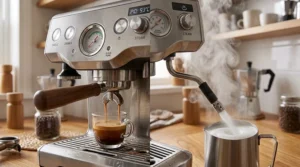
6. CASABREWS CM5418 — Best Budget Pick With a Pressure Gauge
The CASABREWS CM5418 punches well above its price tag thanks to a real-time pressure gauge — a feature you’d normally need to spend $300+ to get. That gauge gives you visual feedback while dialing in grind and tamp pressure, something most sub-$200 machines skip entirely.
In practice, the 20-bar pump (which, like every machine here, still extracts at roughly 9 bars during brewing) combined with a 34oz removable tank makes this a genuinely usable daily driver, not just a toy. The steam wand handles basic microfoam competently, even if it lacks the refinement of pricier wands.
Reviewers describe it as one of the best-selling semi-automatic machines on Amazon, with most complaints centered on the lightweight portafilter and a tendency to need a cooldown period between back-to-back steaming uses.
✅ Built-in pressure gauge, large 34oz tank, genuinely low price
❌ Lightweight build quality, needs cooldown time between steam uses
Best for: Tight budgets, dorm rooms, or a backup office machine where you still want real feedback while learning. Usually available in the $140–$170 range.
7. De’Longhi Stilosa — Best True Entry Point
The De’Longhi Stilosa is the cheapest machine here that still clears the “real espresso” bar. Its stainless-steel boiler (rare at this price point, where plastic boilers are common) and proper 15-bar pump mean you’re not just making strong coffee — you’re pulling genuine, crema-topped shots once you dial in grind and dose.
What the spec sheet doesn’t capture is how the constant pump hum (versus the pulsing knock of cheaper thermoblock units) signals a steadier, more consistent extraction — a small but telling detail for anyone comparing budget machines side by side.
Reviewers are candid about the plastic build and a tamper that doesn’t fit the portafilter particularly well, but nearly everyone agrees the shot quality outperforms the price.
✅ True 15-bar pump performance, steel boiler, lowest price on this list
❌ Plastic body feels fragile, accessories (tamper, milk jug) need upgrading immediately
Best for: Anyone testing whether they actually enjoy the espresso hobby before investing more. Typically priced around $140–$150.
Full Specs Comparison Table
| Machine | Portafilter | Heating | Steam Wand | Boiler Material |
|---|---|---|---|---|
| Breville Bambino Plus | 54mm | ThermoJet (3 sec) | Automatic | Thermocoil |
| Gaggia Classic Evo Pro | 58mm | Boiler | Manual | Brass |
| Flair 58 | 58mm | N/A (manual lever) | None | N/A |
| Dedica Maestro Plus | ~51mm | Thermoblock | Automatic | Thermoblock |
| Dedica Deluxe | ~51mm | Thermoblock | Manual, adjustable | Thermoblock |
| CASABREWS CM5418 | 51mm | Thermoblock | Manual | Thermoblock |
| De’Longhi Stilosa | 51mm | Thermoblock | Manual | Stainless steel |
The portafilter size tells you more than most buyers realize: the 58mm machines (Gaggia, Flair) tap into the broader commercial accessory market, so replacement baskets, bottomless portafilters, and tampers are easy to find for years. The 51–54mm machines trade that flexibility for a smaller, more counter-friendly footprint. On boiler material, brass and stainless steel resist mineral scale longer than standard thermoblocks, which is one reason the Gaggia and Stilosa tend to get reported lifespans in the 10+ year range despite sitting at opposite price extremes.
✨ Don’t Miss These Exclusive Deals!
🔍 Take your home café setup to the next level with these carefully selected machines. Click on any highlighted item to check current pricing and availability. These picks will help you create authentic espresso-bar drinks your family will love!
Benefits vs. Traditional Coffee Shop Visits
| Factor | Espresso Machine Under $500 | Daily Coffee Shop |
|---|---|---|
| Cost per drink | $0.40–$0.70 (beans + milk) | $4–$7 |
| Time per drink | 2–5 minutes | 10–20 min round trip |
| Customization | Full control over roast, dose, milk | Limited to menu options |
| Annual cost (1 drink/day) | ~$150–$550 total (machine + supplies, year one) | $1,460–$2,555 |
A $15-a-week latte habit adds up to roughly $780 a year, and a daily $5 trip easily clears $1,800 — numbers that track closely with the household coffee-spending patterns the National Coffee Association tracks each year. Run those numbers against any machine on this list, and even the priciest pick — the Gaggia Classic Evo Pro at roughly $450 — pays for itself well before the six-month mark for a regular drinker. The catch is that the machine alone doesn’t guarantee café-quality results; pairing it with a decent burr grinder (a separate $100–$200 investment for most of these machines) matters as much as the machine itself, which we’ll cover in the maintenance section below.
How to Choose the Right Espresso Machine Under $500
- Decide how hands-on you want to be. If you want zero learning curve, prioritize automatic steam wands (Bambino Plus, Dedica Maestro Plus). If you want to develop real skill, choose manual steam (Gaggia, Stilosa, Dedica Deluxe) or go fully manual (Flair 58).
- Check your counter space first. Widths range from 6 inches (Dedica Deluxe) to roughly 8 inches (Bambino Plus) — measure before you fall in love with a machine that won’t fit.
- Budget for a burr grinder separately. None of these machines include one; pre-ground coffee will noticeably underperform freshly ground beans on every single pick here.
- Match portafilter size to your future plans. If you might upgrade accessories later, a 58mm machine (Gaggia, Flair) gives you access to a much wider accessory market than 51mm machines.
- Consider boiler material for longevity. Brass and stainless steel resist scale better than standard thermoblock plastic-and-metal hybrids, generally translating into a longer working lifespan.
- Decide if milk drinks matter daily. If lattes and cappuccinos are a daily habit, automatic steam wands save real time over the course of a year.
- Read the warranty terms. Coverage on this list ranges from 1 to 2 years — factor repair costs into your decision if you tend to keep appliances a decade or longer.
Getting Started: A Practical Usage Guide for New Owners
Your first 30 days with any espresso machine under 500 matter more than the machine itself for how good your coffee tastes. Start with a medium-fine grind setting and adjust in small increments — going too fine too fast causes bitter, over-extracted shots that taste nothing like the smooth crema you’re after.
Run a water-only cycle through the machine before your first real shot to clear manufacturing residue, and don’t skip the included instruction booklet’s first-use steps, even if you’ve owned a machine before — every brand handles priming slightly differently.
Descale on schedule (roughly every 2–3 months with regular use, sooner with hard water) rather than waiting for a warning light. Mineral buildup is the single most common cause of early machine failure across every price tier, and it’s entirely preventable maintenance.
Finally, resist the urge to judge the machine on day one. Dialing in grind size, dose, and tamp pressure typically takes a solid week of daily practice before shots start tasting consistently good — that learning curve is normal, not a sign you bought the wrong machine.
Real-World Scenarios: Matching the Machine to Your Life
The busy commuter: Someone making one drink before work, every weekday, with zero patience for fiddly technique should look at the Breville Bambino Plus. The 3-second heat-up and automatic milk texturing mean you’re not sacrificing five extra minutes you don’t have.
The weekend hobbyist: If espresso is a Saturday-morning ritual rather than a daily grind, the Gaggia Classic Evo Pro or Flair 58 make more sense. Both reward the slower, more involved process with noticeably better flavor control, and neither punishes you for taking your time since you’re not racing a work clock.
The small-kitchen renter: Counter space is the real constraint here, not budget. The De’Longhi Dedica Deluxe’s 6-inch width wins this scenario outright, even though the Dedica Maestro Plus offers more automation if you can spare an extra inch or two.
The first-time buyer testing the waters: If you’re not sure espresso is even your thing yet, the De’Longhi Stilosa or CASABREWS CM5418 let you find out for under $170 — a sensible way to avoid buyer’s remorse on a $450 machine you might not stick with.
Common Mistakes When Buying an Espresso Machine Under $500
The most frequent mistake is buying the machine and skipping the grinder. Pre-ground coffee, no matter how fresh-tasting on the shelf, loses the aromatic oils that make espresso worth drinking within days of grinding — every machine here will underperform badly on pre-ground beans compared to freshly ground.
A second common error is fixating on “bar” ratings as a quality signal. A 20-bar pump (like the CASABREWS) isn’t twice as good as a 15-bar pump (like the Stilosa) — both still extract espresso at roughly 9 bars; the higher number just reflects the pump’s maximum capacity, not the brewing pressure that hits your puck.
Buyers also frequently underestimate steam wand importance if they drink milk-based coffee daily, then get frustrated within weeks when manual steaming proves harder than expected. If lattes are a daily habit, prioritize automatic steam wands from day one rather than assuming you’ll “figure it out.”
Semi-Automatic vs. Manual Lever: Which Fits Your Workflow
Semi-automatic machines like the Bambino Plus, Gaggia, and both Dedica models handle heating and pressure generation electronically — you control dose, grind, and (on manual-wand models) steaming, but the pump does the heavy lifting. This suits anyone who wants real espresso without becoming a full-time hobbyist.
The Flair 58 flips that entirely: you generate every bit of pressure yourself, with a lever and your own arm strength, guided by a built-in pressure gauge. The payoff is unmatched control over the extraction curve — slow pre-infusion, controlled ramp-up, gentle taper — the kind of pressure profiling that costs thousands on electric machines. The cost is time and effort per cup, plus no steam wand for milk drinks. Neither approach is objectively better; they serve genuinely different relationships with the morning coffee ritual.
Features That Actually Matter (And Those That Don’t)
Matters: Boiler material and OPV tuning (determines longevity and shot consistency), portafilter size (determines accessory ecosystem), and steam wand type (determines your daily milk-drink workflow).
Doesn’t matter as much as marketing suggests: Bar ratings above 9 (anything past that is just headroom, not better espresso), digital displays (a basic pressure gauge tells you more useful information), and color options (purely cosmetic, though De’Longhi and CASABREWS both offer several if aesthetics matter to your kitchen).
A genuinely useful but often-overlooked feature is pre-infusion, present on the Bambino Plus and Flair 58, which gently wets the puck before full pressure hits — this reduces channeling (uneven water flow through the grounds) and produces a noticeably more balanced shot than machines that jump straight to full pressure. The Specialty Coffee Association lists slow, even extraction as a core brewing standard, and pre-infusion is one of the simplest ways a home machine can meet it.
Long-Term Cost & Maintenance: The Real ROI
Budget roughly $15–$25 a year for descaling solution, plus the cost of a separate grinder ($100–$200 for a capable entry-level burr grinder) as a near-mandatory companion purchase. Filter baskets and steam wand tips occasionally need replacement after a few years of heavy use, typically running $10–$30 per part.
The brass-boiler Gaggia and stainless-steel Stilosa tend to have the longest reported lifespans — multiple owners describe 10+ years of service with basic care — while thermoblock-based machines (Bambino Plus, both Dedica models, CASABREWS) generally last 5–8 years before thermoblock replacement becomes more economical than repair. Factor that difference into your total cost of ownership rather than just the sticker price.
What to Expect: Real-World Performance vs. Marketing Claims
The “15-bar” or “20-bar” figure printed on every box is the pump’s maximum capacity — actual brewing happens at roughly 9 bars regardless of which machine you buy. What separates a great shot from a mediocre one is temperature stability and even water distribution, not pump horsepower.
In daily use, expect your first two weeks to involve real trial and error: grind size that’s slightly too coarse produces a thin, sour shot; too fine produces a bitter, clogged one. Once you find the sweet spot for your specific bean and machine, that consistency holds remarkably well — most owners across this entire list report dialing in a “house setting” they barely adjust after the first month.
Espresso Machines Under $500 for Different Types of Buyers
Total beginners benefit most from the forgiving pressurized baskets on the Dedica Deluxe or Stilosa, which make a passable shot nearly foolproof even with technique mistakes. Intermediate users ready to develop real skill should look at the Gaggia Classic Evo Pro’s commercial-style 58mm system. Families who want quick milk drinks without a learning curve are best served by the Bambino Plus or Dedica Maestro Plus’s automatic steaming. And dedicated enthusiasts chasing maximum flavor nuance, regardless of speed, belong with the Flair 58’s manual lever control.
FAQ: Espresso Machines Under $500
❓ Can you get real espresso for under 500 dollars?
❓ Do I need a separate grinder for an espresso machine under 500?
❓ What is the difference between semi automatic espresso machine under 500 and manual lever models?
❓ Is a higher bar rating better for an espresso machine 300 to 500 dollar range?
❓ How long does a home espresso machine 500 dollars or under typically last?
Conclusion
The right espresso machine under 500 depends far more on your daily habits than on chasing the single “best” spec sheet. If mornings are rushed, the Breville Bambino Plus removes every point of friction between you and a good shot. If you want to actually learn the craft and own a machine for the next decade, the Gaggia Classic Evo Pro or Flair 58 reward that patience with genuinely excellent results. And if you’re still deciding whether home espresso is worth the investment at all, the De’Longhi Stilosa or CASABREWS CM5418 let you find out without much financial risk.
Whichever you choose, pair it with a decent grinder, give yourself a couple of weeks to dial in technique, and don’t judge the machine by your first shot — every option on this list is capable of café-quality espresso once you find its sweet spot.
Recommended for You
- Breville Bambino vs Gaggia Classic Pro: 7 Picks for 2026
- Breville Bambino Review 2026: Is It Worth It? 7 Picks Compared
- Best Beginner Espresso Machine: 7 Honest Picks for 2026
Disclaimer: This article contains affiliate links. As an Amazon Associate, I earn from qualifying purchases. If you purchase products through these links, we may earn a small commission at no additional cost to you.
✨ Found this helpful? Share it with your friends! 💬🤗
