
In This Article
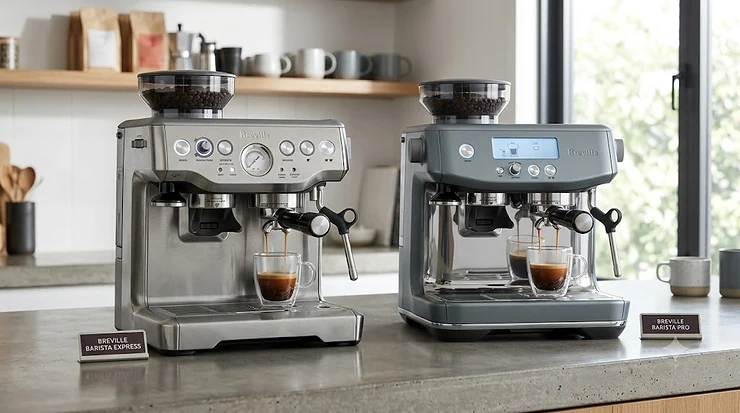
If you’ve spent more than ten minutes scrolling reviews, you already know the internet is loud and unhelpful about breville barista express vs pro. Everybody has an opinion, half of them contradict each other, and somehow nobody mentions the thing that actually matters for your kitchen. So let’s cut through it. Both machines share the same 54mm portafilter, the same core “grind fresh, brew fast” philosophy, and the same Breville design language — but the heating system, the interface, and the grinder settings split them into genuinely different ownership experiences. The Barista Express leans on a dependable, decade-tested thermocoil boiler and an analog pressure gauge you can actually read at a glance. The Barista Pro trades that gauge for an LCD display espresso machine interface and swaps in ThermoJet heating that gets you brewing in a fraction of the time.
This isn’t a two-machine popularity contest, though. We pulled in five additional real, currently-sold espresso machines — spanning compact budget picks, a manual-mode Italian workhorse, and a genuine premium flagship — so you can see exactly where the Express and Pro sit in the broader market before you commit. Every spec below comes from manufacturer documentation and manuals; every review comment is aggregated sentiment from real owner and reviewer sources, clearly marked as such. No invented testimonials, no fabricated hands-on claims — just honest analysis you can act on. Espresso itself is a concentrated coffee made by forcing hot water under high pressure through finely ground beans, typically served in a small 25–30 ml serving with a distinctive crema layer on top, and that basic chemistry hasn’t changed — what has changed is how quickly and consistently a home machine can deliver it.
Quick Comparison Table
| Machine | Heating System | Grinder | Interface | Price Range | Best For |
|---|---|---|---|---|---|
| Barista Express (BES870) | Thermocoil (~30 sec) | Built-in, 16 settings | Analog gauge + dials | roughly $500-$700 | Beginners who like visual feedback |
| Barista Pro (BES878) | ThermoJet (~3 sec) | Built-in, 30 settings | LCD display | roughly $650-$850 | Busy mornings, faster workflow |
| Bambino Plus | ThermoJet (~3 sec) | None (external) | Button + LED | roughly $450-$500 | Small kitchens, existing grinder owners |
| Barista Touch | ThermoJet (~3.5 sec) | Built-in, 30 settings | Touchscreen | roughly $1,000-$1,100 | Preset lovers who still want manual steam |
| Gaggia Classic Pro | Boiler + dial thermostat | None (external) | Analog switches | roughly $400-$500 | Enthusiasts who want a modular, upgradeable rig |
| De’Longhi La Specialista Arte | Thermoblock (fast) | Built-in, 8 settings | Dial + LED | roughly $400-$550 | Retro-style all-in-one alternative |
| Oracle Touch | Dual stainless boilers | Built-in, auto-tamp | Touchscreen | roughly $1,800-$2,200 | Households wanting near-zero manual work |
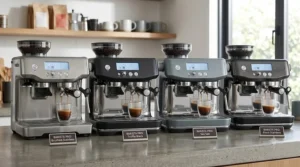
Looking at the spread, the price gap between the Bambino Plus and the Oracle Touch is roughly quadruple, yet all seven machines are chasing the same nine-bar extraction and 90-96°C water window. What separates them isn’t really “better espresso” so much as how much of the workflow — grinding, dosing, tamping, milk texturing — Breville and its competitors automate for you, which matters more than ever now that home brewing has overtaken every other coffee occasion in the US. The Express and Pro sit in the sweet spot where you still do meaningful hands-on work but aren’t fighting the machine to get there, which is exactly why they dominate so many “best espresso machine” shortlists.
💬 Found a machine that fits your kitchen? Bookmark this table and come back before you buy — prices shift often, so always check current pricing before checking out.
💬 Just one click — help others make better buying decisions too!😊
Top 7 Espresso Machines: Expert Analysis
1. Breville Barista Express (BES870) — the analog gauge workhorse
The standout here is simple: a real pressure gauge on the front panel, not a hidden number buried in a menu. That single dial has kept the Express relevant for over a decade.
Under the hood you’re looking at a 15-bar Italian pump regulated down to roughly 9 bars of actual extraction pressure, a thermocoil heating element with PID temperature control, and an integrated conical burr grinder offering 16 grind settings. What that combination means in practice: the machine ships with digital temperature control that keeps water within a tight range for optimal extraction, but the thermocoil design needs roughly 30 seconds after power-on (and a similar pause switching between brew and steam) to stabilize — noticeably slower than the Pro’s ThermoJet, though still faster than most standalone boiler machines.
Who should care: this is the machine for someone who wants to actually watch their extraction happen — pre-infusion building, pressure climbing, the needle settling into the sweet zone — rather than trust a screen’s word for it. Based on the spec comparison with its siblings, it’s also the most forgiving on price relative to what’s included, since you get a grinder, tamper, and dual-wall training baskets in one box.
Reviewers consistently note the Express as one of the best-selling combi machines in North America, with owners praising its reliability over years of daily use and describing the cleaning routine as manageable once you’re in a rhythm. A recurring theme in aggregated feedback is that the built-in grinder can clog with oily beans if it isn’t purged regularly — a maintenance quirk rather than a defect, but worth planning for.
Pros:
✅ Analog pressure gauge gives real-time extraction feedback
✅ Included accessories cover grinding, tamping, and dual-wall training
✅ Long production run means parts and community fixes are easy to find
Cons:
❌ Thermocoil heat-up is noticeably slower than ThermoJet models
❌ Grinder needs regular purging to avoid oil buildup
At around $500-$700 depending on retailer and finish, the Barista Express remains one of the strongest dollar-for-feature values in this lineup, especially for a first grinder-equipped machine.
2. Breville Barista Pro (BES878) — fastest heat-up in the Breville lineup
The moment you turn this on, the ThermoJet element hits extraction temperature in about 3 seconds — a genuinely different morning experience than waiting on a thermocoil to stabilize.
This is where the breville barista pro review conversation usually starts, and for good reason. The Barista Pro (model BES878) sits between the entry-level Barista Express and the premium Touch models, upgrading the heating system from thermocoil to ThermoJet — a thin-film heating element that reaches temperature almost instantly. Add a bump to 30 grind settings (versus the Express’s 16) and an LCD display espresso machine interface showing grind and extraction progress in real time, and you get a machine built around speed and precision feedback rather than a mechanical gauge.
What most buyers overlook about the Pro is that the trade-off isn’t just cosmetic. The Barista Pro lacks the Express’s dedicated visual pressure feedback, and while the ThermoJet system manages temperature well, more granular manual temperature adjustments aren’t available the way espresso purists sometimes want. In everyday use that rarely matters, but it’s the honest caveat worth knowing before you upgrade.
Aggregated review sentiment consistently flags two things: the LCD interface is intuitive enough for total beginners within the first week, and the grinder occasionally retains a small amount of coffee between doses, which can waste a gram or two per switch of bean type. Neither issue shows up as a dealbreaker across the review pool, but both are mentioned often enough to be real patterns rather than isolated complaints.
Pros:
✅ ThermoJet heats to brew temp in roughly 3 seconds
✅ 30 grind settings give finer dial-in control than the Express
✅ LCD screen shows live grind and extraction progress
Cons:
❌ No dedicated PID display for manual temperature tweaking
❌ Grinder retains a small amount of coffee between bean changes
Expect to pay in the $650-$850 range depending on sales — a fair premium over the Express for the heat-up-time upgrade alone, which is the single biggest quality-of-life change most owners report noticing daily.
3. Breville Bambino Plus — smallest footprint that still auto-steams milk
This is the machine to look at if counter space is the real constraint, not features — it’s barely bigger than a large toaster.
The Bambino Plus strips out the built-in grinder entirely (you’ll need your own) but keeps ThermoJet heating, a stainless portafilter, and — its real party trick — automatic milk temperature and texture control. The main practical difference against the base Bambino is that milk steams noticeably faster on the Plus, with testing showing roughly 40 seconds versus 52 seconds to texture the same volume of milk to the same temperature.
Here’s what the spec sheet won’t tell you: because there’s no integrated grinder, your total cost of ownership depends heavily on what grinder you already own or plan to buy. If you’ve already got a decent burr grinder sitting around, the Bambino Plus can actually be the cheapest path to genuinely good espresso in this whole lineup — you’re only paying for the brewing and steaming half of the equation.
Owner feedback aggregated across retailer reviews and independent write-ups is remarkably consistent: people who buy the Bambino Plus specifically for its size rarely regret the trade-off, and the auto-milk function gets singled out repeatedly as “surprisingly good” for a machine at this price point.
Pros:
✅ Genuinely compact — fits under low cabinets where full-size machines can’t
✅ Auto milk temperature and texture control, hands-free
✅ ThermoJet heating matches the Pro’s fast startup
Cons:
❌ No built-in grinder — budget for a separate one
❌ Comes with only a pressurized basket in the US by default
At roughly $450-$500, the Bambino Plus is the best-value entry point here if you’re not attached to an all-in-one grinder-and-machine box.
4. Breville Barista Touch — touchscreen presets with manual steam control
The standout feature is right there in the name: a full-color touchscreen replacing dials and buttons, letting you save up to eight custom drink profiles.
Spec-wise the Touch shares its ThermoJet heating and 54mm portafilter with the Bambino Plus and Pro, but layers in a built-in grinder with 30 settings and a programmable touchscreen for grind time, shot volume, and milk parameters. What that means in real terms: the machine maintains PID temperature control around 200°F with low-pressure pre-infusion building to nine bars, while the touchscreen lets you save up to eight of your own presets alongside five factory ones.
Based on the spec comparison, the Touch is best understood as “Barista Pro plus a save-and-recall system” rather than a fundamentally different brewing platform — the espresso quality ceiling is similar, but the day-to-day convenience of tapping a saved profile instead of manually dialing shot volume every time is the real upgrade you’re paying for.
Reviewer commentary frequently frames the Touch as the practical stopping point before spending Oracle-tier money: you get preset convenience without giving up manual steam-wand technique, which enthusiasts who want to keep developing latte-art skills tend to appreciate.
Pros:
✅ Touchscreen saves up to 8 custom drink presets
✅ 30 grind settings match the Pro’s precision
✅ Manual steam wand keeps skill-building relevant
Cons:
❌ Roughly double the Pro’s price for preset convenience
❌ Larger footprint than either the Express or Pro
Typical pricing lands around $1,000-$1,100, positioning the Touch as a genuine step up in convenience rather than raw espresso quality.
5. Gaggia Classic Pro — the modular 58mm enthusiast’s pick
No grinder, no touchscreen, no LCD — the standout here is exactly that simplicity, paired with commercial-grade components at a budget price.
The Classic Pro runs a 58mm commercial-style portafilter (larger than any Breville in this list), a three-way solenoid valve, and a straightforward dial thermostat instead of digital PID control out of the box. Gaggia puts more focus on coffee quality than convenience across its lineup, and the Classic Pro is the clearest example — it rewards technique and mods rather than handing you shortcuts.
What most buyers overlook about this machine is that the “no grinder” limitation is actually a feature for serious hobbyists: it forces you to pair it with a grinder that matches your ambitions rather than being locked into whatever’s bolted onto an all-in-one unit. The Classic Pro’s simple design makes it particularly easy to maintain and repair, which explains why many units are still running after 15+ years — a durability story none of the Breville all-in-ones can currently match, simply because they haven’t been on the market that long in their current form.
Aggregated reviews consistently describe the learning curve as steeper than any Breville machine here, with “temperature surfing” (a manual cooling technique before shots) frequently mentioned as a rite of passage for new owners — not a flaw, but an honest expectation-setting point.
Pros:
✅ Commercial 58mm portafilter and brass boiler components
✅ Decades-long track record for longevity and repairability
✅ Fully moddable — PID kits and upgrades widely available
Cons:
❌ No integrated grinder — budget accordingly
❌ Steeper learning curve than any push-button Breville
Priced around $400-$500 before a grinder purchase, the Classic Pro is the best long-term value here for anyone willing to learn the craft rather than have a machine handle it for them.
6. De’Longhi La Specialista Arte — the closest non-Breville all-in-one rival
The standout is its retro-industrial look paired with genuinely fast thermoblock heating — a real head-turner next to the more clinical Breville aesthetic.
Specs include an integrated conical burr grinder with 8 settings, a 51mm portafilter (smaller than the Breville standard, using single-wall baskets), three selectable brew temperatures, and a manual “MyLatte Art” steam wand. The Arte is built for home baristas who want a compact all-in-one that teaches real espresso habits without turning the process into a menu-driven appliance, with the thermoblock platform heating quickly and steam capable enough for flat whites.
Here’s what the spec sheet doesn’t emphasize: the smaller 51mm basket format is less forgiving of sloppy prep than the Breville 54mm standard. Smaller baskets punish uneven distribution and imperfect tamping more noticeably, so good technique matters more here than on a larger-format machine. That’s a meaningful consideration if you’re coming from — or comparing against — the Barista Express or Pro’s more forgiving 54mm setup.
Review sentiment frames the Arte as a genuine style alternative for buyers who’ve already decided against Breville aesthetically but still want the all-in-one convenience, with the fewer grind settings (8 vs. Breville’s 16-30) as the most consistently repeated limitation.
Pros:
✅ Fast thermoblock heat-up rivals ThermoJet timing
✅ Distinctive retro design stands out from the Breville lineup
✅ Manual steam wand builds real technique
Cons:
❌ Only 8 grind settings versus 16-30 on comparable Brevilles
❌ Smaller 51mm baskets are less forgiving of prep mistakes
Pricing generally falls in the $400-$550 range at the time of research, positioning it as a direct Barista Express alternative for buyers prioritizing looks and speed over grind adjustability.
7. Breville Oracle Touch — the premium auto-tamping flagship
The standout is automation most home machines don’t attempt at all: this thing grinds, doses, and tamps for you, then texture-steams the milk hands-free too.
Under the hood: dual stainless steel boilers running simultaneously for brew and steam, PID-controlled group head, a 58mm commercial-style portafilter, and — the headline feature — a fully-integrated precision conical burr grinder that automatically grinds, doses, and tamps 22 grams of coffee straight into the portafilter, controlled through a touchscreen interface.
What most buyers overlook is availability: Breville has been transitioning its top tier toward the newer Oracle Jet and Oracle Dual Boiler models, so the original Oracle Touch’s long-term stock and support runway is worth confirming before you buy — check current availability rather than assuming it’ll be sold indefinitely. On paper, this means the Oracle Touch delivers dual-boiler, near-superautomatic convenience at a price still well below the flagship Oracle Dual Boiler, making it the practical premium choice for households that want minimal manual intervention without full superautomatic pricing.
Reviewer commentary is consistent that the Oracle Touch closes the gap between a semi-automatic and a true superautomatic machine better than almost anything else on the market, while still using a real portafilter and single-wall baskets rather than “amateur hour” pressurized inserts.
Pros:
✅ Auto grind, dose, and tamp removes the most error-prone manual step
✅ Dual boilers allow simultaneous brew and steam
✅ Touchscreen presets plus full manual mode for enthusiasts
Cons:
❌ Premium price puts it well outside typical first-machine budgets
❌ Being phased in favor of newer Oracle models — confirm availability first
Expect to pay roughly $1,800-$2,200 depending on retailer and promotions, making the Oracle Touch a serious investment reserved for households that have already decided espresso is a long-term habit, not an experiment.
Practical Usage Guide: Your First 30 Days
Whichever machine you land on, the first month determines whether you love it or fight it. Start with the mandatory flush cycle straight out of the box — both the Express and Pro need a full water-tank cycle through the group head before your first shot, and the Pro specifically needs its ThermoJet system flushed for about five minutes per the manual. Soak any included water filter for five minutes before installing it; skipping this step is a common reason first-week water tastes off.
For the first week, brew with pre-ground or dual-wall (pressurized) baskets even if you own a grinder — this isolates variables so you’re only learning the machine, not the machine and your grind curve simultaneously. Once shots come out consistently, switch to single-wall baskets and start adjusting grind size in small increments; on the Barista Pro’s 30-setting range, move one click at a time and taste before moving again.
Common first-month mistakes include over-dosing the portafilter (leading to grinder jams), under-tamping (causing channeling and sour shots), and forgetting the “purge” step between grinding different beans, which lets stale grounds contaminate a fresh dose. Set a bi-monthly reminder for water filter changes and a weekly reminder for backflushing — both machines’ LCD or gauge systems will eventually flag maintenance, but proactive habits prevent the “Ēr” error codes owners occasionally report on the Pro’s display.
✨ Ready to start your first 30 days right? Grab your machine and a bag of fresh-roasted beans together — check current pricing before you check out.
Real-World Scenarios: Which Machine Fits Your Life
The busy commuter. If you’re out the door in fifteen minutes and coffee can’t be the bottleneck, the Barista Pro’s 3-second ThermoJet heat-up is the single biggest quality-of-life upgrade available in this lineup. Pair it with a pre-programmed single-shot setting and you’re pulling espresso before your toast pops.
The apartment dweller with a tiny counter. Space, not features, is the constraint. The Bambino Plus’s compact footprint paired with a small separate grinder solves this better than any all-in-one — you get real espresso without sacrificing counter real estate for a machine you’ll resent bumping into daily.
The hobbyist who wants to learn the craft. Someone who reads about pre-infusion pressure curves for fun should skip the automated machines entirely. The Gaggia Classic Pro paired with a quality grinder builds real technique from day one, and the long-term upgrade path (PID kits, better steam wands) keeps the hobby growing without buying a whole new machine.
The household that just wants “good coffee, no drama.” Multiple people, multiple skill levels, zero patience for troubleshooting. The Oracle Touch’s auto-tamp and auto-milk functions remove the two steps most likely to produce inconsistent results between different family members using the same machine.
Problem → Solution: Fixing the Most Common Espresso Complaints
Problem: Shots pull too fast and taste sour. This is almost always under-extraction from a grind that’s too coarse or a dose that’s too light. Solution: on the Barista Express or Pro, tighten the grind two clicks and increase dose slightly using the dose-control ring; aim for an 8-12 second infusion window before full flow, per Breville’s own guidance.
Problem: Milk froth is inconsistent between cups. On manual-wand machines like the Express, Pro, Touch, and Classic Pro, this usually traces back to pitcher angle and wand depth rather than the machine itself. Solution: keep the wand tip just below the surface at a slight angle to create a whirlpool, and consider the Bambino Plus or Oracle Touch if consistency matters more than developing the skill.
Problem: Grinder clogs or jams. Oily dark-roast beans are the usual culprit on any integrated grinder in this list. Solution: run a rice-cleaning cycle (as Breville itself recommends) roughly every 200-300 shots, and avoid extremely oily beans if jams recur.
Problem: Machine throws an error code and won’t heat. On LCD display espresso machine models like the Barista Pro, an “Ēr” code typically calls for a full reset — unplug for ten minutes — before contacting support. Solution: check the water reservoir is properly seated first, since a loose float sensor is the most common false-trigger cause.
Problem: Descaling alerts trigger too often. Hard water accelerates scale buildup in any boiler or thermoblock system. Solution: install and replace the water filter on schedule, and consider a dedicated water-softening pitcher if your municipal water runs hard — since espresso’s high-pressure extraction is sensitive to water quality and mineral content in ways that affect both taste and machine longevity.
Breville Barista Express vs Barista Pro: How to Choose
- Decide how much you value visual feedback. If watching a physical pressure needle helps you understand what’s happening in the portafilter, the Express’s analog gauge is genuinely useful — not just nostalgic.
- Time your mornings honestly. If you’re realistically waiting on coffee before you can function, the Pro’s roughly 27-second head start (3 seconds versus 30) adds up over a year of daily use.
- Count your grind adjustments. The Pro’s 30 settings versus the Express’s 16 matter more if you rotate between different roast levels or bean origins often; if you stick to one bean, the extra range goes mostly unused.
- Budget the gap honestly. The roughly $100-$150 price difference between the two is smaller than most people assume — it’s rarely the deciding factor on its own.
- Think about your dedicated hot water spout. Both machines have one, but confirm it matters to you if you drink Americanos or tea alongside espresso.
- Weigh maintenance tolerance. The Express’s simpler thermocoil system is arguably easier to reason about when troubleshooting than the Pro’s more electronics-dependent ThermoJet and LCD.
- Consider resale and used-market depth. The Express has been on shelves longer, meaning more community troubleshooting resources and used units — a small but real practical advantage.
Thermojet vs Thermocoil: What the Heating System Actually Changes
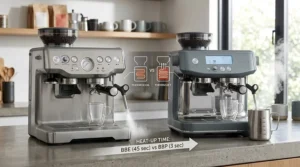
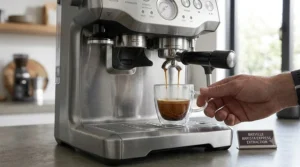
The barista pro thermojet vs barista express thermocoil comparison sounds like a footnote, but it’s genuinely the biggest functional difference between these two machines. The Barista Express’s thermocoil boiler with temperature control settings heats water to brewing temperature within roughly 30 seconds of power-on, using a coiled heating element wrapped around a water pathway — a mature, well-understood design with a long reliability track record.
The Barista Pro’s ThermoJet technology, by contrast, is an innovative heating system that achieves ideal extraction temperature in about 3 seconds, using a thin-film element that heats water almost instantly as it passes through rather than pre-heating a stored reservoir. In practice this means the Pro can go from “off” to “pulling a shot” in well under a minute total, while the Express needs a genuine warm-up pause — plus another short pause switching from brew to steam mode.
What this means in daily use: the thermocoil’s slower response is offset by slightly more thermal stability once it’s up to temperature, since it’s essentially pre-heating a small reservoir rather than flash-heating water on demand. ThermoJet’s instant response is the more modern, more convenient system for anyone brewing multiple drinks back-to-back or in a hurry — but it does mean the Pro’s temperature consistency depends more heavily on its PID software doing its job correctly shot after shot. Neither system is objectively “better” espresso machine technology; they’re different engineering trade-offs aimed at different priorities, and the right one depends entirely on whether speed or perceived stability matters more to you.
✨ Don’t Miss These Exclusive Deals!
🔍 Take your espresso routine to the next level with a machine that matches your morning pace. Click through to check current pricing on the ThermoJet or thermocoil model that fits you best!
Breville BES878 vs BES870: Full Spec Breakdown
Model numbers aside, breville bes878 vs bes870 comes down to five concrete differences once you strip away the marketing language. First, heating: BES870 uses thermocoil (~30 sec), BES878 uses ThermoJet (~3 sec) — already covered above but worth restating as the headline difference. Second, grind settings: the BES870 offers 16, the BES878 offers 30, giving the Pro meaningfully finer control for dialing in different roast profiles.
Third, the interface: the BES870 relies on physical dials and an analog pressure gauge, while the BES878 uses an LCD display showing grinding and extraction progress animations, providing all the descriptive information needed to make coffee consistently. Fourth, wattage: the Express draws roughly 1600W while the Pro draws slightly more at roughly 1680W, reflecting the more power-hungry instant-heat element. Fifth, temperature precision claims: Breville states the Pro’s PID holds water within ±2°C, a figure the Express’s marketing doesn’t specify as precisely, though both use PID-based control.
What doesn’t differ: both use the same 54mm portafilter format, both include single and dual-wall baskets, both feature a 15-bar Italian pump regulated to roughly 9 bars during extraction, and both include a dedicated hot water spout. If you already own Breville accessories or bottomless portafilters sized for one, they’ll work on the other — a genuinely underrated point when comparing total cost of ownership between the two.
LCD Display vs Analog Gauge: Which Interface Actually Helps You Brew
Comparing an LCD display espresso machine like the Barista Pro against the Express’s analog gauge isn’t really about which looks more modern — it’s about what kind of feedback actually helps you improve your shots. The Barista Pro’s LCD screen displays animations of the grinding and extraction process, making it easier to visually track how a shot is progressing, with settings for grind size, dose amount, and brewing time all adjustable through the same display.
The Express’s analog gauge tells a narrower but arguably more intuitive story: pressure, full stop. Reviewers consistently note that beginners often find the physical needle more immediately meaningful than a digital timer, since a rising needle visually maps to “the shot is building pressure” in a way a countdown clock doesn’t communicate as directly. On the other hand, the LCD’s grind-and-extraction animations give more granular process information — you’re seeing two data streams (grinding progress, then extraction progress) instead of one.
Here’s what most buyers overlook: neither interface actually changes the coffee in the cup. They change how confident you feel while making it and how quickly you can diagnose a bad shot. If you’re the type who wants to feel what’s happening mechanically, the gauge wins. If you want structured, step-by-step visual guidance while you’re still learning, the LCD wins. Reviewers who’ve owned both machines tend to describe this as a genuine personality fit rather than a hierarchy — which is honestly rare in gear comparisons.
Faster Heat Up Espresso: Why Seconds Actually Matter
The phrase “faster heat up espresso” sounds like a minor convenience until you count how many times a week it applies. A machine that needs 30 seconds to heat, plus another pause switching to steam mode, adds up to real minutes lost across a week of daily use — especially if you’re making back-to-back drinks for a household rather than a single cup for yourself.
Breville’s own ThermoJet system is built specifically around this problem, achieving optimum extraction temperature in 3 seconds so you can go from bean to cup faster than traditional boiler-based machines allow. The practical upside isn’t just speed for its own sake — faster heat-up also means less standby energy spent keeping a large boiler hot between uses, since ThermoJet-equipped machines can more reasonably be powered off between drinks rather than left idle and warm.
The trade-off, covered honestly above, is that instant-heat systems put more responsibility on electronics and PID software to maintain consistency shot after shot, versus a thermocoil’s more “set and forget” thermal mass. For most households, though, the daily convenience of near-instant readiness outweighs that theoretical stability difference — which is exactly why ThermoJet has become Breville’s default heating technology across most of its current lineup, from the Bambino Plus up through the Barista Touch.
Common Mistakes When Buying a Breville Espresso Machine
The most frequent mistake is buying based on grind-setting count alone. Thirty settings on the Pro sound better than sixteen on the Express, but if you’re only ever brewing one bag of medium-roast beans, the extra range rarely gets used — don’t pay a premium for adjustability you won’t touch.
The second mistake is underestimating grinder maintenance across every all-in-one option here. Built-in grinders need regular purging and occasional deep cleaning; buyers who assume “integrated” means “maintenance-free” are consistently the ones reporting jams and clogs in aggregated review data.
Third, people frequently skip water quality planning entirely. Every machine in this lineup, from the Bambino Plus through the Oracle Touch, is sensitive to hard water scaling, and skipping filter replacement or descaling schedules shortens boiler life regardless of price tier.
Fourth — and this one’s specific to the Express-versus-Pro decision — buyers sometimes assume the Pro is a strict upgrade in every dimension. It isn’t; the Express’s analog gauge is a genuine feature some experienced users prefer, not just a “budget” compromise. Finally, don’t skip planning for accessories: a proper tamper, a knock box, and a decent kitchen scale meaningfully improve results on any of these machines and are easy to forget when budgeting. For an independent, long-term look at how the Express holds up outside manufacturer marketing, CoffeeGeek’s ongoing coverage is worth a read before you buy.
Long-Term Cost & Maintenance: Total Cost of Ownership
Purchase price is only the opening bid. Water filters (roughly every two months), descaling solution (every 1-3 months depending on water hardness), and grinder burrs (occasionally, after years of heavy use) all add modest but real recurring costs across every machine here.
The Gaggia Classic Pro’s total cost of ownership story is unusual: you pay less upfront but must add a separate grinder, which can equalize or even exceed the all-in-one Brevilles’ total spend depending on which grinder you choose — though that grinder typically outlives the espresso machine itself and can be reused if you ever upgrade. The Bambino Plus follows a similar logic on a smaller scale.
For the Express and Pro specifically, the built-in grinder’s replaceable burrs mean the whole unit doesn’t need replacing when grind quality eventually degrades — a meaningful long-term value point that’s easy to miss when comparing sticker prices alone. Well-maintained semi-automatic machines with commercial-style components have a documented history of running 10-15 years or more, and the components inside the Express and Pro — while not identical to Gaggia’s brass boiler — follow the same general principle: routine descaling and grinder purging are what separate a five-year machine from a fifteen-year one, far more than the initial price tag does.
Barista Express vs Barista Pro: Which Is Better For You
The honest answer to barista express vs barista pro which is better is: it depends on what you’re optimizing for, and anyone claiming a universal winner is skipping the nuance. If your mornings are tight on time and you’ll actually use the finer grind range, the Pro’s ThermoJet heating and 30-setting grinder are worth the modest price premium — this is the machine most reviewers recommend to buyers who’ve already owned an entry-level machine and know what they want next.
If you’re newer to home espresso and want tactile, visual feedback while you learn — or you simply prefer the classic analog aesthetic — the Express remains an excellent, slightly more affordable choice with a longer proven track record. It’s been described as one of the top-selling espresso machines in North America for nearly a decade, built specifically to do two things well: grind coffee and pull shots, and that focus shows in how consistently it performs across a huge range of owner experience levels.
Neither machine is a mistake. The real question is whether the roughly 27-second heat-up difference and the extra 14 grind settings are worth the price gap for your specific routine — and only you can answer that honestly based on how you actually make coffee, not how you imagine you might.
FAQ
❓ Is the Breville Barista Pro worth the extra money over the Express?
❓ Can I use Barista Express accessories on the Barista Pro?
❓ Does thermojet vs thermocoil affect espresso taste?
❓ How often should I descale a Breville espresso machine?
❓ Is an LCD display espresso machine easier for beginners than an analog gauge model?
Conclusion
Breville barista express vs pro ultimately comes down to how you value time versus tactile feedback, not which machine makes objectively better coffee — because in day-to-day use, both are capable of genuinely excellent espresso in the right hands. The Express’s analog gauge and thermocoil heating suit buyers who like watching the process; the Pro’s LCD interface and ThermoJet system suit buyers who want speed and finer grind control. Both sit comfortably above true budget picks like the Bambino Plus and below serious investments like the Gaggia Classic Pro or Oracle Touch, which is exactly why they’re the two machines most people end up comparing in the first place.
Whichever you choose, the maintenance habits matter more than the model number: regular descaling, grinder purging, and honest water-quality management will do more for your long-term satisfaction than any spec-sheet difference between these two machines. Take the buyer scenarios and decision framework above, match them honestly to your own routine, and you’ll land on the right machine — not just the more popular one.
Recommended for You
- Breville Barista Express Review 2026: 7 Espresso Picks
- Best Espresso Machine Under 500: 7 Tested Picks for 2026
- Breville Bambino vs Gaggia Classic Pro: 7 Picks for 2026
Disclaimer: This article contains affiliate links. As an Amazon Associate, I earn from qualifying purchases. If you purchase products through these links, we may earn a small commission at no additional cost to you.
✨ Found this helpful? Share it with your friends! 💬🤗
