
In This Article
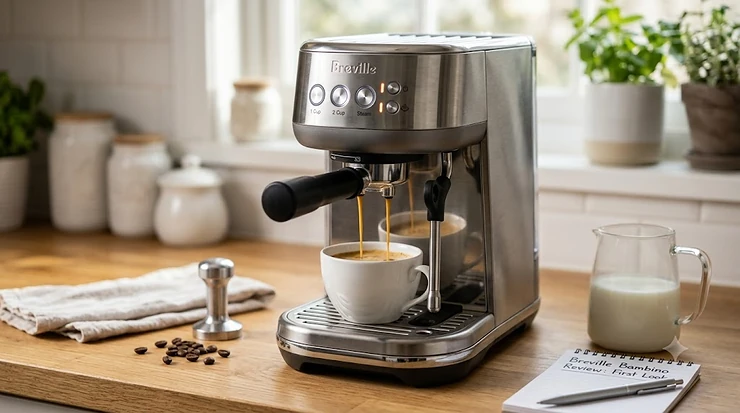
Here’s the thing nobody tells you before you buy your first “real” espresso machine: the gap between drinkable and genuinely good is razor thin, and it usually comes down to three seconds. That’s roughly how long the Breville Bambino takes to go from cold metal box to ready-to-pull-a-shot, thanks to its proprietary ThermoJet heating system that gets the machine ready to start in 3 seconds. No fifteen-minute warm-up ritual, no hovering by the kitchen counter wondering if today’s the day you finally make coffee shop espresso at home.
This breville bambino review exists because the compact espresso machine category has gotten crowded — and confusing. Everyone claims “barista quality.” Almost nobody tells you which machine actually earns that label at which price.
So here’s what this is, in plain terms: the Bambino is a 54mm-portafilter, ThermoJet-powered semi-automatic espresso machine built by Breville to squeeze café-style extraction into one of the smallest footprints on the market, using low pressure pre-infusion followed by high pressure 9 bar extraction. It’s the machine Breville built for people who want the real thing without the real-estate commitment.
Below, we’ll break down what the Bambino does well, where it falls short, how it compares to the step-up Bambino Plus, and how both stack up against five other genuinely available compact espresso machines — from a $100 entry-level option to a nearly $1,000 splurge. Real models, real specs, real (if occasionally annoying) trade-offs.
Quick Comparison Table
| Machine | Price Range | Heating | Milk System | Best For |
|---|---|---|---|---|
| Breville Bambino (BES450) | Around $300 or less | ThermoJet, ready in 3 sec | Manual steam wand | Overall compact pick |
| Breville Bambino Plus (BES500) | Around $500 | ThermoJet + auto-purge | Automatic steam wand | Hands-off milk drinks |
| De’Longhi Stilosa (EC260) | $100–$150 | Real stainless steel boiler | Manual panarello | Rock-bottom budget |
| De’Longhi Dedica (EC685) | $250–$300 | Thermoblock | 2-setting panarello | Tiniest kitchens |
| Gaggia Classic Pro / Evo Pro | $450–$500 | Single boiler, dual elements | Commercial steam wand | Tinkerers & upgraders |
| Breville Barista Express | $500–$700 (often discounted) | Thermocoil + PID | Manual steam wand | All-in-one with grinder |
| Rancilio Silvia | $900–$1,000 (US) | Single brass boiler | Articulating steam wand | Long-term splurge |
A few things jump out here. The Bambino and Bambino Plus sit almost exactly where the Gaggia Classic Pro does in price once you factor in sales, but they’re solving a different problem — speed and footprint instead of repairability and commercial-grade parts. Meanwhile, the Rancilio Silvia costs roughly $995 in the US due to import fees and tariffs, which is a brutal markup compared to its European pricing — worth knowing before you fall for the romance of a boiler machine. If your budget caps out under $200, the Stilosa and Dedica are really the only two honest contenders on this list.
💬 Just one click — help others make better buying decisions too! 😊
What Is the Breville Bambino?
The Breville Bambino is a compact, semi-automatic espresso machine that uses a 54mm portafilter and Breville’s ThermoJet heating system to deliver espresso-quality extraction — 9 bar pressure, low-pressure pre-infusion, and a powerful steam wand for microfoam — in roughly the time it takes to read this paragraph. It’s positioned as Breville’s entry point into “real” home espresso, sitting just below the auto-frothing Bambino Plus.
Top 7 Compact Espresso Machines — Expert Analysis
1. Breville Bambino (BES450)
The Breville Bambino is the machine this whole article is built around, and there’s a reason it keeps showing up on budget espresso shortlists years after launch. The headline feature is that ThermoJet heating system, which gets the machine ready in about 3 seconds — compare that to traditional boiler machines that need five to fifteen minutes, and you start to understand why this thing has a cult following among people who just want espresso before their first Zoom call.
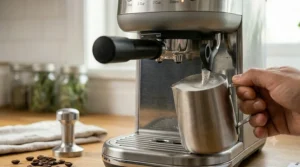
In practical terms, that speed doesn’t come at the cost of extraction quality. The Bambino still runs digital PID temperature control with low-pressure pre-infusion before a 9-bar extraction, which is the same fundamental recipe used in machines costing three times as much. What it skips is an automatic steam wand — unlike the Bambino Plus, the Bambino uses a classic one-hole manual steam wand, which means you’re learning to texture milk by feel, not by button press.
✅ Pros: Near-instant heat-up, genuine pre-infusion and PID control, tiny footprint
❌ Cons: No built-in grinder, manual-only steaming curve to learn
Use-case match: Solo drinkers and couples who want one good shot (or two) without dedicating counter real estate to it.
Price verdict: At around $300 or less — occasionally lower on sale, this is arguably the best dollar-for-dollar entry point into legitimate home espresso on this whole list.
2. Breville Bambino Plus (BES500)
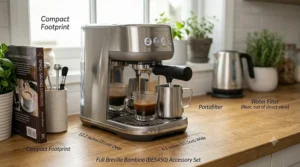
The Breville Bambino Plus is the Bambino’s older sibling, and the one upgrade matters more than people expect: milk. The Plus adds convenient one-touch volumetric control and an automatic steam wand that produces silky microfoam with up to a million micro bubbles per ml, plus an auto-purge system that resets the heating element after steaming so your next shot extracts at the right temperature.
What most buyers overlook here is that automating milk isn’t just convenience — it’s consistency. A manual wand rewards practice; an automatic one removes the variable entirely, which matters if cappuccinos are a daily habit rather than a weekend hobby. The trade-off, per reviewers comparing it against the Gaggia Classic Pro, is that the Bambino Plus automates temperature control and milk steaming, making it far easier for beginners — even though its thermocoil heating can’t match a true boiler’s steam recovery for back-to-back drinks.
✅ Pros: Automatic milk texturing, auto-purge heat system, longer 2-year warranty
❌ Cons: Roughly $200 more than the base Bambino, still no integrated grinder
Use-case match: Households making multiple milk-based drinks a day who don’t want to babysit a steam wand.
Price verdict: Priced around $499 — a fair jump from the base Bambino if milk drinks are your daily ritual.
3. De’Longhi Stilosa (EC260)
The De’Longhi Stilosa is the honest budget pick of this group, and it earns that spot by not pretending to be something it isn’t. It runs a 15-bar pump and a durable stainless steel boiler engineered for consistent performance, and at around $149 from Amazon US, it undercuts everything else here by a wide margin.
What most buyers overlook is that “real boiler” detail — a lot of sub-$150 machines fake their way through with a thermoblock, but the Stilosa’s actual boiler is part of why testers have managed to pull shots with an impressive 22.7% extraction yield from it after some tinkering. It won’t hand you café-quality espresso out of the box, but with a decent grinder, it gets surprisingly close.
✅ Pros: Lowest price on this list, real boiler (not just thermoblock), forgiving pressurized basket for beginners
❌ Cons: Plasticky build quality, slow recovery if you’re making several drinks back to back
Use-case match: First-time espresso buyers and budget-conscious households testing the waters before committing more money.
Price verdict: At around $100–$150 with a 4.4-star average across 1,200+ reviews, it’s the safest low-risk entry point on this list.
4. De’Longhi Dedica (EC685)
The De’Longhi Dedica wins the “fits literally anywhere” category. Its slim profile genuinely fits where wider machines don’t — useful if your counter is already crowded with an air fryer and a toaster you keep meaning to put away.
The catch: speed comes with compromise. All thermoblock machines in this price range, the Dedica included, don’t heat the brew group or portafilter, and it’s missing a 3-way solenoid valve to release pressure on the puck. In real terms, that means it’s not built for hosting — a single thermoblock machine like the Dedica will quickly be overwhelmed if you’re making drinks for a group. For one or two people on a weekday morning, though, it’s plenty.
✅ Pros: Slimmest footprint here, fast thermoblock heat-up, two-setting milk frother
❌ Cons: No 3-way solenoid valve, struggles with consecutive drinks
Use-case match: Apartment dwellers and tiny kitchens where every inch of counter space is contested territory.
Price verdict: North American pricing hovers around $250–$300, putting it right between the Stilosa and the Bambino.
5. Gaggia Classic Pro / Evo Pro
The Gaggia Classic Pro is the machine espresso hobbyists graduate into, not out of. Its commercial 58mm portafilter accepts standard professional parts — VST baskets, IMS screens, bottomless portafilters — future-proofing your whole setup in a way budget proprietary baskets never can.
The honest trade-off, according to long-term testing, is that the Classic Pro has the highest quality ceiling of any machine at its price point but also a greater tendency to channel than similarly priced machines, meaning proper puck prep matters more here than almost anywhere else on this list. It also ships with a comparatively underpowered stock steam wand, so milk drinks aren’t its strong suit out of the box.
✅ Pros: Commercial-grade 58mm accessory ecosystem, durable brass boiler, huge modding community
❌ Cons: Prone to channeling without technique, weak stock steam wand
Use-case match: Buyers who see espresso as a long-term hobby and don’t mind a learning curve in exchange for a machine that can be upgraded for a decade.
Price verdict: Typically listed around $449–$499 — and per Tom’s Guide’s comparison testing, it beats the similarly priced Bambino Plus on build quality but loses on ease of use for milk drinks.
6.Breville Barista Express
The Breville Barista Express solves a problem none of the machines above can: grinding. It promises café-quality espresso without needing a separate grinder, pairing dose-control grinding with PID-controlled extraction, and it’s backed by over 26,000 Amazon reviews averaging 4.5 stars.
What that integrated grinder actually means day to day: one machine, one workflow, no juggling a separate burr grinder on your counter. The honest caveat is that heavy commercial-style use of 8+ drinks daily will wear out the grinder and pump prematurely — it’s built for home volume, not café volume, and serious enthusiasts eventually find its grind range limiting.
✅ Pros: Built-in conical burr grinder, PID temperature control, proven reliability track record
❌ Cons: Bigger upfront cost, grinder isn’t best-in-class for light-roast purists
Use-case match: Anyone who doesn’t already own a grinder and wants one machine to handle the entire bean-to-cup process.
Price verdict: RRP sits near $700, but it’s frequently discounted to around $499.95–$549.95 around sales events — worth waiting for a deal.
7. Rancilio Silvia
The Rancilio Silvia is the splurge pick, and it splurges on exactly the right things. Its single boiler holds 0.3 liters — the largest volume capacity of any home machine in its class — paired with a patented ergonomic 58mm portafilter taken straight from Rancilio’s commercial line.
The real-world payoff is steam recovery and thermal stability that the thermoblock machines on this list simply can’t touch. The catch, as covered above, is US pricing — tariffs and import fees push it to roughly $995 stateside, a price that buys you a genuinely different machine in Europe for far less.
✅ Pros: Largest single-boiler capacity here, true commercial 58mm group head, two decades of parts availability
❌ Cons: Steep US price premium, can’t steam and brew simultaneously
Use-case match: Buyers who want a boiler machine for the long haul and have the budget to absorb the US import markup.
Price verdict: Expect to pay around $900–$1,000 — only worth it if you’re certain you want a boiler machine specifically.
How to Choose a Compact Espresso Machine
- Decide how much milk you actually drink. If lattes and cappuccinos are a daily habit, an automatic steam wand (Bambino Plus) earns its price premium fast. Straight-shot drinkers don’t need it.
- Check your countertop, not just the spec sheet. The Dedica’s slim profile only matters if your kitchen is genuinely tight — otherwise it’s a feature you’re paying for without using.
- Figure out if you already own a grinder. If not, the Barista Express’s built-in grinder often costs less than buying a separate quality grinder plus a budget machine.
- Ask whether you want to tinker. The Gaggia Classic Pro’s open accessory ecosystem rewards people who enjoy fiddling with baskets and pressure profiles; it punishes people who just want to push a button.
- Be honest about how many drinks you make back to back. Thermoblock and ThermoJet machines (Dedica, Bambino, Bambino Plus) excel at single drinks fast; true boiler machines (Silvia, Gaggia) recover steam power better for entertaining.
- Set your real budget — not your aspirational one. A $150 Stilosa paired with a $150 grinder will often beat a $1,000 machine paired with stale pre-ground coffee.
Breville Bambino vs Bambino Plus: What Actually Changes
This is the most-searched comparison on this whole list, so let’s settle it directly. Both machines share the same 54mm portafilter, 18–19g dose, and ThermoJet heating system. The differences are narrower than the price gap suggests.
The Bambino Plus adds automatic milk texturing and an auto-purge heat system, plus a longer warranty. The base Bambino claws back one feature the Plus doesn’t have: a dedicated hot water button for tea and Americanos. If you can already steam milk by feel, or you mostly drink straight espresso, that’s a real $200 you’re keeping in your pocket. If milk drinks are non-negotiable and you’d rather not practice your wand technique, the Plus pays for itself in reduced frustration alone.
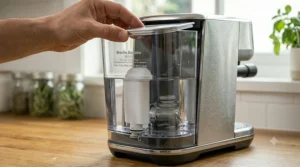
What to Expect: Real-World Performance
Specs are one thing; mornings are another. Here’s what the numbers above actually translate to in daily use.
ThermoJet heating system, in practice: The 3-second readiness claim isn’t marketing fluff — it’s the single biggest quality-of-life difference between this machine and a boiler-based competitor. You’re not planning your morning around a warm-up window; you press a button and the machine catches up to you.
Steam wand milk frothing, in practice: On the base Bambino, that’s a skill you build over the first couple of weeks — a classic one-hole steam wand that rewards repeatable technique rather than guesswork. On the Plus, that skill gets automated away entirely.
Breville Bambino espresso shots quality, in practice: Because the machine runs real low-pressure pre-infusion followed by a 9-bar extraction, shots come out closer to specialty-café territory than the price suggests — assuming you’re using a decent grinder and fresh beans. The machine won’t fix bad coffee; it just won’t get in the way of good coffee.
Setting Up and Living With the Bambino: A Practical Usage Guide
Getting the most out of any of these machines comes down to habits more than hardware. A few that actually move the needle:
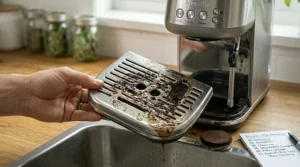
- Descale on a schedule, not a whim. Plan to descale every 3–6 months, sooner if you have hard water. Skipping this is the single most common reason these machines underperform after year one.
- Wipe down between uses. A microfiber cloth on the steel casing and a quick rinse of the portafilter basket after each shot keeps coffee oils from building up and turning bitter over time.
- Soak baskets weekly. A weekly soak in hot water (with a backflushing tablet if your machine supports it) clears oil residue that a quick rinse misses.
- Avoid pre-ground coffee past week one. It works, but it’s the fastest way to taste exactly how much a fresh grind matters.
- Don’t judge the machine on shot one. Dialing in grind size against a new bean takes a handful of attempts — that’s normal, not a defect.
For broader brewing fundamentals beyond espresso specifically, the National Coffee Association’s brewing guide is a solid, brand-neutral reference worth bookmarking.
Who Should Buy the Bambino (and Who Shouldn’t)
Buy the Bambino if: you want real espresso fast, you’re comfortable learning manual steam technique, and your counter space is at a premium.
Buy the Bambino Plus instead if: milk drinks are a daily habit and you’d rather pay for automation than practice.
Skip the whole Bambino line if: you’re hosting frequently and need to pull back-to-back milk drinks — that’s a job for a true boiler machine like the Gaggia Classic Pro or Rancilio Silvia.
Go cheaper (Stilosa or Dedica) if: you’re not yet sure home espresso is a habit you’ll keep, and you want to test that before spending $300+.
Go bigger (Barista Express) if: you don’t own a grinder yet and don’t want to buy two appliances when one will do.
Common Mistakes When Buying a Compact Espresso Machine
The most expensive mistake isn’t the machine — it’s everything around it. Buyers routinely pair a $500 machine with a $30 blade grinder, which caps shot quality far below what the machine is capable of. Spend on the grinder before you spend on the upgrade machine.
The second mistake is judging steam power from a spec sheet instead of a review. A machine with the highest quality ceiling on paper, like the Gaggia Classic Pro, can still ship with a genuinely weak stock steam wand — a detail that never shows up in a bullet-point feature list.
The third: assuming “compact” means “compromise.” Compact machines like the Bambino can still deliver third-wave specialty coffee quality — small footprint and serious extraction aren’t mutually exclusive anymore.
Long-Term Cost & Maintenance
Upfront price tells maybe half the story. A $150 Stilosa with no built-in grinder needs a separate grinder (budget another $100–$150) to hit its potential — pushing real cost closer to $300. A $700 Barista Express bundles that grinder in, which is why its effective cost-per-feature is closer than the sticker price suggests.
Maintenance costs skew differently too. The Gaggia Classic Pro’s brass boiler and commercial parts ecosystem mean repairs are realistic and affordable for the life of the machine. Thermocoil and ThermoJet machines like the Bambino line are cheaper to buy but, per industry commentary on heating systems in this price range, are less repairable than a comparable boiler design if the heating element eventually fails — a trade-off worth knowing before you buy, not after.
FAQ
❓ Is the Breville Bambino worth it in 2026?
❓ What is the difference between the Breville Bambino and Bambino Plus?
❓ How long does the Breville Bambino take to heat up?
❓ Does the Breville Bambino come with a built-in grinder?
❓ How much caffeine is in an espresso shot?
Conclusion
If this breville bambino review boils down to one sentence, it’s this: the Bambino earns its reputation by doing the unglamorous fundamentals — heat, pressure, pre-infusion — without making you wait or compromise on counter space. The Bambino Plus is the easy upgrade if milk drinks matter to you. Everything else on this list exists to answer a question the Bambino can’t: cheaper (Stilosa, Dedica), more serious (Gaggia Classic Pro, Rancilio Silvia), or more complete (Barista Express).
There’s no universally “best” machine here — just the one that matches how you actually drink coffee, not how you imagine you might.
✨ Don’t Miss These Exclusive Deals!
🔍 Take your morning coffee routine to the next level with these carefully selected espresso machines. Click on any highlighted pick above to check current pricing and availability. These machines will help you pull café-quality shots your whole household will love!
Recommended for You
- Breville Barista Express Review 2026: 7 Espresso Picks
- Best Espresso Machine Under 500: 7 Tested Picks for 2026
- Breville Bambino vs Gaggia Classic Pro: 7 Picks for 2026
Disclaimer: This article contains affiliate links. As an Amazon Associate, I earn from qualifying purchases. If you purchase products through these links, we may earn a small commission at no additional cost to you.
✨ Found this helpful? Share it with your friends! 💬🤗
