In This Article
There’s a specific kind of 11 p.m. spiral that happens right before you buy your first espresso machine. You open a browser tab. You close it. You open three more. Forty-five minutes later you’re reading a 4,000-word forum argument about portafilter diameters between two people who clearly hate each other, and you still don’t know whether you should spend $100 or $700. We’ve all been there, and the honest truth is that almost nobody needs to spend that long deciding.
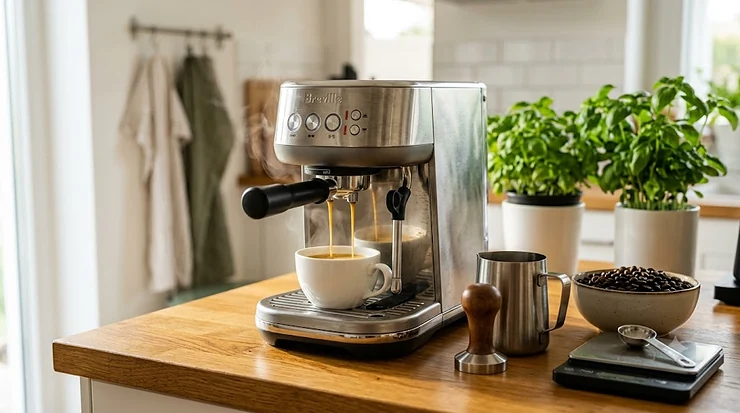
A beginner espresso machine is simply a home machine built to forgive the mistakes a first-timer is guaranteed to make — too-coarse grind, uneven tamp, a milk pitcher held at the wrong angle — while still pulling a real shot with actual pressure and actual crema, not the watery stuff a pod machine pretends is espresso. The good ones do this through pressurized baskets, automatic milk systems, or literal on-screen coaching. The bad ones just slap “espresso” on the box and hope you don’t know the difference.
Home espresso has quietly become a real habit and not just a pandemic hobby that fizzled out: espresso-based drinks now make up a sizable and growing share of how Americans drink coffee, with past-week espresso-based beverage consumption climbing several percentage points over just the last few years according to the National Coffee Association’s most recent data. That’s a lot of people deciding a $40 milk frother and a jar of instant aren’t cutting it anymore.
This guide skips the forum arguments. Below are seven machines that are actually for sale on Amazon today, spanning a $100 manual lever-and-knob setup to a $700 touchscreen that coaches you through every shot, with honest pros, cons, and who each one is actually for.
Quick Comparison: 7 Beginner Espresso Machines at a Glance
| Machine | Price Range | Built-In Grinder | Best For |
|---|---|---|---|
| De’Longhi Stilosa EC260BK | $100–$150 | No | Tightest budgets, dorms, “am I even into this” testers |
| Casabrews 5700Pro | $450–$600 | Yes | First-timers who want fresh-ground shots without a second gadget |
| Breville Bambino Plus | $400–$500 | No | Fastest heat-up and the most hands-off milk texturing here |
| Ninja Luxe Café Premier ES601 | $500–$600 | Yes | Beginners who want the machine to guess dose and grind for them |
| KitchenAid Semi-Automatic Espresso Machine KES6551 | $500–$700 | Yes | Buyers who want commercial-size parts and a gauge from day one |
| Gaggia Classic Pro E24 | $450–$500 | No | Anyone who already knows they’re going deep into this hobby |
| De’Longhi La Specialista Touch | $650–$750 | Yes | Guided learning at the high end — touchscreen hand-holding |
A pattern jumps out fast: grinders, not pump pressure, are what actually separate these price tiers. Every machine here brews real espresso, but the moment a built-in burr grinder enters the picture, the price jumps $300–$400, because you’re really buying two appliances welded into one. If you already own a decent grinder, the Bambino Plus or Gaggia Classic Pro stretch your budget the furthest. If you don’t, and don’t want to shop for one separately, the Casabrews or Ninja earn their higher price tags back in convenience.
✨ Quick tip: Tap any machine name above to check today’s price and availability on Amazon — listed prices shift weekly, so treat the ranges here as a guide, not gospel.
Just one click — help others make better buying decisions too! 😊
The 7 Best Beginner Espresso Machines You Can Buy Right Now
1. De’Longhi Stilosa EC260BK — Best Budget Pick
The De’Longhi Stilosa is the espresso equivalent of a learner’s permit: cheap, a little unglamorous, and genuinely enough to find out if you actually like this hobby before you commit real money to it.
Under the hood it’s a 15-bar pump pushing water through a pressurized filter basket, which is the part that matters most for a true beginner. A pressurized basket compresses the puck internally, which means even a sloppy tamp or a too-coarse grind still produces a believable shot with real crema on top — most higher-end machines skip this safety net entirely and just give you a thin, sour shot if your technique is off. The Stilosa pairs that basket with a genuine stainless steel boiler rather than the bare aluminum some rivals use at this price, so it holds temperature more consistently shot to shot.
What reviewers consistently flag, and what we’d echo, is that the plastic portafilter handle and bundled tamper feel like an afterthought — most owners replace the stock tamper with a $10–$15 metal one almost immediately. The fixed basket is also genuinely small, which caps how big a double shot can get before things turn bitter.
✅ Pros: rock-bottom price, real steel boiler, forgiving pressurized basket, weighs under 10 lbs
❌ Cons: flimsy stock tamper and portafilter, small basket limits dose size, manual steam wand takes practice
Who it’s for: anyone who wants the cheapest possible honest answer to “do I actually like making espresso,” plus dorm rooms, RVs, and tiny kitchens where a 7-inch-wide footprint matters.
Price verdict: at $100–$150, this is one of the only real espresso machines — not a pod system — you can buy for less than a nice pair of running shoes.
2. Casabrews 5700Pro — Best Budget Pick With a Built-In Grinder
If the Stilosa is the learner’s permit, the Casabrews 5700Pro is the car you actually want to keep driving after you pass the test. It bundles a 15-setting conical burr grinder, a 20-bar Italian pump, and PID temperature control into one stainless-steel unit, which means you’re skipping the “now I need a separate grinder” tax that hits almost everyone six months into this hobby.
The LCD display does real work here: it shows a live shot timer and grind animation, which matters more than it sounds, because extraction time is one of the few numbers that tells a beginner whether they’re over- or under-extracting without needing a $200 refractometer to find out. The 91-ounce water tank is enormous for this price tier, too — you’ll go days between refills instead of topping off every morning.
The honest trade-off: this machine is loud. Reviewers consistently measure it around 65 dB while brewing and 75–80 dB while steaming, which is genuinely louder than most machines twice its price. There’s also a real learning curve to dialing in the grinder’s 15 settings, and a small minority of buyers report grinder reliability issues, so it’s worth registering the warranty the day it arrives.
✅ Pros: built-in grinder removes a whole shopping trip, huge water tank, shot timer takes the guesswork out of extraction
❌ Cons: noticeably loud, learning curve on the grinder dial, occasional QC complaints
Who it’s for: beginners who’ve decided they want fresh-ground espresso from day one and don’t want grinder-shopping to be a second research project.
Price verdict: list price sits around $500–$600, but it’s rarely sold at that number — manufacturer coupons regularly knock it into the $400s, so it’s worth checking the current price before assuming it’s out of budget.
3. Breville Bambino Plus — Best for Fast, Hands-Off Mornings
The Breville Bambino Plus solves a problem most beginner machines don’t even acknowledge: the first two weeks of espresso ownership are mostly spent waiting. Breville’s ThermoJet system gets this machine from cold to brewing temperature in about three seconds, which sounds like a marketing number until you’ve actually stood in front of a different machine for ten minutes waiting for a single boiler to heat.
The bigger beginner win is the automatic steam wand. You pick one of three milk temperatures and three texture levels, drop the wand in your pitcher, and walk away — the machine handles the part that takes most home baristas months to get good at by hand. Combined with a 54mm portafilter dosed at 18–19 grams and a 7.7-inch-wide footprint, this is the easiest path in this whole list to a genuinely good latte with almost zero manual milk-steaming skill required.
What it doesn’t have is a grinder, so budget for one separately — pairing it with a sub-$100 blade grinder will bottleneck everything else it does well. The three-way solenoid valve that keeps your portafilter dry after each shot also dumps that water straight into a small drip tray, so expect to empty it more often than you’d like.
✅ Pros: 3-second heat-up, genuinely hands-free milk texturing, tiny footprint, simple one-button workflow
❌ Cons: no grinder included, small drip tray fills up fast, steam wand is automatic-only (no manual override on this model)
Who it’s for: anyone whose main goal is café-quality lattes and cappuccinos with the least possible daily fuss, and who already owns — or will buy — a real burr grinder.
Price verdict: typically $400–$500, occasionally dipping toward $399 during sales.
4. Ninja Luxe Café Premier ES601 — Easiest Espresso Machine to Use at Home
If you’ve ever wished an espresso machine could just tell you what to do, the Ninja Luxe Café Premier is the closest thing on this list to that fantasy. Its Barista Assist Technology recommends a grind setting for your chosen brew style, then uses a built-in scale to weigh out the exact dose — no eyeballing, no kitchen scale purchase required, no guessing whether 18 grams “looks right” in the basket.
That built-in scale is genuinely the standout feature here, because dosing inconsistency is one of the most common reasons a beginner’s shots taste different every single day. The 25-setting conical burr grinder and Dual Froth System (hands-free hot or cold microfoam, four presets) round out a machine that also brews drip coffee and real cold brew, not just espresso, which matters if other people in your house aren’t espresso converts yet.
The catch on the U.S. model: there’s no dedicated hot water spout, so making an Americano means running a separate kettle or pulling extra blank shots to dilute — a strange omission on an otherwise thoughtfully engineered machine. It also uses proprietary, non-pressurized baskets, which is great for real extraction but means you can’t swap in third-party baskets later if you want to upgrade.
✅ Pros: built-in scale eliminates the #1 beginner dosing mistake, grind recommendations take the guesswork out, also makes drip coffee and cold brew
❌ Cons: no hot water spout on the U.S. model, proprietary baskets limit future upgrades, runs loud during grinding
Who it’s for: true first-timers who want the machine to actively coach the early decisions instead of leaving them to trial and error.
Price verdict: launched around $499 and commonly lists in the $500–$600 range depending on retailer and finish.
5. KitchenAid Semi-Automatic Espresso Machine with Burr Grinder (KES6551) — Best for Commercial-Grade Parts Early
The KitchenAid Semi-Automatic Espresso Machine takes a different approach to beginner-friendliness: instead of automating decisions for you, it hands you commercial-spec hardware and a pressure gauge so you can actually see what’s happening during extraction. The 58mm flat-base portafilter is the same diameter used in real café equipment, which means if you eventually want to upgrade to precision baskets or a bottomless portafilter, this machine can already take them — no need to replace the whole setup later.
Dual smart temperature sensors and a thermocoil heater that’s ready in under a minute address the other classic beginner frustration: waiting around. The built-in burr grinder uses Smart Dosing Technology to produce a consistent volume at the push of a button, and the pressure gauge — visibly marked for the ideal espresso range — gives visual feedback that pairs nicely with a beginner barista course or YouTube tutorial.
It’s a genuinely heavy machine at roughly 25 pounds, and the grind-adjustment lever runs coarse-to-fine in a direction some new owners initially find counterintuitive. There’s no touchscreen guidance here, either — if you want hand-holding rather than hardware, the Ninja or the La Specialista Touch will feel friendlier.
✅ Pros: real 58mm commercial portafilter with upgrade headroom, visible pressure gauge for learning, fast thermocoil heat-up
❌ Cons: heavy and bulky for small kitchens, grind-lever orientation takes adjustment, no app or screen guidance
Who it’s for: beginners who’d rather learn on equipment they won’t outgrow than on a machine engineered to need less skill.
Price verdict: prices vary unusually widely by retailer and finish — expect $500 on the low end and up to $700 depending on color and seller.
6. Gaggia Classic Pro E24 — Best for Beginners Who Already Know They’re All In
Most “beginner” machines are built to be outgrown. The Gaggia Classic Pro is built on the assumption that you won’t outgrow it for a decade, which makes it an unusual but genuinely smart pick for a specific kind of first-time buyer. Inside is a 58mm commercial portafilter and group head, a 9-bar OPV, a brass boiler on the current E24 version, and a three-way solenoid valve that vents pressure after each shot for a drier, cleaner puck — all components lifted straight from Gaggia’s commercial lineage rather than scaled down for the home market.
The honest reason this belongs on a beginner list at all: it’s one of the most heavily documented machines in the hobby. Decades of forum threads, mod guides, and YouTube walkthroughs on sites like Home-Barista mean that whatever question you hit in month one, someone has already answered it in detail. That community support meaningfully lowers the real-world learning curve even though the machine itself asks more of you than an automated competitor.
What it doesn’t do is automate anything. There’s no grinder, no PID temperature display out of the box (it’s a common and well-documented aftermarket add), and a single boiler that means you’ll wait between pulling a shot and steaming milk, or learn the “temperature surfing” technique experienced owners use to manage it.
✅ Pros: genuine commercial parts at a fraction of commercial prices, enormous mod and support community, durable enough to last decades
❌ Cons: no grinder included, single boiler means waiting between espresso and steaming, steepest learning curve on this list
Who it’s for: beginners who’ve done enough research to know they want to go deep into the craft, and would rather invest in gear they’ll never need to replace.
Price verdict: consistently $450–$500 on Amazon — notably, almost the same price as several fully-automated machines on this list, just with very different priorities.
7. De’Longhi La Specialista Touch — Best Guided Experience at the High End
The De’Longhi La Specialista Touch is what happens when a manufacturer tries to put an actual barista trainer inside the machine. Its 3.5-inch touchscreen and Bean Adapt system walk you through setting grind size, dose, pre-infusion, and brewing temperature for whatever beans you’re using, complete with visual feedback if your shot ran too fast or too slow — genuinely closer to interactive coaching than anything else in this price range.
Underneath that screen is a 15-setting conical burr grinder, PID temperature control holding steady 9-bar extraction, and an automatic milk frother with five froth levels and four temperature settings across dairy and plant-based milk. A built-in cold brew mode and ten saved drink presets round out a machine clearly designed for someone who wants café variety without juggling separate gadgets. It also won the 2025 Red Dot and iF Design Awards, which, fair or not, shows in how compact and considered the whole unit feels on a counter.
The trade-offs are mostly about budget and materials: this is the priciest machine in the lineup, and despite the brushed-metal accents, the chassis is mostly lightweight plastic rather than the all-steel build of the Gaggia or KitchenAid. The grinder hopper is also on the smaller side compared to some rivals in this price bracket.
✅ Pros: genuinely interactive coaching through the touchscreen, automatic frother with real range, cold brew mode included
❌ Cons: highest price here, mostly plastic body despite steel accents, smaller bean hopper than some competitors
Who it’s for: beginners with a flexible budget who want to feel guided rather than thrown in, especially anyone intimidated by dialing in grind settings from scratch.
Price verdict: U.S. listings on Amazon have generally run $650–$750, though pricing has shifted by region and bundle — always worth a quick price check before buying.
Detailed Spec Comparison
| Machine | Pressure | Portafilter | Grinder | Milk System | Price Range |
|---|---|---|---|---|---|
| Stilosa EC260BK | 15 bar | 51mm, pressurized | None | Manual wand | $100–$150 |
| Casabrews 5700Pro | 20 bar | 58mm | Built-in, 15 settings | Manual wand | $450–$600 |
| Bambino Plus | 9 bar extraction | 54mm | None | Automatic, 3 temp/3 texture | $400–$500 |
| Ninja Luxe Café Premier | Proprietary | Proprietary, non-pressurized | Built-in, 25 settings | Automatic Dual Froth | $500–$600 |
| KitchenAid KES6551 | 15 bar | 58mm, flat-base | Built-in, adjustable | Manual multi-angle wand | $500–$700 |
| Gaggia Classic Pro E24 | 9 bar OPV | 58mm commercial | None | Manual commercial wand | $450–$500 |
| La Specialista Touch | 9 bar (PID) | Proprietary | Built-in, 15 settings | Automatic, 5 froth levels | $650–$750 |
The number that actually predicts your day-to-day happiness here isn’t bar pressure — every machine above 9 bar is already past the threshold real espresso needs, so a “20-bar” spec is mostly a marketing flex, not a quality signal. What predicts happiness is whether the portafilter size locks you into proprietary parts (Ninja, La Specialista Touch) or opens the door to the wider 58mm aftermarket (Casabrews, KitchenAid, Gaggia). If you think you’ll want VST baskets or a bottomless portafilter down the line, that single column matters more than anything else in this table.
✨ Found a few that fit your budget? Tap the name to check today’s price on Amazon before the list price changes again.
How to Choose the Right Beginner Espresso Machine
A beginner espresso machine is best chosen by working backward from how much manual control you actually want, not by chasing the highest bar-pressure number on the box. Here’s the short version, then the reasoning behind each step.
- Decide if you want a built-in grinder. Pre-ground coffee staling within days is the single biggest quality killer in home espresso — if you’re not ready to shop for a separate grinder, pay the premium for one built in.
- Set a real budget, not an aspirational one. A $150 manual machine used daily beats a $700 machine that intimidates you into using a Keurig instead. The Specialty Coffee Association maintains formal testing standards for both home grinders and semi-automatic machines — useful context for what separates a toy from a real tool at any price.
- Check the portafilter size. A 58mm commercial-style basket (Casabrews, KitchenAid, Gaggia) keeps an upgrade path open; proprietary baskets (Ninja, La Specialista Touch) trade that flexibility for an easier out-of-box experience.
- Weigh automation against learning. Automatic steam wands and touchscreen guidance shorten the learning curve dramatically but can make you a passenger in your own hobby — decide which feeling you actually want each morning.
- Look at footprint before features. A 7-inch-wide Bambino Plus fits where a 13-inch KitchenAid won’t; measure your counter before falling for a spec sheet.
- Factor in noise. Several machines on this list run loud while grinding or steaming — a real consideration if you’re brewing before anyone else in the house is awake.
- Plan for a $150–$250 grinder if your machine doesn’t include one. This is the most commonly underestimated true cost of “going manual,” and it changes the real price comparison between machines significantly.
Common First Espresso Machine Mistakes (And How to Dodge Them)
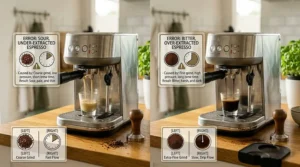
Almost every frustrated first-week review on Amazon traces back to one of the same handful of mistakes, not a defective machine.
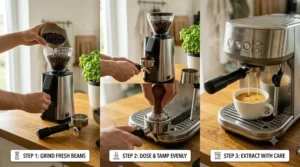
Buying pre-ground coffee in bulk. Ground coffee loses most of its aromatic complexity within about two weeks of grinding, well before a typical bag is finished. If your machine doesn’t grind for you, buy whole beans in smaller quantities — a 12-ounce bag, used within a couple of weeks, beats a 5-pound bag you’ll be drinking stale espresso from by week three.
Tamping like you’re packing a suitcase. New owners consistently over-tamp, assuming more pressure means a better shot. Even, moderate pressure with a level base matters far more than brute force — a channeled, unevenly packed puck will give you a sour, fast-running shot no matter how hard you pressed.
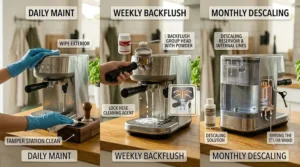
Skipping the descaling schedule. Hard water leaves mineral scale inside boilers that gradually chokes pump pressure and wrecks flavor — and it happens slowly enough that owners often blame the machine instead of the buildup. Run a descaling cycle every 1–3 months depending on your local water hardness, not “whenever it seems slow.”
Treating the first few shots as the final verdict. Dialing in a new bag of beans typically takes several adjusted shots, not one. If your first pull tastes sour or bitter, that’s the machine doing its job and giving you feedback — it’s not proof you bought the wrong machine.
Forgetting that more caffeine control means more caffeine, period. Brewing your own means it’s genuinely easy to drink more cups than you would when each one cost $5 and a walk outside. The FDA’s general guidance puts roughly 400 milligrams a day as the threshold most healthy adults can handle without issues — worth keeping in the back of your mind once a “quick second shot” becomes a daily habit.
Your First 30 Days: A Beginner Barista Usage Guide
The first month with any of these machines follows a predictable arc, and knowing the shape of it in advance saves a lot of unnecessary self-doubt.
Days 1–3: Run the machine with plain water only, no coffee, following the manufacturer’s first-use instructions — this clears manufacturing residue and primes the internal lines. Pull your first few shots and expect them to taste mediocre; you’re calibrating your grind size, not your skill.
Days 4–10: This is when most of the “common mistakes” above actually happen, so it’s the window to be deliberate. Buy a basic kitchen scale if your machine doesn’t have one built in (looking at you, Stilosa and Bambino Plus owners), and start logging dose, time, and yield for each shot. Three numbers, written down, will get you dialed in faster than ten YouTube videos.
Days 11–20: Milk texturing usually clicks around here for machines with manual wands. The trick almost nobody mentions clearly enough: keep the wand tip just below the milk surface, angled to create a whirlpool, rather than burying it deep in the pitcher. That whirlpool — not the steam pressure itself — is what builds microfoam.
Days 21–30: Run your first full descale cycle, even if the machine isn’t prompting you to yet, and start experimenting with a second bag of beans from a different roaster. Tasting the same recipe on two different beans is the fastest way to understand what your machine is actually doing versus what the beans are doing.
Real-World Scenarios: Which Machine Fits Your Life
The college student with a shared dorm fridge and zero counter space: the De’Longhi Stilosa is the obvious answer — it’s small, cheap enough to survive a move-out, and forgiving of imperfect technique under deadline-week stress.
The remote worker who wants a latte before every 9 a.m. call: the Breville Bambino Plus wins here on pure speed — a 3-second heat-up and hands-free milk texturing mean you’re not losing ten minutes of your morning to the machine itself.
The household where one person wants espresso and everyone else wants regular coffee: the Ninja Luxe Café Premier earns its higher price by also brewing drip coffee and cold brew, so it’s one purchase instead of two appliances competing for counter space.
The hobbyist who’s already watched too many espresso YouTube channels to be a “true” beginner: the Gaggia Classic Pro is worth the steeper learning curve, because its commercial 58mm portafilter and brass boiler mean you’re buying the last espresso machine you’ll need for a long time, not a stepping-stone you’ll resell in a year.
Semi-Automatic vs. Fully Guided: Which Should Beginners Choose
A semi automatic espresso machine for beginners — meaning you control grind, dose, and tamp, while the machine handles water pressure and temperature — is the category that includes the Stilosa, Bambino Plus, KitchenAid, and Gaggia on this list. A more fully guided machine, like the Ninja or La Specialista Touch, automates dosing and often grind recommendations on top of that.
Neither is objectively “easier” in the way marketing implies. Semi-automatic machines ask more of you upfront but teach transferable skills — once you understand tamping and dosing on a Gaggia, you understand it everywhere, including a café’s commercial machine. Guided machines remove that early friction, which lowers the odds you give up in week two, but they can leave you without the underlying skill if you ever switch to a different, less automated machine later.
If you’ve never made coffee more complicated than pressing a button, lean guided. If you’ve already nerded out reading this far into a buying guide, you can probably handle semi-automatic just fine — and you’ll likely enjoy the extra control more than the automation anyway.
Features That Actually Matter (And the Ones That Don’t)
Matters: portafilter size. A 58mm commercial-standard basket (Casabrews, KitchenAid, Gaggia) opens up a huge aftermarket of precision baskets and accessories later. Proprietary sizes lock you into the manufacturer’s ecosystem.
Doesn’t matter much: bar pressure above 9. Espresso extracts properly around 9 bar; a “15-bar” or “20-bar” pump spec mostly describes the pump’s maximum capacity, not the pressure during actual extraction, which most machines regulate down regardless. Marketing aside, a machine advertising 20 bar isn’t brewing “stronger” espresso than one advertising 9.
Matters: a real PID or digital temperature display. Temperature consistency shot-to-shot is one of the biggest variables separating a good cup from a mediocre one, and it’s invisible without some kind of readout or stable thermoblock system.
Doesn’t matter much: touchscreens, by themselves. A touchscreen is convenient, but it’s the underlying grind/dose/temperature guidance behind it — like La Specialista Touch’s Bean Adapt system — that actually improves your shots. A screen with no real logic behind it is just a prettier knob.
Matters: water tank size and accessibility. A small or awkwardly placed tank (hello, KitchenAid’s rear-mounted reservoir) becomes a daily annoyance fast, in a way no spec sheet conveys until you’re the one refilling it under a low cabinet.
Long-Term Cost & Maintenance: What Your First Machine Really Costs
The sticker price is rarely the real price. A no-grinder machine like the Bambino Plus or Gaggia Classic Pro needs a separate burr grinder, and a genuinely useful one starts around $150–$250 — meaning the “cheaper” $450 Gaggia and a decent grinder can land you near $650–$700 total, roughly the same as the all-in-one La Specialista Touch.
Ongoing costs are modest but real: descaling solution runs about $10–$15 every few months depending on water hardness, replacement water filters (where applicable) add another small recurring cost, and steam wand gaskets or seals on manual-wand machines typically need replacing every couple of years of regular use. None of this is expensive in isolation, but it’s worth budgeting roughly $50–$75 a year in consumables on top of whatever the machine cost upfront.
The payback math against buying coffee out, though, is genuinely fast. A home espresso shot costs roughly $0.30–$0.60 in beans once you’ve covered the equipment, against $4–$7 for a similar drink from a café. For a daily two-drink habit, most of these machines — even the $700 ones — pay for themselves within two to six months.
Beginner Espresso Machine vs. Pod Machine vs. Coffee Shop
| Category | Beginner Espresso Machine | Pod Machine | Daily Coffee Shop Run |
|---|---|---|---|
| Upfront cost | $100–$750, once | $80–$250, once | $0 |
| Cost per drink | ~$0.30–$0.60 | ~$0.75–$1.25 per pod | $4–$7 |
| Skill required | Low to moderate, grows over time | Almost none | None |
| Flavor ceiling | High, fully customizable | Capped by pod formulation | High, but inconsistent |
| Typical payback period | 2–6 months for daily drinkers | N/A | N/A |
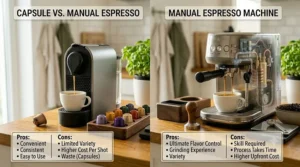
The numbers make a strong case for espresso machines on cost alone, but the real differentiator is the flavor ceiling. A pod machine can be perfectly consistent, but it’s consistent at whatever quality the manufacturer baked into that pod — there’s no version of “better technique” that improves it. A real espresso machine, even the $100 Stilosa, has genuine room to get better as you do, which is the entire appeal for anyone who’s decided this is a hobby and not just a caffeine-delivery errand. It’s also worth noting that the vast majority of past-day coffee drinkers — over 80% by recent survey data — already prepare their coffee at home rather than buying it out, so the shift toward home espresso isn’t a fringe trend; it’s where most coffee drinking already happens anyway.
FAQ
❓ What is the best beginner espresso machine under $200?
❓ Do I need a grinder with a beginner espresso machine?
❓ How long does it take to learn espresso at home?
❓ What's the difference between semi-automatic and automatic espresso machines for beginners?
❓ How often should I descale a beginner espresso machine?
Conclusion
There isn’t one “best” beginner espresso machine, no matter how confidently a headline promises otherwise — there’s the right machine for your budget, your counter space, and how much manual control you actually want on a Tuesday morning before coffee has kicked in yet. If you want the cheapest honest answer to whether this hobby is for you, the Stilosa earns its spot. If you want the machine to do more of the thinking, the Ninja Luxe Café Premier or La Specialista Touch will hold your hand through it. And if you already know you’re in this for the long haul, the Gaggia Classic Pro is gear you won’t outgrow.
Whichever one you land on, the single biggest predictor of happiness isn’t the spec sheet — it’s whether the machine fits the morning you actually have, not the morning you’re hoping to have.
✨ Ready to pick one? Tap any machine above to check today’s price on Amazon — and if this guide helped you decide, sharing it helps someone else skip their own 11 p.m. research spiral.
Recommended for You
- Breville Barista Express Review 2026: 7 Espresso Picks
- Best Espresso Machine Under 500: 7 Tested Picks for 2026
- Breville Bambino vs Gaggia Classic Pro: 7 Picks for 2026
Disclaimer: This article contains affiliate links. As an Amazon Associate, I earn from qualifying purchases. If you purchase products through these links, we may earn a small commission at no additional cost to you.
✨ Found this helpful? Share it with a friend who’s still drinking instant. 💬
