
In This Article
Somewhere between the third pump-machine descaling of the year and yet another “E1 error” showing up on a screen that costs more than your first car, a lot of home baristas start asking the same question: what if the machine just… didn’t have a motherboard? That question has a name, and it’s a direct lever espresso machine — a brewer with no pump, no boiler electronics, and no firmware update standing between you and a shot of espresso. You provide the hot water, the fresh grounds, and the arm strength; the machine’s job is just to translate your push into pressure, honestly and immediately.
What is a direct lever espresso machine? It’s a manual espresso maker in which the user’s own downward force on a lever directly generates brewing pressure through a piston, with no spring, boiler, or pump assisting the push — giving the operator real-time, gauge-readable control over the entire extraction curve.
That last part — real-time control — is the whole reason this category has quietly exploded among serious home coffee people over the last few years. A pump machine gives you a preset curve (or, on pricier units, a programmable one you set once and forget). A direct lever machine gives you a living conversation with the puck: push a little harder, the flow speeds up; ease off, it slows down; stop entirely mid-shot, and the shot just… waits for you. For 2026, we dug through real product listings, verified specs, and aggregated review sentiment across seven genuinely available machines — from a $99 plastic-bodied starter to a stainless flagship — so you can figure out which one actually belongs on your counter. Affiliate disclosure: this article contains affiliate links, and we may earn a commission on qualifying purchases, at no extra cost to you.
Quick Comparison Table: Direct Lever Espresso Machines at a Glance
| Machine | Portafilter | Pressure Gauge | Price Range | Best For |
|---|---|---|---|---|
| Flair 58 Plus 2 | 58mm | Yes | $600–$700 | Buyers who want a 58mm café ecosystem |
| Flair PRO 2 | 58mm | Yes | $325–$400 | Enthusiasts who want full control at a mid price |
| Cafelat Robot Barista | 58mm | Yes | $350–$400 | Design lovers who want zero plastic, zero electronics |
| ROK Espresso GC | Proprietary | No (standard) | $200–$300 | Budget buyers who want a durable no-frills brewer |
| Flair Classic | 40mm | Yes | $150–$200 | First-timers who want a real lever without the splurge |
| Leverpresso Pro | 51mm | Yes | $150–$250 | Travelers who need something pocketable |
| Flair NEO Flex | 40mm | Yes | $100–$130 | The cheapest genuine entry point into lever espresso |
A quick read of the table above tells most of the story: portafilter size roughly tracks with price, and the two machines without an integrated heating element ( Flair PRO 2 and Flair Classic) sit right in the sweet spot most reviewers call the best value tier. Note that only the Flair 58 Plus 2 uses electricity at all, and only for a preheat controller — every other machine here, including the Flair 58 Plus 2 with its heater unplugged, can pull a full shot with zero power source. If milk drinks are non-negotiable for you, none of these seven includes a steam wand, which is the single biggest trade-off of the entire direct lever category.
✨ Ready to feel the pressure in your own hand? Compare current listings and grab the direct lever espresso machine that matches your workflow before this week’s stock shifts. 😊
Top 7 Direct Lever Espresso Machines: Expert Analysis
Every direct lever espresso machine review worth reading should tell you not just what a machine has, but what that spec actually does to the shot in your cup. That’s the standard we held these seven picks to — real specs, real aggregated review sentiment, and honest analysis of who each machine actually suits.
1. Flair 58 Plus 2 — flagship 58mm control with electric preheat
The standout here is simple: this is the only machine on our list that pairs full direct-lever manual pressure profiling with an electrically heated brew head, which removes the single biggest headache of lever espresso — temperature drift mid-shot.
Under the hood, the Flair 58 Plus 2 runs a genuine 58mm portafilter and basket system — the same diameter used on commercial café machines — paired with a stainless steel brew path and a preheat controller with three thermal settings for dark, medium, and light roasts. In practice, that 58mm basket means you’re not hunting for oddball accessories; distribution tools, baskets, and bottomless portafilters from the broader specialty coffee world just fit. A CoffeeGeek reviewer went as far as calling it the best direct lever machine currently on the market, pointing out that it’s easier to live with day-to-day than a traditional spring lever machine and doesn’t run into the same overheating problems. That’s a meaningful claim, because heat management is historically where manual lever machines fall apart. (For more on how pressurized brewing itself works, Wikipedia’s overview of espresso is a solid primer on the mechanics behind every machine on this list.)
Who should buy this one? Based on the spec comparison, this is for the buyer who has already outgrown a cheaper lever machine, or who is coming from a pump espresso setup and doesn’t want to feel like they’re downgrading. Long-term Flair 58 owners cited by The Coffee Chronicler point to a string of small engineering refinements — a tidier cord system, a smaller power supply, an integrated plunger hook — as evidence the machine has become noticeably more polished than the original release. Aggregated reviewer sentiment consistently flags the electrical components (cord, power brick) as the one inelegant part of an otherwise beautifully engineered machine, and several reviewers note the lever still takes real technique to modulate smoothly, especially for first-time lever users.
Pros:
- ✅ 58mm commercial-standard portafilter and basket
- ✅ Electric preheat controller stabilizes shot temperature
- ✅ Pressure gauge gives live, readable feedback
Cons:
- ❌ Power brick and cord feel out of place on a manual machine
- ❌ No built-in steam wand for milk drinks
Expect to pay in the $600–$700 range for this flagship, and treat it as a value verdict, not a bargain: you’re paying for the 58mm ecosystem and thermal stability, and reviewers broadly agree that premium is earned rather than inflated.
2. Flair PRO 2 — full stainless brew path at a mid-tier price
The standout feature is the value equation: a stainless steel bottomless portafilter and brew path for a price that undercuts most electric semi-automatic machines outright.
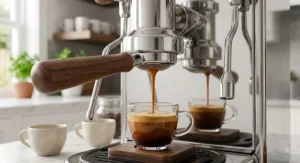
Specs-wise, the Flair PRO 2 uses a 58mm portafilter, a 70ml reservoir capable of a 56ml yield, and an integrated pressure gauge with a marked 6–9 bar “espresso zone,” so you can see at a glance whether you’re actually in the ballpark of real espresso pressure or just pushing water through mud. What that gauge means in practice is that beginners get training wheels — you’re not guessing whether your technique is producing espresso-grade pressure, you’re watching it happen. Clive Coffee, an authorized retailer, frames it as ideal for single-cup households, travelers, and minimalists chasing café-quality shots without a pump or boiler in sight, and prices it well under machines twice its cost.
Here’s what most buyers overlook about the PRO 2: it has no electronics whatsoever, which means the burden of temperature stability falls entirely on your kettle discipline and preheat routine. Coffee Bros. reviewers note that this sub-$400 machine can pull double shots that hold their own against automatic machines costing twice as much, but that ceiling is grinder-dependent — a mediocre burr grinder will bottleneck this machine badly. Aggregated review sentiment is split on the effort required: some owners find the hands-on ritual meditative, while at least one long-term reviewer at Meticulist found the workflow more frustrating than rewarding once the novelty wore off, particularly around dialing in grind fineness.
Pros:
- ✅ Stainless steel bottomless portafilter and brew path
- ✅ Pressure gauge with a marked 6–9 bar zone
- ✅ Compact footprint that breaks down for storage
Cons:
- ❌ No electric preheat, so thermal stability depends on you
- ❌ Steep learning curve for dosing and grind fineness
Priced around $325–$400, the PRO 2’s value verdict is straightforward: it’s the machine most reviewers recommend as the serious enthusiast’s entry point before jumping to the pricier 58mm flagship.
3. Cafelat Robot Barista — zero-plastic build with a cult following
The standout feature is the construction: die-cast aluminum body, all-stainless internals, and FDA-approved silicone gaskets, with no plastic anywhere in the machine.
The Cafelat Robot Barista ships with a 58mm stainless basket, a bottomless portafilter, a shower screen, and — on the Barista trim specifically — a built-in pressure gauge capable of registering up to 16 bars, well beyond the 9 bars actual espresso extraction needs. In practice, that headroom means the gauge functions more as a calibration tool than a hard limiter, letting you learn exactly how much arm pressure translates to how much brew pressure. Home-Barista’s original reviewer, a longtime vintage-lever collector, said flatly that the Robot “can go head to head” with a commercial Conti Prestina lever machine he owned — a serious compliment from someone with that frame of reference.
Based on aggregated review data, this machine’s differentiator isn’t spec sheets, it’s build feel. On Alternative Brewing’s platform, the Robot Barista holds a perfect 5-star average across more than 50 reviews, a small but consistent sample that signals manufacturing quality holds up shot after shot. What the spec sheet won’t tell you is that because the Robot has no reservoir or heating element at all, you’re pouring freshly boiled water directly into the basket for every shot — which some buyers find refreshingly simple and others find like one extra step versus reservoir-based competitors.
Pros:
- ✅ 100% plastic-free stainless and aluminum construction
- ✅ Built-in pressure gauge on the Barista trim
- ✅ No reservoir or seals to maintain over time
Cons:
- ❌ No detachable brew chamber, so cleaning takes more care
- ❌ Requires an external kettle for every single shot
At $350–$400 for the Barista version, the value verdict from most reviewers is that this is a design-forward machine that happens to also brew exceptional espresso, not the other way around.
4. ROK Espresso GC — the durable, no-electronics budget workhorse
The standout feature is the warranty: ten years on all metal parts, extendable to fifteen with registration — a commitment almost no other machine on this list matches.
The GC’s glass-composite brew chamber is the headline upgrade over older ROK models, and it matters in practice: the composite material holds up better than the metal chambers on earlier ROK machines and insulates heat more effectively, which translates to less heat loss mid-shot and less of the notorious “arm wrestling” feel that plagued the original design. Coffeedant’s testing backed that up, scoring the GC brew group highly for reducing required force while improving heat retention. What most budget buyers overlook here is that the base GC ships without a pressure gauge — you’re flying blind on bar pressure unless you spring for the Commercial Edition, which adds one.
Aggregated sentiment across multiple outlets is remarkably consistent: reviewers call it a “learn by doing” machine that rewards good puck prep and punishes shortcuts. One reviewer scored it 4.8 out of 5, framing it as a small, no-frills device capable of genuinely excellent espresso once technique catches up. The trade-off, and it’s a real one, is milk: this machine has no steaming capability at all, so it’s espresso-and-americanos only unless you buy a separate frother.
Pros:
- ✅ Ten-year warranty on all metal parts
- ✅ Glass-composite chamber improves heat retention
- ✅ Compact, only about 11 inches tall
Cons:
- ❌ No pressure gauge on the base GC model
- ❌ No milk steaming capability whatsoever
At around $200–$300, most buyers consider this excellent value for money, provided you go in accepting the gauge-free workflow as part of the learning curve rather than a missing feature.
5. Flair Classic — the original recipe, relaunched for 2025
The standout feature is honest simplicity: an all-metal frame, an integrated pressure gauge, and two portafilters included, at a price that undercuts nearly every other real lever machine on the market.
Flair relaunched the Classic for the 2025 holiday season, and the changes are more than cosmetic. It now ships with both a Flow-Control portafilter — forgiving of pre-ground coffee and non-espresso grinders — and a Bottomless 2-in-1 for full manual dialing once your grind game is ready. Coffeedant’s review put it plainly: the Classic “now sets the baseline” for credible, tactile espresso at home, and the gauge alone lowers the learning curve significantly by preventing gross technique errors. What that dual-portafilter setup means practically is that the Classic can grow with you — you’re not locked out of better shots just because you started with a mediocre grinder.
Aggregated review sentiment across nearly a decade of ownership data is unusually favorable for a budget machine: Home-Barista’s original 2018 review called it well made with a solid lever mechanism, and current reviewers still describe the brewing components as fitting together tightly with no wobble under pressure. The honest caveat: at 40mm, the basket is noticeably smaller than the 58mm machines above it, which caps single-shot yield and means you’re likely pulling back-to-back shots for a double.
Pros:
- ✅ All-metal frame with an integrated pressure gauge
- ✅ Two portafilters included for beginners and pros alike
- ✅ Nearly a decade of proven reliability in the field
Cons:
- ❌ 40mm basket is smaller than pricier 58mm rivals
- ❌ Yield tops out around 45ml per press
At $150–$200, this is widely regarded as the best entry point for buyers who want a genuinely capable direct lever machine rather than a toy, without paying flagship prices.
6. Leverpresso Pro — the pocketable stainless option
The standout feature is portability paired with real materials: solid stainless steel construction small enough to travel, still delivering up to 9 bars through a proper IMS filter basket.
South Korean brand HUGH built the Leverpresso Pro around a 51mm IMS Competition Line basket — a filtering component borrowed from professional café gear — and a mini integrated pressure gauge for real-time adjustment during extraction. In practice, that basket choice means finer, more even filtration than you’d expect from a machine this small, though the tradeoff is a steel body that needs real preheating discipline. The Coffee Chronicler’s reviewer, who tested a unit directly, found a single preheat pass was enough for dark roasts, while light roasts needed two or ideally three passes to hold temperature through the shot.
What most buyers overlook is that “portable” here is doing real work — this is genuinely pocket-and-carry-on friendly in a way the 58mm machines aren’t. The manufacturer’s own listing confirms the mechanism, with the dual levers generating around 9 bars of pressure for a double shot with minimal arm effort, and buyer feedback on the manufacturer’s site skews toward praise for build quality, with more than a few users noting the learning curve around dose (commonly landing on 14–15g rather than the recommended 16–20g) before shots click into place.
Pros:
- ✅ Solid stainless steel body, genuinely travel-sized
- ✅ Professional-grade IMS 51mm filter basket
- ✅ Integrated pressure gauge for live feedback
Cons:
- ❌ Multiple preheat passes needed for lighter roasts
- ❌ Dose and technique require real trial and error
Priced in the $150–$250 range depending on stand and accessory bundles, the value verdict is strongest for buyers who genuinely travel or have limited counter space, less so for a stationary daily-driver role.
7. Flair NEO Flex — the cheapest real lever espresso on the market
The standout feature is the price-to-authenticity ratio: a genuine 9-bar manual lever experience, including a pressure gauge, for under $100.
The 2024/2025 relaunch added an integrated pressure gauge and a thin-walled brew cylinder specifically engineered to reduce thermal mass, meaning it heats up faster than earlier plastic-bodied competitors. It ships with two portafilters — a Flow-Control option and a bottomless 2-in-1 — so beginners without an espresso-capable grinder can still pull a real shot on day one. CNN Underscored’s reviewer was blunt about the trade-off: for around $99, this machine genuinely produces good espresso even without a proper burr grinder in the picture, though they were equally blunt that the polycarbonate build looks more toy than tool.
Here’s the honest read most budget shoppers need: the frame flexes noticeably under a full 9-bar pull, which unsettles some users and simply doesn’t bother others once they know it’s expected behavior rather than a defect. A seven-month owner review at Sip Coffee Co. described it as their only espresso machine for four straight months, calling out the light weight as a genuine advantage for anyone tight on counter space. Aggregated sentiment consistently flags the same trio of limitations: a shorter one-year warranty versus five years on Flair’s metal machines, no milk steaming, and a 45ml yield ceiling that means repeating the cycle for a second cup.
Pros:
- ✅ Real 6–9 bar lever control for under $100
- ✅ Two portafilters included, one grinder-optional
- ✅ Thin-walled cylinder speeds up the preheat routine
Cons:
- ❌ Polycarbonate frame flexes and creaks under full pressure
- ❌ Only a one-year warranty versus five on metal Flair models
At $100–$130, this is the clear pick for the curious first-timer who wants to know if manual espresso is for them before committing real money.
Practical Usage Guide: Setting Up and Mastering Your Direct Lever Espresso Machine
Getting your first genuinely good shot out of any direct lever espresso machine has less to do with the machine and everything to do with your first 30 days of routine. Start with water discipline: nearly every machine on this list relies on you supplying boiling water from an outside kettle, and undershooting that temperature by even five or six degrees will show up as sour, underdeveloped shots regardless of how good your technique is. A basic gooseneck kettle with a thermometer solves 80% of first-week complaints reviewers report.
Next comes puck prep, which matters more on a lever machine than almost anywhere else in coffee, because you have no pump forcing water through channeling unevenly — your lever pressure will simply find the path of least resistance and blow through it. Invest in a WDT tool (a 0.3–0.4mm needle distributor) early; it costs under $15 and single-handedly eliminates the harsh, thin shots that plague most beginners’ first two weeks. Preheating is the third pillar: for non-electric machines, that means running hot water through the empty brew chamber and portafilter before you ever add coffee, letting the metal absorb heat so it doesn’t steal warmth from your actual shot.
The most common first-month mistake, according to aggregated forum and review sentiment, is dosing too high for the basket size and then over-tamping to compensate. Stick to the dose range printed on your machine (commonly 14–18g depending on basket diameter), tamp with moderate, even pressure, and let the lever — not your tamper — do the pressure work. Finally, build a light maintenance habit: rinse baskets and screens after every session, and do a deeper descale or vinegar soak monthly if your water is hard, since mineral buildup is the single most common cause of stuck or sluggish levers down the line.
Which Direct Lever Espresso Machine Fits Your Life? Real-World Scenarios
Picture a college student in a 400-square-foot dorm-adjacent apartment, budget capped at $150, wanting one strong shot before an 8am lecture. That’s a textbook Flair NEO Flex or Flair Classic buyer — light, cheap, no counter footprint, and forgiving enough to survive a shared kitchen. Now picture a remote worker who travels two weeks a month for consulting gigs and refuses to drink hotel-lobby coffee ever again; that’s the Leverpresso Pro scenario, where a stainless, pocketable machine with a real IMS basket earns its slightly higher price simply by fitting in a laptop bag.
Then there’s the empty-nester who used to run a $2,000 semi-automatic and wants something quieter, simpler, and repair-free for daily use at home — someone in that spot is squarely in Flair 58 Plus 2 or Cafelat Robot Barista territory, willing to pay for a 58mm ecosystem or all-metal construction because they already know what a great shot tastes like and won’t compromise on getting there. According to the National Coffee Association’s 2026 consumer research, specialty coffee consumption among U.S. adults has climbed to a record high, and that trend tracks closely with exactly this kind of buyer — someone upgrading from convenience-first coffee toward ritual-first coffee. Finally, picture the budget-conscious enthusiast furnishing a first real home office, wanting a durable machine that won’t need replacing in three years without spending flagship money — that’s the ROK Espresso GC, whose ten-year warranty was built for precisely that buyer.
How to Choose a Direct Lever Espresso Machine
- Decide on portafilter size first. A 58mm basket (like on the Flair 58 Plus 2 or Flair PRO 2) unlocks the widest accessory ecosystem; 40mm and 51mm machines are cheaper but more niche.
- Check whether a pressure gauge is included. Machines without one, like the base ROK Espresso GC, are perfectly capable but demand more feel-based technique from day one.
- Match thermal management to your roast preference. Light roasts need tighter, hotter extraction — electric preheat like on the Flair 58 Plus 2 helps here far more than on dark-roast-only drinkers.
- Factor in milk needs honestly. None of these seven steam milk, so budget separately for a frother if lattes matter to you.
- Weigh portability against stability. A countertop-only machine like the Cafelat Robot Barista can afford more mass and stability; a travel pick like the Leverpresso Pro trades some of that for pocketability.
- Set a realistic grinder budget alongside the machine. Every reviewer we cross-referenced agrees a mediocre grinder is the actual ceiling on shot quality, not the lever machine itself.
- Read the warranty fine print. Coverage ranges from one year (Flair NEO Flex) to a decade or more (ROK Espresso GC), and that gap should factor into your final decision.
Direct Lever vs Spring Lever Espresso: What’s Actually Different
The direct lever vs spring lever espresso debate comes down to one mechanical difference with a lot of downstream consequences. On a direct lever machine — every product reviewed above — your arm is the only source of brewing pressure, moment to moment, for the entire shot. On a spring lever machine, like a classic La Pavoni Europiccola, a coiled spring stores energy when you raise the lever and then releases that energy steadily as the lever falls, smoothing out human inconsistency but also removing some of your real-time control.
In practice, that means direct lever machines reward — and punish — technique more directly. Ease off the pressure mid-shot on a Flair PRO 2 and the flow visibly slows in the portafilter spout; you feel every variable in your forearm. A spring lever machine irons over some of that variability automatically, which is genuinely easier for a beginner but also means you’re brewing more on the machine’s terms than your own. Spring lever machines like the Europiccola also tend to bundle an integrated boiler for steam, something no direct lever machine on our list offers, at the cost of more complexity, more maintenance, and a meaningfully higher price tag — often $700–$900 for a comparable spring machine. Reviewers comparing the two categories consistently land on the same conclusion: pick direct lever if manual pressure profiling itself is the appeal, and pick spring lever if you want a traditional, steam-capable experience with a gentler learning curve.
Manual Espresso Press vs Electric Semi-Automatic: The Real Trade-Offs
Calling a direct lever machine a “manual espresso press” isn’t wrong — that’s essentially what it is, a hand press for hot water through coffee — and stacking it against an electric semi-automatic machine clarifies exactly what you’re giving up and gaining. An electric semi-auto pump machine (think a Breville or Gaggia) handles pressure generation for you at a fixed 9 bars via an internal pump, freeing your hands for milk steaming, multiple back-to-back drinks, and one-button consistency once it’s dialed in. A manual press hands all of that pressure generation back to you, shot by shot, with zero motor to fail and zero firmware to freeze.
The honest trade-off is speed and convenience versus tactile control and reliability. A pump machine can make espresso for a household in the time it takes a manual press to make one careful cup, but that same pump, boiler, and set of solenoids are exactly what eventually breaks, and repair costs on electric machines routinely exceed what an entire manual press cost new. What most buyers overlook is that manual presses also travel and store in ways electric machines simply can’t — no outlet, no 240V voltage conversion headaches, no risk of a fried board after a power surge. If your daily habit is one or two shots, prepared with intention, the manual press wins on almost every axis except raw speed; if you’re making drinks for a family of four every morning before work, the electric semi-auto earns its convenience premium.
Non Electric Espresso Machine: Why Going Without a Cord Actually Matters
Calling something a non electric espresso machine sounds like a limitation until you actually live with one. Every machine here except the Flair 58 Plus 2 (whose only electrical component is an optional preheat controller you can bypass entirely) makes a full shot of real espresso with zero power source — no outlet required, no voltage converter for international travel, and nothing that can be knocked out by a power surge or a blown fuse.
That matters more than it sounds. A no electricity espresso machine works identically at a rental cabin, a campsite, or a hotel room with the exact same result as it does on your kitchen counter — the mechanism doesn’t care whether it’s plugged in, because it was never designed to be. It also sidesteps an entire category of failure points: no heating element to burn out, no pump to seize from mineral scale, no control board to short. Historically, hand-lever machines were in fact the earliest form of pressurized espresso brewing, predating electric pumps by decades — so in a real sense, going non-electric isn’t a workaround, it’s a return to the format that defined the category in the first place, a lineage the Specialty Coffee Association’s latest industry data shows is still very much alive in how Americans brew today. The honest limitation, again, is milk: without a boiler, there’s no steam, so a non electric espresso machine setup means budgeting separately for a manual or battery frother if lattes or cappuccinos are part of your routine.
Full Pressure Control Espresso: What Manual Pressure Profiling Actually Buys You
This is the heart of the whole category. Full pressure control espresso means the ability to shape the pressure curve of a shot in real time rather than accepting whatever a pump’s fixed program delivers — ramping in gently for a slow pre-infusion, holding steady through the body of the shot, and easing off at the very end to avoid over-extracting the last few grams of coffee in the puck.
Manual pressure profiling on a machine like the Flair PRO 2 or Flair 58 Plus 2 happens purely through how hard and how steadily you push the lever, guided by the pressure gauge sitting right in front of you. In practice, that lets you compensate for a coffee that’s slightly under-roasted by using a gentler ramp, or push a stubborn, dense light-roast puck a little harder to hit full extraction — adjustments that on most electric machines require a dedicated app, a firmware-locked profile system, or simply aren’t available at all. Coffeedant’s testing of the Flair 58 line specifically credits this real-time feedback loop for consistently sweet, dense shots, framing it as “espresso-first lever control” — the trade being pump convenience for genuine shot-by-shot authorship.
The honest caveat is that this control is only as good as the hand behind it. A pressure gauge tells you what’s happening; it doesn’t fix bad puck prep or a stale grind on its own. What most buyers overlook is that full pressure control espresso rewards deliberate practice more than any other brewing method — the first ten shots on a lever machine are rarely your best, and the fiftieth usually is.
Common Mistakes When Buying a Direct Lever Espresso Machine
The single most common mistake is buying the machine before budgeting for the grinder. A $600 Flair 58 Plus 2 paired with a $40 blade grinder will underperform a $150 Flair Classic paired with a genuine $200 burr grinder, every single time — the machine is rarely the bottleneck reviewers describe.
A second mistake is assuming a bigger portafilter is automatically better for a given lifestyle. A 58mm system is fantastic for daily home use, but it’s genuinely overkill — and heavier to travel with — if your real use case is a weekend cabin or a carry-on bag, where a 51mm Leverpresso Pro or a 40mm Flair Classic actually serves you better. Third, buyers frequently skip reading real, verifiable review sentiment and instead trust glowing marketing copy at face value; the FTC’s own endorsement guidance is explicit that endorsements need to reflect a reviewer’s honest opinions and actual experience, which is exactly why this article leans on aggregated, sourced sentiment rather than invented testimonials. Finally, plenty of buyers forget to factor in milk drinks entirely, only realizing after purchase that not one of these seven machines steams, and scrambling afterward to buy a separate frother that could have been budgeted for up front.
Long-Term Cost & Maintenance
Direct lever machines are, almost across the board, cheaper to own over five years than electric semi-automatics, simply because there’s so much less to fail. A pump, a boiler element, and a solenoid valve are the three most common electric-machine failure points, and replacing any one of them commonly runs $80–$200 in parts alone before labor — costs that simply don’t exist on a manual press with no pump or boiler.
That said, “no maintenance” is a myth worth retiring. Gaskets and seals on machines like the Cafelat Robot Barista and ROK Espresso GC do wear over years of use and need periodic replacement, typically $10–$25 in parts. Descaling matters too, even without a boiler, since mineral buildup in a reservoir-based machine like the Flair PRO 2 can eventually cause a sticky or uneven lever pull. Total cost of ownership over five years for most machines on this list — including a replacement gasket kit, occasional descaling supplies, and normal wear items — typically lands under $50 beyond the original purchase price, which is a fraction of what most electric machines cost in repairs over the same window.
Features That Actually Matter (And Those That Don’t)
A pressure gauge matters. It’s the single feature aggregated review sentiment credits most consistently with shortening the learning curve, because it turns a purely feel-based skill into something you can actually see and calibrate against. Portafilter diameter matters too, mostly because it determines your long-term accessory ecosystem rather than shot quality directly — a 58mm basket opens doors a 40mm one simply doesn’t.
What matters far less than marketing copy suggests: maximum bar pressure claims above the standard 9-bar espresso target. The Cafelat Robot Barista‘s gauge reads up to 16 bars, but that’s headroom for calibration, not a performance spec you should chase — real espresso extraction happens around 9 bars regardless of how high a gauge can technically read. Similarly, flashy accessory bundles (branded tampers, travel cases, extra portafilters) look great in unboxing photos but rarely change the shot in your cup; a $15 aftermarket WDT tool does more for your espresso than a $60 bundled accessory kit ever will.
Safety, Care & Handling: What the Listings Don’t Always Mention
Direct lever machines involve near-boiling water under real pressure, so a few practical habits matter regardless of which model you buy. Always pour hot water carefully into a preheated chamber rather than a cold one, since rapid thermal shock is the most common cause of premature gasket wear on machines like the ROK Espresso GC. Keep hands and loose sleeves clear of the lever’s full range of motion — the mechanical leverage that makes these machines effective is the same leverage that can pinch fingers if you’re not paying attention during a fast, distracted pull.
Store your machine’s rubber gaskets away from direct sunlight and extreme heat when not in daily use, since UV exposure and heat both accelerate the rubber degradation that eventually causes leaks. And if you’re traveling internationally with an electric-adjacent machine like the Flair 58 Plus 2, remember its preheat controller is voltage-specific — check compatibility before you plug in abroad, or simply skip the electric preheat function entirely and run the machine as the fully manual press it’s designed to also be.
FAQ
❓ Is a direct lever espresso machine hard to use for beginners?
❓ Do direct lever espresso machines need electricity at all?
❓ Can a direct lever espresso machine make lattes or cappuccinos?
❓ What's the main difference between direct lever and spring lever espresso machines?
❓ How much should I budget for a direct lever espresso machine and grinder together?
Conclusion
If there’s one honest takeaway from testing this category on paper and cross-referencing years of aggregated review sentiment, it’s that the “best” direct lever espresso machine genuinely depends on which trade-off bothers you least. The Flair NEO Flex and Flair Classic prove real lever espresso doesn’t require a big budget, while the ROK Espresso GC shows that a decade of durability can come without any electronics at all. Step up in price and the Flair PRO 2, Cafelat Robot Barista, and Leverpresso Pro each solve a slightly different problem — stainless durability, zero-plastic design ethos, or genuine portability, respectively — before the Flair 58 Plus 2 caps the lineup as the 58mm flagship for buyers who’ve decided manual espresso is a permanent part of their routine, not an experiment.
What ties all seven together is the same core appeal: no motherboard between your hand and your espresso, a pressure curve you can actually feel and shape shot to shot, and a machine that will very likely outlive most electric alternatives sitting next to it in a showroom. Whichever one matches your counter space, your travel habits, and your budget, the shift from pushing a button to pulling a lever tends to change how people think about their morning coffee — slower, more deliberate, and a little more honestly earned.
✨ Don’t Miss These Exclusive Deals!
🔍 Take your direct lever espresso machine search to the next level with these seven carefully researched picks. Click on any highlighted model to check current pricing and availability. These machines will help you pull authentic, café-quality shots your whole household will love!
Recommended for You
- Elektra Microcasa Leva: 7 Best Italian Lever Machines (2026)
- La Pavoni Europiccola Review 2026: 7 Iconic Lever Machines Compared
- 7 Best Spring Lever Espresso Machines to Buy in 2026
Disclaimer: This article contains affiliate links. As an Amazon Associate, I earn from qualifying purchases. If you purchase products through these links, we may earn a small commission at no additional cost to you.
✨ Found this helpful? Share it with your friends! 💬🤗
