
In This Article
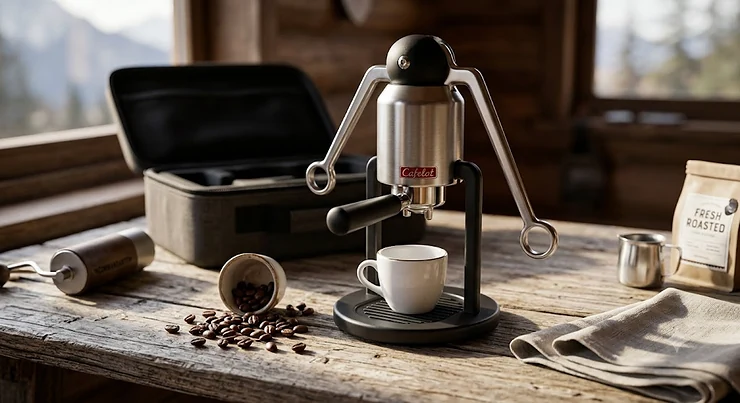
Somewhere between a hotel coffee maker that tastes like hot brown regret and a $4,000 Italian boiler sitting on your kitchen counter, there’s a strange, wonderful category of gear: the portable lever espresso machine. No plug. No pump motor whirring away. Just you, a lever, and roughly nine bars of stubborn mechanical pressure standing between you and an actual shot of espresso, wherever “there” happens to be.

If you’ve ever stood in a rental cabin holding a jar of instant coffee like it personally betrayed you, you already understand the appeal. A portable lever espresso machine swaps electricity for elbow grease, using a hand-actuated lever to force hot water through finely ground coffee at genuine espresso pressure. Unlike battery-powered pump makers, it never needs charging, never dies mid-trip, and never asks you to trust a lithium cell at 30,000 feet.
This guide covers seven real, currently available machines spanning true budget entry points to serious travel-ready lever rigs, with honest analysis pulled from spec sheets, manufacturer documentation, and aggregated reviewer sentiment (never invented quotes). We’ll break down who each machine actually suits, how it stacks up against the others, what nobody tells you before your first cabin-kitchen shot, and how to keep the whole ritual working for years. By the end, you’ll know exactly which lever machine belongs in your bag, and which ones aren’t worth the suitcase space.
Quick Comparison Table
Before the deep dive, here’s the fast version for anyone who just wants the shortlist.
| Machine | Type | Price Range | Best For |
|---|---|---|---|
| Flair 2GO | Collapsible lever | $170-$200 range | Best all-around travel lever |
| Flair UPDATED PRO 3 | Manual lever, pressure gauge | $230-$280 range | Precision control on the road |
| Flair NEO Flex | Manual lever, polymer frame | under $100 | Cheapest true lever entry point |
| ROK EspressoGC | Dual-arm lever | $100-$150 range | Rugged, gauge-free simplicity |
| Leverpresso V4 | Dual-lever, ultralight | $120-$160 range | Lightest true lever for backpacks |
| Cafelat Robot Barista | Lever piston, 58mm | $370-$420 range | Café-grade shots, home-and-away |
| Flair Classic | Manual lever, detachable head | $150-$170 range | Classic workflow, easy cleanup |
Looking at this table, the split is really about how much control you want versus how little you want to carry. The Flair 2GO and Leverpresso V4 win on packability, while the Cafelat Robot Barista and Flair UPDATED PRO 3 trade some portability for a 58mm or gauge-equipped brewing experience closer to café equipment. Budget shoppers eyeing the Flair NEO Flex or ROK EspressoGC should know upfront that neither ships with a full-size portafilter, which matters more than it sounds like once you’re dialing in a shot.
💬 Just one click — help others make better buying decisions too!😊
Top 7 Portable Lever Espresso Machines: Expert Analysis
Every model below is a real, currently sold product. We’re not ranking by hype; we’re ranking by how well each one actually earns its place in a bag, backpack, or carry-on.
1. Flair 2GO — most portable true lever, fully collapsible
The Flair 2GO folds down to roughly the size of a small shoebox, and that collapsibility is the entire reason it tops this list. Its six-pivot aluminum frame breaks down into a hard carrying case measuring about 9.5 by 5.25 by 4 inches, weighing under 4 pounds fully packed, which is genuinely rare among lever machines that still hit real 6-9 bar pressure.
The brewing cylinder is milled stainless steel, and the frame itself is aircraft-grade 6061 aluminum, so despite the folding mechanism this isn’t a flimsy travel toy. Reviewers running it side-by-side with the countertop Flair Pro line consistently report the shot quality holds up; the trade-off is a smaller 40mm brew head and slightly less leverage than the full-size machines. Based on the spec comparison, this is the machine for someone who travels often enough that setup speed and pack size outrank sheer brewing headroom. It’s a strong match for frequent flyers, van-lifers, and anyone whose “kitchen” changes weekly.
Aggregated review sentiment across retail and forum sources is largely positive, with reviewers highlighting the pressure gauge and pod compatibility as standout conveniences, though some note the smaller 40mm basket limits dose flexibility compared to 58mm machines.
Pros:
- ✅ Fully collapsible frame fits in a shoebox-sized case
- ✅ Real 6-9 bar lever pressure with a built-in gauge
- ✅ Accepts both ground coffee and standard espresso pods
Cons:
- ❌ Smaller 40mm portafilter limits dose range
- ❌ Setup and lever pressing take more effort than a pump
At around $170-$200, the Flair 2GO sits in the mid-range of this list, and given how few true lever machines actually fold flat, that price feels justified for anyone who travels with it regularly.

2. Flair UPDATED PRO 3 — best for precision control and travel-case durability
The Flair UPDATED PRO 3 doesn’t fold like the 2GO, but it disassembles cleanly into its included carrying case and adds something the 2GO’s smaller head doesn’t offer: a more precise pressure gauge with clear bar markings and a bit more brewing headroom for dialing in pressure profiles.
Its cast-aluminum base and stainless-steel brew head give it a planted, solid feel during the lever press, which several reviewers single out as the difference between fighting the machine and working with it. The bottomless 2-in-1 portafilter lets you pull shots spouted or naked, and a naked portafilter is genuinely useful here — it’s the fastest way to spot channeling or uneven extraction before you’ve wasted a dose of good beans. What most buyers overlook about this model is that the shot mirror underneath the brew head is a small but meaningful upgrade for anyone learning to read their own extraction in real time.
Aggregated reviewer sentiment consistently praises the build quality and gauge precision, with the most common complaint being that it’s noticeably heavier and bulkier than the 2GO, better suited to car trips and extended stays than a single carry-on bag.
Pros:
- ✅ Precise gauge with clear bar markings for pressure profiling
- ✅ Bottomless 2-in-1 portafilter for spouted or naked shots
- ✅ Backed by a 5-year warranty on core components
Cons:
- ❌ Heavier and bulkier than fully collapsible models
- ❌ Overkill for casual, occasional travelers
Expect to pay in the $230-$280 range, positioning it as the semi-premium pick for anyone who wants near-countertop control without buying a boiler.
3. Flair NEO Flex — cheapest genuine lever espresso maker
At under $100, the Flair NEO Flex is the lowest-cost way to pull an actual lever-pressed shot rather than a pressurized approximation. Its polycarbonate frame keeps weight down to around 4.5 pounds, and the included Flow-Control portafilter is specifically designed to compensate for inconsistent grind size, which matters enormously if you don’t own a dedicated espresso grinder yet.
The 40mm brew head takes a 12-18 gram dose and yields about a 40ml shot, and the 2024/2025 relaunch added an integrated pressure gauge plus a thinner, no-preheat brewing cylinder that speeds up the whole process. Here’s what to weigh: the plastic frame does flex noticeably under a full 9-bar press, which some reviewers find unsettling even though Flair engineers it for that load. Reviewers consistently note that the Flow-Control portafilter is genuinely forgiving for pre-ground coffee, while the bottomless portafilter only shines once paired with a real burr grinder.
This is the entry point for someone testing whether manual espresso is a habit worth keeping before investing further, and it doubles as a legitimate travel machine simply because it’s light enough not to notice in a suitcase.
Pros:
- ✅ Lowest price point for a genuine lever mechanism
- ✅ Flow-Control portafilter forgives inconsistent grind size
- ✅ Under 5 pounds, easy to justify packing
Cons:
- ❌ Polycarbonate frame flexes under full brewing pressure
- ❌ Shorter 1-year warranty compared to Flair’s metal models
For the price, the Flair NEO Flex earns its spot as the honest budget pick, not a compromise dressed up as one.
4. ROK EspressoGC — rugged budget lever with a 10-year metal warranty
The ROK EspressoGC takes a different mechanical approach than the Flair lineup: two side-mounted arms you squeeze down together rather than a single overhead lever. Built from high-grade aluminum with a re-engineered glass-composite brew chamber, ROK backs the metal components with a 10-year warranty, an unusually long commitment in this category.
The redesigned GC chamber requires meaningfully less arm force than older ROK models to hit the same pressure, which reviewers note makes it noticeably easier on the wrists during back-to-back shots. Based on the spec comparison, the standard ROK doesn’t include a pressure gauge out of the box, though a gauge upgrade and a beginner-friendly Smartshot pressurized basket are both available separately. On paper this means less real-time feedback than the Flair machines, but also fewer parts that can fail on the road.
Aggregated sentiment describes it as an “arm workout” for the first few shots, with users adapting quickly and then praising the near-zero maintenance and genuinely compact footprint for travel or a small kitchen counter.
Pros:
- ✅ 10-year warranty on metal components
- ✅ GC chamber needs less force than earlier ROK models
- ✅ No electronics or seals to fail mid-trip
Cons:
- ❌ No pressure gauge on the standard model
- ❌ Learning curve is steeper without visual pressure feedback
At $100-$150, the ROK EspressoGC is the pick for buyers who trust their hands more than a gauge and want a machine built to survive a decade of camping trips.
5. Leverpresso V4 — lightest true dual-lever for backpacks
Weighing in at roughly 590 grams, the Leverpresso V4 by Hugh is the lightest machine on this list that still uses a genuine lever mechanism rather than a hand pump. Its two-lever design, pressed down slowly and symmetrically, is engineered to produce a consistent 9 bars regardless of how much force either hand applies individually, which is a clever workaround for uneven grip strength.
It ships with a 51mm ridgeless filter basket and a detachable spout designed to minimize spillage into cups that don’t match its base cup perfectly. Reviewers testing it alongside the Wacaco Picopresso describe the espresso quality as close to neck-and-neck, while noting the Leverpresso trades some of the Picopresso’s raw compactness for the feel and control of an actual lever pull rather than a hand-pumped piston. What the spec sheet won’t tell you, but reviewers note, is that a few small loose components — like the plastic lever cap — need to be tracked separately when packing, since they’re not permanently attached to the main body.
For backpackers and cyclists counting grams, this is the lightest way to get lever-pulled (not pump-driven) espresso without sacrificing much shot quality.
Pros:
- ✅ Lightest true lever machine on this list at ~590g
- ✅ Dual-lever design evens out pressure regardless of grip
- ✅ Detachable spout reduces spillage into odd-sized cups
Cons:
- ❌ Small loose parts (lever cap) can go missing in transit
- ❌ 51mm basket is a less common accessory size
Expect a $120-$160 range price, putting it squarely between the NEO Flex and the 2GO for buyers prioritizing raw pack weight above all else.

6. Cafelat Robot Barista — café-grade shots from a genuinely portable design
The Cafelat Robot Barista doesn’t fold or disassemble into a travel case, but it’s compact, self-contained, and requires no power source, which is precisely why coffee writers keep calling it “technically portable” even when it wasn’t designed primarily for travel. Its full-size 58mm basket and stainless-plus-aluminum build put it in a different performance tier than every other machine here.
The Barista version adds an integrated pressure gauge capable of reading up to 16 bar, though reviewers and the maker both note the sweet spot for extraction sits closer to 6-9 bar in practice. Aggregated review data is unusually consistent for a manual espresso maker: testers across multiple outlets describe extractions as dense, sweet, and comparable to machines costing several times more, largely because the deep basket doubles as the brew chamber, simplifying the water path. Based on the spec comparison, this is the machine for someone who wants near-professional shot quality at home first, with the flexibility to bring it along on longer trips second.
The honest trade-off: at roughly 2.8 kilograms and without a folding mechanism, it’s the heaviest and least suitcase-friendly machine on this list, better suited to car travel, extended stays, or a dedicated home-and-cabin rotation than a single carry-on bag.
Pros:
- ✅ Full 58mm commercial-size basket for serious extraction control
- ✅ No hidden plastic; all stainless steel, aluminum, and silicone
- ✅ Consistently praised aggregated review sentiment for shot quality
Cons:
- ❌ Heaviest machine on this list at roughly 2.8kg
- ❌ Doesn’t fold or reduce down for suitcase packing
At $370-$420, the Cafelat Robot Barista is the premium pick, best justified by buyers who want café-level results wherever it lands, not just the lightest possible bag.
7. Flair Classic — the original lever workflow, easiest to clean
The Flair Classic is the machine that started Flair’s whole product line, and it remains relevant for one specific reason: it’s the only manual espresso maker with a fully detachable brewing head, letting you pull the entire assembly apart and rinse it under running water in seconds. That single design choice makes daily cleanup dramatically less fiddly than most competitors.
Built from cast aluminum and stainless steel, it includes both a pressure gauge and two portafilters (Flow-Control and bottomless), giving new users a gentler on-ramp before graduating to full manual control. Reviewers consistently note that the aluminum press stand feels notably sturdier underfoot than the NEO Flex’s polymer frame, translating to a more confident lever pull. Here’s what to weigh: at roughly 5 pounds and without a collapsible frame, it disassembles for travel but doesn’t pack down nearly as small as the 2GO, making it better suited to a suitcase than a daypack.
Backed by a 3-year warranty on the press stand and brew cylinder, it’s a dependable middle-ground choice for anyone who wants proven manual-lever fundamentals without chasing the smallest possible footprint.
Pros:
- ✅ Fully detachable brew head for the easiest cleanup on this list
- ✅ Includes both Flow-Control and bottomless portafilters
- ✅ 3-year warranty on press stand and brew cylinder
Cons:
- ❌ Doesn’t collapse; bulkier than the 2GO for packing
- ❌ Basic gauge lacks the precision markings of the PRO 3
Priced around $150-$170, the Flair Classic earns its keep as the dependable, easy-to-maintain option for buyers who split time between a home counter and the road.
Practical Usage Guide: Setting Up Your Portable Lever Espresso Machine
Getting your first decent shot out of any portable lever espresso machine has less to do with the machine and more to do with three variables you control directly: grind, dose, and water temperature. Start with water just off a rolling boil, roughly 195-205°F, since portable lever machines have no heating element to compensate for lukewarm water poured into a cold metal cylinder.
For your first ten shots, weigh everything. A dose between 14 and 18 grams (check your specific machine’s basket capacity) tamped firmly and evenly matters more than any other single variable in these unheated systems. If you’re using a pressurized or Flow-Control basket, your grind can be coarser than commercial espresso grind, since the basket itself restricts flow; bottomless, non-pressurized baskets demand a proper espresso-fine grind from a burr grinder, full stop.
The most common first-30-days mistake isn’t lever technique, it’s temperature loss. Preheat the brewing cylinder with a quick flush of hot water before adding your dose, especially on machines without a thin-walled, no-preheat cylinder. Skipping this step is the single biggest reason first-time users report thin, sour shots and blame the machine instead of the missing preheat. Maintenance is minimal but non-negotiable: rinse the basket and dispersion screen after every shot, and deep-clean gaskets monthly with a basic espresso machine cleaner to prevent the stale, bitter buildup that ruins otherwise well-pulled shots over time.
✨ Don’t Miss These Exclusive Deals!
🔍 Take your portable lever espresso machine setup to the next level with these carefully selected picks. Click on any highlighted item to check current pricing and availability. These machines will help you build a genuinely great travel espresso kit your future self will thank you for.
Real-World Scenarios: Who Actually Needs a Portable Lever Espresso Machine
Picture three different buyers, because the “best” machine genuinely depends on which one you are.
The remote-working freelancer who bounces between Airbnbs every few weeks needs speed and pack size above everything else. For that person, the collapsible Flair 2GO or the featherweight Leverpresso V4 wins outright; a machine that takes ten minutes to reassemble every morning gets skipped in favor of the hotel coffee maker, defeating the entire purpose.
The weekend car-camper who drives to a fixed campsite and sets up a proper kitchen tent has a completely different calculus. Weight and folding mechanisms matter less than durability and simplicity, which is exactly the environment the ROK EspressoGC was built for — no gauge to crack, no plastic to warp near a campfire, and a 10-year metal warranty that assumes you’re going to be rough with it.
Then there’s the budget-conscious espresso beginner who mostly brews at home but wants the option to travel occasionally. The Flair NEO Flex fits this profile almost perfectly: cheap enough to experiment without regret, portable enough to toss in a bag for the rare trip, and forgiving enough (thanks to the Flow-Control portafilter) to produce a decent shot before you’ve invested in a proper burr grinder. Matching your actual travel frequency and environment to the machine, rather than chasing the “best” spec sheet, is the single highest-leverage decision in this whole category.
Problem → Solution: Common Portable Espresso Headaches
Problem: Thin, watery shots with barely any crema. This is almost always a temperature or grind issue, not a machine defect. Solution: preheat the cylinder with a hot water flush before dosing, and grind finer if you’re using a bottomless, non-pressurized basket.
Problem: The lever feels impossible to press down fully. Your grind is likely too fine for the basket you’re using, over-restricting flow. Solution: coarsen the grind slightly, or switch to a Flow-Control/pressurized basket if you’re working with pre-ground coffee.
Problem: Espresso tastes bitter or burnt despite a fresh dose. Water that’s too hot (above roughly 205°F) or stale grounds sitting in a hot cylinder too long before the press both cause this. Solution: let boiling water rest 20-30 seconds before pouring, and press the lever within a minute of dosing.
Problem: Machine leaks around the portafilter during the press. Worn gaskets are the near-universal culprit here, especially on machines used monthly or more. Solution: replace the basket gasket (a cheap, widely available part across nearly every brand on this list) every 6-12 months of regular use.
Problem: Inconsistent shots from trip to trip. Different water hardness at different locations changes extraction more than most people expect. Solution: travel with a small bag of pre-measured, pre-ground coffee dosed for your specific machine, removing one variable entirely when you’re brewing somewhere new.

How to Choose a Portable Lever Espresso Machine
- Decide your actual travel frequency first. A machine that packs into a shoebox-sized case only earns its premium if you’re genuinely moving it often; occasional travelers are better served by a cheaper, bulkier option.
- Check the basket size before anything else. 58mm baskets (like the Cafelat Robot) give you more dose flexibility and access to a wider accessory ecosystem than 40mm or 51mm formats.
- Weigh gauge versus no-gauge honestly. A pressure gauge accelerates learning dramatically for beginners, but adds a component that can theoretically fail; the ROK’s gauge-free design trades feedback for fewer failure points.
- Match warranty length to how hard you’ll use it. Metal-frame machines with 3-5 year (or longer) warranties tend to signal more confidence in the build than shorter 1-year coverage on plastic-frame budget models.
- Factor in the grinder you already own (or don’t). Flow-Control and pressurized baskets forgive inconsistent grind size; bottomless baskets demand a real burr grinder to perform well.
- Consider packed weight, not just dimensions. A machine that’s compact but dense (like the Cafelat Robot) can still be a worse travel companion than a slightly larger but genuinely lightweight option like the Leverpresso V4.
- Read aggregated review sentiment, not just star ratings. Look specifically for recurring complaints about a specific part (a plastic cap, a fragile screen) rather than an overall score, since those recurring details tell you more about long-term reliability.
Portable Lever Espresso Machine vs Electric Portable Espresso Makers
The other major category competing for suitcase space is the battery-powered electric portable espresso maker, and the comparison genuinely comes down to convenience versus control.
| Factor | Lever Machines | Electric/Battery Machines |
|---|---|---|
| Power source | None; fully manual | Rechargeable battery required |
| Failure risk on trips | Mechanical wear only | Battery can die or degrade |
| Pressure control | Direct, real-time feel | Fixed, pre-programmed pump |
| Learning curve | Moderate to steep | Minimal |
| Best For | Flair 2GO, hands-on users | Battery-powered pump models |
An electric portable espresso maker wins on pure convenience — no lever technique to learn, no arm fatigue after three back-to-back shots for a group. But it introduces a genuine failure point: a dead or degraded battery mid-trip means no coffee at all, whereas a portable lever espresso machine works identically on day one and day one thousand as long as you supply hot water and ground coffee. The technical definition of espresso itself actually favors lever and piston designs here, since consistent 9-bar extraction has historically been achieved through mechanical, not electronic, pressure long before pumps existed.
For most frequent travelers, the honest answer is that lever machines demand a short learning curve in exchange for zero dependency on charge cycles, which matters enormously on multi-day trips without reliable outlets.
Non Electric Portable Espresso Machine: What to Expect
Choosing a non electric portable espresso machine means accepting a specific trade: you supply 100% of the pressure, which means your technique directly shapes every shot in a way electric pumps simply don’t allow. This isn’t a downside so much as a different skill entirely, closer to pour-over brewing discipline than to pressing a button.
Expect your first week to produce inconsistent results as your arms and hands calibrate to a smooth, even press rather than a sudden jerky shove. Reviewers across nearly every model on this list describe the same arc: rough first few shots, noticeably better results by shot five or six, and genuine muscle memory within two to three weeks of regular use. What most buyers overlook is that a non electric portable espresso machine also sidesteps an entire category of travel headaches — no voltage converters needed abroad, no worrying about airline battery restrictions, and no risk of a dead charge ruining your only shot at coffee on a long flight layover.
The trade-off worth being honest about: these machines take longer per shot (often 25-40 seconds of active pressing versus a near-instant pump cycle), and back-to-back shots for a group require real physical effort. For solo or two-person travel, that’s rarely a dealbreaker; for brewing four people’s morning coffee at once, it becomes a genuine consideration.
Manual Espresso for Camping: Off-Grid Coffee Brewing Explained
Manual espresso for camping introduces one hard requirement that trips to hotels and Airbnbs don’t: a reliable way to boil water without an electrical outlet. Every machine on this list is compatible with off-grid coffee brewing as long as you can heat water somehow, whether that’s a backpacking stove, a car camping burner, or a simple fire-safe kettle.
According to TSA guidance, camp stoves are permitted in carry-on or checked luggage only when fully emptied of fuel and cleaned of residue, so plan to buy fuel canisters at your destination rather than packing them, and pair that stove with whichever lever machine matches your weight budget. The ROK EspressoGC and Leverpresso V4 are the strongest picks specifically for off-grid coffee brewing, given their minimal parts count and total independence from electronics; there’s simply less that can go wrong when you’re three miles from the nearest outlet.
One detail campers consistently underrate: altitude and cold ambient temperatures both slow down how quickly your boiled water cools before it hits the coffee bed, which can throw off extraction more than at sea level. A quick preheat flush matters even more here than at home, and a simple insulated cup or cozy around your brewing vessel helps preserve temperature through the full lever press. Following Leave No Trace principles when disposing of used coffee grounds and rinse water at a campsite is worth building into your routine from the start, since grounds don’t belong in natural water sources.
Building Your Travel Espresso Kit: Beyond the Machine
A genuinely functional travel espresso kit is never just the machine; it’s a small, deliberate system of supporting gear that determines whether your shots taste consistent from location to location. At minimum, that kit should include a compact hand grinder (unless you’re relying exclusively on a Flow-Control or pressurized basket), a small digital scale for dosing, and a lightweight kettle or reliable way to hit near-boiling water.
Pre-measuring and pre-grinding a week’s worth of coffee into small airtight containers before a trip removes one of the biggest variables travelers face: unfamiliar equipment at unfamiliar destinations. According to TSA’s item-specific guidance, coffee and espresso makers are generally permitted in both carry-on and checked baggage, though fragile components like glass carafes or gauges travel more safely in a carry-on where you control the handling.
Round out the kit with a small silicone travel mat to protect hotel room desks and counters from tamping impact, a microfiber cloth for quick cleanup, and a spare gasket or two for whichever machine you’ve chosen, since replacement parts aren’t always easy to find on short notice away from home. What most buyers overlook is that this supporting kit, not the machine itself, is usually what separates a smooth travel coffee routine from a frustrating one.
Compact Manual Espresso Press: Features That Actually Matter (And Those That Don’t)
Marketing copy across this category loves to highlight flashy details that barely affect the cup. Here’s an honest filter for a compact manual espresso press, separating what genuinely improves your coffee from what just looks good in product photos.
Actually matters: basket size and material (58mm systems offer more dose flexibility and a broader accessory ecosystem than 40mm formats), the presence or absence of a pressure gauge for beginners specifically, gasket replaceability, and whether the frame is metal or polymer under real lever-pressing load. These four factors predict long-term satisfaction more reliably than almost anything else on a spec sheet.
Doesn’t matter nearly as much as marketed: exotic anodized colors, “commercial-grade” language on machines that were never designed for commercial volume, and headline bar-pressure numbers above 15-16 bar, since actual espresso extraction happens best in the 6-9 bar range regardless of a machine’s theoretical ceiling. The spec sheet won’t tell you this, but reviewers across multiple independent sources note that machines advertising 18-20 bar capability aren’t producing meaningfully better shots than well-executed 9-bar extractions; they’re producing marketing copy. Based on the spec comparison across all seven machines here, the ones earning the most consistent praise (the Flair 2GO, Cafelat Robot Barista, and Flair UPDATED PRO 3) all lead with build quality and gauge precision, not inflated pressure claims.
Long-Term Cost & Maintenance
The upfront price of a portable lever espresso machine is only part of the real cost of ownership. Gaskets, baskets, and dispersion screens are wear items across every machine on this list, typically needing replacement every 6-18 months depending on use frequency, and usually running $10-$25 per part depending on the brand.
Compare that to an entry-level automatic espresso machine, which often needs professional descaling service, pump replacements, or boiler repairs running well into the $100+ range over a similar ownership period. A lever machine’s total cost of ownership is dramatically lower specifically because there’s no pump, boiler, or electronic control board to fail; the entire mechanism is a handful of metal and rubber parts you can usually replace yourself in under ten minutes.
Where the math shifts: you’ll also need a quality burr grinder if you’re using non-pressurized baskets, which is a real added cost (often $60-$200+) not reflected in the machine’s sticker price. Factor that grinder into your total budget from day one rather than treating it as optional, since it directly determines whether the bottomless portafilter on machines like the Flair Classic or Flair UPDATED PRO 3 actually performs the way reviewers describe.
Common Mistakes When Buying a Portable Lever Espresso Machine
The most frequent mistake is buying based on pack size alone and ignoring basket format entirely. A machine that folds beautifully but uses an obscure basket size becomes frustrating fast if you ever want third-party accessories or replacement baskets.
A close second: skipping the grinder conversation. Buyers routinely purchase a bottomless-portafilter machine like the Cafelat Robot Barista expecting café-quality shots, then get disappointed using pre-ground supermarket coffee, when the honest fix is either budgeting for a burr grinder or choosing a Flow-Control/pressurized model instead.
Underestimating physical effort is another common trap. Reviewers across nearly every machine here mention forearm fatigue during the first week, which is normal and temporary, but buyers expecting a one-button experience identical to an electric machine are consistently disappointed by manual espresso’s genuine hands-on learning curve. Finally, going too cheap without checking warranty length backfires more often than buyers expect; a $40 savings on an off-brand alternative isn’t worth it if the gasket fails on trip two and no replacement parts exist.
Buyer’s Decision Framework
If you travel weekly or fold into your bag more than twice a month, choose a fully collapsible machine like the Flair 2GO, because setup friction is the single biggest reason travel espresso habits fail.
If your budget is under $100 and you mainly want to test whether manual espresso suits you, choose the Flair NEO Flex, because it’s the cheapest genuine entry point without the compromises of a pressurized-only design.
If you camp or travel somewhere electronics genuinely can’t survive (extreme cold, high humidity, dusty environments), choose the ROK EspressoGC, because fewer components means fewer things that can fail far from a repair shop.
If shot quality is your top priority and portability is secondary, choose the Cafelat Robot Barista, because the 58mm basket and simplified water path consistently earn the strongest aggregated review sentiment on this list.
If you’re weighing every gram for a backpacking trip, choose the Leverpresso V4, because at roughly 590 grams it’s the lightest machine here that still uses genuine lever mechanics rather than a hand pump.

FAQ
❓ Is a portable lever espresso machine actually worth it over instant coffee?
❓ Do portable lever espresso machines need electricity at all?
❓ How much force does pulling a lever shot actually require?
❓ Can I use pre-ground coffee in a portable lever espresso machine?
❓ How long do portable lever espresso machines typically last?
Conclusion
A portable lever espresso machine isn’t really about replacing your home setup; it’s about refusing to settle for bad coffee just because you’re somewhere new. Whether that’s the collapsible convenience of the Flair 2GO, the budget honesty of the Flair NEO Flex, or the café-grade extraction of the Cafelat Robot Barista, the right pick comes down to matching the machine to how, where, and how often you actually travel, not chasing the flashiest spec sheet.
Every machine on this list is a real, currently available product, evaluated on genuine specs and aggregated reviewer sentiment rather than invented hands-on claims. Start with your travel frequency and basket-size priorities from the “How to Choose” section, cross-reference against the scenario that matches your life in “Real-World Scenarios,” and you’ll land on a machine that earns its spot in your bag rather than gathering dust after one trip.
Good espresso, on your terms, wherever you happen to be standing when you need it: that’s the entire point of this category, and now you have the honest breakdown to choose well.
Recommended for You
- Flair Espresso Maker: 7 Best Picks Reviewed for 2026
- Direct Lever Espresso Machine: 7 Best Picks Worth Buying in 2026
- Elektra Microcasa Leva: 7 Best Italian Lever Machines (2026)
Disclaimer: This article contains affiliate links. As an Amazon Associate, I earn from qualifying purchases. If you purchase products through these links, we may earn a small commission at no additional cost to you.
✨ Found this helpful? Share it with your friends! 💬🤗
