
In This Article
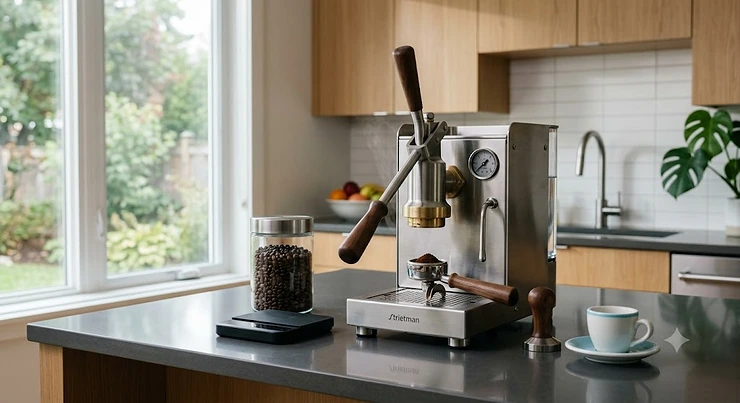
Somewhere between a French press and a full-blown commercial rig sits a strange little category of coffee gear that refuses to modernize on purpose. A manual lever espresso machine has no pump, no circuit board, and usually no idea what “one-touch” even means. You pull an arm, your shoulder does the work a motor would normally do, and — if you’ve done everything right — a thin ribbon of crema-topped espresso drips into your cup like it’s 1961 again. That’s the appeal, and it’s also the catch. This guide breaks down seven real, currently available machines across budget, mid-range, and premium tiers, with honest analysis pulled from spec sheets, manufacturer documentation, and aggregated owner feedback — not fabricated hands-on claims. Whether you’re upgrading from a pod machine or you’ve been circling this hobby for years, you’ll leave with a clear sense of which lever fits your kitchen, your patience level, and your budget.
What Is a Manual Lever Espresso Machine?
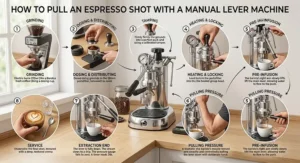
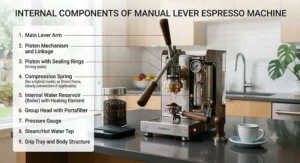
A manual lever espresso machine is a brewer that generates the 6-9 bars of pressure needed for real espresso using a hand-operated lever instead of an electric pump. Some models use a direct lever (you supply all the force), while others use a spring-assisted piston that smooths out the pressure curve for you.
That single mechanical distinction — arm versus motor — is the entire reason this category exists, and it’s why the people who love these machines tend to love them a lot.
Quick Comparison Table
Before diving into the full lineup, here’s a fast-scan snapshot of where each machine lands on price, mechanism, and who it actually suits.
| Machine | Mechanism | Price Range | Best For |
|---|---|---|---|
| Flair Classic | Direct lever, no electricity | Under $220 | First-timers on a tight budget |
| ROK EspressoGC | Dual-arm lever, no electricity | Under $200 | Travel and off-grid brewing |
| Cafelat Robot | Dual-lever, no boiler | $350-$450 range | Minimalists who want serious build quality |
| La Pavoni Europiccola (EPC-8) | Spring-piston with boiler & steam wand | $500-$700 range | All-in-one brew-and-steam ritual |
| Flair 58 | Direct lever with electric-assisted preheat | $550-$650 range | Daily drivers who want thermal consistency |
| La Pavoni Professional (PC-16) | Spring-piston, large boiler | Around $700-$900 | Entertaining and back-to-back shots |
| Ponte Vecchio Lusso (1 Group) | Spring-piston, thermosyphon-stabilized | From roughly $1,050+ | Buyers who want café-grade temperature stability |
A quick look at this table already tells you most of what you need to know about positioning: the two cheapest options skip electricity and boilers entirely, trading convenience for portability and a rock-bottom price of entry. The three mid-tier machines each add one major comfort feature — a boiler, a steam wand, or electric preheating — while the Ponte Vecchio Lusso sits alone at the top because its thermosyphon design solves the one problem that plagues every other lever machine on this list: heat drift over a brewing session.
💬 Just one click — help others make better buying decisions too!😊
Top 7 Manual Lever Espresso Machines: Expert Analysis
We picked these seven because they represent genuinely different approaches to the same mechanical idea, not seven versions of the same machine with different paint jobs. Each entry below covers real specs, what those specs mean in daily use, aggregated review sentiment, and an honest pros-and-cons breakdown.
1. Flair Classic — cheapest legitimate entry into manual lever espresso
The Flair Classic is the machine most people mean when they say “I just want to try lever espresso without spending a fortune.” It’s a 100% manual, electricity-free press that you preheat with hot water from your kettle, then operate entirely by arm strength to build 6-9 bars of pressure.
Because there’s no boiler, no thermostat, and no circuit board, the entire machine is really just three interlocking metal parts and a lever arm — which means fewer failure points and a teardown-for-cleaning process that takes under a minute. It ships with both a pressurized basket for forgiving early shots and a “pro” non-pressurized basket once your grind and technique catch up.
Based on the spec comparison against boilered machines, the trade-off is obvious: you manage water temperature manually with a kettle instead of getting it automated, and there’s no steam wand, so milk drinks require a separate frother. That makes the Flair Classic best for budget buyers, apartment dwellers without much counter space, and anyone who wants to test whether manual espresso is a hobby they’ll stick with before spending real money.
Reviewers consistently describe the learning curve as real but worthwhile, noting that shot quality depends heavily on pairing the machine with a decent burr grinder rather than pre-ground coffee. Several owners mention it as a “lasts a lifetime” purchase given how few parts there are to wear out or replace.
Pros:
- ✅ Fully portable with zero electricity required
- ✅ Ships with two portafilter baskets for beginners and pros
- ✅ Minimal parts mean fast cleanup and few things to break
Cons:
- ❌ No built-in steam wand for milk drinks
- ❌ Manual kettle preheating adds a learning curve for temperature
At under $220, the Flair Classic delivers real 6-9 bar espresso for less than most semi-automatic pod machines cost, making it one of the best value entry points in this entire category.
2. ROK EspressoGC — most compact for off-grid brewing
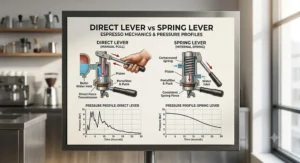
The ROK EspressoGC uses a distinctive dual-arm lever system instead of a single overhead handle, which changes the entire ergonomics of the pull. Rather than pressing down, you squeeze two arms together like a pair of oversized pliers, and that mechanical difference is the machine’s whole identity.
Like the Flair Classic, there’s no boiler or heating element inside — you preheat with hot water and rely entirely on your own pull for pressure, which the brand and independent reviewers both peg in the same 6-9 bar useful range as its lever siblings. The dual-arm design distributes force differently than a single lever, which some owners find easier on the wrist for long brewing sessions.
What most buyers overlook about this format is that the compact folding-friendly footprint makes it genuinely suited to campers, van-lifers, and small apartments where counter space is at a premium — it’s designed to be stashed in a cabinet, not left out as a centerpiece appliance.
Aggregated owner sentiment across coffee gear roundups generally places the ROK EspressoGC a notch below the Cafelat Robot in shot consistency and build refinement, while acknowledging it as the lower-cost way into the same dual-lever mechanical family.
Pros:
- ✅ No electricity needed, fully portable design
- ✅ Dual-arm squeeze mechanism eases wrist strain
- ✅ Compact enough for cabinets, bags, and small kitchens
Cons:
- ❌ Less refined build quality than pricier dual-lever rivals
- ❌ Temperature stability depends entirely on your preheat routine
For under $200, this is the machine to grab if portability outranks polish — a genuinely capable travel companion rather than a countertop showpiece.
3. Cafelat Robot — best boilerless build quality
The Cafelat Robot looks like it wandered out of a mid-century sci-fi film, and that retro styling isn’t just for show — this is a seriously engineered machine wrapped in a fun shell. It has no boiler and no heating element at all, which sounds like a limitation until you understand why that’s actually the point.
Because the brewing chamber has minimal thermal mass, preheating is nearly unnecessary for most roasts — you can go from cold to pulling a shot faster than any boilered lever machine on this list. Every part that touches water, including the plunger, basket, and shower screen, is stainless steel, while the die-cast aluminum body gets a durable powder coat finish. Reviewers who’ve compared it directly to the Flair 58 note the Robot uses a two-lever system rather than a single arm, which some find slightly less responsive but others prefer for the physical feedback it gives during the pull.
Based on the spec comparison, the Cafelat Robot is best suited to buyers who already understand grind size and dose but want a machine with almost no maintenance overhead — no gaskets to replace on a schedule, no heating element to eventually fail.
Aggregated feedback frames it as one of the most respected boilerless machines available, prized for build quality that punches well above its mid-tier price point.
Pros:
- ✅ Minimal thermal mass means little to no preheating
- ✅ All water-contact parts are stainless steel
- ✅ Distinctive retro design with genuinely serious engineering
Cons:
- ❌ Dual-lever action feels less direct than a single-arm design
- ❌ No steam wand, so milk drinks need a separate tool
Priced in the $350-$450 range, the Cafelat Robot is the sweet spot for buyers who’ve outgrown the Flair Classic but aren’t ready to commit to a boilered machine yet.
4. La Pavoni Europiccola (EPC-8) — most iconic all-in-one lever machine
The La Pavoni Europiccola, sold under model number EPC-8, has been a fixture of Italian coffee culture since 1961, and it remains the machine most people picture when they hear “lever espresso machine.” Unlike the boilerless options above, this one is a complete brewing station: an 0.8-liter brass boiler, a built-in steam wand, and a spring-assisted piston lever all in one chrome-and-brass body.
That built-in boiler means the water heats itself and stays at temperature between shots, and the spring assist in the piston smooths out some of the inconsistency that comes with a fully manual pull — the spring releases force at a steadier rate than your arm alone would. The trade-off, and it’s a real one, is that direct-boiler lever designs like this one are prone to heat creep during long sessions, since the grouphead is bolted straight to the boiler with no thermal buffer between them.
What the spec sheet won’t tell you, but multiple owner reviews consistently note, is that the Europiccola rewards patience: expect a genuine learning curve before your shots taste the way you want, and expect the machine to run warmer as a session goes on rather than staying perfectly flat.
Aggregated reviewer sentiment describes it as a “labor of love” purchase — one that produces excellent espresso once mastered but asks real commitment from the person operating it, especially compared with pump-driven alternatives.
Pros:
- ✅ All-in-one design brews and steams milk without extra tools
- ✅ Spring-assisted piston smooths out pressure inconsistency
- ✅ Genuine Italian heritage design dating back to 1961
Cons:
- ❌ Temperature can drift upward during longer brewing sessions
- ❌ Steep learning curve for consistent, repeatable shots
In the $500-$700 range depending on finish, the La Pavoni Europiccola earns its reputation as the classic choice, but it’s best for buyers who want the full ritual, not just a fast espresso fix.
5. Flair 58 — most consistent thermal control in a manual lever
The Flair 58 is the machine Flair built for people who loved the brand’s earlier levers but wanted less friction in daily use. Its headline feature is an electronic temperature control system that preheats the brewing chamber itself — not the water — across three settings: roughly 185°F on low, 194°F on medium, and 203°F on high.
That’s a meaningful shift from the fully manual preheat routine on the Flair Classic: instead of guessing with a kettle, you dial in a target and let the brew head stabilize before you load your dose. Paired with a genuine 58mm portafilter (the same size used on most commercial and prosumer machines), the Flair 58 also gives you access to a much wider ecosystem of baskets and accessories than smaller-format levers allow.
Based on the spec comparison, traditionalists will note that adding electronics to a “manual” machine is a bit of a contradiction, but the trade-off buys real consistency — you’re not reheating a kettle between shots, and the lever action itself has been redesigned to require noticeably less arm strength than the Classic’s.
Reviewer sentiment across manual-brewing comparisons consistently ranks the Flair 58 as the more “daily driver” friendly option next to boilerless machines like the Cafelat Robot, specifically because of that improved workflow.
Pros:
- ✅ Electronic brew-head preheat removes the kettle-guessing step
- ✅ Professional 58mm portafilter compatible with wider accessories
- ✅ Redesigned lever requires less physical effort than earlier Flairs
Cons:
- ❌ Requires a power outlet, losing the fully off-grid appeal
- ❌ Priced well above boilerless machines like the Robot or ROK
Running around $550-$650, the Flair 58 is the pick for buyers who want manual control without babysitting water temperature every single shot.
6. La Pavoni Professional (PC-16) — best for entertaining and back-to-back shots
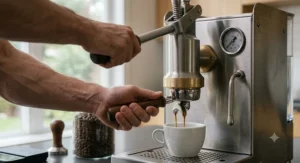
The La Pavoni Professional, model PC-16, scales up the Europiccola formula for higher volume. It houses a 38-ounce solid brass boiler — nearly triple the Europiccola’s capacity — with electric heating in the 900-1200 watt range and an internal thermostat designed to hold water at a consistent target rather than requiring constant manual monitoring.
That larger boiler is the whole story here: it means significantly more shots between refills and less waiting for reheat cycles when you’re making drinks for guests rather than just yourself. The machine also includes a dual frothing system, with separate steam settings tuned for the denser microfoam cappuccinos need versus the lighter steamed milk a latte calls for — a level of milk-drink flexibility the Europiccola doesn’t quite match.
Reviewers consistently flag one recurring issue worth knowing about upfront: despite the internal thermostat, several owners report the temperature can still run inconsistent during extended use, which is a fair trade to weigh against the bigger boiler’s convenience.
Pros:
- ✅ Large 38-ounce boiler supports back-to-back brewing sessions
- ✅ Dual frothing system tailors milk texture to the drink
- ✅ Internal thermostat automates temperature holding
Cons:
- ❌ Reviewers report occasional temperature inconsistency despite the thermostat
- ❌ Significantly pricier than most home lever machines
Typically listed in the $700-$900 range, the La Pavoni Professional is the right call for households or small offices that need a lever machine to keep up with more than one coffee drinker.
7. Ponte Vecchio Lusso (1 Group) — best temperature stability in a home lever machine
The Ponte Vecchio Lusso solves the single biggest complaint lever enthusiasts have about every other machine on this list: heat drift. Where the Europiccola and Professional bolt the grouphead directly to the boiler, the Lusso detaches the two and links them with thermosyphon tubes that continuously circulate hot water between them.
The practical result, confirmed by long-time lever forums and detailed owner comparisons, is a machine that holds a stable brewing temperature shot after shot rather than climbing hotter as a session goes on — the exact problem that plagues direct-boiler designs like the Europiccola, the Olympia Cremina, and the Elektra Microcasa. The trade-off is warm-up time: because the grouphead isn’t in direct contact with the boiler, it simply takes longer to reach brewing temperature from cold than a direct-boiler machine does.
Here’s what most spec sheets won’t spell out: the two-group version of the Lusso essentially solves lever espresso’s other classic annoyance, the minute-long pressure bleed-off between shots, by letting you pull from the second group while the first recovers — meaning near-continuous service that single-lever machines simply can’t offer.
Owner feedback collected across specialty forums consistently praises the enameled steel and brass construction and backs the 1-year parts-and-labor warranty as reassuring for a machine at this price point.
Pros:
- ✅ Thermosyphon design keeps temperature stable across a session
- ✅ Two-group version enables near back-to-back shot pulling
- ✅ Commercial-grade brass and enameled steel construction
Cons:
- ❌ Highest price point of any machine on this list
- ❌ Longer warm-up time than direct-boiler lever machines
Starting around $1,050 for the single-group version, the Ponte Vecchio Lusso is squarely for buyers who’ve already lived with a lever machine’s quirks and are ready to pay to eliminate the biggest one.
Top 7 Products at a Glance
| Machine | Boiler/Heat Source | Skill Level Needed | Price Range |
|---|---|---|---|
| Flair Classic | None (kettle preheat) | Beginner | Under $220 |
| ROK EspressoGC | None (kettle preheat) | Beginner | Under $200 |
| Cafelat Robot | None (minimal thermal mass) | Beginner-Intermediate | $350-$450 |
| La Pavoni Europiccola | 0.8L brass boiler | Intermediate | $500-$700 |
| Flair 58 | Electric brew-head preheat | Intermediate | $550-$650 |
| La Pavoni Professional | 38oz electric boiler | Intermediate-Advanced | $700-$900 |
| Ponte Vecchio Lusso | 3L thermosyphon boiler | Advanced | From $1,050 |
Read across this table and a pattern jumps out: skill level climbs roughly in step with price, but not because the expensive machines are harder to use — it’s that buyers who reach for a thermosyphon-stabilized machine like the Ponte Vecchio Lusso usually already know exactly what they want from their shots. The Cafelat Robot stands out as the rare exception, offering near-beginner accessibility at a mid-tier price because its minimal thermal mass removes one of the hardest variables — temperature management — from the equation entirely.
✨ Don’t Miss These Exclusive Deals!
🔍 Take your home espresso setup to the next level with these carefully selected lever machines. Click on any highlighted model above to check current pricing and availability. These tools will help you create authentic, café-quality espresso your whole household will love!
Practical Usage Guide: Your First 30 Days With a Lever Machine
The first month with any manual lever espresso machine is genuinely a skills-building period, not a plug-and-play experience, and knowing that upfront saves a lot of frustration. Start by dialing in your grinder before you even touch the machine — a burr grinder capable of fine, consistent espresso grind is non-negotiable, since pre-ground or blade-ground coffee simply can’t extract properly under lever pressure.
For boilerless machines like the Flair Classic or Cafelat Robot, build a preheat routine: run hot water through the empty group and basket two or three times before loading coffee, since a cold brew chamber is the single most common cause of sour, under-extracted shots in week one. For boilered machines like the La Pavoni Europiccola or Professional, budget 8-15 minutes of warm-up time and resist the urge to pull a shot the moment steam appears.
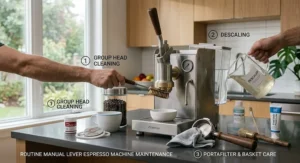
Common first-month mistakes include tamping too hard (lever machines don’t need commercial-level tamp pressure), pulling the lever too fast (which channels water unevenly through the puck), and giving up on a grind adjustment after just one bad shot instead of dialing in gradually. Maintenance is light across this category — a weekly backflush or basket soak in warm water with a small amount of espresso machine cleaner, and gasket inspection every few months, keeps most of these machines running for years.
Real-World Scenarios: Who Should Actually Buy One
If you’re a college student sharing a dorm kitchen with three roommates, the Flair Classic or ROK EspressoGC make the most sense — no outlet competition, no permanent counter footprint, and low enough cost that a bad semester doesn’t sting. If you’re a remote worker who drinks two or three espresso-based drinks a day and wants the ritual built into your morning without babysitting temperature, the Flair 58 or Cafelat Robot fit that rhythm well, since both minimize the fussiest variable in manual brewing.
If you’re a household that regularly hosts weekend brunch and needs to pull four or five drinks in a short window, the La Pavoni Professional or the two-group Ponte Vecchio Lusso are worth the higher investment, since their larger boilers and (in the Lusso’s case) dual groups directly solve the volume problem smaller lever machines struggle with. And if you’re the kind of coffee drinker who already owns a nice grinder and just wants the most traditional, hands-on ritual possible regardless of convenience, the La Pavoni Europiccola remains the emotionally resonant choice — imperfections and all.
Buyer’s Decision Framework: Is a Lever Espresso Machine Worth It?
The honest, unglamorous answer to whether a lever espresso machine worth it question depends entirely on what you’re optimizing for. If speed and consistency are your top priorities, a semi-automatic pump machine will get you there faster with less practice. If you value the process itself — the tactile feedback of the pull, the total control over pressure and pace — a lever machine offers something no pump machine replicates.
Here’s a simple framework: if you want espresso in under 90 seconds with minimal skill investment, skip this category entirely. If you’re drawn to coffee as a craft and don’t mind a genuine learning curve in exchange for total manual control, start with a budget option like the Flair Classic before committing to a boilered machine. If you already know you love the process and want fewer compromises, jump straight to a mid-tier pick like the Flair 58 or La Pavoni Europiccola. And if temperature stability across a whole session matters more than anything else, the Ponte Vecchio Lusso is the only machine on this list purpose-built to solve that specific problem.
How to Choose a Manual Lever Espresso Machine
Picking the right lever machine comes down to weighing a handful of concrete factors against your actual daily habits, not just your Pinterest board. Here’s the order most experienced buyers work through:
- Decide if you want a boiler. Boilerless machines like the Flair Classic and Cafelat Robot are cheaper and simpler but require a kettle for preheating every session.
- Consider your milk needs. Only boilered machines with steam wands, like the La Pavoni Europiccola or Professional, let you steam milk without a separate frother.
- Match your budget to your commitment level. Don’t buy a $900 machine before confirming you actually enjoy the manual brewing ritual on something cheaper first.
- Check portafilter size. A 58mm portafilter, as found on the Flair 58, opens up compatibility with a much wider range of commercial baskets and accessories.
- Think about session volume. If you regularly brew for multiple people, prioritize boiler capacity or a two-group design like the Ponte Vecchio Lusso.
- Factor in counter space and portability. Boilerless, electricity-free machines pack down smaller and travel far better than anything with a built-in boiler.
- Read aggregated owner sentiment, not just marketing copy. Look for recurring themes across multiple independent reviews rather than a single glowing (or scathing) outlier.
Common Mistakes When Buying a Manual Lever Espresso Machine
The most frequent mistake first-time buyers make is assuming a lever machine will feel like their old pod machine with extra steps — it won’t, and that mismatch in expectations causes more returns than any hardware flaw. A close second is buying a boilered, steam-wand-equipped machine like the La Pavoni Professional without first confirming they actually want to steam milk regularly, when a simpler boilerless model plus a $20 handheld frother would have covered the same need for far less money.
Another common misstep is skipping the grinder upgrade entirely. A lever machine paired with a mediocre grinder will underperform badly regardless of how much the machine itself cost, since even pressure and even extraction depend on grind consistency the machine has no way to compensate for. Finally, plenty of buyers overlook portafilter size before purchasing, then discover their existing basket collection or aftermarket accessories don’t fit — checking whether a machine uses a 49mm, 51mm, or 58mm portafilter before buying saves real headaches down the line.
Manual Lever Espresso Machine vs Semi-Automatic Espresso
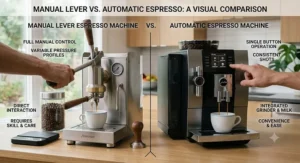
The core lever vs semi automatic espresso debate comes down to who controls the pressure curve during extraction. A semi-automatic machine uses an electric pump to deliver a fixed or programmable pressure profile — consistent, repeatable, and largely hands-off once you’ve dialed in your settings. A manual lever machine puts that entire curve in your hands (literally), which means every shot can be slightly different based on how you pull, but also means you can shape the extraction in ways no button-driven pump allows.
In practice, this plays out as a trade between consistency and control. Semi-automatic machines are more forgiving for daily, high-volume use — hit the button, walk away, get a reliably similar shot every time. Lever machines reward attention and punish inattention; a rushed pull or an inconsistent grind shows up in the cup immediately, but a well-executed pull on a machine like the Ponte Vecchio Lusso or La Pavoni Europiccola can produce a texture and body that many enthusiasts describe as more layered than what a standard 9-bar pump profile delivers. Neither approach is objectively better — it genuinely depends on whether you view brewing espresso as a task to automate or a skill to develop, which is really the whole appeal of traditional espresso brewing methods that predate electric pumps entirely. According to Wikipedia’s overview of La Pavoni, the company’s direct-lever Europiccola and Professional models — introduced in 1961 and 1974 respectively — helped define this entire manual category and were significant enough to be included in a Museum of Modern Art design exhibition.
Lever Machine Learning Curve and Pressure Profiling by Hand
Every manual lever espresso machine carries a real lever machine learning curve, and pretending otherwise does new buyers a disservice. Expect your first two to three weeks of shots to be inconsistent — some too fast and sour, some too slow and bitter — as you calibrate grind size, dose, and pull speed against each other simultaneously rather than adjusting one variable at a time like you might on an automated machine.
Pressure profiling by hand is the actual skill being developed during that curve. Because you control the lever’s speed and force throughout the entire pull, you can intentionally start slow to pre-infuse the puck evenly, build to peak pressure through the middle of the shot, and taper off toward the end — a manual version of what expensive commercial machines charge a premium to automate electronically. What the spec sheet won’t tell you is that this manual profiling ability is precisely why enthusiasts gravitate toward machines like the Flair 58 and Cafelat Robot: the pressure gauges on both give real-time visual feedback, turning what would otherwise be a guessing game into a skill you can actually see yourself improving at, shot by shot. A recent physics analysis of espresso extraction dynamics notes that pressure-driven extraction fundamentally changes flow behavior through the coffee puck compared to gentler brewing methods, which helps explain why small changes in your lever pull translate into such noticeably different cups.
Manual Lever Espresso Machines for Home Baristas
A lever espresso machine for home use asks something different of a buyer than a commercial-grade unit would. Home baristas typically brew for one to three people at a time, have realistic counter space constraints, and — critically — value the meditative, unhurried pace of the ritual rather than needing to serve a line of customers.
That context changes which machines actually make sense. The single-group La Pavoni Europiccola and boilerless options like the Flair Classic are purpose-built for exactly this use case: modest daily volume, a manageable footprint, and a brewing process that rewards the kind of unrushed attention a home kitchen (unlike a busy café counter) can actually accommodate. Commercial environments, by contrast, generally can’t tolerate a lever machine’s slower per-shot pace or the minute-long pressure recovery between pulls — which is precisely the gap the two-group Ponte Vecchio Lusso was engineered to close for higher-volume settings, while still remaining realistic for a well-equipped home kitchen that regularly entertains.
Long-Term Cost & Maintenance
The upfront price tag is only part of the ownership equation. Lever machines are mechanically simple compared to pump-driven alternatives, which generally means lower long-term maintenance costs — there’s no pump to fail, and in the case of boilerless machines like the Flair Classic or Cafelat Robot, no heating element or thermostat to eventually replace either.
Where costs do show up: gaskets and seals wear over time on every machine in this category and typically need replacing every one to three years depending on use frequency, usually for $10-$30 in parts. Boilered machines carry a small additional electricity cost that’s negligible for home use, and higher-end models like the La Pavoni Professional or Ponte Vecchio Lusso may eventually need professional descaling in hard-water areas. Weighed against a daily $5 café habit, even the priciest machine on this list — the Ponte Vecchio Lusso — typically pays for itself within the first year for a regular one-to-two-drink-a-day household, which is the real long-term value argument for this entire category.
Frequently Asked Questions
❓ Is a manual lever espresso machine hard to learn?
❓ Do manual lever espresso machines need electricity?
❓ Which manual lever espresso machine is best for beginners?
❓ Can lever espresso machines steam milk?
❓ How long do lever espresso machines typically last?
Conclusion
Choosing among these seven machines really comes down to how much of the process you want to control versus automate, and how much counter space and budget you’re realistically working with. Beginners and budget-conscious buyers should start with the Flair Classic or ROK EspressoGC, both of which offer genuine 6-9 bar lever espresso without asking for a big financial commitment upfront. Buyers ready for a daily-driver upgrade should look at the Cafelat Robot or Flair 58, depending on whether minimal maintenance or thermal consistency matters more to them personally.
For anyone chasing the full traditional ritual — boiler, steam wand, and all — the La Pavoni Europiccola remains the emotional and historical heart of this category, while the La Pavoni Professional scales that same experience up for households that entertain often. And for buyers who’ve already lived with a lever machine’s quirks and want the one model engineered specifically to eliminate temperature drift, the Ponte Vecchio Lusso stands alone at the top of this list. Whichever you choose, the underlying appeal is the same: a slower, more deliberate cup of espresso that a pump machine simply can’t replicate. For general background on how these machines fit into the wider espresso equipment landscape, Wikipedia’s espresso machine overview is a useful starting point, and pioneering manufacturers like Gaggia, whose founder patented an early pressure-based brewing method in 1938, are worth reading about if you want the fuller history behind why pressure brewing works the way it does.
Recommended for You
- Is Jura Worth the Price in 2026? 7 Models, Honest Verdict
- Jura S8 vs Z10: 7 Real Differences That Justify $1,000 (2026)
- Jura Z10 Review 2026: 7 Rivals Tested, Is It Worth $3K?
Disclaimer: This article contains affiliate links. As an Amazon Associate, I earn from qualifying purchases. If you purchase products through these links, we may earn a small commission at no additional cost to you.
✨ Found this helpful? Share it with your friends! 💬🤗
