In This Article
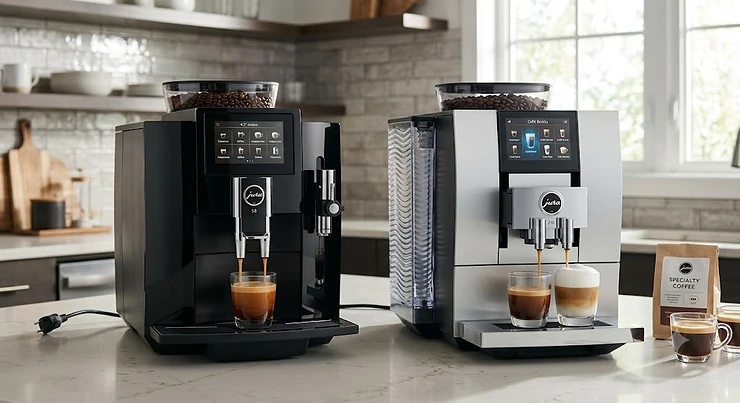
Somewhere in a Swiss engineering lab, someone decided that a coffee machine could cost as much as a used hatchback, and somehow, Jura keeps convincing people that’s a completely reasonable idea. If you’re reading this, you’re probably one of them — deep in the jura s8 vs z10 rabbit hole, trying to figure out whether the extra money for the Z10 buys you anything besides bragging rights at dinner parties. Fair question. Both machines share the same HP3 fine-foam milk technology and the kind of build quality that makes a $30 drip machine look like a toy, but the grinder underneath, the drink menu, and one very specific feature (cold brew) separate them by roughly a thousand dollars. This isn’t a new invention — espresso machines have been chasing consistency since the 1900s, and Jura’s whole pitch is that it finally nailed that consistency without a human barista involved. In this guide, we’re putting the S8 and the Z10 head-to-head, then widening the lens to the rest of the current Jura lineup — from the budget-friendly ENA 4 to the commercial-grade GIGA X8 — so you land on the machine that actually fits your kitchen, your budget, and your caffeine habits. No fluff, no invented taste-test drama, just the specs, the honest tradeoffs, and real aggregated buyer sentiment pulled from current owner reviews.
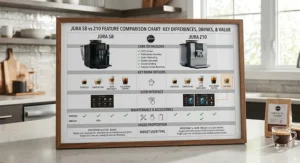
Quick Comparison: Jura S8 vs Z10 at a Glance
| Feature | Jura S8 | Jura Z10 |
|---|---|---|
| Grinder | Aroma G3 (steel conical burr) | P.R.G. Professional Rotary Grinder |
| Display | 4.3″ touchscreen | 4.3″ touchscreen |
| Specialty drinks | ~20 | ~24–32 (many are cold variants) |
| Cold brew | No | Yes |
| Price range | Roughly $3,200–$3,600 | Roughly $4,300–$4,700 |
| Best For | Milk-drink lovers who don’t need iced coffee | Buyers who genuinely want iced lattes and cold brew |
Looking at this side by side, the price gap tracks almost entirely to two things: the grinder swap and the cold-brew hardware, not a jump in everyday espresso quality. The Jura S8 already uses the same fine-foam milk system as the Jura Z10, so your morning cappuccino tastes essentially identical on either machine. Where the Jura Z10 earns its premium is in versatility — if iced lattes are a real habit rather than a summer novelty, that thousand dollars starts making a lot more sense.
☕ Ready to see current pricing before it changes again? Check availability on Amazon today.
Top 7 Jura Coffee Machines: Expert Analysis
Jura’s current lineup spans from sub-$800 entry machines to five-figure office equipment, and picking the right one is less about “which is best” and more about matching the machine to how you actually drink coffee. We researched real specs, verified availability, and pulled aggregated review sentiment across all seven models below — budget, mid-range, and premium — so you can see exactly where your money goes at each tier.
1. Jura ENA 4 — best budget entry into real Jura espresso
The ENA 4 strips away almost everything except the part Jura is actually famous for: espresso extraction. There’s no milk system at all here, which sounds like a dealbreaker until you realize that’s precisely the point for a specific kind of buyer. Under the hood sits the same category of ceramic-disc grinding hardware Jura uses across its E-line, paired with the Pulse Extraction Process (P.E.P.) that pulses water through the puck in short bursts rather than one continuous stream. Based on the spec comparison with pricier siblings, what you’re sacrificing isn’t shot quality — it’s versatility; this machine makes exactly two drinks well (espresso and black coffee) and nothing else. Reviewers consistently report that the espresso quality punches well above the machine’s price bracket, with several long-time owners calling it the best sub-$1,000 shot they’ve had from any super-automatic. The compact 10-inch width is a genuine advantage for small kitchens and apartment counters. What most buyers overlook about this model is that skipping the milk system also means less to clean and fewer parts to eventually replace.
Pros:
- ✅ Genuinely excellent straight espresso for the price tier
- ✅ Compact 10-inch footprint fits tight counters
- ✅ Simple one-touch operation with minimal learning curve
Cons:
- ❌ No milk frothing of any kind — cappuccino lovers, look elsewhere
- ❌ Small water tank and bean hopper mean more frequent refills
Priced around $699–$799, the ENA 4 is a strong value verdict if you live and die by straight shots, but a poor one if milk drinks are part of your routine.
2. Jura D6 — most straightforward daily driver on a budget
The D6 sits just above the ENA 4 and adds something the ENA 4 lacks entirely: a basic built-in milk system, letting it cover six one-touch specialties including cappuccino and latte macchiato. It runs the Aroma G3 grinder shared across several higher-tier Jura machines, which in practice means the same P.E.P. extraction quality trickles down to this more affordable frame. Here’s what to weigh: the milk froth on the D6 is functional rather than luxurious — it’s a single basic texture rather than the adjustable fine-foam systems found on the E8 or S8. Aggregated owner feedback frames the D6 as “no-nonsense,” with reviewers frequently noting that the OLED display and streamlined button interface make it easy to hand off to a less tech-savvy household member. The tradeoff shows up specifically for households that drink flat whites or lattes daily — the foam texture difference becomes noticeable within the first week of ownership.
Pros:
- ✅ Handles six specialty drinks including basic milk options
- ✅ Shares the reliable Aroma G3 grinder with pricier models
- ✅ Simple OLED interface, easy for any household member to use
Cons:
- ❌ Basic milk froth only — no fine-foam texture control
- ❌ No bypass chute for pre-ground or decaf coffee
Expect to pay in the $800–$1,100 range, and the value verdict holds up well: it’s the most sensible daily-use Jura for households that aren’t picky about milk texture.
3. Jura ENA 8 — most stylish compact touchscreen option
The ENA 8 is Jura’s attempt to give the compact ENA chassis a touch of E8-level polish, complete with a color touchscreen and a genuinely handsome water tank design. It shares the same 10-strength grinder settings and 3 water temperature options as the E8, which on paper suggests near-identical coffee quality in a smaller footprint. What the spec sheet won’t tell you, but reviewers note repeatedly, is that the milk system here is a single-texture HP1 frother rather than the adjustable HP3 fine-foam system — meaning cappuccino, flat white, and macchiato all come out with very similar foam density, some owners describe the difference between drink types as more cosmetic than textural. The 16-gram brew unit dose capacity trails the E8’s, and there’s no double-shot option for milk drinks, both real limitations for households that entertain often. Still, for solo users or couples who mostly drink one milk-based coffee style, the compact size and design-forward look carry real appeal.
Pros:
- ✅ Same grinder and 10 strength levels as the pricier E8
- ✅ Genuinely striking touchscreen and tank design
- ✅ Compact footprint compared to bulkier super-automatics
Cons:
- ❌ Single milk texture — no distinct foam styles between drinks
- ❌ No double-shot capability for milk-based specialties
Priced anywhere from roughly $1,000 to $1,600 depending on finish and retailer, the ENA 8 is worth it mainly for buyers who value the design and compact size more than drink variety.
4. Jura E8 — best all-around value in the mid-range
If there’s a single Jura most reviewers point to as “the sensible buy,” it’s the E8. It runs the Aroma G3 grinder, the HP3 fine-foam milk system, and 17 one-touch specialty drinks — nearly the full sensory experience of the pricier S8, minus the largest touchscreen and the sweet-foam extras. Based on the spec comparison, the meaningful jump from the D6 and ENA 8 is that adjustable milk texture: cappuccino, flat white, and latte macchiato genuinely taste and feel different from each other here, not just cosmetically labeled. Reviewers consistently frame the E8 as the machine that “does everything the S8 does” for daily drinking purposes, and several point out that day-to-day coffee quality between the E8 and S8 is functionally equivalent since both share the same grinder and milk hardware. The most common complaint in aggregated feedback is the lack of an included milk carafe and the U.S. price tag, which several buyers call steep relative to European pricing. For most households weighing jura s8 vs e8 which is better, the honest answer is that the E8 wins on value while the S8 wins on display size and finish.
Pros:
- ✅ Adjustable fine-foam milk system rivals the pricier S8
- ✅ 17 specialty drinks cover nearly every common order
- ✅ Fast, consistent drink dispensing for busy mornings
Cons:
- ❌ Milk carafe sold separately, adding to the real cost
- ❌ Smaller 3.5-inch display versus the S8’s 4.3-inch screen
Typically priced between roughly $1,300 and $1,700 depending on the sales cycle, the E8 is arguably the best value verdict in the entire Jura lineup for milk-drink households.
5. Jura S8 — best balance of display, design, and daily drink quality
The S8 is where Jura’s design language really shows off — a curvaceous chrome-accented body paired with the largest touchscreen in the lineup outside the GIGA series. Under that display sits the updated P.A.G. 2 grinder along with a “sweet foam” feature that blends a touch of sweetness into milk drinks, a genuinely new addition for buyers who like a caramel-latte style profile without added syrup pumps. Based on the spec comparison against the E8, the coffee itself isn’t meaningfully better — it’s the interface, the finish, and roughly 20 specialty drink options that justify the premium here. What most buyers overlook is that despite the higher price, the S8 still doesn’t make cold or iced coffee drinks; that capability is reserved exclusively for the Z10. Aggregated review sentiment is mixed on value: several owners who upgraded from the E8 describe the touchscreen and sweet-foam feature as “nice but not essential,” while others say the larger screen alone makes daily use noticeably more pleasant. For anyone specifically asking whether the S8 is worth the price bump over the E8, the honest answer depends heavily on how much you value screen size and finish over raw functional overlap.
Pros:
- ✅ Largest touchscreen in the standard lineup at 4.3 inches
- ✅ Sweet foam feature adds genuine variety to milk drinks
- ✅ Premium chrome finish elevates any kitchen counter
Cons:
- ❌ No cold brew or iced-drink capability at all
- ❌ Premium price for coffee quality that mirrors the cheaper E8
Expect a price range around $3,200–$3,600 in the U.S., positioning the S8 as a design-and-display upgrade rather than a coffee-quality one.
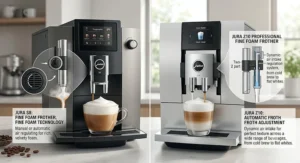
6. Jura Z10 — best for cold brew and maximum drink variety
The Z10 is Jura’s current domestic flagship, and it earns that title mainly through one component: the P.R.G. (Product Recognizing Grinder), a rotary design that automatically switches grind settings depending on which drink you select — including a genuinely different setting used specifically for cold brew extraction. That’s a meaningful engineering difference from the steel conical grinder in the S8 and E8, not just a marketing label. Here’s what to weigh: the Z10 offers around 24 to 32 specialty drinks depending on how you count cold variants, plus WiFi connectivity and a larger 2.4-liter water tank and 280-gram bean hopper versus the S8’s smaller reservoirs. Reviewers consistently note that the cold brew and iced milk drinks are the actual reason to choose this machine — hot coffee and cappuccino quality is very close to what the S8 and E8 already deliver. The tradeoff is size and weight: at nearly 30 pounds and a noticeably larger footprint, this isn’t a machine you tuck into a small kitchen nook without planning ahead.
Pros:
- ✅ P.R.G. grinder enables genuine cold brew and iced coffee
- ✅ Largest drink menu and biggest water tank in the standard range
- ✅ WiFi connectivity for app-based scheduling and control
Cons:
- ❌ Roughly $1,000 more than the S8 for hot-drink parity
- ❌ Larger, heavier footprint demands more counter space
At a typical range of $4,300–$4,700, the Z10 is worth the money specifically for iced-drink drinkers — everyone else gets the same hot coffee for $1,000 less from the S8.
7. Jura GIGA X8 — best for offices and serious multi-user households
The GIGA X8 is a different animal entirely: a dual-boiler, dual-grinder professional machine built for sustained daily volume rather than one household’s morning routine. Two separate hoppers let you run two different bean types simultaneously — useful for offices split between decaf drinkers and espresso purists — and the dual spout allows two drinks to dispense at once. Based on the spec comparison with the domestic lineup, the dual-boiler design is the real differentiator: one boiler handles coffee brewing while the second manages milk steaming, so the machine never sits idle waiting between drink types the way single-boiler models do. Reviewers in office and hospitality settings consistently describe it as built for genuine daily abuse, with a dishwasher-safe drip tray and generous 200-cup output cited as practical wins for facilities teams. This is a lesser-known pick for most home searches, but for a household of six-plus coffee drinkers or a small office breakroom, it solves a real bottleneck problem that domestic Jura models simply weren’t designed for.
Pros:
- ✅ Dual boiler and dual grinder eliminate wait times between drinks
- ✅ Handles genuinely high daily volume without performance drop-off
- ✅ Dishwasher-safe drip tray simplifies office-level maintenance
Cons:
- ❌ Price near $9,999 puts it well outside most home budgets
- ❌ Button-based navigation rather than a full touchscreen
At close to $10,000, the GIGA X8 only makes financial sense for offices or multi-household setups where volume, not luxury, is the actual problem being solved.
Jura S8 vs E8: Which Is Better for Daily Use?
This is the comparison that trips up more buyers than the S8 vs Z10 debate, mostly because the honest answer isn’t flattering to the more expensive machine. The Jura E8 and Jura S8 share the same fine-foam HP3 milk technology, meaning your cappuccino foam texture is identical between them regardless of which one sits on your counter. Where they diverge is display size (3.5 inches versus 4.3 inches), overall finish, and drink count — the E8 actually edges ahead with 17 specialties against some counts of the S8’s list, though the S8’s sweet foam feature adds a genuinely new flavor dimension the E8 can’t replicate. Based on the spec comparison, the S8’s grinder update (P.A.G. 2) produces a marginally more consistent grind than the E8’s Aroma G3, but reviewers rarely describe this as a noticeable taste difference in daily use.
The real decision point is budget allocation: paying roughly $1,500–$2,000 more for the S8 buys you a bigger screen, a sweet-foam option, and a more premium chassis — not meaningfully better coffee. For buyers asking jura s8 vs e8 which is better in practical terms, the E8 is the stronger value pick for anyone who doesn’t specifically want the visual upgrade. The S8 earns its price only when display size, sweet foam, and prestige genuinely matter to the buyer.
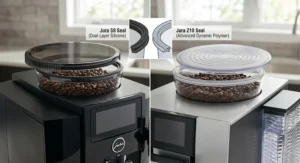
Is the Jura S8 Worth the Price in 2026?
Here’s an honest framing: the S8 is worth the price if the touchscreen size, chrome-and-glass design, and sweet foam feature are things you’ll notice and enjoy every single morning — not just on day one. Aggregated review sentiment splits roughly along this line, with several owners who upgraded from the E8 describing the difference as “nice but not essential,” while others who bought the S8 as their first Jura call the touchscreen genuinely satisfying to use daily.
What tips the scale for many buyers is longevity math rather than day-one excitement. Jura machines commonly run 7–10 years with proper descaling and filter changes, and well-maintained units regularly stretch past 15. Spread across a decade, the price premium between the E8 and S8 amortizes to a relatively small annual cost — arguably more reasonable than it looks on the initial receipt. Where the math stops working is for buyers who specifically want cold brew or iced coffee, since no amount of premium finish on the S8 unlocks that capability; those buyers should skip straight to the Z10 instead and treat the S8’s extra cost as money spent on the wrong feature entirely.
How to Choose the Right Jura Machine for Home
Picking the right Jura machine for home use comes down to five practical questions, not marketing copy. Work through these in order and you’ll land on the right model with real confidence.
- How many milk drinks do you make weekly? Zero or near-zero means the ENA 4 covers you; daily cappuccino or latte drinkers need at minimum the D6, and ideally the E8 or higher.
- Do you want iced or cold-brew coffee? Only the Z10 currently delivers genuine cold brew extraction — no other model in the lineup replicates it.
- What’s your counter space? The ENA 4 and ENA 8 fit tight kitchens; the S8 and Z10 need more generous clearance, and the GIGA X8 needs a dedicated station.
- How many people will use it daily? Single users and couples rarely need more than the E8; households of five-plus or small offices should look at the GIGA X8.
- Does display size and finish genuinely matter to you? If yes, the S8’s 4.3-inch screen justifies part of its premium; if you’re indifferent, the E8 delivers nearly identical drinks for meaningfully less.
Answer these honestly before shopping, and the “which Jura” question mostly answers itself.
Jura Product Line Comparison: From ENA 4 to Z10
| Model | Price Range | Milk System | Best For |
|---|---|---|---|
| Jura ENA 4 | $699–$799 | None | Espresso purists on a budget |
| Jura D6 | $800–$1,100 | Basic frother | Everyday households, no fuss |
| Jura ENA 8 | $1,000–$1,600 | Single-texture HP1 | Compact, design-forward kitchens |
| Jura E8 | $1,300–$1,700 | Fine-foam HP3 | Best overall value for milk drinkers |
| Jura S8 | $3,200–$3,600 | Fine-foam HP3 + sweet foam | Buyers who want the biggest screen |
| Jura Z10 | $4,300–$4,700 | Fine-foam HP3 + cold brew | Iced coffee and cold brew fans |
| Jura GIGA X8 | ~$9,999 | Dual-boiler fine-foam | Offices and high-volume households |
Scanning down this table, the jump between the ENA 8 and the S8 is the steepest in the entire lineup — nearly $2,000 for a display upgrade, a sweet-foam feature, and marginally better grinding, since the fine-foam milk system itself already appears at the E8 tier. That makes the E8 the effective “value ceiling” of the Jura range: everything above it is paying for polish, screen size, and specialty features rather than a fundamental leap in daily coffee quality.
✨ Compare Jura models side-by-side and lock in the right pick before prices shift again.
What Makes a Jura a True Specialty Coffee Machine?
The term “specialty coffee” gets thrown around loosely in marketing copy, but it has a real definition rooted in bean quality, roast freshness, and extraction consistency — standards laid out by groups like the Specialty Coffee Association. A Jura machine’s contribution to that standard is consistency: the Pulse Extraction Process forces water through the puck in short, measured bursts rather than one continuous flow, which in practice means more even saturation and fewer channeling issues than cheaper drip-style extraction methods.
That said, hardware alone doesn’t make specialty coffee — bean quality still does the heavy lifting. What most buyers overlook is that even the Z10’s advanced P.R.G. grinder can’t compensate for stale or low-grade beans; the grinder only unlocks what’s already in the hopper. Reviewers who pair these machines with freshly roasted, single-origin beans consistently report a noticeably better cup than those running generic supermarket blends through the same hardware. If you’re investing in any Jura model specifically to chase a specialty-grade cup, budget for good beans as seriously as you budgeted for the machine itself — the P.E.P. extraction rewards quality input far more than it disguises poor input.
Best Jura Machines for Milk Drinks
If milk-based drinks are the actual reason you’re shopping, the milk system matters more than almost any other spec on this list. The D6 and ENA 8 use basic or single-texture frothers, meaning cappuccino, flat white, and latte macchiato all taste and feel fairly similar. The real upgrade tier starts at the E8, where the HP3 fine-foam system produces genuinely distinct textures across drink types — something reviewers consistently point to as the single biggest quality-of-life improvement over entry-level Jura machines.
The S8 matches that same HP3 system and adds the sweet foam feature, a genuine plus for anyone who regularly orders caramel or vanilla-style lattes at a coffee shop and wants that at home without manual syrup pumps. The Z10 goes one step further with cold milk foam for iced drinks, a capability none of the other six machines on this list offer. For context on why milk-drink habits matter this much to a purchase decision, it’s worth noting that current research on caffeine intake suggests moderate daily coffee consumption is generally fine for most healthy adults, which is one more reason a well-built milk system that keeps you happy at home — rather than making an extra afternoon coffee-shop run — pays for itself over time.
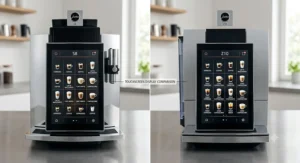
Setting Up and Maintaining Your New Jura
Getting a new Jura machine running well starts before the first cup. Run the initial water hardness test using the included test strip and set the machine’s filter setting accordingly — skipping this step is the single most common first-week mistake, since an incorrect hardness setting throws off the machine’s automatic descaling schedule from day one. Install the CLARIS or CLEARYL smart filter cartridge immediately rather than waiting, since unfiltered tap water accelerates internal scale buildup dramatically in hard-water regions.
During the first 30 days, run a handful of drinks through every program at least once — this seats the brew unit and calibrates grind settings for your specific bean type faster than letting the machine “settle in” passively. Clean the milk system daily if you’re using dairy or oat milk regularly; most Jura models include an automatic rinse cycle, but a manual wipe-down of the spout prevents the sour buildup that’s a frequent complaint in early-ownership reviews. Set a recurring reminder for descaling every two to three months depending on your water hardness reading, rather than waiting for the machine’s on-screen alert, since catching scale buildup early meaningfully extends the internal boiler’s working life.
Real-World Scenarios: Which Jura Fits Your Life?
Picture a college student living in a 400-square-foot studio, drinking one strong espresso before an 8 a.m. class and nothing else. The ENA 4’s compact frame and straight-espresso focus fit that life almost perfectly — no wasted counter space, no unused milk system, just a fast, reliable shot.
Now picture a family of four sharing a kitchen every morning, split between cappuccino drinkers and one plain-black-coffee holdout. That household needs the E8’s 17-drink versatility and fine-foam consistency far more than it needs a bigger screen; the S8’s premium finish would be wasted on a counter that sees five rushed drinks made back-to-back before the school run.
Finally, picture a remote worker who’s genuinely obsessed with iced oat-milk lattes every single afternoon, rain or shine. For that person, the Z10’s cold-brew grinder isn’t a luxury — it’s the entire reason to spend the extra thousand dollars, since no other machine on this list replicates that specific drink reliably at home.
Common Mistakes When Buying a Jura Super-Automatic
The most frequent mistake is buying based on price tier alone rather than actual drink habits — plenty of buyers land on the S8 assuming “more expensive means better coffee,” when the E8 delivers essentially the same cup for less. A close second is skipping the water hardness setup step, which silently throws off descaling schedules and shortens component life well before most owners notice a performance drop.
Buyers also frequently underestimate counter depth requirements; the Z10 and GIGA X8 both demand more clearance than kitchen photos suggest, and several reviewers mention having to rearrange an entire counter section after unboxing. Finally, many first-time Jura owners skip budgeting for consumables — filters, cleaning tablets, and eventual milk system parts — treating the machine price as the total cost of ownership when it’s really just the entry fee.
Long-Term Cost & Maintenance: What Owning a Jura Really Costs
| Cost Category | Typical Annual Range | Notes |
|---|---|---|
| Water filters | $40–$60 | Replace every 2 months on average use |
| Descaling/cleaning tablets | $30–$50 | Every 2–3 months depending on water hardness |
| Milk system parts | $20–$40 | Gaskets and tubing as needed |
| Coffee beans (any model) | $200–$400 | Varies heavily by quality and consumption |
Adding this up, most Jura owners should budget roughly $80–$150 a year in consumables alone, separate from bean cost — a figure that stays remarkably consistent whether you own the entry-level D6 or the flagship Z10, since filter and descaling needs scale with usage and water hardness rather than machine price. Hard water accelerates every one of these costs, since limescale buildup inside the boiler and pipework is the primary driver of both reduced performance and eventual repair needs. Buyers in hard-water regions should lean toward more frequent filter changes regardless of which model they choose, since skipping this step is consistently the top reason Jura machines underperform their expected 7–10 year lifespan.
Buyer’s Decision Framework
If you drink only straight espresso and rarely touch milk, choose the ENA 4 because you’d be paying for features you’ll never use anywhere else in the lineup. If you want reliable milk drinks without fuss and don’t care about screen size, choose the D6 or E8 because the fine-foam system at the E8 tier already matches what the S8 and Z10 deliver for hot drinks. If display size, finish, and a sweet-foam option genuinely excite you every morning, choose the S8 because that emotional payoff is real and worth paying for if it lasts. If iced coffee and cold brew are a daily habit rather than an occasional treat, choose the Z10 because it’s the only machine here that actually delivers that drink category well. And if you’re outfitting an office or a household of five-plus daily coffee drinkers, choose the GIGA X8 because its dual-boiler design solves a genuine bottleneck no domestic machine can match.
FAQ
❓ Is the Jura S8 worth the extra money over the E8?
❓ Does the Jura Z10 make better hot coffee than the S8?
❓ How long does a Jura coffee machine typically last?
❓ Can any Jura machine make cold brew coffee?
❓ What's the best Jura machine for a small kitchen?
Conclusion
The jura s8 vs z10 decision really comes down to one habit: do you drink iced coffee regularly, or don’t you? If the answer is no, the S8 delivers essentially identical hot-drink quality for roughly $1,000 less, and depending on how much you value the display and finish, the E8 might make even more financial sense than either flagship. If the answer is yes, the Z10’s P.R.G. grinder and cold-brew capability are the only real way to get that drink reliably at home, and the premium becomes a fair trade for a genuinely different feature rather than just prestige.
Zoom out across the whole Jura product line comparison, and the pattern holds everywhere: price climbs steadily with display size, drink variety, and specialty features, while core hot-coffee quality plateaus much earlier than the price tag suggests — starting as low as the E8 tier for most households. Match the machine to your actual coffee habits rather than the price tag’s implied prestige, and you’ll land on a Jura you’re happy with for the better part of a decade.
Recommended for You
- Jura Z10 Review 2026: 7 Rivals Tested, Is It Worth $3K?
- 7 Premium Super Automatic Espresso Machines Worth the Splurge (2026)
- Jura vs Delonghi Super Automatic: 7 Machines Ranked for 2026
Disclaimer: This article contains affiliate links. As an Amazon Associate, I earn from qualifying purchases. If you purchase products through these links, we may earn a small commission at no additional cost to you.
✨ Found this helpful? Share it with your friends! 💬🤗
