In This Article
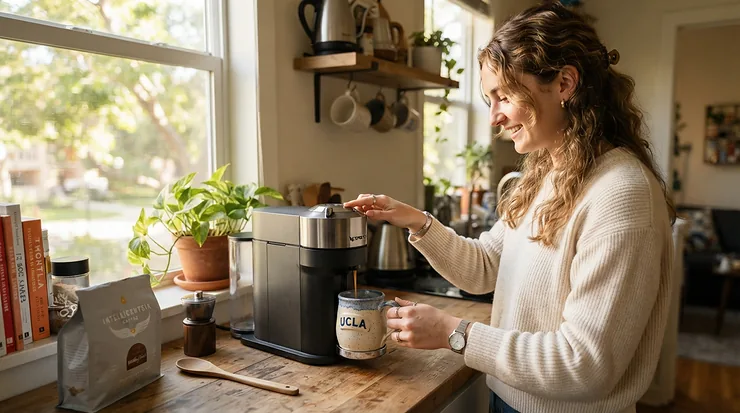
A compact thermoblock espresso machine for dorm rooms is a small, semi-automatic or pod-based espresso maker that heats water on demand through a metal block instead of a storage boiler. It’s ready in seconds, fits on a desk shelf, keeps its heater sealed inside the body, and still pushes pressurized water through coffee. Think café ritual, minus the café footprint.
Here’s the tension every student knows. Your room is roughly the size of a generous walk-in closet. Your roommate owns more laundry than furniture. Your 8 a.m. lecture does not care that you slept four hours. Meanwhile, the campus coffee line quietly drains your account by midterms. A dorm-friendly espresso machine looks like the obvious fix, until you remember that housing offices treat anything with a glowing coil like a suspect in a lineup.
The good news is that the rules are friendlier than the rumors. A survey of 101 college appliance policies found coffee makers allowed at 91 schools, prohibited at five, and dependent on the building at another five. The real dividing line is exposed heating elements, not caffeine. Thermoblock machines hide the heater inside the body, which is exactly why they dominate this category.
Below you’ll find seven real machines, from bare-bones budget picks to a premium compact. Each is interpreted for dorm life: footprint, wattage, tank size, easy cleanup, and what the spec sheet quietly leaves out. We’ll also cover portability for move-in and move-out, how a small thermoblock machine for students fits real schedules, and where student budget appliances actually earn their keep. Grab a mug. A small one. Space is tight.
Quick Comparison: 7 Thermoblock-Style Espresso Makers That Fit a Dorm Desk
Specs come from manufacturer and retailer listings gathered at the time of research. Prices are ranges, so check current price before you buy.
| Machine | Type | Approx. width | Water tank | Price range | Best For |
|---|---|---|---|---|---|
| Casabrews 3700 Essential | Semi-auto, 20-bar | ~5.7″ | 43.9 oz | $100–$150 | Lowest-cost entry with a big tank |
| Casabrews CM5418 | Semi-auto, 20-bar, pressure gauge | ~5.5–5.9″ | 34 oz | $100–$160 | Tinkerers on a tight budget |
| Casabrews CM7036E | Nespresso Original pods, 20-bar | See listing | 21 oz | Under $200 | Pod simplicity without Nespresso-brand pricing |
| Nespresso Essenza Mini | Pods, 19-bar | ~3.3–4.3″ | 20.3 oz | $150–$200 | Smallest footprint and easiest portability |
| De’Longhi Dedica EC685 | Semi-auto, 15-bar | ~5.9″ | ~37 oz | $200–$300 | Slim all-rounder (grounds or pods) |
| Breville Bambino | Semi-auto, manual steam | Under 8″ | 47 oz | $250–$350 | Learning real latte technique |
| Breville Bambino Plus | Semi-auto, automatic steam | ~7.7″ | 64 oz | $350–$500 | Hands-off milk drinks |
Read the table sideways and a pattern emerges. The two budget Casabrews portafilter machines undercut everything on price while staying under six inches wide, but they expect you to supply a grinder and some patience. The Nespresso Essenza Mini and Casabrews CM7036E trade craft for convenience. The De’Longhi Dedica EC685 is the slim all-rounder, accepting ground coffee or ESE pods, which helps when your schedule swings between “perfect ritual” and “five minutes to class.” At the premium end, the Breville Bambino versus the Breville Bambino Plus decision comes down to whether you steam milk by hand or let the machine do it.
One thing the table can’t show is wattage. The models with published figures draw roughly 1,255 to 1,560 watts. That’s normal for any espresso maker, but strict campuses cap it. Carnegie Mellon, for example, limits personal appliances to 700 watts, according to that same policy survey. Confirm your school’s limits before you click buy.
💬 Just one click — help others make better buying decisions too!😊
Top 7 Compact Thermoblock Espresso Machines for Dorm Rooms: Expert Analysis
Every entry follows the same logic: what the specs mean in a cramped room, who should buy it, what reviewers report, and where it falls short. Where I couldn’t verify a deep review pool, I say so instead of inventing one. One honesty note up front: Breville’s Thermojet heater is its own proprietary on-demand design, in the same family as a thermoblock. I’m including both Bambino models because shoppers in this category constantly run into them.
1. Casabrews 3700 Essential — biggest tank for the least money
The standout is the 43.9 oz removable tank, generous for a machine this cheap. That means fewer refill trips down the hallway during finals week. The spec sheet lists a 20-bar pump, roughly 1,350 W of heating power, and dimensions of about 5.7 inches wide, 12.6 deep and 12.2 high. In practice, that width is narrower than most textbooks lying flat, so it slides onto a shelf or desk corner without a fight. As for the “20 bar” headline, it describes pump capability. Espresso is traditionally brewed near 9 bars, so don’t let that number drive your decision.
This one suits first-time buyers who want a real portafilter experience at the lowest sticker price and can tolerate a learning curve. TechRadar’s review calls it beginner-friendly and space-savvy, but flags inconsistent shot quality, and consistency is the thing you’re actually paying for. It’s close to a twin of the CM5418, sharing the portafilter size and nearly the same dimensions.
Pros:
- ✅ Large tank for the price class
- ✅ Narrow footprint fits shelves and desks
- ✅ Beginner-friendly controls and steam wand
Cons:
- ❌ Shot-to-shot consistency can be uneven
- ❌ Needs ground coffee or a separate grinder
Expect roughly the $100–$150 range at the time of research; check current price. Verdict: strong value if you accept some tinkering.
2. Casabrews CM5418 — a pressure gauge that teaches while you brew
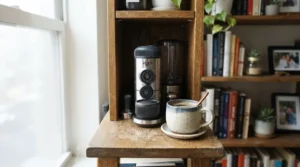
That little built-in gauge is the quiet star. It shows what the pump is doing mid-shot, turning every morning into a mini-lesson in grind size and tamping. The machine pairs a 20-bar pump with a 51 mm portafilter, a steam wand, low-pressure pre-infusion and a purge function that adjusts temperature after steaming. It measures about 5.5 to 5.9 inches wide, roughly 12.3 inches deep and 12 inches tall, and weighs around 8.6 pounds. Translation: slim enough for a shelf, light enough to carry across a quad.
The catch is the 34 oz tank. Tom’s Guide pointed out it’s about half the size of the Bambino’s, so you’ll refill more often. On paper, the gauge makes this a better teacher than the Casabrews 3700 Essential, though the smaller tank costs you daily convenience.
Tom’s Guide found it makes pretty good espresso for the money, with thinner crema than pricier machines deliver. Tom’s Coffee Corner flagged the slim tank, which can spill if you seat it carelessly, and a small drip tray. A buyer review on Walmart mentions pump noise, so consider your light-sleeping roommate.
Pros:
- ✅ Pressure gauge gives live brewing feedback
- ✅ Slim body fits shelves and corners
- ✅ Pre-infusion and purge function included
Cons:
- ❌ 34 oz tank means frequent refills
- ❌ Pump noise noted in buyer reviews
Roughly the $100–$160 range; check current price. Verdict: the best budget pick for students who enjoy tinkering.
3. Casabrews CM7036E — pods, presets and a built-in waste drawer
Pods are the cheat code for easy cleanup, and this machine leans into it. The retail listing describes a 20-bar pump for Nespresso Original capsules, a roughly 25-second brew, four presets (Ristretto, Espresso, Lungo and Americano), a 21 oz removable tank good for about 12 cups, and a drawer that holds six to eight used pods. No grinding, no tamping, no knock box.
Who’s it for? The student who wants espresso-style coffee in under a minute and zero kitchen skills. The preset buttons mean your sleepy brain makes exactly one decision. Be aware that you’re locked into the Nespresso Original capsule system, so ongoing cost depends on the pods you choose.
Review sentiment: I couldn’t verify a deep, independent review pool for this specific model, so the details above lean on the retailer’s own description. Treat it as promising but unproven, and read current buyer reviews before purchasing. The listing I found also didn’t confirm the exact heater type; pod machines in this class typically heat on demand, but verify on the spec sheet.
Pros:
- ✅ Four one-touch drink presets
- ✅ Used-pod drawer simplifies cleanup
- ✅ Compatible with Nespresso Original capsules
Cons:
- ❌ Limited independent review coverage
- ❌ Capsule-only brewing, no ground coffee
Expect it under the $200 range; check current price. Verdict: worth a look for pod fans, but wait for more reviews if you’re risk-averse.
4. Nespresso Essenza Mini — the narrowest machine on this list
Smallest wins, sometimes. Depending on version, this machine measures roughly 3.3 to 4.3 inches wide, which means it takes up less desk than a stack of paperbacks. Breville’s spec sheet lists a 19-bar pump, a thermoblock heating element, about 25 seconds to heat up, a 0.6 L removable tank, a drawer for five to six used capsules, two programmable cup sizes (40 ml espresso and 110 ml lungo), and auto-off after nine minutes. It weighs about 2.3 kg (5.1 pounds), which matters enormously on move-out day.
In real terms, that auto-off is a dorm-safety bonus, because it guards against the “did I unplug it?” panic halfway across campus. The trade-offs are a small tank you’ll refill often and no steam wand, so milk drinks need a separate frother.
Review sentiment: I couldn’t verify a robust U.S. review pool for this exact SKU. What I can say is that buying guides repeatedly name the Nespresso Essenza Mini among the narrowest espresso machines available.
Pros:
- ✅ Tiny footprint, ideal for crowded desks
- ✅ 25-second heat-up and auto shut-off
- ✅ Capsule drawer makes cleanup simple
Cons:
- ❌ Pod costs add up over a semester
- ❌ Small tank and no built-in steam wand
Roughly the $150–$200 range depending on bundle; check current price. Verdict: the best pick for portability and tidiness.
5. De’Longhi Dedica EC685 — slimmest portafilter machine here
At about 14.9 cm (5.9 inches) wide, the De’Longhi Dedica EC685 is essentially a tall, skinny appliance that borrows desk height instead of desk width. Listings show a 15-bar pump, a thermoblock heater, a 1.1 L tank, 1,300 W of power, dimensions of 149 × 330 × 304 mm, and a weight of 4.2 kg (about 9.3 pounds). It also fits cups up to 120 mm tall with a height-adjustable holder, so a travel tumbler may squeeze in. The heat-up time is roughly 40 seconds.
What makes it flexible is that it accepts ground coffee or E.S.E. pods. On a dorm schedule, that’s pure gold: pods for rushed mornings, fresh grounds when you’ve got ten minutes and a point to prove. The cup-warming surface is a charming extra, though not a reason to buy.
Review sentiment: I found plenty of commentary comparing other machines to this one, but not a verified volume of direct buyer reviews. Tom’s Coffee Corner notes that the Casabrews CM5418 copies its look and pre-infusion behavior while shipping with a smaller, slimmer tank.
Pros:
- ✅ Very slim body saves precious desk space
- ✅ Works with grounds or E.S.E. pods
- ✅ Larger 1.1 L tank than the Casabrews
Cons:
- ❌ Costs more than the budget Casabrews picks
- ❌ Steam nozzle takes practice for good foam
Roughly the $200–$300 range; check current price. Verdict: the sweet spot if you can stretch your budget.
6. Breville Bambino — ready in three seconds, built to teach
Three seconds. That’s Breville’s stated heat-up time for its Thermojet system, and it changes the morning math completely. Specs include 1,560 W, a 47 oz (1.4 L) tank, a 54 mm portafilter dosing about 18 to 19 grams, digital temperature control, one-touch one-cup and two-cup volumes, a hot water button, and a manual steam wand. The width falls under eight inches, though retailers list it anywhere from 6.3 to 7.7 inches, so check the spec sheet for your exact version.
The manual wand is both the best and worst thing about it. Steam power is modest, according to Seattle Coffee Gear, so milk takes longer than on bigger machines. The reward is real latte-art practice. It also ships with both pressurized and non-pressurized baskets, which helps beginners using pre-ground coffee.
Buyer feedback on eBay calls it easy to use and easy to clean and a good starter machine. One reviewer reported weak pressure until they stopped using the finest grind, and another called the plastic steam-tip tool flimsy.
Pros:
- ✅ Heats up in about three seconds
- ✅ Includes pressurized and standard baskets
- ✅ Manual steam wand builds real skills
Cons:
- ❌ Steam is slower than larger machines
- ❌ Highest wattage in this lineup, so check campus limits
Roughly the $250–$350 range; check current price. Verdict: the best value for someone serious about learning.
7. Breville Bambino Plus — automatic milk for hands-off lattes
If the Breville Bambino is a driving lesson, the Breville Bambino Plus is the automatic transmission. The automatic steam wand lets you pick milk temperature (warm, ideal or hot) and foam level (low, medium or high), then handles the texturing itself. Add a 64 oz tank, a 54 mm portafilter, an auto-purge after steaming, a flushing reminder after 200 extractions, and automatic cleaning and descaling functions, and you’ve got the most self-managing machine here. It measures roughly 7.7 inches wide, 12.6 deep and 12.2 high.
That convenience carries a price in size and cost. It’s the biggest, thirstiest machine on this list. But the large tank is a real quality-of-life upgrade if you make lattes daily, and the maintenance reminders protect the heater from neglect.
A Walmart reviewer called it brilliant, noted it doesn’t take much bench space, said the portafilter was stiff at first but loosened after about six coffees, and mentioned buying a grinder as well.
Pros:
- ✅ Automatic wand adjusts texture and temperature
- ✅ 64 oz tank outlasts every other model here
- ✅ Built-in cleaning and descaling prompts
Cons:
- ❌ Costs the most of the seven
- ❌ Still needs a separate grinder for best results
Roughly the $350–$500 range; check current price. Verdict: premium, but excellent if milk drinks are your daily habit.
Easy Cleanup: A Practical Usage Guide for Small Dorm Spaces
Easy cleanup is the difference between an espresso habit and an expensive paperweight. Thermoblock machines are naturally tidy: no boiler to drain, no giant reservoir sloshing around. What you need is a routine short enough to finish before your coffee cools.
Daily (two minutes). Knock out the puck, rinse the portafilter and basket at the bathroom or kitchen sink, and wipe the steam wand immediately, because milk bakes on fast. A Breville Bambino buyer specifically recommends wiping the wand right after steaming. Empty the drip tray when it’s half full, and leave the tank lid ajar overnight so it dries.
Weekly. Pull the tank, wash it with mild soap, and rinse well. Soak the basket in warm water. For the Breville Bambino Plus, Breville says to hand-wash removable parts and wipe the housing with a damp cloth.
Descaling. Thermoblocks have narrow internal channels, and scale there is a classic way for these machines to die early. One parts supplier’s glossary warns it can be impossible to clear once it takes hold. How often you descale depends on water hardness and usage. General guidance runs about every four to eight weeks with frequent use, but your manual wins. Citric acid is the standard descaling agent, and one maintenance guide suggests about 20 grams per liter followed by two clear-water rinses. Some guides caution against undiluted vinegar, so check your manufacturer’s instructions first.
First-30-days mistakes. Using straight hard-water tap water, forgetting to purge after steaming, and letting the drip tray overflow onto your desk (and possibly your laptop). Don’t be that student.
Real-World Scenarios: Three Illustrative Student Profiles
These are hypothetical profiles built to show how the machines map to real constraints, not real customers.
The budget-first freshman. Shared double, a $120 total budget, and one or two drinks a day. The Casabrews CM5418 (or the Casabrews 3700 Essential if you want the bigger tank) is the logical match. Buy pre-ground coffee at first, then add a hand grinder when your allowance allows. Expect a few weak shots while you learn.
The pod-policy sophomore. Lives in a building that follows Columbia-style rules: pod machines allowed, anything with an exposed heating plate banned. Mornings are a blur, and the room is tiny. The Nespresso Essenza Mini wins on footprint, 25-second heat-up and the used-capsule drawer. Budget around $200 plus capsules.
The grad student with a single room. Daily lattes, a $400-plus budget, and a strong opinion about oat milk. The Breville Bambino Plus delivers automatic texturing and a tank that rarely runs dry. If you’d rather learn real technique and save money, the manual Breville Bambino is the better teacher.
The pattern: decide how much effort you’ll tolerate before 9 a.m., then buy the machine that matches that number, not your aspirational self.
Problem → Solution: Dorm Espresso Headaches Fixed
Problem: the breaker trips. Most espresso machines draw 1,200+ watts. NFPA advises students not to overload circuits, so run the machine alone on its outlet instead of sharing it with a heater or microwave.
Problem: the pump sounds like a small helicopter. Buyer reviews note noise on 20-bar Casabrews models. Brew before your roommate wakes, and set the machine on a folded towel to dampen vibration.
Problem: weak, watery shots. One Breville Bambino buyer solved weak pressure by moving away from the finest grind. If shots run fast and thin, adjust grind and tamp before blaming the machine.
Problem: spilled tank. Tom’s Coffee Corner’s experience with the Casabrews CM5418 shows slim tanks can spill if misaligned. Seat the tank slowly, and fill it at the sink instead of carrying it full.
Problem: crusty steam wand. Wipe and purge right after steaming. Thirty seconds beats twenty minutes of scraping.
How to Choose a Dorm-Friendly Espresso Machine: 6 Steps
A dorm-friendly espresso machine isn’t the one with the most bars. It’s the one that survives your housing inspection and your actual routine.
- Check your housing rules first. Search your handbook for “prohibited items” and “heating appliances.” Enclosed heaters usually pass; exposed elements usually don’t.
- Measure your space. Width matters, but depth near 12 inches and height near 12 inches matter too. Check shelf clearance for the steam wand and tall cups.
- Compare wattage to campus limits. Published figures here run about 1,255–1,560 W, which breaks strict caps like 700 W.
- Pick your effort level. Pods for convenience, portafilter machines for craft. Be honest about 8 a.m. you.
- Match tank size to refill tolerance. A 20 oz tank means frequent refills; a 64 oz tank means almost never.
- Plan the grinder and budget. Portafilter machines work best with fresh-ground coffee, so factor in a grinder or buy ground coffee.
Thermoblock vs Boiler vs Pods: What Actually Changes in a Dorm
A thermoblock heats water as it flows through a heated metal block, so these machines come up to temperature in a minute or less, according to Seattle Coffee Gear’s explainer. The downside is that a single thermoblock struggles to brew and steam at the same time, and temperature stability is generally weaker than in a true boiler. Boiler machines hold temperature better but are typically larger and slower to warm up, which is the wrong trade for a closet-sized room.
| Feature | Thermoblock machine | Single-boiler machine | Pod machine |
|---|---|---|---|
| Heat-up | Seconds to about a minute | Longer warm-up | Seconds to 30 seconds |
| Footprint | Compact | Usually larger | Smallest |
| Skill needed | Moderate | High | Minimal |
| Best For | Breville Bambino, De’Longhi Dedica EC685 | Enthusiasts willing to wait for something like the Gaggia Classic Evo Pro | Nespresso Essenza Mini, Casabrews CM7036E |
The takeaway: thermoblocks win on speed and size, boilers on consistency, pods on simplicity. In a dorm, speed and size usually decide the matter. If you’d rather not wait through a boiler’s warm-up before a lecture, thermoblock or pod machines are the pragmatic choice.
Will Your Dorm Allow It? Rules, Wattage and Fire Safety
Dorm rules aren’t uniform, and a few details change everything. Duke and Minnesota ban any appliance with an open heating element. Columbia permits pod machines but prohibits coffee makers with an exposed heating plate. Carnegie Mellon caps personal appliances at 700 watts, according to the policy survey linked earlier, which would exclude every machine here with a published wattage. Santa Clara University’s orientation page approves single-serve brewers but prohibits drip-style makers with exposed heating elements. At Williams, a personal coffee maker is prohibited in dorm rooms but allowed in common rooms.
Because espresso machines with steam wands aren’t always named in policies, email Residential Life and ask directly: “Is an enclosed-element espresso machine allowed in my room?” Get the answer in writing. I’m not a housing official, and policies change, so this is general guidance only.
Safety matters beyond the rulebook. NFPA and the Center for Campus Fire Safety state that unattended cooking and improper use of kitchen appliances remain primary causes of cooking fires in student housing. Their advice includes checking school rules before using electrical appliances, buying only products with an independent testing lab label, and not overloading circuits. Unplug your machine when you leave, and never run it unattended.
Student Budget Appliances: The Real Cost of Ownership
Student budget appliances only count as bargains if they’re cheaper than the habit they replace. Here’s an illustrative calculation, flagged as an assumption rather than a measurement: if a café latte costs about $5 and a home version costs roughly $1–$1.50 in beans and milk, each homemade drink saves around $3.50–$4. At two drinks a week, a $130 machine pays for itself in roughly a semester.
| Tier | Upfront range | Main ongoing cost | Best For |
|---|---|---|---|
| Budget portafilter | $100–$160 | Beans, grinder later | Casabrews CM5418, Casabrews 3700 Essential |
| Pods | $150–$200 | Capsules | Nespresso Essenza Mini, Casabrews CM7036E |
| Mid-range | $200–$350 | Beans, milk | De’Longhi Dedica EC685, Breville Bambino |
| Premium | $350–$500 | Beans, milk, descaler | Breville Bambino Plus |
Pods look cheaper upfront but shift the cost to capsules, so check current capsule pricing before assuming savings. Portafilter machines cost less per drink but add a grinder and a learning curve. The silent line item is descaler, which is cheap compared with replacing a clogged heater. Over a four-year degree, the sensible choice is the machine you’ll still use in senior year, not the one that looked cheapest on move-in day.
Portability: Moving In, Moving Out and Storing Over Summer
Portability is the feature nobody thinks about until they’re hauling a box up three flights of stairs. The Nespresso Essenza Mini weighs about 2.3 kg (5.1 pounds) and is one of the easiest to carry. The De’Longhi Dedica EC685 is about 4.2 kg (9.3 pounds), and the Casabrews CM5418 is around 8.6 pounds, both manageable with one hand and a free elbow.
Move-out routine: empty the tank, drain the drip tray, run a purge to clear residual water, and let everything dry fully before boxing. Shipping or storing a machine with water inside invites scale and mildew. Keep the original foam and box if you can, since compact machines are surprisingly fragile in a laundry bag. Wrap the cord, bag the portafilter separately, and store the machine somewhere cool and dry.
Good portability also means choosing a machine that moves between dorm, off-campus apartment and family kitchen without drama. Slim bodies like the Casabrews 3700 Essential and De’Longhi Dedica EC685 tuck under a bed or into a closet shelf over summer.
Small Thermoblock Machine for Students: Matching Machine to Schedule
A small thermoblock machine for students needs to survive chaos. Think in terms of schedule and habit.
Early-morning commuter: speed rules. The Breville Bambino (about three seconds to heat) and Nespresso Essenza Mini (about 25 seconds) get you out the door fastest.
Night-owl studier: you’ll make multiple drinks, so tank size matters. Lean toward the Casabrews 3700 Essential or Breville Bambino Plus.
Social host: friends will visit, and ESE pod flexibility on the De’Longhi Dedica EC685 lets you pour quick drinks without grinding.
Minimalist: if you can’t spare drawer space for a grinder, pods or pre-ground coffee keep the setup compact.
One practical tip: pair a small thermoblock machine for students with a hand grinder only if you’ll actually use it. A neglected grinder is just another thing taking up room.
Features That Actually Matter (And Those That Don’t)
Matter: wattage, because campus caps can disqualify a machine outright. Tank size, because refills break your flow. Cup clearance, because a tall tumbler under a short spout is a spill waiting to happen (the De’Longhi Dedica EC685 fits cups up to 120 mm). Auto-off, because “did I unplug it?” is a stressful thought on a lecture hall bench. Removable drip tray and tank, because they define easy cleanup.
Don’t matter as much: the 20-bar versus 15-bar number. Espresso is traditionally brewed near 9 bars, and extra pump capacity doesn’t guarantee better shots. Cup warmers add polish but little else. Fancy color options are nice, but resale value on a $120 machine is basically sentiment.
Depends: pressure gauges, like the one on the Casabrews CM5418, are great learning tools but irrelevant if you only want a quick drink. Automatic milk on the Breville Bambino Plus is wonderful if you steam daily and wasted if you take your coffee black.
Common Mistakes When Buying a Dorm Espresso Machine
Mistake one: skipping the grinder question. Portafilter machines depend on fresh, correctly sized grounds, and a tiny machine is useless without a plan for them.
Mistake two: ignoring wattage. A 1,560 W machine on a 700 W campus is a returned machine and a lost deposit.
Mistake three: buying pods without checking ongoing costs. Capsules turn a $150 purchase into a subscription.
Mistake four: no hard-water plan. Scale is the quiet killer of thermoblocks, so use filtered water when possible and descale on schedule.
Mistake five: forgetting your roommate. Pump noise, steam hiss and early alarms are shared experiences, so negotiate brewing hours.
Mistake six: leaving it plugged in. NFPA’s guidance on unattended appliances applies to coffee too.
FAQ
❓ Is it safe to leave a dorm espresso machine plugged in all day?
❓ How long does a thermoblock machine take to heat up?
❓ Can I use pre-ground coffee in a portafilter machine?
❓ How much desk space does a compact espresso machine need?
❓ What's the cheapest way to start with espresso on a student budget?
Conclusion
The best compact thermoblock espresso machine for dorm rooms isn’t the most powerful or the cheapest. It’s the one that fits your rules, your space and your honest morning energy. For the lowest cost, the Casabrews 3700 Essential and Casabrews CM5418 deliver real portafilter espresso in under six inches of width. For tidy, tiny convenience, the Nespresso Essenza Mini and Casabrews CM7036E take pods and cleanup off your plate. The De’Longhi Dedica EC685 is the slim, flexible all-rounder. And if you want craft or hands-off milk drinks, the Breville Bambino and Breville Bambino Plus earn their premium.
Whichever you choose, treat the housing rules, wattage and descaling as part of the purchase. A small thermoblock machine for students rewards a little discipline with a lot of mornings that start right.
Recommended for You
- Thermoblock Espresso Machine For Quick Heat-Up: 7 Proven Picks 2026
- Thermoblock Espresso Machine For Small Apartments: 7 Best 2026
- Thermoblock Espresso Machine For Beginners: 7 Best Easy Picks 2026
Disclaimer: This article contains affiliate links. As an Amazon Associate, I earn from qualifying purchases. If you purchase products through these links, we may earn a small commission at no additional cost to you.
✨ Found this helpful? Share it with your friends! 💬🤗
