In This Article
A thermoblock espresso machine for small apartments is a compact home espresso maker that heats water on demand by pushing it through a hot metal block, instead of warming a whole boiler first. The payoff is simple: brew-ready in seconds, a slim body, and a footprint that respects a rental kitchen. Wikipedia’s overview of espresso machines covers the wider family of heating designs, but the thermoblock is the one that shrinks best.
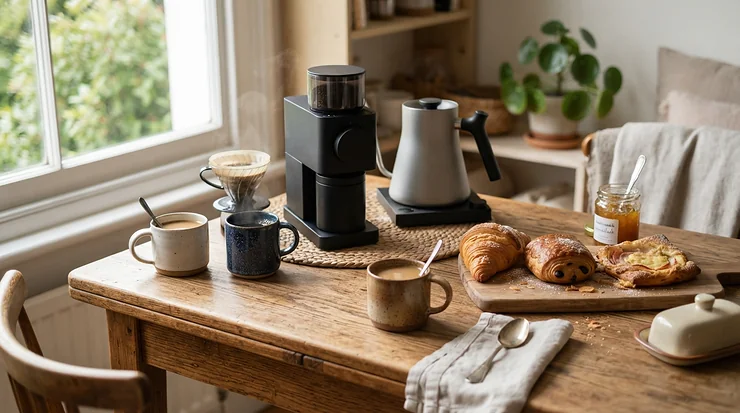
Let’s be honest about apartment life. The counter is a negotiation. The toaster has squatter’s rights, the dish rack isn’t going anywhere, and the gleaming boiler machine from your favorite café? It wants a footprint, and an electrical appetite, that most studios can’t host.
That’s where a compact thermoblock machine earns its keep. The models below run from roughly 4 inches wide to about 10, and several have the kind of lightweight design that lets you slide them into a cabinet when guests arrive. That matters more than any spec sheet admits.
This guide is built from manufacturer specs, retailer listings, and published review roundups, not from claims of hands-on lab testing. You’ll get seven real machines across budget, mid-range, and premium tiers, honest comparison tables, and a 30-day setup plan. Think of it as a shortlist of small-space espresso machine options that treats apartment-friendly appliances as a design problem, not a trend. Prices appear as ranges only, so check current price on each product page.
Quick Comparison: Thermoblock Espresso Machine for Small Apartments at a Glance
Here’s the fast version. Skim it, then dig into the details below.
| Machine | Approx. Width | Heat-Up | Milk Wand | Best For |
|---|---|---|---|---|
| CASABREWS CM5418 | ~5.5–5.9 in | ~40 sec–1 min | Manual | Budget buyers who want a gauge |
| De’Longhi Dedica Deluxe EC685 | 5.9 in | ~40 sec | Panarello | The narrowest counters |
| De’Longhi Dedica Arte EC885 | 5.9 in | ~40 sec | Manual (My LatteArt) | Latte-art learners |
| Breville Bambino | ~6.1–7.7 in (listings vary) | ~3 sec | Manual | Fast, serious-feeling shots |
| Breville Bambino Plus | 7.7 in | ~3 sec | Automatic | Milk-drink households |
| Gaggia Brera | 10 in | ~1 min | Panarello | Bean-to-cup convenience |
| Nespresso Essenza Mini | ~3.3–4.3 in (listings vary) | ~25 sec | None | Zero-effort, tiny kitchens |
Looking at the table, the De’Longhi Dedica Deluxe EC685 and De’Longhi Dedica Arte EC885 win the narrow-counter contest among portafilter machines. The Breville Bambino and Breville Bambino Plus give up a little width for a 3-second heat-up, which makes “I’ll just make one” a realistic thought at 7 a.m. The Nespresso Essenza Mini is the outlier, slimmest and lightest but capsule-only, while the Gaggia Brera is the only machine here that grinds beans for you. Widths come from manufacturer and retailer listings that sometimes disagree by an inch or so, so confirm on the product page.
💬 Just one click — help others make better buying decisions too!😊
Top 7 Thermoblock Espresso Machines for Small Apartments: Expert Analysis
Seven machines, three price tiers, one rule: every spec gets translated into what it means on an actual counter.
1. CASABREWS CM5418 — budget pick with a real pressure gauge
Counter space is the scarce resource, and the CASABREWS CM5418 respects that. It’s a stainless-steel body roughly 5.5 to 5.9 inches wide and about 12.3 inches deep, with a front-mounted pressure gauge that’s rare at this price.
The brand lists a 20-bar pump, 1350W of power, and a 34 oz removable tank. That 20-bar figure is the pump’s ceiling at zero flow, not the pressure at your coffee, so the gauge teaches you more about your grind and tamp. The 51mm portafilter ships with pressurized baskets that forgive imperfect grinding. Because it uses a single thermoblock, brewing and steaming can’t overlap, so pull the shot first and then steam.
Based on the spec comparison, this is the right first machine for someone testing whether espresso fits their routine before spending serious money. Newer brand listings mention PID temperature control while older ones don’t, so verify the version you’re buying. Reviewers consistently praise the value and small footprint. A minority report early failures, which hints at some quality-control variance, so keep your order records and check the warranty.
Pros:
- ✅ Pressure gauge helps you dial in shots
- ✅ Narrow body, roughly 5.5–5.9 inches wide
- ✅ Generous 34 oz tank for its size
Cons:
- ❌ Some owners report early failures
- ❌ Brews and steams one at a time
Typically in the $100–$200 range at the time of research (check current price), and the value verdict for first-timers is hard to argue with.
2. De’Longhi Dedica Deluxe EC685 — slimmest portafilter body here
At about 5.9 inches wide, 13 inches deep, and 12 inches tall, the De’Longhi Dedica Deluxe EC685 is the machine people mean when they say “slim.”
Under the hood is a thermoblock that reaches brewing temperature in roughly 40 seconds, a 15-bar pump, and a removable tank of about 35–37 oz. In practice, 40 seconds is about how long it takes to grab a mug and your phone charger. The 51mm portafilter uses pressurized baskets and also accepts ESE pods, so a bad grinder day is survivable. One independent reviewer who measured the pump reports it peaking closer to 12 bar than 15, which is still plenty for a pressurized basket.
Here’s what to weigh: the stock panarello wand makes serviceable foam, not silky microfoam, so this is a “good lattes, not latte art” machine. At roughly 9 pounds, it’s light enough to reposition but not exactly pocketable. Reviewers consistently highlight the narrow design and beginner-friendliness, while the usual complaints are a modest tank, a limited quality ceiling, and no PID.
Pros:
- ✅ Ultra-slim body of about 5.9 inches
- ✅ Fast heat-up, around 40 seconds
- ✅ Takes ground coffee or ESE pods
Cons:
- ❌ Panarello wand limits milk texture
- ❌ Pressurized baskets cap shot quality
Expect roughly the $200–$300 range (check current price); as a space-per-dollar play, it’s among the strongest here.
3. De’Longhi Dedica Arte EC885 — manual wand for latte-art practice
The De’Longhi Dedica Arte EC885 keeps the Dedica’s 14.9 cm (about 5.9 inch) body but swaps in a manual “My LatteArt” steam wand, which is the whole point.
It pairs a thermoblock and a 15-bar pump with a 1.1-liter tank and roughly 40-second heat-up. It also offers three-level brew temperature adjustment through a button sequence, though there’s no PID. The adjustable drip tray handles cups up to about 12 cm tall, which sounds trivial until you try a travel mug under a fixed-height machine. Weight sits around 4.2–4.4 kg (roughly 9.3–9.7 pounds).
On paper, this means you can start learning real milk texturing without surrendering counter width. What the spec sheet won’t tell you, but reviewers note, is that steam power is modest, and the pressurized basket sets a ceiling on shot quality no matter how good your technique gets. Reviewers praise the footprint and cup clearance.
Pros:
- ✅ Manual wand teaches real milk texturing
- ✅ Same 5.9-inch slim footprint
- ✅ Adjustable drip tray fits taller cups
Cons:
- ❌ Modest steam power for milk-heavy households
- ❌ Pressurized basket limits shot upgrades
Roughly the $250–$350 range (check current price); the premium over the Deluxe buys hands-on milk practice, so it’s worth it only if you’ll use it.
4. Breville Bambino — 3-second heat-up with a 54mm portafilter
The Breville Bambino is the machine for people who want “serious” in a toaster-sized shell. Its ThermoJet system heats in about 3 seconds, and retailers class it as thermoblock-type heating.
You get a 54mm portafilter with an 18–19g dose, PID temperature control, low-pressure pre-infusion into roughly 9-bar extraction, a 47 oz tank, and a manual steam wand. Width is listed anywhere from about 6.1 to 7.7 inches depending on the source, so verify before measuring your nook. A bigger basket and PID mean more control, and more ways to taste your own mistakes. At about 10–11 pounds, it’s light, though one review mentions the base feels weighty enough to lock the portafilter without sliding.
The catch, per reviewers: no three-way solenoid, so the puck stays wet and the group head drips, and the 47 oz tank is awkward to refill under a low cabinet. There’s also no grinder, so budget for one. Owners commonly praise the speed and temperature consistency, while milk drinkers find the manual wand takes real practice.
Pros:
- ✅ 3-second heat-up, no morning ritual
- ✅ PID control and pre-infusion included
- ✅ 54mm portafilter allows real upgrades
Cons:
- ❌ Wet puck and drippy group head
- ❌ Smallish tank, no built-in grinder
Roughly the $250–$350 range (check current price); this is the most espresso hardware per dollar in this guide, if you’ll add a grinder.
5. Breville Bambino Plus — automatic microfoam wand
The Breville Bambino Plus shares the Bambino’s ThermoJet brain but adds the feature milk-drink households crave: an automatic steam wand.
It measures 7.7 inches wide, 12.6 deep, and 12.2 tall, with a 64 oz tank, three milk temperatures, three textures, and an auto-purge after steaming. The extra tank means fewer refills for two coffee drinkers. Breville also claims up to 32% less annual energy use than a conventional thermoblock, based on its own internal benchmark, so treat that as a manufacturer claim. Weight listings range from roughly 11 pounds (net) to higher shipping figures.
Here’s what to weigh: if your mornings are lattes and flat whites, the automatic wand removes the steepest learning curve in home espresso. The trade-off is that you won’t learn manual texturing. Reviewers frequently mention the compact size, quick heat-up, and ease of use. The usual gripes are the higher price and, as with its sibling, the missing grinder.
Pros:
- ✅ Automatic wand makes consistent microfoam
- ✅ Large 64 oz tank cuts refills
- ✅ 3-second heat-up with auto-purge
Cons:
- ❌ Wider than the Dedica machines
- ❌ Costs noticeably more than the Bambino
Roughly the $400–$500 range (check current price); for daily milk drinks, the extra spend buys convenience you’ll feel every morning.
6. Gaggia Brera — bean-to-cup convenience in 10 inches
The Gaggia Brera is the one machine here that grinds, tamps, and brews at a button press, in a 10-inch-wide body.
It’s a super-automatic with a thermoblock, a 15-bar pump, a ceramic burr grinder with five settings, a 1.2-liter front-access tank, and an airtight bean hopper of about 8.8 oz. A bypass doser accepts pre-ground coffee. Depth is the sneaky number at roughly 17.5 inches, and at about 18 pounds this isn’t a casual shelf-mover. It wins on daily friction, since every refillable part is reachable from the front.
On paper, that means less setup than any portafilter machine, and no separate grinder to shop for or store. Reviewers describe it as a strong entry-level super-automatic, though some flag plastic build and grinder complaints. The small tank also needs frequent refills for two-person households. The panarello wand is manual, so milk skills still apply.
Pros:
- ✅ Built-in ceramic grinder, one-touch brewing
- ✅ Front-access tank and parts
- ✅ Bypass doser accepts pre-ground coffee
Cons:
- ❌ Deep and heavy for tight counters
- ❌ Small tank for two-person households
Pricing varies by retailer and stock, and it has historically sat above most semi-automatic machines here, so check current price and availability. It’s worth it if convenience beats footprint.
7. Nespresso Essenza Mini — lightest and slimmest on the list
The Nespresso Essenza Mini is the featherweight, at roughly 4.4–5.1 pounds and only about 3.3–4.3 inches wide depending on the listing.
It’s a capsule machine, not a portafilter machine, so be clear-eyed about that. You get a 19-bar pump, about 25-second heat-up, two programmable cup sizes (espresso and lungo), a 20.3 oz tank, and a 9-minute auto-off. One retailer lists it as thermoblock-heated. This is lightweight design taken to its logical extreme: one-handed lifting, tiny storage, no grinder, no tamping.
The honest analysis is that it exists for one type of buyer, someone who wants decent espresso with minimal counter sacrifice and zero learning curve. Reviewers praise its space-saving size, simplicity, and quick start. Common limits are the small tank, frequent emptying of the capsule bin, and no milk frother, so budget for a separate one if you want lattes.
Pros:
- ✅ Smallest, lightest machine in this guide
- ✅ Fast 25-second heat-up
- ✅ Nearly zero learning curve
Cons:
- ❌ Capsule-only, ongoing pod costs
- ❌ No built-in milk frother
Roughly the $150–$200 range (check current price); an excellent value for solo drinkers, assuming you’re happy living inside the capsule ecosystem.
Side-by-Side: How the Top 7 Stack Up
Numbers tell the story faster than adjectives. Here’s the hardware head-to-head, with approximate weights and tank sizes from manufacturer and retailer listings.
| Machine | Tank | Approx. Weight | Price Range | Best For |
|---|---|---|---|---|
| CASABREWS CM5418 | 34 oz | ~8.6 lb | $100–$200 | First-time espresso buyers |
| De’Longhi Dedica Deluxe EC685 | ~35–37 oz | ~9 lb | $200–$300 | Narrowest portafilter fit |
| De’Longhi Dedica Arte EC885 | ~37 oz (1.1 L) | ~9.3–9.7 lb | $250–$350 | Milk-texturing practice |
| Breville Bambino | 47 oz | ~10–11 lb | $250–$350 | Espresso quality per dollar |
| Breville Bambino Plus | 64 oz | ~11 lb (net) | $400–$500 | Daily lattes, low fuss |
| Gaggia Brera | ~40 oz | ~18 lb | Check current price | Bean-to-cup convenience |
| Nespresso Essenza Mini | 20.3 oz | ~4.4–5.1 lb | $150–$200 | Solo drinkers, tiny kitchens |
The pattern is clear. Tank size climbs with price, and so does footprint, except for the Nespresso Essenza Mini, which wins on size but pays in refills. The CASABREWS CM5418 and De’Longhi Dedica Deluxe EC685 are the budget-conscious middle path, while the Breville Bambino Plus is where convenience gets expensive. If your counter is truly tiny, weight and width should break ties before price does.
How to Choose a Thermoblock Espresso Machine for Small Apartments
Seven steps, in order of how often they decide the purchase:
- Measure width, depth, and height first. Include the clearance under upper cabinets and the room needed to pull the machine forward for tank access. Several models here have rear-mounted tanks.
- Decide your drink. Straight espresso and americanos reward a fast heater, while daily milk drinks reward a stronger wand or an automatic one.
- Match your patience to the portafilter. Pressurized baskets forgive sloppy technique but cap quality, while 54mm setups reward effort.
- Budget for a grinder. Most semi-automatic machines here don’t include one, and fresh grinding is where flavor jumps.
- Check tank size and access. Small tanks mean frequent refills, so front-access or generous capacity saves daily annoyance.
- Check weight and storage. If the machine lives in a cabinet between uses, pounds matter.
- Verify warranty and descale support. A descale alert and responsive warranty are worth more than an extra bar of “pressure.”
For context on trade-offs, Clive Coffee’s guide to boiler types frames thermoblocks as less expensive and well suited to lower-volume drinking. Note that dual-thermoblock designs can brew and steam together, but the single-thermoblock models here can’t.
Compact Thermoblock Machine vs Boiler, Pod, and Super-Automatic Options
A compact thermoblock machine isn’t the only way to fit coffee into a small kitchen. It’s just the most balanced one. As Seattle Coffee Gear’s explainer puts it, a thermoblock heats water on the fly while a boiler keeps a reservoir hot. That gives thermoblocks speed and a slim build, with slightly less temperature consistency.
| Option | Heat-Up | Counter Footprint | Learning Curve | Best For |
|---|---|---|---|---|
| Thermoblock semi-auto (De’Longhi Dedica Deluxe EC685) | ~40 sec | Very slim | Moderate | Hands-on drinkers |
| ThermoJet-style (Breville Bambino) | ~3 sec | Slim | Moderate | Speed plus 54mm control |
| Small boiler or heat-exchanger machine | Usually longer | Wider, heavier | Steeper | Enthusiasts with room |
| Pod machine (Nespresso Essenza Mini) | ~25 sec | Smallest | Minimal | Effortless mornings |
| Compact super-auto (Gaggia Brera) | ~1 min | Deep, heavy | Low | Bean-to-cup convenience |
Boiler machines are generally considered the gold standard for temperature stability, but they typically cost more, weigh more, and need more space. Thermoblocks trade a little consistency for apartment-sized convenience, and for most renters that’s the right swap. Pod and super-automatic options win on friction, but they lock you into capsules or a bigger body.
Small-Space Espresso Machine: Measure Before You Buy
A small-space espresso machine only works if it actually fits your specific kitchen, not the average one.
Check three dimensions, not one
Width gets the headlines, but depth bites harder. The De’Longhi Dedica Deluxe EC685 is about 5.9 inches wide yet roughly 13 inches deep, and its tank sits at the back, so you’ll pull it forward to refill. The Gaggia Brera is the opposite, with a front-access tank but a depth near 17.5 inches. Height matters too: the Breville Bambino runs roughly 12–13.5 inches depending on the listing, which affects clearance under upper cabinets.
Check your outlet, too
The Breville Bambino lists 1560W, around 13 amps at 120V. That’s fine on its own, but sharing a circuit with a microwave or space heater is a classic way to trip a breaker. Skip extension cords, and check the rating label before you plug in.
Outline it with tape
Mark the machine’s footprint on your counter with painter’s tape, then add 4–6 inches in front for the portafilter and cup. If daily life still functions inside that rectangle, you’re good.
Lightweight Design: When Pounds Actually Matter
Lightweight design is a rental-life superpower, with one caveat.
The Nespresso Essenza Mini (about 4.4–5.1 pounds) can live in a cabinet and come out in seconds. The De’Longhi Dedica Deluxe EC685 (about 9 pounds) and the CASABREWS CM5418 (about 8.6 pounds) are manageable one-handed. The Gaggia Brera at roughly 18 pounds is a countertop resident, not a wanderer.
The caveat is stability. Light machines can skate when you lock a portafilter, and one owner review of the Breville Bambino specifically credits its base for staying put. A cheap silicone mat, or a non-slip shelf liner cut to size, solves most of that. It also protects rental countertops from heat and scratches.
The practical rule: if you’ll move it regularly, favor under 10 pounds. If it’s a permanent coffee corner, weight becomes a stability feature rather than a flaw.
Apartment-Friendly Appliances: Noise, Outlets, and Neighbors
Apartment-friendly appliances share a few traits: they’re quick, tidy, and don’t demand infrastructure.
Warm-up and standby. A 3-second heater like the Breville Bambino or Breville Bambino Plus means you can power it on when you need it, instead of leaving it idling. The Nespresso Essenza Mini auto-shuts off after 9 minutes, and the De’Longhi Dedica Deluxe EC685 offers an energy-saving standby mode.
No plumbing. Every machine here runs on a removable tank, so there’s nothing to install, drill, or explain to your landlord.
Noise. Vibration pumps are audible, and spec sheets rarely publish decibel figures. If early mornings share walls with sleepers, a rubber mat under the machine helps, and so does pulling the shot before you start the grinder rather than during.
Water. Hard water is common in many U.S. regions, and your landlord’s plumbing won’t change that. Filters and descaling (covered below) are the realistic fix.
Features That Actually Matter (And Those That Don’t)
Marketing loves big numbers. Your counter loves honest ones.
What matters:
- Footprint and tank access. You’ll feel these daily.
- A three-way solenoid. It relieves pressure after a shot, so the puck is drier and cleanup is easier. The Breville Bambino Plus adds one, and the Breville Bambino lacks it.
- Steam wand type. Automatic for convenience, manual for skill.
- A grinder plan. Built in, bought separately, or pods.
What matters less:
- The “20 bar” headline. That’s pump capability, not extraction pressure, and the real target at the coffee is around 9 bar.
- Cup warmers. On compact machines they’re passive and modest.
- Pod compatibility on semi-automatic machines, unless you genuinely want a backup option.
Treat every extra feature as rent. If you won’t use it weekly, it’s costing you counter space.
Long-Term Cost & Maintenance
The sticker price is the down payment, not the total.
| Machine | Typical Range | Biggest Ongoing Cost | Best For |
|---|---|---|---|
| CASABREWS CM5418 | $100–$200 | Beans, plus a grinder if upgrading | Low-risk first machine |
| De’Longhi Dedica Deluxe EC685 | $200–$300 | Beans, descaler | Tight spaces |
| De’Longhi Dedica Arte EC885 | $250–$350 | Beans, descaler, milk | Latte-art learners |
| Breville Bambino | $250–$350 | Grinder, beans | Quality-first buyers |
| Breville Bambino Plus | $400–$500 | Grinder, beans, milk | Milk-drink households |
| Gaggia Brera | Check current price | Beans, filters, descaler | Convenience seekers |
| Nespresso Essenza Mini | $150–$200 | Capsules | Solo drinkers |
Here’s the ROI logic. A 12 oz bag of beans typically yields around 18 double shots at an 18g dose, so the per-shot cost is a fraction of a café drink. Machine cost divided by weekly café visits replaced is your break-even clock, though your real numbers depend on bean prices and how often you’d otherwise buy a latte. Capsule machines flip the math, with a low entry price and a higher per-cup cost, so check current capsule pricing before deciding.
Maintenance is the quiet cost. Thermoblock channels are narrow, so scale matters. Use filtered water where practical, descale when your machine’s alert says so, and don’t let water sit in the tank for days.
Practical Usage Guide: Your First 30 Days
Setup in week one decides whether the machine becomes a habit or a countertop sculpture.
Days 1–3: Break it in. Rinse the tank, run water through the group head and steam wand, and flush the thermoblock before pulling any coffee. Warm your cup, since a cold cup steals heat from a small shot.
Days 4–10: Dial in one variable at a time. Keep the dose constant, adjust the grind, and aim for a shot that runs in roughly 25–30 seconds. With pressurized baskets, you’ll see less variation but also less control. A pressure gauge, as on the CASABREWS CM5418, helps you spot problems early.
Days 11–30: Build the routine. Wipe the steam wand right after every use, purge it, and empty the drip tray. Brew first, then steam, because single-thermoblock machines need a brief transition between the two.
Water and scale. The USGS Water Science School explains that hard water is high in dissolved calcium and magnesium, and that heating it can leave calcium carbonate deposits. In a thermoblock’s narrow channels, that scale adds up fast. Descale on schedule, and consider a filter if your tap water is hard.
Common first-month mistakes: skipping the pre-flush, overfilling the portafilter, leaving old water in the tank, and ignoring the descale alert.
Real-World Scenarios: Which Machine Fits Which Apartment
Scenario 1: The studio dweller
You have a studio kitchen with about 18 inches of usable counter, you drink one cup a day, and your budget is around $150–$200. The Nespresso Essenza Mini is the cleanest fit, with a tiny footprint, a 25-second start, and no tamping. If you’d rather learn real espresso, the CASABREWS CM5418 costs about the same and gives you a pressure gauge to learn on.
Scenario 2: The couple with daily lattes
You share a one-bedroom, drink lattes most mornings, and have around $400–$500 to spend. The Breville Bambino Plus earns its premium here, thanks to the automatic wand, the larger tank, and fast heat-up. The saved refill time adds up over a year.
Scenario 3: The hobbyist renter
You want to learn milk texturing, but the kitchen is narrow. The De’Longhi Dedica Arte EC885 gives you a manual wand in a 5.9-inch body, while the Breville Bambino is the pick if you’d rather chase better shots and are ready to buy a grinder.
Scenario 4: The remote worker with a dedicated corner
You’ve cleared a permanent spot and want zero morning fuss. The Gaggia Brera trades footprint for convenience, but only if you can spare the depth and weight.
✨ Ready to Upgrade Your Coffee Corner?
🔍 Take your small-apartment coffee routine to the next level with these carefully selected machines. Click on any highlighted item to check current pricing and availability. These picks can help you pull café-style drinks your whole household will love! ☕
Problem → Solution Guide
Problem: the counter’s too crowded. Pick the narrowest option your drinks allow. The De’Longhi Dedica Deluxe EC685 or De’Longhi Dedica Arte EC885 at about 5.9 inches wide are the portafilter answers, and the Nespresso Essenza Mini is the capsule answer. A small cart or shelf can also give the machine its own zone.
Problem: shots taste weak or sour. Grind finer, give the machine its full heat-up time, and run a blank shot to warm the group head. Many entry-level machines use pressurized baskets, which narrow the margin for error but also limit the ceiling.
Problem: milk comes out bubbly. A manual wand takes practice. If you’d rather skip the learning curve, the Breville Bambino Plus automates it. If you want to learn, the De’Longhi Dedica Arte EC885 is the friendlier teacher.
Problem: refilling is a hassle. Rear tanks mean pulling the machine forward. The Gaggia Brera has front access, and the Breville Bambino Plus has a 64 oz tank that cuts the frequency. For tight spots, fill a small pitcher and top up the tank in place.
Problem: the machine slides when locking in. Lighter machines can shift. A silicone mat usually fixes it.
FAQ
❓ Is a thermoblock espresso machine for small apartments good enough for daily lattes?
❓ What is the narrowest thermoblock espresso machine I can buy?
❓ Do I need a separate grinder for a compact thermoblock machine?
❓ How often should I descale a compact thermoblock machine?
❓ Is the Breville Bambino Plus worth the extra money over the Breville Bambino?
Conclusion: Small Counter, Big Cup
The right thermoblock espresso machine for small apartments isn’t the one with the biggest spec numbers. It’s the one that fits your counter, your drinks, and your patience. If you want the most espresso hardware per dollar and don’t mind buying a grinder, the Breville Bambino leads. If milk drinks rule your mornings, the Breville Bambino Plus earns its premium.
For the narrowest footprints, the De’Longhi Dedica Deluxe EC685 and De’Longhi Dedica Arte EC885 both come in around 5.9 inches wide. The CASABREWS CM5418 is the low-risk starter with a gauge. The Gaggia Brera wins on convenience if you can spare the depth, and the Nespresso Essenza Mini wins on sheer lightness for solo drinkers. Whatever you choose, measure twice, check current price and availability, and plan for descaling from day one.
Recommended for You
- Thermoblock Espresso Machine For Beginners: 7 Best Easy Picks 2026
- Thermoblock Espresso Machine: 7 Proven Picks For 2026
- PID Espresso Machine For Espresso And Milk Drinks: 7 Best 2026
Disclaimer: This article contains affiliate links. As an Amazon Associate, I earn from qualifying purchases. If you purchase products through these links, we may earn a small commission at no additional cost to you.
✨ Found this helpful? Share it with your friends! 💬🤗
