In This Article
Buying your first espresso machine feels a bit like walking into a guitar shop. Shiny things everywhere, jargon flying, and someone insisting the $3,000 model is the only “real” option. It isn’t. A thermoblock espresso machine for beginners skips the ten-minute warm-up ritual, shrinks the footprint, and keeps the price sane. That is why this heating style now powers everything from budget starter pumps to premium bean-to-cup machines.
So what’s the catch? Thermoblocks heat water on demand instead of storing it hot. That makes them fast and compact, but slightly less steady from shot to shot than a big boiler. For a first machine, that trade is usually a bargain. You get coffee in about a minute (or three seconds, in one clever case), and you spend your energy learning espresso instead of babysitting hardware. If you want the backstory on how espresso machines evolved from steam-era patents to modern pump designs, Wikipedia’s overview is a solid primer.
This guide rests on spec comparisons, aggregated review sentiment, and honest analysis. It makes no claims of hands-on testing. You’ll find seven real machines across budget, mid-range, and premium tiers. They run from a simple thermoblock espresso machine you can learn on in a weekend to push-a-button models built around one-touch operation. Every spec is translated into what it means on your counter at 7 a.m., and every table is followed by plain-English analysis. Prices appear as ranges only because they move constantly, so check current price before you buy.
Whether you want a beginner-friendly thermoblock machine that teaches real technique, or a hands-off appliance that puts ease of use above everything, the next sections will narrow the field fast.
Quick Comparison: Thermoblock Espresso Machine for Beginners at a Glance
| Machine | Heat-Up (approx.) | Operation Style | Milk System | Price Range | Best For |
|---|---|---|---|---|---|
| De’Longhi Stilosa EC260BK | 40-60 sec | Manual semi-auto | Manual steam wand | Around $100-$150 | Tightest budgets |
| De’Longhi Dedica Deluxe EC685 | 35-40 sec | Manual semi-auto | Manual steam wand | Around $250-$350 | Small kitchens |
| Breville Bambino | ~3 sec | Semi-auto | Manual steam wand | Around $300 | Learning technique fast |
| Breville Bambino Plus | ~3 sec | Semi-auto | Automatic steam wand | Around $500 | Daily milk drinks |
| De’Longhi Magnifica Evo | ~30 sec | Bean-to-cup, one-touch | LatteCrema carafe (varies by model) | Roughly $400-$700 | Hands-off mornings |
| Philips 3200 LatteGo | About 1 min | Bean-to-cup, one-touch | LatteGo carafe | Roughly $500-$800 | Easy cleanup |
| Jura E8 | ~30 sec | Premium bean-to-cup | Automatic fine foam | $2,000-$2,800 range | Convenience-first buyers |
The table splits into two camps. The first four machines teach you espresso technique, with portafilters, tamping, and steaming. The last three do the work for you. Within the manual group, the Breville Bambino and Breville Bambino Plus win on warm-up speed, while the De’Longhi Stilosa EC260BK wins on entry price. Choose the Jura E8 only if you value convenience enough to pay several times what the others cost.
💬 Just one click — help others make better buying decisions too!😊
Top 7 Thermoblock Espresso Machines for Beginners: Expert Analysis
1. De’Longhi Stilosa EC260BK — cheapest ticket to real espresso
The De’Longhi Stilosa EC260BK is what you buy to find out whether you actually enjoy espresso before spending real money. It’s a simple thermoblock espresso machine: few buttons, one knob, no surprises.
It pairs a 15-bar pump with a compact 51mm portafilter and pressurized baskets. Those baskets restrict the outlet to build pressure artificially, so you get crema even when your grind and tamp are sloppy. That is a beginner’s lifeline, and also what caps flavor later. Because one heater handles both brewing and steam, you’ll wait roughly 20-30 seconds after a shot before the steam is ready. The 51mm size also means fewer aftermarket baskets than the common 54mm or 58mm formats. Most reviewers describe its heater as a thermoblock, though spec language varies, so confirm the listing.
Based on the spec comparison, this suits someone who wants lattes at home, accepts plastic construction, and values low cost over longevity. Retail reviewers consistently praise easy daily use, while recurring complaints include a stiff portafilter lock, small baskets, and occasional leaks.
Pros:
- ✅ Lowest entry price in this lineup
- ✅ Pressurized baskets forgive sloppy grinding
- ✅ Simple controls, nearly no learning curve
Cons:
- ❌ Plastic-heavy build and snug portafilter fit
- ❌ Small 51mm baskets limit upgrade options
Price check: around $100-$150, so the De’Longhi Stilosa EC260BK is strong value as a trial run and weaker as a long-term keeper.
2. De’Longhi Dedica Deluxe EC685 — slim enough for any counter
The De’Longhi Dedica Deluxe EC685 is what happens when someone asks, “What if espresso fit in a studio apartment?” At about six inches wide, it takes up less room than most toasters.
The thermoblock reaches brewing temperature in roughly 35-40 seconds, according to multiple review roundups. In practice, you can switch it on while grinding and be pulling a shot before the kettle would have boiled. The 15-bar pump produces proper espresso, and the steam wand is described as better than most at this price. That matters because milk steaming is where cheap machines usually fall apart. Like the De’Longhi Stilosa EC260BK, it ships with pressurized baskets, so shot quality plateaus once you outgrow them.
Our analysis: this is a beginner-friendly thermoblock machine for small-space dwellers who want to learn manual steaming without a huge learning cliff. Review roundups consistently flag its slim footprint and quick heat-up as highlights, and its beginner-oriented ceiling as the main limitation.
Pros:
- ✅ Roughly six inches wide, ideal for tight counters
- ✅ Heats in about 40 seconds
- ✅ Steam wand outperforms rivals at this price
Cons:
- ❌ Pressurized baskets cap flavor development
- ❌ Manual steaming still takes practice
Price check: around $250-$350. The De’Longhi Dedica Deluxe EC685 is a fair value for space-starved kitchens, but hobbyists may outgrow it within a year or two.
3. Breville Bambino — three-second heat-up changes everything
The Breville Bambino removes the single biggest friction point in home espresso: waiting. Breville’s ThermoJet heater reaches brewing temperature in about three seconds.
Technical testers at Kaffeemacher note that ThermoJet is a trendy marketing name for a thick-film “flow through” heater. It is essentially a modern cousin of the classic thermoblock, which is why it belongs in this guide. Add PID temperature control, low-pressure pre-infusion with 9-bar extraction, and a proper 54mm portafilter, and you have a machine with genuine growth room. The 1-hole manual steam wand is gentler and slower (about 50 seconds, per one comparison), which gives beginners more time to learn milk texture without scorching.
Honestly, it’s the strongest teaching machine here. The catch is that it has no built-in grinder, and reviewers repeatedly stress pairing it with a decent one. Review themes: praise for speed and shot quality with a real grinder, criticism of lightweight, plastic-heavy construction.
Pros:
- ✅ Ready to brew in roughly three seconds
- ✅ PID control and pre-infusion aid consistent shots
- ✅ 54mm portafilter supports basket upgrades
Cons:
- ❌ Needs a separate grinder for best results
- ❌ Light, plastic-heavy construction
Price check: around $300. The Breville Bambino is excellent value for anyone willing to learn.
4. Breville Bambino Plus — automatic steam wand handles the milk
The Breville Bambino Plus keeps the three-second ThermoJet heater and adds the feature beginners crave: hands-free milk. Put the wand in the pitcher, press a button, and walk away.
The automatic wand offers three temperature settings and three foam levels, plus auto-purge after steaming. Compared with the standard model, the Plus also adds a larger 1.9L tank and a stronger multi-hole wand. One review comparison clocked steaming at about 35 seconds versus roughly 50 seconds on the basic version. The trade-off: reviewers note the automatic mode tends to put more foam on top than latte art demands. You can switch to manual, though, so you never hit a ceiling.
Our take: for daily cappuccino or latte drinkers, the roughly $200 premium over the Breville Bambino buys consistency and forgiveness. Reviewers praise hands-free texturing and workflow, while recurring critiques include the plastic build and, in some reports, reliability caveats over time.
Pros:
- ✅ Automatic milk texturing with adjustable temperature and foam
- ✅ Manual override keeps learning options open
- ✅ Fast steam recovery and auto-purge
Cons:
- ❌ Auto mode limits fine latte art control
- ❌ Still needs a separate grinder
Price check: around $500. The Breville Bambino Plus is a worthwhile upgrade if milk drinks are your daily habit.
5. De’Longhi Magnifica Evo — bean-to-cup in one touch
The De’Longhi Magnifica Evo answers a different question: what if you never wanted to learn espresso, only drink it? Beans in the hopper, press a button, done.
It uses a thermoblock that heats in about 30 seconds, a 15-bar pump, and a conical burr grinder with 13 settings. The US milk-drink variant adds a LatteCrema carafe and seven one-touch recipes: espresso, coffee, cappuccino, latte macchiato, iced coffee, hot water, and a customizable “My Latte.” Grinding, dosing, tamping, and brewing all happen internally, so there’s no portafilter to master.
Here’s what the spec sheet won’t say: this isn’t a hobby machine. It’s an appliance for people whose real hobby is something else. Reviewers consistently describe drinks as pleasant and easy, though common complaints include oversensitive soft-touch buttons, “My Latte” saving only the most recent recipe, and a noisy grinder. Variants differ (some use a manual steam wand), so double-check the model number.
Pros:
- ✅ Genuine one-touch operation for milk drinks
- ✅ Built-in 13-setting conical burr grinder
- ✅ Heats in roughly 30 seconds
Cons:
- ❌ Limited customization and a basic display
- ❌ Soft-touch buttons can feel overly sensitive
Price check: roughly $400-$700 depending on variant. The De’Longhi Magnifica Evo is good value for hands-off households.
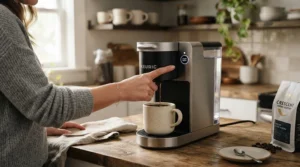
6. Philips 3200 LatteGo — milk system rinses in seconds
The Philips 3200 LatteGo is the cleanup champion. Its LatteGo milk carafe has just two dishwasher-safe parts and no tubes, which removes the chore that makes people abandon milk-based machines.
It uses a thermoblock, a ceramic flat burr grinder with 12 steps, and a 1.8L tank. The common EP3241 variants offer five core drinks (espresso, coffee, americano, cappuccino, latte macchiato), and some versions add a dedicated iced coffee setting. The AquaClean filter is rated for up to 5,000 cups before descaling, though that depends on replacing filters on schedule. Retail listings show warm-up plus first brew taking roughly a minute or more.
Honestly, this is the machine for people who value ease of use over customization. Retail reviewers praise quick setup (about 15 minutes in one account), simple cleaning, and adjustable strength, while critics point to the limited drink menu and plastic exterior.
Pros:
- ✅ Two-piece LatteGo milk system cleans in seconds
- ✅ Ceramic grinder resists heat buildup
- ✅ AquaClean filter reduces descaling frequency
Cons:
- ❌ Fewer drink options than pricier machines
- ❌ Plastic exterior feels less premium
Price check: roughly $500-$800. The Philips 3200 LatteGo is strong value for households wanting low-effort cleanup.
7. Jura E8 — premium one-touch with Pulse Extraction
The Jura E8 is the splurge. It’s still a thermoblock machine, just a refined one, wrapped in Swiss engineering and a polished touchscreen.
The headline feature is Pulse Extraction, which delivers water in short pulses to extend contact time without over-extracting. Other specs include a 15-bar pump, a professional grinder, automatic fine milk foam, and, on the current generation, 27 one-touch specialties according to one 2026 review. Because it has a single thermoblock, it can’t brew and steam simultaneously, so milk drinks run in sequence.
For this buyer, the logic is simple: pay more for consistency and polish, accept no technique development. Reviewers praise one-touch results and build quality, while criticisms center on price, a mildly inconvenient milk system, and weaker performance with non-dairy milks.
Pros:
- ✅ Extremely approachable one-touch operation
- ✅ Pulse Extraction improves shot character
- ✅ Strong consistency across consecutive drinks
Cons:
- ❌ Costs several times more than other picks
- ❌ Milk system needs fuss with non-dairy options
Price check: $2,000-$2,800 range. The Jura E8 only makes sense if the convenience premium genuinely matters to you.
✨ Ready to Find Your First Machine?
🔍 Take your home coffee routine to the next level with these carefully selected machines. Click any highlighted product name to check current pricing and availability. These picks will help you enjoy café-style drinks without the guesswork!
Your First 30 Days: Setup, Maintenance and Rookie-Mistake Guide
Day one is about rinsing, not brewing. Run a few cycles of plain water through the machine to flush manufacturing residue. If you bought a portafilter model such as the Breville Bambino or De’Longhi Dedica Deluxe EC685, preheat the portafilter and your cup too. The Stilosa guidance itself recommends it for hotter coffee.
In week one, change only one variable at a time. Keep the dose steady, adjust grind size, and aim for a shot that drips steadily instead of gushing or choking. Pressurized baskets, as on the De’Longhi Stilosa EC260BK, will hide most errors, so enjoy that safety net while you build habits.
By week two, add milk practice. On manual wands, purge steam before and after use, and wipe the wand immediately because dried milk is surprisingly stubborn. On the Breville Bambino Plus, try both automatic and manual modes to understand what the machine is doing for you. On the Philips 3200 LatteGo and De’Longhi Magnifica Evo, rinse the milk carafe after every use.
By week four, schedule maintenance: descale per the manufacturer’s guidance, replace water filters on time, and empty drip trays daily. Skipping descaling is the single fastest way to shorten a thermoblock’s life, because scale clogs the narrow internal channels. Common first-month mistakes include stale beans, packing too much coffee in small baskets, and ignoring the water tank’s cleanliness.
Real-World Scenarios: Matching a Thermoblock Machine to Your Life
Scenario 1: The college student with a tiny budget. You live in a shared apartment, have a limited counter, and want a daily latte without a café habit. The De’Longhi Stilosa EC260BK fits the budget, and pre-ground beans work fine with its pressurized baskets. Expect compromise on build quality, but the cost-per-drink math is excellent.
Scenario 2: The busy parents. You make two or three milk drinks each morning in a rush. The Philips 3200 LatteGo or De’Longhi Magnifica Evo is the better match, because one-touch operation and quick cleanup remove steps. Weigh the Philips for easy rinsing and the De’Longhi for its larger recipe menu.
Scenario 3: The curious hobbyist in a small apartment. You want to learn technique and have limited space. The Breville Bambino teaches proper extraction with a three-second warm-up, and the De’Longhi Dedica Deluxe EC685 offers the slimmer footprint. If you drink mostly cappuccinos and want less to learn, the Breville Bambino Plus takes over the milk.
Scenario 4: The convenience-first professional. You pull multiple drinks daily and consider time more valuable than money. The Jura E8 is the premium route, with consistent results and minimal fuss. Just remember its single thermoblock means milk drinks run sequentially.
Simple Thermoblock Espresso Machine or Fully Automatic? A Buyer’s Decision Framework
Think of this as a priority checklist rather than a flowchart. Start with the question that matters most: do you want to learn espresso, or just drink it?
- If you want to learn technique on a budget, choose a simple thermoblock espresso machine like the De’Longhi Stilosa EC260BK, because pressurized baskets forgive errors while you build skills.
- If space is your constraint, choose the De’Longhi Dedica Deluxe EC685, because its slim body fits where others can’t.
- If you want fast, real-barista growth, choose the Breville Bambino, because PID control, pre-infusion, and a 54mm portafilter leave room to improve.
- If milk drinks dominate, choose the Breville Bambino Plus, because automatic texturing removes the hardest skill.
- If you want true one-touch operation, choose the De’Longhi Magnifica Evo or Philips 3200 LatteGo, because grinding and brewing are fully automatic.
- If budget is secondary to convenience, choose the Jura E8, because it delivers premium consistency with almost no effort.
One more tiebreaker: if cleaning is the chore you’d skip, favor the Philips 3200 LatteGo. If counter space is the constraint, favor the De’Longhi Dedica Deluxe EC685. Nothing here is permanent, and plenty of people move from a Breville Bambino to a boiler machine after a year or two of experience.
What Is a Thermoblock Espresso Machine for Beginners?
A thermoblock espresso machine for beginners is a compact, pump-driven machine that heats water on demand by passing it through a heated metal block instead of storing it in a boiler. It warms up in seconds to about a minute, costs less than boiler machines, and often includes forgiving features like pressurized baskets or automatic milk systems.
How the heating works
Cold water enters a metal block with internal channels, electric heating elements raise its temperature as it flows through, and hot water exits ready to brew or steam. No reservoir of hot water sits waiting, which is why thermoblocks save energy and space.
Why beginners tend to like them
Fast heat-up builds better habits, since you’re more likely to make coffee when you don’t have to wait. Compact size suits modern kitchens, and lower prices reduce the risk of a first purchase. The trade-off is temperature stability: because water is heated in transit, shot-to-shot consistency depends on the heater catching up between pulls. Pricier thermoblock models add PID control to smooth this out.
How to Choose a Thermoblock Espresso Machine for Beginners
- Decide how hands-on you want to be. A portafilter machine teaches technique, while a bean-to-cup machine automates everything. Honest answer first, shopping second.
- Check heat-up time. Three seconds, 30 seconds, and a minute all sound similar, but they change how often you actually make coffee.
- Look at the milk system. Manual wands reward practice, while automatic systems reward convenience. Be realistic about how many milk drinks you’ll make weekly.
- Evaluate the basket and portafilter. Pressurized baskets are forgiving but cap flavor. A 54mm or 58mm portafilter widens upgrade options.
- Plan for a grinder. Portafilter models need a decent grinder, so budget for it. Bean-to-cup machines include one.
- Factor in maintenance. Cleaning milk parts and descaling are recurring chores. Choose a machine whose upkeep you’ll actually do.
What makes a beginner-friendly thermoblock machine?
It forgives mistakes, heats quickly, steams milk without drama, and is easy to clean. Pressurized baskets, automatic milk systems, and clear controls all qualify. If you can describe a machine’s workflow in two sentences, it’s probably beginner-friendly.
Thermoblock vs Boiler Machines: What You Gain and Give Up
Boiler machines dominate coffee-shop lore. The Smithsonian’s history of the espresso machine shows how boiler and lever designs shaped the category for decades. Thermoblocks arrived later as a compact, quick alternative.
| Feature | Thermoblock | Single Boiler | Heat Exchanger / Dual Boiler |
|---|---|---|---|
| Heat-up | Seconds to ~1 min | Roughly 5-10 min | Often 10+ min |
| Temperature stability | Good, varies by shot | Better, needs temp management | Best |
| Steam power | Modest | Moderate to strong | Strong, simultaneous |
| Footprint & weight | Small, light | Larger | Largest |
| Price tier | Entry to premium | Mid-range | Higher |
| Best For | Breville Bambino, De’Longhi Dedica Deluxe EC685 | Gaggia Classic Pro | Enthusiasts who want pro workflow |
The headline takeaway is speed versus steadiness. A Gaggia Classic Pro-style boiler machine can take 8-10 minutes to warm, according to one comparison, while the Breville Bambino is ready almost instantly. If mornings are rushed, thermoblock wins. If you eventually chase tiny temperature refinements, boilers pull ahead. For beginners, that gap rarely matters in the first year.
Features That Actually Matter (And Those That Don’t): Ease of Use and One-Touch Operation
Ease of use
The single most important feature is how likely you are to use the machine daily. Fast heat-up, readable controls, forgiving baskets, and simple cleaning all raise that probability. A machine you actually use beats a better machine collecting dust.
One-touch operation
True one-touch operation means grinding, dosing, brewing, and milk all happen from one press. It’s the defining feature of the De’Longhi Magnifica Evo, Philips 3200 LatteGo, and Jura E8. The trade-off is less control and a less hands-on learning experience.
Features that matter less than marketing suggests
Pump pressure numbers like “15 bar” or “20 bar” are largely a marketing contest, since espresso extraction is generally around 9 bar at the puck. Extra drink presets matter less than a quality grinder and clean milk system. App connectivity is nice but rarely decisive.
Features worth paying for
PID temperature control, pre-infusion, automatic purge, and easy-clean milk systems all deliver daily benefits. For beginners, that list is more useful than any spec on the box.
Common Mistakes When Buying a Thermoblock Espresso Machine for Beginners
The first mistake is buying for the person you hope to become instead of who you are now. If you won’t tamp and clean a portafilter on weekdays, a Breville Bambino will sit idle, and a De’Longhi Magnifica Evo might serve you better.
The second is forgetting the grinder. Portafilter machines such as the Breville Bambino Plus and De’Longhi Stilosa EC260BK can’t reach their potential with stale pre-ground coffee, though pressurized baskets soften the blow.
Third, buyers misread “15-bar” as a quality signal. Pressure rating isn’t the same as pressure at the puck, and it says little about shot quality.
Fourth, people ignore milk cleanup. A machine with a fussy milk system becomes a chore. That is why Philips 3200 LatteGo reviewers focus so heavily on how easy it is to rinse.
Finally, many skip descaling. Because thermoblocks have narrow channels, scale can reduce performance and shorten life. Treat maintenance as part of the purchase price.
Long-Term Cost and Maintenance: Price Range & Value Analysis
| Machine | Price Range | Machine Cost per Drink* | Best For |
|---|---|---|---|
| De’Longhi Stilosa EC260BK | ~$100-$150 | ~5-7¢ | Trial runs |
| De’Longhi Dedica Deluxe EC685 | ~$250-$350 | ~11-16¢ | Small spaces |
| Breville Bambino | ~$300 | ~14¢ | Learning technique |
| Breville Bambino Plus | ~$500 | ~23¢ | Daily milk drinks |
| De’Longhi Magnifica Evo | ~$400-$700 | ~18-32¢ | Hands-off use |
| Philips 3200 LatteGo | ~$500-$800 | ~23-37¢ | Easy cleanup |
| Jura E8 | ~$2,000-$2,800 | ~91¢-$1.28 | Convenience-first |
*Machine cost only, spread over two drinks daily for three years. Excludes beans, filters, descaler, and a separate grinder for portafilter models.
The numbers show why the De’Longhi Stilosa EC260BK is a safe experiment: a few cents per drink makes the risk tiny. Mid-range machines like the Breville Bambino Plus and De’Longhi Magnifica Evo land in the low-to-mid double-digit cents range, which is still far below café prices. The Jura E8 costs much more per drink, so its value depends on whether convenience and consistency matter to you.
Safety, Water Quality and Descaling Guide
Scale is the thermoblock’s natural enemy. When hard water is heated, calcium carbonate can form solid deposits, and the U.S. Geological Survey’s water hardness guide explains that this scale can reduce the life of equipment and lower heating efficiency. Hardness varies across the U.S., so check your local level.
Practical steps: use filtered or softened water if your area has hard water, follow descaling intervals from the manufacturer, and never skip the process because the machine “seems fine.” Machines like the Philips 3200 LatteGo use filters to extend descaling intervals, but the filter must be replaced on schedule.
For safety, always release steam pressure and purge wands before cleaning, keep hands clear of the steam wand’s tip, and let hot parts cool. Unplug before wiping electrical areas. Look for manufacturer instructions specific to your model, since steps differ between a Breville Bambino and a bean-to-cup Jura E8.
Frequently Asked Questions
❓ How long does a thermoblock espresso machine take to heat up?
❓ Is a thermoblock machine good for lattes and cappuccinos?
❓ Do thermoblock machines need descaling more often?
❓ Which one-touch machine is easiest to clean?
❓ Can I use pre-ground coffee with a beginner machine?
Conclusion
Choosing a thermoblock espresso machine for beginners comes down to one honest question: do you want to learn espresso, or simply enjoy it? If it’s the former, the Breville Bambino is the strongest teacher, the De’Longhi Dedica Deluxe EC685 is the best fit for tight counters, and the De’Longhi Stilosa EC260BK is the cheapest experiment. Milk-drink lovers should look hard at the Breville Bambino Plus.
If it’s the latter, the De’Longhi Magnifica Evo and Philips 3200 LatteGo deliver real one-touch operation at mainstream prices, with the Philips winning on cleanup. The Jura E8 is the premium shortcut for people who value convenience above all.
Whichever you choose, treat water quality, descaling, and cleaning as part of ownership. A beginner-friendly thermoblock machine rewards consistent habits more than fancy specs. Pick the one you’ll use every morning, and the rest takes care of itself.
Recommended for You
- Thermoblock Espresso Machine: 7 Proven Picks For 2026
- PID Espresso Machine For Espresso And Milk Drinks: 7 Best 2026
- PID-Controlled Single Boiler Espresso Machine: 7 Proven Picks 2026
Disclaimer: This article contains affiliate links. As an Amazon Associate, I earn from qualifying purchases. If you purchase products through these links, we may earn a small commission at no additional cost to you.
✨ Found this helpful? Share it with your friends! 💬🤗
