In This Article
Here’s the thing nobody tells you before you drop four figures on a coffee machine: the countertop doesn’t care how much you spent. It just sits there, silently judging you every morning until you press the button and find out if today’s the day it finally earns its keep. A premium super automatic espresso machine is built specifically to end that anxiety — grinding, dosing, tamping, brewing, and frothing milk in one motion, with zero guesswork required once it’s dialed in.
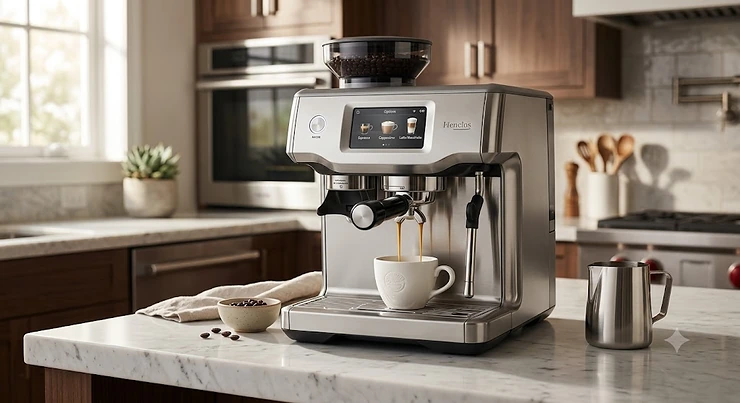
So what actually counts as “premium” in this category? A premium super automatic espresso machine is a bean-to-cup appliance that combines an integrated burr grinder, programmable extraction, and automated milk texturing in a single unit, typically priced from around $1,200 into the $4,000-plus range depending on materials, drink variety, and brewing tech. That’s a wide band, and honestly, the difference between the bottom and top of it is enormous — it’s the gap between “nice kitchen upgrade” and “I built a coffee bar.”
Coffee culture in the U.S. hasn’t exactly been standing still while these machines got smarter. Specialty coffee consumption has been hitting record highs among American adults, and that shift toward café-style drinks at home is a big part of why manufacturers keep stuffing these machines with dual boilers, twin hoppers, and app connectivity. This guide walks through seven real machines worth considering, how to actually choose between them, and where people waste money without realizing it.
Quick Comparison: 7 Premium Super Automatic Espresso Machines
| Machine | Price Range | Standout Feature | Best For |
|---|---|---|---|
| De’Longhi Rivelia | $1,200–$1,500 | Dual interchangeable bean hoppers | Households that rotate between roasts |
| Saeco Xelsis | $1,500–$1,700 | Dual thermoblock, external milk jug | Buyers who want café-hot milk drinks |
| Terra Kaffe TK-02 | $1,700–$2,000 | App-based recipe profiles | Tech-forward single or dual-user homes |
| KitchenAid KF8 | $1,900–$2,100 | Whisper-quiet operation, 50+ recipes | Design-focused kitchens, open-plan homes |
| Miele CM 6360 | $2,800–$3,000 | German engineering, WiFi + tea function | Buyers who want it to outlast the mortgage |
| Breville Oracle Touch | $2,900–$3,300 range | Dual boiler with manual override mode | Enthusiasts who want prosumer control |
| Jura Z10 | $3,300–$4,500 range | Cold-extraction brewing, P.R.G. grinder | High-volume coffee-and-cold-brew homes |
Looking at the spread above, the jump from the De’Longhi Rivelia to the Jura Z10 isn’t really about “better coffee” in a straight line — it’s about how many problems the machine solves without you touching it. The Saeco Xelsis and Terra Kaffe TK-02 occupy a sensible middle ground where you get genuine customization without flagship pricing, while the Miele CM 6360, Breville Oracle Touch, and Jura Z10 compete less on daily convenience and more on longevity, materials, and how far they can push extraction quality. If you’re shopping specifically for a super automatic espresso machine over 1500 dollars, six of these seven land comfortably in that zone, and even the Rivelia creeps into it once you add the optional cold-milk accessory.
☕ Not sure which tier fits your morning routine? Scroll to the buyer’s framework below before you commit.
Top 7 Premium Super Automatic Espresso Machines: Expert Analysis
1. De’Longhi Rivelia — dual bean hoppers for switching roasts instantly
The headline feature here is genuinely useful, not gimmicky: two interchangeable, twist-off bean hoppers mean you can keep a dark roast loaded for lattes and a lighter roast loaded for straight espresso, swapping between them in seconds. The 1450W thermoblock heating system pushes 19 bars of pressure through a stainless steel conical burr grinder with 14 grind settings, and De’Longhi’s Bean Adapt System lets you save dialed-in profiles per bean type, which matters more than it sounds since roast level dramatically changes ideal grind and dose. Based on the spec comparison with De’Longhi’s own Dinamica and Magnifica lines, the Rivelia trades a larger single hopper and bigger water tank for that compact dual-hopper design — a real tradeoff, not a pure upgrade, since it means more frequent refills for high-volume households. This machine suits people who genuinely rotate coffee styles throughout the day (espresso in the morning, milk drinks in the afternoon) more than it suits a single-drink household that would rather have fewer moving parts. Reviewers consistently note that the milk temperature runs slightly cooler than expected for cappuccino purists, though the dial-based control over foam density (hot milk, soft foam, dense foam) draws consistent praise for giving more say over texture than most machines in this price bracket. What the spec sheet won’t tell you is that the “Switch Mode” prompt — which asks whether to use up remaining beans or purge them when you swap hoppers — is the kind of small design touch that suggests real engineers thought about real mornings.
Pros:
- ✅ Dual hoppers eliminate the single biggest super-auto hassle
- ✅ Bean Adapt System saves per-roast grind profiles
- ✅ Milk dial gives real texture control, not just on/off
Cons:
- ❌ Smaller individual hopper capacity than single-hopper rivals
- ❌ Milk temperature runs cool for cappuccino traditionalists
Pricing generally sits in the $1,200 to $1,500 range depending on finish and retailer promotions, check current price before buying since De’Longhi runs frequent seasonal deals. For the value it delivers, especially if you’re a multi-roast household, it’s one of the smarter entry points into premium territory.
2. Saeco Xelsis — dual thermoblock precision with café-hot milk
The Saeco Xelsis (built under the Philips umbrella after Saeco’s acquisition) takes a different approach to the milk problem than the Rivelia: instead of an integrated carafe, it uses an external cappuccinatore jug, which sounds like a downgrade until you realize it keeps the machine’s body notably slimmer and makes cleaning the milk path a genuinely five-minute job rather than a disassembly project. Twin thermoblocks — one dedicated to brewing, one to steaming — mean the machine doesn’t have to choose between a hot espresso and hot milk in the same drink cycle, which is exactly the kind of spec that sounds trivial until you’ve waited on a single-boiler machine to reheat mid-pour. On paper, this means faster back-to-back drinks for multi-person households, and reviewers who’ve compared it against single-boiler competitors consistently flag the speed difference as noticeable rather than marginal. The 15 coffee varieties and six user profiles put it solidly in “family kitchen” territory, where everyone gets their exact drink without touching a settings menu. What most buyers overlook about the Xelsis is that its slimness comes from that external jug decision — if you want an integrated carafe that lives in the fridge, this isn’t your machine, but if counter depth is tight, it’s an underrated advantage.
Pros:
- ✅ Dual thermoblocks brew and steam simultaneously
- ✅ External cappuccinatore is easy to clean and store
- ✅ Slim footprint fits narrower counters than most rivals
Cons:
- ❌ No integrated milk carafe like higher-tier competitors
- ❌ Six profiles can feel tight for larger households
The Saeco Xelsis typically lands in the $1,500 to $1,700 range, occasionally dipping lower during major retail sales events — prices may vary by up to a couple hundred dollars depending on the season, so it’s worth checking current price before deciding.
3. Terra Kaffe TK-02 — app-connected brewing built for the phone-first buyer
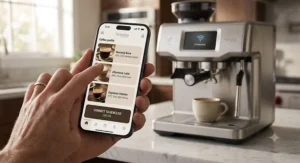
Where the first two machines lean traditional, the TK-02 leans into smart-home territory. Its app lets you build, save, and trigger custom drink recipes remotely, and the machine’s electronically adjusting stainless steel conical burr grinder recalibrates itself based on bean weight and selected drink type — a level of automation Terra Kaffe borrowed conceptually from machines costing twice as much. Here’s what most spec sheets won’t tell you: the hybrid brew unit can pull espresso or run a full drip cycle from the same hardware, which is how the TK-02 pulls off its cold-brew-style iced coffee function without a second machine cluttering the counter. Based on the spec comparison, its five grind settings are notably fewer than rivals like the Jura Z10’s more granular system, and that’s the honest tradeoff for the TK-02’s compact, tech-forward design. Aggregated reviewer sentiment is genuinely split on the noise level during grinding, with more than one reviewer clocking it near 90 decibels on a phone meter, loud enough to notice in an open kitchen. For a single professional or a couple who wants café-shop quality drinks without learning barista skills, and who actually likes fiddling with an app before their first sip, the TK-02 earns its keep. For anyone who just wants to press one physical button and walk away, it’s more interface than they need.
Pros:
- ✅ App-based custom recipes with remote triggering
- ✅ Hybrid brew unit makes both espresso and drip/iced coffee
- ✅ Self-adjusting grinder calibrates to bean weight automatically
Cons:
- ❌ Grinder noise runs louder than most competitors in testing
- ❌ Only five grind settings versus finer competitor gradients
Pricing has moved around as the lineup matured, generally settling in the $1,700 to $2,000 range on Terra Kaffe’s own site, with occasional subscription-bundle discounts — prices may vary, so check current availability directly.
4. KitchenAid KF8 — whisper-quiet operation for open-concept kitchens
KitchenAid’s flagship fully automatic machine is the one built for households where the kitchen is also the living room — the standout feature isn’t a brewing gimmick, it’s decibel level. Testers who’ve directly compared it against rival machines have flagged it as one of the quietest in its class, a genuinely underrated spec for anyone who’s been startled awake by a grinder at 6 a.m. in a studio apartment. The KF8 sits atop KitchenAid’s three-tier lineup (KF6, KF7, KF8), and the jump to the top model buys you the largest touchscreen, the most user profiles, over 50 recipe options, and dual-milk delivery that the lower KF6 lacks entirely. What most buyers overlook is that KitchenAid’s stainless steel outer panels — rather than the painted plastic common at lower price points — genuinely change how the machine ages on a counter that gets wiped down twice a day. Reviewers consistently praise the intuitive recipe menu for new users, framing it as the machine that best hides its own complexity, which matters if more than one person in the house will be operating it without a manual. On paper, the plant-based milk setting exclusive to the KF7 and KF8 tiers reflects where dietary trends have pushed the category, and it’s a real feature rather than a marketing checkbox — oat and almond milk froth differently than dairy, and the machine actually compensates.
Pros:
- ✅ Notably quieter operation than most direct competitors
- ✅ Stainless steel panels resist wear better than plastic rivals
- ✅ Dual-milk delivery and plant-based milk setting included
Cons:
- ❌ Meaningful price jump versus the KF6 and KF7 tiers
- ❌ Fewer specialty drinks than the priciest European flagships
The KitchenAid KF8 generally runs in the $1,900 to $2,100 range, with occasional promotional pricing bringing it closer to $1,700 — always confirm the current price, since KitchenAid rotates deals through big-box retailers fairly often.
5. Miele CM 6360 — German engineering built to outlast the kitchen remodel
If the other machines on this list are chasing features, the Miele CM 6360 is chasing decades. Miele isn’t primarily a coffee brand — it’s a luxury appliance maker that happens to build coffee machines the same way it builds dishwashers meant to survive twenty years of daily use, and that philosophy shows up in the CM 6360’s stainless steel conical burr grinder, deliberately old-school text-display interface, and a genuinely unusual built-in tea function alongside the expected espresso and milk drinks. The DoubleShot function brews a stronger dose in two extraction passes rather than one long pull, which on paper produces a more balanced, less bitter concentrate than simply running more water through the same grounds — something reviewers consistently confirm tastes different, not just stronger. WiFiConn@ct support lets you monitor and control the machine remotely, though aggregated owner sentiment suggests the companion app feels distinctly secondary to the hardware, more afterthought than headline feature. What the spec sheet won’t tell you, but reviewers note repeatedly, is that this machine’s onboard menu is intentionally less flashy than touchscreen rivals, which some buyers read as dated and others read as refreshingly unfussy. This is the luxury fully automatic espresso machine pick for someone who wants to buy once, expects best-in-class build quality, and genuinely does not care about chasing the newest touchscreen trend.
Pros:
- ✅ Exceptional build quality with a strong reliability reputation
- ✅ DoubleShot function meaningfully improves concentrate balance
- ✅ Rare built-in tea brewing alongside espresso and milk drinks
Cons:
- ❌ Text-display interface feels dated next to touchscreen rivals
- ❌ No iced coffee function despite the premium price point
Current pricing for the Miele CM 6360 typically sits in the $2,800 to $3,000 range on Amazon and through Miele’s own retail channels — as always, prices may vary by finish (obsidian black versus stainless), so check current price before ordering.
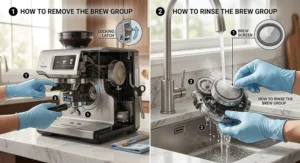
6. Breville Oracle Touch — dual boiler power with a manual override mode
The Oracle Touch occupies an unusual niche: it’s a super automatic machine built by a brand best known for prosumer manual espresso machines, and that DNA shows. Dual stainless steel boilers, PID-controlled temperature stability, an Over Pressure Valve, and pre-infusion technology all come standard, and the touchscreen interface lets you run the whole process hands-off or step in and adjust dose, grind size, and extraction time manually if you want to actually learn the craft rather than just consume the result. On paper, that hybrid flexibility is the single biggest differentiator versus the Jura and Miele machines on this list, which are engineered specifically to remove your hands from the process entirely. Reviewers consistently frame the Oracle Touch as the machine for people who eventually want to graduate toward manual technique without buying a second, cheaper machine to practice on — Breville even includes accessories like a tamper and trimming tool that fully automatic-only competitors skip because they assume you’ll never need them. Aggregated customer sentiment is strongly positive on the automatic milk texturing quality, which produces genuinely silky microfoam suitable for latte art, a detail that separates it from machines whose milk systems just produce serviceable foam. The tradeoff, and it’s a real one, is a noticeably larger countertop footprint than the slimmer De’Longhi or Saeco machines — this is not a compact-kitchen pick.
Pros:
- ✅ Manual override mode teaches real barista technique over time
- ✅ Dual boiler with PID control produces genuinely consistent shots
- ✅ Automatic milk system produces latte-art-capable microfoam
Cons:
- ❌ Large countertop footprint compared to most rivals here
- ❌ Steeper learning curve if you actually use manual mode
Pricing has fluctuated as Breville has refreshed the Oracle lineup, but the Oracle Touch generally sits in the $2,900 to $3,300 range at full retail — prices may vary meaningfully during Breville’s periodic clearance events, so check current price and stock before buying.
7. Jura Z10 — flagship hot-and-cold extraction for the serious household
At the very top of this lineup sits the Jura Z10, and the standout feature is genuinely novel rather than incremental: true cold-extraction brewing, which changes pressure and timing rather than just chilling hot coffee, to produce a smoother cold-brew-style espresso on demand. Paired with Jura’s Product Recognizing Grinder (P.R.G.), which automatically adjusts grind parameters based on the selected drink, the Z10 delivers a 32-item specialty menu spanning ristrettos, lungos, and both hot and cold milk drinks, more range than any other machine on this list. Dual automatic milk systems allow two different milk-based drinks to be prepared back-to-back without swapping components, a detail high-volume households will notice immediately and casual drinkers may never use. Based on the spec comparison against Jura’s own E8, the jump in price largely buys you three things: interface polish, the expanded specialty menu, and that cold-extraction capability specifically — if cold coffee isn’t a regular part of your week, the E8 delivers roughly 85 percent of the experience for meaningfully less money. Reviewers who cover the category broadly consistently rank the Z10’s espresso extraction among the best of any super automatic for coffee shop quality output, crediting the conical burr grinder and dual thermoblock system for aromatic, well-balanced shots rather than the flat, over-extracted taste cheaper machines can produce. What the spec sheet won’t tell you is how large this machine actually is on a counter — at nearly 20 inches deep with the milk system attached, it demands real kitchen real estate.
Pros:
- ✅ Only super automatic on this list with true cold extraction
- ✅ P.R.G. grinder auto-adjusts for each specialty drink selected
- ✅ Dual milk systems handle two drinks without component swaps
Cons:
- ❌ Largest footprint and highest price on this entire list
- ❌ Cold-extraction feature is wasted on hot-coffee-only households
The Jura Z10 typically runs $3,300 to $4,500 depending on color finish and retailer, occasionally dropping a few hundred dollars during Black Friday or Prime Day promotions. For households that drink both hot and cold specialty coffee in real volume, it remains the strongest all-around flagship in the category — for everyone else, it’s worth cross-shopping the E8 first.
Practical Usage Guide: Your First 30 Days
Getting a premium one-touch espresso machine dialed in isn’t instant, even though the marketing implies otherwise. The first week matters most: run at least two full water-tank cycles through the machine before your first real drink, since manufacturing residue and factory testing water can linger in the internal lines longer than you’d expect. Set your water hardness level correctly during setup — nearly every machine on this list asks for it, and skipping this step is the single most common reason new owners see premature scale buildup within the first two months.
By week two, start adjusting grind coarseness in small increments rather than big swings; a single click finer or coarser changes extraction time more than most new owners anticipate, and overcorrecting is how people end up chasing a “perfect” setting for weeks instead of days. This is also when you should dial in milk texture settings for your specific milk of choice, since whole milk, oat milk, and skim all foam at meaningfully different rates.
The most common first-month mistake, across nearly every brand, is neglecting the daily rinse cycle on the milk system. Bacteria and dried milk residue build up fast in warm, humid milk lines, and a machine that smells slightly sour after a week almost always traces back to a skipped rinse rather than a hardware flaw. Set a maintenance schedule now: daily milk-line rinse, weekly deep clean of the drip tray and grounds container, and descaling every 1 to 3 months depending on your water hardness and usage volume. Machines with auto-reminders, like the AquaClean-equipped De’Longhi models, make this easier to stick to than ones relying purely on memory.
Real-World Scenarios: Who Actually Needs Which Machine
The rotating-shift household. Picture two adults with staggered work schedules who each want a completely different drink at completely different hours — one wants a straight double espresso at 5 a.m., the other wants an oat milk latte at 10 p.m. This is exactly the De’Longhi Rivelia‘s use case: dual hoppers mean dark roast for the latte drinker and a brighter single-origin for the espresso purist, no bean-swapping required.
The design-conscious open kitchen. If your kitchen opens directly into your living space and you’ve spent real money on cabinetry and finishes, a machine that hums loudly at 6 a.m. undoes a lot of that investment fast. The KitchenAid KF8‘s quiet operation and stainless panels are built precisely for this scenario — form and noise level matter as much as the coffee here.
The high-volume, high-standards office micro-kitchen. A small office or showroom serving 15-plus specialty drinks a day needs speed and consistency more than novelty features. The Saeco Xelsis‘s dual thermoblocks or the Jura Z10‘s dual milk systems both solve the “everyone wants a drink at 9 a.m.” bottleneck that single-boiler machines struggle with.
How to Choose a Premium Super Automatic Espresso Machine
- Start with your milk habit, not your espresso habit. If most of your drinks involve milk, prioritize dual thermoblock or dual boiler machines like the Saeco Xelsis or Breville Oracle Touch — single-boiler machines force a wait between espresso and steamed milk.
- Match hopper design to your bean rotation. Single-drink households do fine with a single large hopper; multi-roast households benefit hugely from dual-hopper designs like the De’Longhi Rivelia.
- Weigh footprint against counter space honestly. The Jura Z10 and Breville Oracle Touch are large machines — measure your counter depth before falling for the spec sheet.
- Decide how much control you actually want. If you enjoy fiddling with grind size and extraction time, the Oracle Touch‘s manual override mode is a genuine differentiator; if you want to never touch a setting again, look toward the Miele CM 6360 or Jura Z10.
- Factor in noise tolerance for your kitchen layout. Open-plan homes should weight this heavily — the KitchenAid KF8 stands out here specifically.
- Check for app or smart-home integration only if you’ll actually use it. The Terra Kaffe TK-02‘s app is genuinely useful for some buyers and genuinely unnecessary friction for others.
- Budget for maintenance, not just the sticker price. Water filters, descaling solution, and occasional professional servicing add real annual cost across every machine on this list.
Common Mistakes When Buying a Premium Super Automatic
The single most expensive mistake is buying based on price alone without checking milk system architecture. A cheaper machine with a single thermoblock will always feel slower for milk-heavy households, regardless of how good its espresso is on paper — and by the time buyers realize this, they’ve often already sold their old machine.
A close second: ignoring bean hopper capacity relative to household size. A one-person household barely notices a small hopper; a family of four burns through it in days, and constant refilling becomes the daily annoyance that eventually sours people on an otherwise great machine.
Buyers also consistently underestimate footprint. Countertop depth, not just width, catches people off guard — several machines here, especially the Jura Z10 and Breville Oracle Touch, need real clearance behind them for the water tank and bean hopper to open properly. Measure before you buy, not after delivery.
Finally, skipping the water-hardness setup step during installation is a mistake buyers rarely connect to the scale buildup they discover eight months later. It takes thirty seconds and prevents a maintenance headache down the road.
✨ Don’t Miss These Exclusive Deals!
🔍 Take your morning coffee routine to the next level with these carefully selected machines. Click on any highlighted item to check current pricing and availability. These picks will help you create authentic café-quality drinks your whole household will actually love!
Super Automatic vs Semi-Automatic vs Manual Espresso Machines
| Factor | Super Automatic | Semi-Automatic | Manual/Lever |
|---|---|---|---|
| Learning curve | Minimal — mostly one-touch | Moderate — requires grind/dose skill | Steep — full manual control |
| Consistency | Very high, machine-controlled | Depends on operator skill | Depends heavily on operator skill |
| Speed per drink | Fastest, under a minute | Slower, several minutes | Slowest, most hands-on |
| Best For | Convenience-first households | Hobbyists who enjoy the process | Enthusiasts and purists |
The core tradeoff here isn’t really about coffee quality at the top end — a well-dialed super automatic like the Jura Z10 or Breville Oracle Touch can produce shots that compete with a skilled home barista on a semi-automatic. The real difference is where the effort lives. Semi-automatic and manual machines put grind calibration, dosing consistency, and tamping pressure entirely in your hands, which some people find genuinely rewarding as a hobby and others find like unpaid barista labor before their first sip. If you’ve ever wondered whether a top tier automatic coffee machine can really match a manual setup, the honest answer is: for 90 percent of daily drinking, yes — the remaining 10 percent is really about whether you enjoy the process itself, not just the outcome in the cup.
What to Expect: Real-World Performance
Specs on paper rarely translate directly into how a machine feels to live with. A 19-bar pump, for instance, sounds impressive, but pressure alone doesn’t determine espresso quality — pre-infusion timing and grinder consistency matter just as much, which is why the Miele CM 6360‘s DoubleShot function and the Jura Z10‘s P.R.G. grinder consistently outperform machines with higher raw bar ratings but less refined extraction control.
Expect your first cup each morning to take slightly longer than subsequent ones, since most machines run an internal rinse and heat-up cycle from cold. Expect milk texture to vary noticeably between machines with integrated carafes versus external jugs — carafe systems tend to produce more consistent microfoam because the milk stays cold and fresh in a sealed, refrigerated unit, while external jugs depend on how promptly you refill and clean them. And expect noise to be a bigger factor in daily satisfaction than most buyers predict before purchase; a machine that’s five decibels louder doesn’t sound like much on a spec sheet, but it’s the difference between waking a sleeping household and not.
Long-Term Cost & Maintenance
| Cost Factor | Home Premium Machine (10-yr estimate) | Daily Café Habit (10-yr estimate) |
|---|---|---|
| Upfront cost | $1,500–$4,500 one-time | $0 |
| Ongoing cost | ~$400–$700/yr (beans, filters, descaler) | ~$1,800–$2,500/yr (one drink/day) |
| 10-year total | Roughly $5,500–$11,500 | Roughly $18,000–$25,000 |
| Maintenance effort | Weekly cleaning, periodic descaling | None |
The math above interprets some real range, not a guarantee — bean cost varies by roast quality and household consumption, and café pricing varies wildly by region. Still, the pattern holds across almost every scenario: even the Jura Z10 at the top of this list, amortized over a decade of daily use, tends to land well below the cost of a daily café habit, especially for households drinking two or more specialty drinks a day. Given that the National Coffee Association has tracked steady growth in specialty coffee’s share of American drinking habits for decades, that math increasingly favors home brewing for anyone drinking espresso-based drinks regularly rather than occasionally. It’s also worth noting that caffeine intake compounds with convenience — easier access tends to mean more cups, and the FDA’s general guidance suggests most healthy adults can safely handle around 400 milligrams of caffeine per day, which is a genuinely useful number to keep in mind once a one-touch machine makes a fourth or fifth espresso trivially easy to make.
Features That Actually Matter (And Those That Don’t)
Grinder quality matters enormously; touchscreen size matters much less than marketing suggests. A stainless steel conical burr grinder, like those in the Miele CM 6360 and Terra Kaffe TK-02, will meaningfully outlast and outperform cheaper flat burr alternatives over years of daily grinding, while a bigger, flashier screen mostly just looks nice in product photography.
Dual boiler or dual thermoblock systems matter if milk drinks dominate your routine; they’re largely irrelevant if you drink straight espresso exclusively. Similarly, app connectivity is a genuine value-add for households that actually want remote control or multi-user profiles, and pure friction for anyone who just wants to press a physical button.
What doesn’t matter nearly as much as buyers assume: the sheer number of preset drink recipes. A machine boasting 50 specialty drinks sounds impressive, but most households settle into two or three regular orders within the first month regardless of how many options exist on the menu.

Premium Super Automatic Espresso Machine FAQ
❓ What's the difference between a super automatic and a high end bean to cup machine?
❓ Is a premium super automatic espresso machine worth it over a cheaper model?
❓ How often should I descale a premium super automatic espresso machine?
❓ Do premium super automatic espresso machines make better coffee than a barista?
❓ What's the average lifespan of a luxury fully automatic espresso machine?
Conclusion
There’s no single “best” machine on this list — that’s kind of the point of a category this wide. The De’Longhi Rivelia and Saeco Xelsis make the most sense for households easing into premium territory without flagship pricing. The Terra Kaffe TK-02 and KitchenAid KF8 split the difference between tech-forward convenience and design-first kitchens. And the Miele CM 6360, Breville Oracle Touch, and Jura Z10 exist for buyers who’ve decided that coffee is a category worth genuinely investing in, not just a morning obligation.
What all seven share is the same basic promise: café-quality output without café-level effort, delivered consistently enough that the machine eventually just fades into the background of your morning. With nearly 195 million American adults drinking coffee every week, it’s a promise a lot of households are increasingly willing to pay for upfront rather than one cup at a time. Whichever tier fits your kitchen and your habits, the honest advice is the same: buy for how you actually drink coffee today, not the elaborate milk-art routine you imagine adopting someday.
Recommended for You
- Jura vs Delonghi Super Automatic: 7 Machines Ranked for 2026
- Jura E8 Review 2026: Is the Price Tag Actually Worth It?
- DeLonghi Magnifica Evo Review 2026: 7 Bean to Cup Picks Worth It?
Disclaimer: This article contains affiliate links. As an Amazon Associate, I earn from qualifying purchases. If you purchase products through these links, we may earn a small commission at no additional cost to you.
✨ Found this helpful? Share it with your friends! 💬🤗
