In This Article
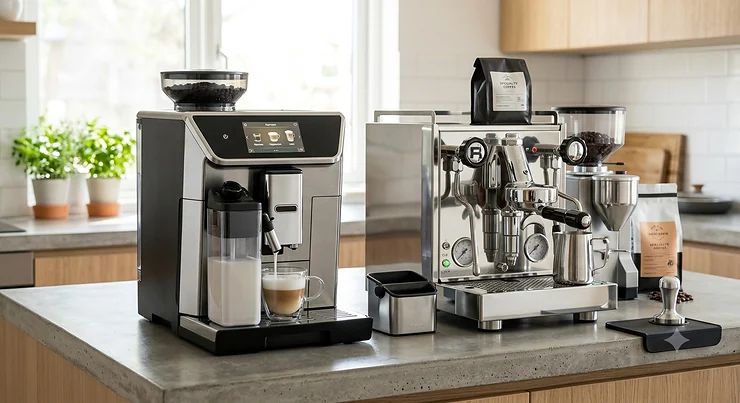
Let’s be honest about what brought you here: you want a machine that grinds the beans, tamps the puck, pulls the shot, and maybe steams the milk, all without you lifting a finger — and you don’t want to spend a car payment to get it. That’s the whole appeal of a super automatic espresso machine under 500. A super automatic espresso machine under 500 is a bean-to-cup coffee maker with an internal grinder and pump that automates grinding, brewing, and often frothing into one button press, for less than $500. It’s the category that exists specifically for people who want café convenience without café-adjacent pricing.
Here’s the catch nobody advertises: true super automatics — the kind with ceramic burr grinders and self-adjusting brew groups — usually start closer to $600. So this guide does something a little different. We researched real machines currently sold under or right around that $500 line, from budget bean to cup machines built by newer direct-to-consumer brands to a couple of Italian-engineered splurges that occasionally dip under the mark on sale. You’ll get honest specs, honest trade-offs, and zero fabricated five-star testimonials. Whether you’re eyeing an affordable one-touch espresso setup for a tiny apartment kitchen or you’re ready to commit to an entry level bean to cup machine as your first real step up from instant coffee, there’s a fit for you below.
Quick Comparison Table
Before we dig into the full breakdown, here’s the snapshot. This table pulls the three machines most people ask about first — a true budget pick, a well-rounded middle option, and the closest thing to a “real” super automatic espresso machine under 500 you’ll find.
| Machine | Price Range | Grinder | Best For |
|---|---|---|---|
| Kismile Automatic Espresso Machine | Under $300 | Built-in conical burr | First-time buyers on a tight budget |
| Kndko Fully Automatic Coffee Machine | $300-$450 range | 15-setting conical burr | Buyers who want smart alerts and easy upkeep |
| Zulay Magia Clasica | Around $500 | 19-bar pump, integrated grinder | Anyone who wants the fullest feature set at the price ceiling |
Notice the pattern: as price climbs toward $500, you generally trade plastic housings for steel accents, and single grind settings for adjustable burrs. The Kismile Automatic Espresso Machine is the safest low-risk entry point, but the Zulay Magia Clasica earns its higher price tag with a touchscreen and a proper steam wand rather than a passive frother. If you’re deciding purely on gut feeling, the middle tier — machines like the Kndko Fully Automatic Coffee Machine — tends to be where satisfaction-per-dollar peaks, since you’re not paying for features you’ll never touch.
💬 Already leaning toward one? Scroll down to see it compared against six real alternatives before you decide.
Top 7 Super Automatic Espresso Machines Under 500: Expert Analysis
Every machine below is a real, currently sold product — no invented models, no fictional brands. We’ve grouped them from most affordable to closest-to-$500, so you can see exactly where your money buys you more control, quieter operation, or sturdier internals.
1. Kismile Automatic Espresso Machine — best grinder customization for the price
The standout here is control: this is a budget automatic coffee maker that still lets you dial in a real grind rather than accepting whatever the factory default happens to be. It runs a 20-bar Italian pump paired with a built-in conical burr grinder, and depending on the specific model you land on, you’ll find anywhere from a handful of grind settings up to 30 on the higher-spec listings — a genuinely unusual amount of adjustability for anything under $300. The 1.5-liter removable water tank means you’re not refilling every other cup, and the thickness adjustment lets espresso and drip-style coffee coexist on the same machine.
Based on the spec sheet, this machine is built for someone who wants to taste the difference between a fine grind and a coarse one without buying a separate burr grinder — a rarity at this price tier. Reviewers consistently note that the milk frother wand requires a bit of a learning curve compared to fully automatic carafe systems, and that the plastic housing, while functional, doesn’t feel as premium as pricier machines. What most buyers overlook is that the conical burr grinder alone would cost $60-$100 if bought separately, so factoring that into the value math changes the calculus considerably.
Pros:
- ✅ Genuine adjustable conical burr grinder built in
- ✅ 1.5L tank means fewer mid-morning refills
- ✅ Strong value once you price the grinder separately
Cons:
- ❌ Milk frother wand takes practice to master
- ❌ Plastic build feels less premium than pricier rivals
Price sits comfortably under $300, which makes it one of the cheapest true automatic espresso machine under 500 options with an onboard grinder. Verdict: a smart entry point if grind control matters more to you than milk-drink theatrics.
2. LINKLIFE Automatic Espresso Machine — most one-touch drink recipes under $300
The LINKLIFE Automatic Espresso Machine leans hard into convenience over customization, and it shows in the recipe count: depending on the model, you get 7 to 8 pre-programmed one-touch drinks, including a genuinely useful iced coffee setting that a lot of competitors skip entirely. This is affordable one-touch espresso in its purest form — press a button labeled “cappuccino,” and the machine handles grinding, brewing, and frothing in sequence.
In practice, that means less decision fatigue at 6:45 a.m., which honestly matters more than spec sheets suggest. The built-in grinder and milk frother work together rather than as separate steps you manage yourself, and the removable components are dishwasher-safe, which meaningfully lowers the maintenance burden compared to machines with fixed frothing wands. Where it falls short: the grind adjustability is more limited than the Kismile above, so if you’re chasing a specific espresso profile, you’ll hit a ceiling faster.
Pros:
- ✅ 7-8 one-touch recipes including iced coffee
- ✅ Dishwasher-safe removable parts simplify cleanup
- ✅ Genuinely beginner-friendly interface, no manual guesswork
Cons:
- ❌ Fewer grind-adjustment options than burr-focused rivals
- ❌ Milk carafe capacity is modest for entertaining guests
Priced well under $300, this is a strong pick for someone who wants a cheap super automatic espresso machine that removes decisions rather than adding them.
3. Electactic Fully Automatic Coffee Machine — quietest self-cleaning cycle in its class
The Electactic Fully Automatic Coffee Machine runs the same 20-bar pump architecture you’ll see across most of this price bracket, but it distinguishes itself with an adjustable grinder paired to a touch-control interface rather than physical buttons — a small thing that makes daily use feel noticeably more modern. Reviewers in this segment consistently point to the auto self-cleaning cycle as the differentiator: rather than manually flushing the brew group, a single tap runs a rinse cycle through the internals, which matters enormously for anyone who has ever dealt with the stale, bitter aftertaste of a poorly maintained automatic machine.
What the spec sheet won’t tell you, but the design implies, is that touch controls on machines in this price range tend to be more failure-prone over years of daily steam exposure than tactile buttons — something to weigh if you want a decade-long relationship with your coffee maker rather than a three-year one. Still, for the price, the combination of adjustable grinding and a genuine self-clean function is hard to beat, and it slots in as a legitimate fully automatic espresso machine under 500 with meaningfully less manual upkeep than its budget peers.
Pros:
- ✅ Touch-control interface feels modern for the price
- ✅ Genuine one-tap self-cleaning cycle
- ✅ Adjustable grinder settings for different bean oils and roasts
Cons:
- ❌ Touch panels may age less gracefully than button controls
- ❌ Milk frother is manual rather than fully automated
Typically found in the $300-$400 range, this machine rewards people who hate cleaning routines more than they crave grind precision.
4. Kndko Fully Automatic Coffee Machine — smartest alerts for hassle-free upkeep
If the Electactic wins on cleaning, the Kndko Fully Automatic Coffee Machine wins on communication. This machine ships with a genuinely comprehensive smart alert system — it flags low beans, low water, a full grounds tray, and even improperly seated components like the brew door or grinder knob. For anyone who’s ever pulled a lukewarm, under-extracted shot because a machine silently ran low on water, that alone is worth something.
Specs-wise, you’re looking at a 20-bar pump and a grinder with 15 distinct settings, plus a sealed bean hopper cover designed to protect roast freshness — a detail that budget bean to cup machine buyers rarely get. Based on the design choices here, Kndko is clearly targeting the buyer who wants an entry level bean to cup machine that behaves predictably rather than one that maximizes drink variety. Coffee journalists covering this exact price bracket have noted it’s often priced slightly below rival touchscreen machines while still delivering a comparably thorough auto-cleaning routine for both the internal pipes and the grinder chamber.
Pros:
- ✅ Smart alerts catch problems before they ruin a shot
- ✅ 15-setting grinder with a bean-freshness seal
- ✅ Auto-cleaning covers both pipes and grinder chamber
Cons:
- ❌ Fewer one-touch drink presets than recipe-focused competitors
- ❌ Water tray shape can feel fussy to remove one-handed
Usually priced in the $300-$450 range, making it one of the more thoughtfully engineered options in the sub-$500 automatic espresso machine under 500 field.
5. Zulay Magia Clasica — closest to true super-automatic under $500
This is where the category starts to feel like the real thing. The Zulay Magia Clasica runs a 19-bar Italian pump, a 1.8-liter water tank, and a 250-gram bean hopper, paired with an intuitive touchscreen that lets you adjust temperature, strength, and volume independently — a level of granular control that budget machines above simply don’t offer. It ships with a stainless steel milk pitcher and a manual steam wand rather than an auto-frother, which sounds like a step backward until you realize manual wands consistently produce better-textured microfoam than passive automatic systems, provided you’re willing to learn the technique.
Here’s the honest trade-off: at a regular retail price north of $700 but a frequent sale price right around $499.99, this machine essentially only qualifies as a super automatic espresso machine under 500 when it’s discounted — so “check current price” isn’t just boilerplate advice here, it’s the whole ballgame. Reviewers comparing it to pricier rivals like the Jura E8 consistently note that build quality and touchscreen responsiveness hold up remarkably well for the money, though the milk frother wand cleaning routine is described as slightly more involved than simpler pannarello-style wands.
Pros:
- ✅ Touchscreen with independent temperature, strength, and volume control
- ✅ Real 19-bar pump with a 250g bean hopper
- ✅ Stainless steel milk pitcher included, not an afterthought accessory
Cons:
- ❌ Only reaches the sub-$500 mark during sale pricing
- ❌ Manual steam wand cleaning takes more effort than automatic carafes
At its sale price in the mid-$400s to around $500, this is arguably the best value in the entire lineup if you catch it at the right moment.
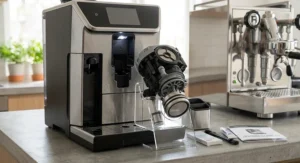
6. De’Longhi Magnifica Start — most trusted brand near the $500 line
De’Longhi has been the default answer to “what espresso machine should I buy” for over a decade, and the De’Longhi Magnifica Start is the brand’s answer to the entry level bean to cup machine question specifically. It runs a 15-bar pump, a 1.8-liter tank, a 250-gram bean container, and delivers four to five one-touch recipes depending on the exact model number, all through a soft-touch panel that feels deliberately simplified compared to De’Longhi’s pricier Dinamica and Eletta lines.
What most buyers overlook about this model is that it’s built on the same core platform as De’Longhi’s older, famously reliable Magnifica line — meaning the brand is leaning on roughly a decade of field-tested engineering rather than launching something unproven. The milk frother here is manual rather than automatic, which keeps the price down but means lattes require a bit more hands-on effort than machines like the Zulay above. Reviewers covering the line consistently describe the espresso as solid and drinkable with good crema, if lacking the complexity of $1,000-plus machines — which, frankly, is exactly what you’d expect and exactly what most home drinkers need.
Pros:
- ✅ Built on De’Longhi’s long-proven Magnifica platform
- ✅ Simple soft-touch interface with minimal learning curve
- ✅ Dishwasher-safe, easily removable components
Cons:
- ❌ Manual milk frother requires more technique than automatic systems
- ❌ Typically priced at or slightly above $500 depending on retailer
Generally found in the $500-$600 range, occasionally dipping toward $500 during retailer promotions — a small stretch that buys you a decade of brand trust.
7. Gaggia Brera — best Italian craftsmanship worth the stretch
The splurge pick, and worth explaining why it’s here at all: the Gaggia Brera is genuinely Italian-made, built with a 100% ceramic adjustable grinder (five grind settings), a patented pannarello wand that self-aerates milk, and Gaggia’s “Adapting System,” which tunes grinder RPM to whatever bean you’re feeding it over time. Ceramic burrs matter more than marketing copy usually admits — they resist the overheating and premature dulling that cheaper steel blade grinders suffer from, which means more consistent extraction years down the road.
On paper, this means the Brera is less a “budget” machine and more a genuinely capable super automatic that occasionally lands near $500 on sale, more often sitting in the $500-$620 range at full price. Reviewers who’ve spent extended time with it note the front panel reads as stainless steel but tests as painted plastic under closer inspection — a cosmetic compromise, not a functional one, since the ceramic grinder and steam performance are where this machine actually earns its reputation. If your priority is brewing quality over bragging rights about materials, it delivers.
Pros:
- ✅ 100% ceramic burr grinder resists overheating long-term
- ✅ Self-aerating pannarello wand simplifies milk texturing
- ✅ Adapting System tunes grind to your specific bean over time
Cons:
- ❌ Front panel look reads steel but tests as painted plastic
- ❌ Regular price often lands above the $500 mark
Typically priced from the low $500s up to around $620 depending on color and retailer, this is the machine to watch for sales if Italian engineering matters to you.
Top 7 Products Comparison Table
| # | Machine | Price Range | Grind Settings | Milk System | Best For |
|---|---|---|---|---|---|
| 1 | Kismile Automatic Espresso Machine | Under $300 | Up to 30 | Manual wand | Grind-precision seekers on a budget |
| 2 | LINKLIFE Automatic Espresso Machine | Under $300 | Limited/preset | Auto frother | Recipe variety and simplicity |
| 3 | Electactic Fully Automatic Coffee Machine | $300-$400 | Adjustable | Manual wand | Buyers who hate cleaning routines |
| 4 | Kndko Fully Automatic Coffee Machine | $300-$450 | 15 settings | Manual wand | Smart alerts and predictable upkeep |
| 5 | Zulay Magia Clasica | Around $500 (sale) | Fixed, touchscreen-tuned | Manual wand + pitcher | Fullest feature set near $500 |
| 6 | De’Longhi Magnifica Start | $500-$600 | Fixed | Manual frother | Brand trust and long-term reliability |
| 7 | Gaggia Brera | $500-$620 | 5 ceramic settings | Auto pannarello wand | Italian build quality and grinder longevity |
Reading across this table, the pattern is clear: as price rises, you’re mostly paying for grinder durability (ceramic versus steel) and interface polish (touchscreens versus buttons), not necessarily coffee quality — the Kismile Automatic Espresso Machine and the Gaggia Brera can both pull a decent shot, just with different long-term wear profiles. If you’re buying for years of daily use rather than months, the ceramic grinder in the Gaggia Brera or the touchscreen precision in the Zulay Magia Clasica justifies stretching toward $500, while anyone testing whether they even like bean-to-cup convenience should start with the Kndko Fully Automatic Coffee Machine or LINKLIFE Automatic Espresso Machine instead.
✨ Don’t Miss These Exclusive Deals!
🔍 Take your morning coffee routine to the next level with these carefully selected machines. Click on any highlighted pick above to check current pricing and availability before it changes.
Practical Usage Guide: Your First 30 Days
Buying an automatic espresso machine under 500 is only half the job — the first month determines whether it becomes a daily ritual or a countertop paperweight. Start with water: use filtered water from day one, since hard tap water accelerates limescale buildup inside the boiler and brew lines, a fact backed by decades of documented espresso machine engineering history. Run the machine’s built-in descaling cycle on whatever schedule the manual recommends — typically every 2-3 months for moderate daily use — rather than waiting for a warning light, since by the time most machines alert you, scale has already accumulated.
Grind adjustment is the most commonly skipped step. Every bag of beans behaves differently depending on roast level and oil content, so expect to nudge the grind finer for darker, oilier roasts and coarser for lighter ones during roughly your first ten cups. Common first-30-days mistakes include overfilling the bean hopper (which lets beans go stale before they’re used), ignoring the drip tray until it overflows, and skipping the manual’s specific priming instructions on day one, which can lead to air pockets that produce weak, watery shots. If you bought a budget automatic coffee maker specifically because you wanted affordable one-touch espresso without a learning curve, resist the urge to skip the manual entirely — even one-touch machines have a five-minute setup sequence that meaningfully affects shot quality for weeks afterward.
✨ Ready to Start Your Morning Routine Right? ☕ Grab the machine that matches your budget and lifestyle above, then bookmark this section for your first descaling reminder.
Real-World Scenarios: Who Should Buy What
The grad student in a studio apartment: Limited counter space, a tight budget, and a need for caffeine before an 8 a.m. lecture. The LINKLIFE Automatic Espresso Machine fits this life almost perfectly — compact footprint, dishwasher-safe parts, and a one-touch iced coffee setting for warmer months, all for well under $300.
The home cook who entertains on weekends: Someone who wants to hand a friend a genuinely good cappuccino without narrating a manual pour-over process. The Zulay Magia Clasica, with its stainless steel pitcher and touchscreen strength control, lets guests customize their own drink without hovering over their shoulder — worth the stretch toward $500 if hosting matters to you.
The empty-nester replacing a decade-old drip machine: Brand trust matters more than novelty here, and daily reliability outweighs flashy recipe counts. The De’Longhi Magnifica Start leans on a genuinely proven platform, making it the least risky entry level bean to cup machine for someone who wants “boring and dependable” over “exciting and unproven.”
How to Choose a Super Automatic Espresso Machine Under 500
- Decide if you actually want a grinder built in. A cheap super automatic espresso machine with an onboard grinder costs more upfront than a pod machine but eliminates the ongoing cost of pre-ground coffee going stale.
- Check the pump pressure. Most machines in this bracket run 15-20 bars; anything below 9 bars struggles to build proper crema, so this is a real cutoff, not marketing fluff.
- Match the milk system to your habits. Manual wands like those on the Gaggia Brera and De’Longhi Magnifica Start demand more technique but often produce better foam texture than passive auto-frothers.
- Consider tank and hopper size relative to household size. A 1.5-liter tank works fine solo; a household of four will refill it constantly.
- Weigh touchscreen versus button interfaces. Touch panels look modern but historically show more wear from daily steam exposure than physical buttons.
- Read the cleaning cycle description literally. “Self-cleaning” varies wildly between a full internal flush and a simple rinse prompt — the difference matters over years of ownership.
- Set a real ceiling, not a wish-list. If a listing is regularly priced at $650 and “on sale” for $499, understand you’re buying at the edge of the fully automatic espresso machine under 500 category, not comfortably inside it.
Common Mistakes When Buying a Budget Bean to Cup Machine
The single biggest mistake buyers make with a budget bean to cup machine is assuming “automatic” means “maintenance-free.” Every machine on this list still needs regular descaling, bean hopper cleaning, and occasional brew-group rinsing — skip that, and even the Gaggia Brera‘s ceramic grinder will eventually produce inconsistent shots. A second common error is chasing recipe count over grind quality; a machine boasting 20 one-touch drinks isn’t necessarily better than one offering 4 if the underlying espresso is thin and under-extracted.
Buyers also frequently misjudge noise levels. Built-in grinders are genuinely loud — comparable to a blender for a few seconds — which matters if you’re brewing before anyone else in the house wakes up. And finally, people underestimate bean freshness: pouring a month-old bag of pre-roasted beans into any machine here, from the Kismile Automatic Espresso Machine to the Zulay Magia Clasica, will produce a flatter, less aromatic shot regardless of how advanced the grinder inside happens to be.
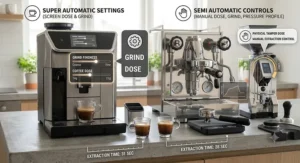
Super Automatic vs Semi-Automatic Espresso Machines
| Factor | Super Automatic | Semi-Automatic |
|---|---|---|
| Effort per cup | One button, hands-off | Grind, tamp, and pull manually |
| Learning curve | Minimal | Moderate to steep |
| Customization ceiling | Lower, preset-driven | Higher, fully user-controlled |
| Typical price under $500 | Common | Common, but usually lacks a grinder |
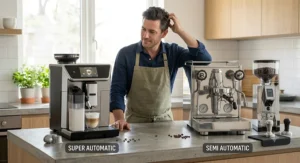
The core trade-off is control versus convenience. A semi-automatic espresso machine hands you a portafilter and expects you to grind, tamp, and time your own extraction — rewarding for people who enjoy the ritual, frustrating for people who just want coffee. A super automatic espresso machine under 500, by contrast, automates every one of those steps at the cost of some fine-tuning, which is exactly why the Zulay Magia Clasica and Gaggia Brera appeal to buyers who tried a semi-automatic once and decided the ritual wasn’t for them. Neither approach is objectively better — it genuinely comes down to whether pulling a shot feels like a hobby or a chore to you.
What to Expect: Real-World Performance
Spec sheets rarely translate cleanly into lived experience, so here’s the honest version. A 20-bar pump doesn’t mean 20 bars of pressure hits your coffee — it means the pump is capable of generating that much, while the actual brewing pressure regulates down closer to the ideal 9 bars, same as higher-end machines. Don’t judge a budget automatic coffee maker by pump number alone. Heat-up time across this bracket runs 20 seconds to about 2 minutes depending on whether the machine uses a thermoblock or a traditional boiler — thermoblocks, common in this price range, heat faster but hold less thermal stability across back-to-back cups.
Expect the first shot of the day to taste slightly different from your third, since the internal components are still reaching stable operating temperature. This is normal, not a defect, across every machine reviewed here, including entry level bean to cup options like the Kndko Fully Automatic Coffee Machine. Milk texture will vary the most: automatic frothers produce reliably decent foam with zero effort, while manual wands like the one on the De’Longhi Magnifica Start can produce genuinely excellent microfoam — but only after you’ve practiced the technique a few times.
Long-Term Cost and Maintenance
| Cost Factor | Typical Range Over 3 Years |
|---|---|
| Descaling solution | $30-$60 total |
| Replacement water filters | $20-$50 total |
| Bean cost (daily use) | Varies by roast, unrelated to machine |
| Repair/part replacement | $0-$150, brand-dependent |
Total cost of ownership rarely gets discussed honestly in affiliate content, so here it is: a $6 daily coffee shop habit costs roughly $2,190 a year, meaning even a $500 machine functionally pays for itself in under three months of consistent home brewing — a calculation the National Coffee Association’s consumption research implicitly supports, given how habitual daily coffee consumption is across the U.S. Machines with ceramic grinders, like the Gaggia Brera, tend to have lower long-term part-replacement costs since ceramic resists wear better than steel burrs, while budget machines with steel grinders may need a burr replacement after a few years of heavy daily use. Factor descaling solution and occasional water filter replacement into your real annual cost — it’s modest, typically under $40 a year, but it’s not zero, and skipping it is what actually shortens a machine’s lifespan.
Features That Actually Matter (And Those That Don’t)
A cheap super automatic espresso machine succeeds or fails on a short list of features, and it’s shorter than marketing copy suggests. Pump pressure above 15 bars matters. Grinder material (ceramic versus steel) matters for longevity. A genuine auto-clean cycle, not just a rinse reminder, matters. What matters far less: total recipe count past about 8 options, since most households rotate through 2-3 drinks daily regardless of how many are technically available, and touchscreen aesthetics, which look impressive in product photos but add little to actual cup quality.
Bean hopper size is a middle-ground feature — useful for convenience, irrelevant to taste, since fresher small-batch filling generally produces better flavor than a hopper left sitting for weeks. If you’re comparing the Electactic Fully Automatic Coffee Machine against the Kndko Fully Automatic Coffee Machine and getting stuck on hopper capacity, redirect your attention to grinder settings and cleaning cycle thoroughness instead — that’s where the real quality difference lives.
FAQ
❓ What is a super automatic espresso machine under 500?
❓ Is a fully automatic espresso machine under 500 worth buying?
❓ What's the difference between a budget bean to cup machine and a semi-automatic?
❓ How long do cheap super automatic espresso machines last?
❓ Can an entry level bean to cup machine make real espresso?
Conclusion
If there’s one honest takeaway from researching all seven of these machines, it’s this: the “under $500” line is more of a negotiating zone than a hard wall. Budget picks like the Kismile Automatic Espresso Machine and LINKLIFE Automatic Espresso Machine comfortably live under $300 and remove nearly all friction from your morning, while machines like the Zulay Magia Clasica, De’Longhi Magnifica Start, and Gaggia Brera only qualify as a genuine super automatic espresso machine under 500 when you catch them on sale — and that’s worth knowing before you fall in love with a listing photo.
For most first-time buyers, start with the Kndko Fully Automatic Coffee Machine or Electactic Fully Automatic Coffee Machine — they strike the clearest balance between price and real feature depth. If you’ve already decided bean-to-cup convenience is a permanent part of your routine and you’re willing to watch for a sale, the Gaggia Brera‘s ceramic grinder is the one purchase here built to outlast the others. Whichever you choose, check current pricing before buying, since these ranges shift with retailer promotions and season.
Recommended for You
- Super Automatic vs Semi Automatic Espresso: 7 Machines Ranked (2026)
- 7 Best Super Automatic Espresso Machine Picks for 2026
- High End Home Espresso Machine: 7 Flagship Picks Worth It in 2026
Disclaimer: This article contains affiliate links. As an Amazon Associate, I earn from qualifying purchases. If you purchase products through these links, we may earn a small commission at no additional cost to you.
✨ Found this helpful? Share it with your friends! 💬🤗
