In This Article
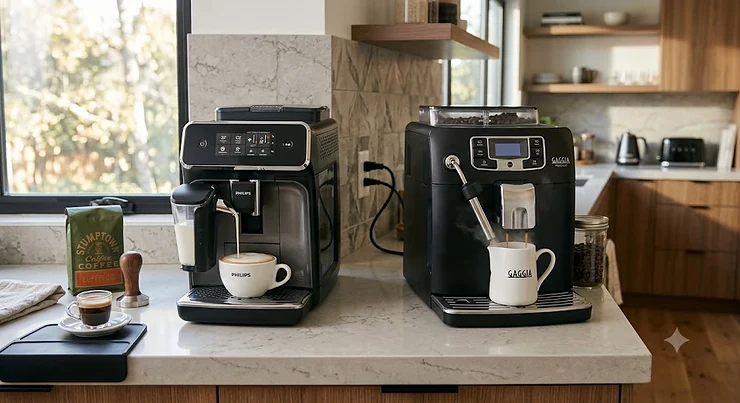
Somewhere around your third $6 oat-milk latte of the week, the math starts doing itself. That’s usually the moment people land on this exact comparison: philips 3200 vs gaggia velasca, two machines that couldn’t be more different in personality while chasing the same goal — great coffee with zero barista skills required. One is Dutch, minimalist, and almost suspiciously easy to live with. The other is Italian, a little fussier, and built by people who’ve been arguing about extraction pressure since before your grandparents were born.
A super automatic espresso machine grinds beans, tamps the puck, brews under pressure, and (on some models) froths milk — all from a single button press, with no manual technique required. That’s the whole appeal, and it’s also where the philips 3200 vs gaggia velasca debate gets interesting, because “automatic” doesn’t mean “identical.”
This guide pits the Philips 3200 LatteGo against the Gaggia Velasca head-to-head, then widens the lens to five more real machines spanning budget, mid-range, and genuinely indulgent price points. You’ll get honest analysis grounded in actual specs and aggregated review sentiment — not marketing copy dressed up as a review, and not fabricated hands-on claims. By the end, you should know exactly which bean-to-cup machine deserves counter space in your kitchen, and why.
Quick Comparison Table
| Feature | Philips 3200 LatteGo | Gaggia Velasca |
|---|---|---|
| Origin | Netherlands | Italy |
| Milk system | LatteGo (tubeless, 2-part) | Pannarello steam wand (auto-froth) |
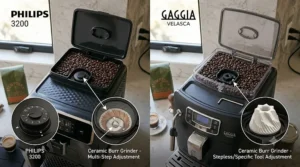
| Grinder | Ceramic flat burr, 12 settings | Ceramic conical burr, 10 settings |
| Price range | Around $500–$650 | Around $625–$800 |
| Best for | Simplicity, easy cleanup | Grind control, Italian shot character |
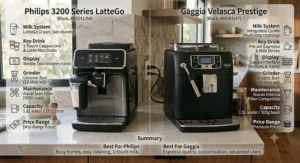
Reading that table, the split becomes obvious fast: Philips 3200 LatteGo wins on day-to-day convenience, while Gaggia Velasca wins on the kind of granular control that espresso tinkerers actually care about. Neither number is “better” in a vacuum — it depends whether you value a five-second milk-system rinse or a finer say over how your shot tastes. Budget-wise they overlap more than people expect, which is exactly why this comparison keeps coming up in forums.
💬 Already leaning one way? Tap the machine above to check today’s availability — these two sell out of stock fast around the holidays!
Top 7 Super Automatic Espresso Machines: Expert Analysis
1. Philips 3200 LatteGo — easiest milk system to clean
The tubeless LatteGo carafe is the headline feature here, and it earns the hype: two dishwasher-safe parts snap together, no rinsing spaghetti-like tubing after every latte.
Under the hood sits a 100% ceramic flat burr grinder with 12 grind settings, which is a genuinely unusual spec at this price — most rivals still ship conical steel burrs. In practice that means more consistent particle size, which translates to steadier extraction shot after shot, especially once the burrs have a few hundred cycles on them. The touchscreen keeps five one-touch drinks (espresso, coffee, Americano, cappuccino, latte macchiato) within two taps, and the AquaClean filter stretches descaling intervals out for months of hard water use.
Based on the spec sheet and the sheer review volume this machine has racked up, the Philips 3200 LatteGo is clearly aimed at first-time super automatic buyers who want reliability over customization. It’s the machine you recommend to a parent, a roommate, or anyone who’s never operated a espresso machine before.
Aggregated buyer sentiment is unusually consistent for a sub-$700 machine: reviewers repeatedly praise the ease of daily cleanup and the speed from bean to cup, while the most common complaints center on the compact water tank needing frequent refills and audible grinder noise during the first grind cycle each morning.
Pros:
- ✅ Tubeless LatteGo system cleans in seconds, dishwasher-safe
- ✅ Ceramic flat burr grinder rare at this price point
- ✅ Huge review base means fewer buying surprises
Cons:
- ❌ Small water tank means more frequent refills
- ❌ Grinder noise is noticeable on early-morning brews
Priced in the $500–$650 range depending on the LatteGo vs classic-frother version, this is arguably the best value entry point into the entire super automatic category — check current price before buying, since Philips periodically bundles the AquaClean filter.
2. Gaggia Velasca — most grind customization for the money
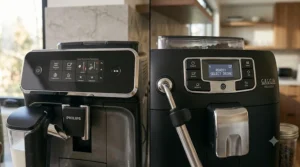
Where the Philips leans on simplicity, the Gaggia Velasca leans hard into control, and its 10-step ceramic burr grinder paired with 5 strength settings and 3 temperature options gives you more dial-in room than almost anything else near its price.
That granularity matters more than it sounds: three temperature settings let you compensate for light-roast beans that taste sour when pulled too cool, something fixed single-temperature machines simply can’t fix. The Gaggia Adapting System also adjusts dosing automatically as you change strength, so cranking up intensity doesn’t just mean “more water through the same puck” — it recalculates the grind and dose together. A bypass doser lets you drop in pre-ground decaf without touching the bean hopper, a small but genuinely useful feature for households with mixed caffeine tolerance.
What most buyers overlook about the Velasca is that its Pannarello wand, while manual-feeling compared to LatteGo, actually gives more control over microfoam texture once you learn the two-second positioning trick — reviewers who’ve owned both systems tend to describe the Pannarello as more “tunable” and LatteGo as more “foolproof.”
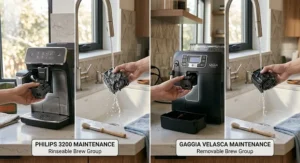
Aggregated review sentiment is strong on drink customization and build quality, with recurring praise for the removable brew group’s easy rinse-under-the-tap cleaning; the most common gripe is the dated LED interface, which looks more 2017 than 2026.
Pros:
- ✅ 10 grind settings — more dial-in range than most rivals
- ✅ Removable brew group rinses clean under a tap
- ✅ Bypass doser accepts pre-ground decaf anytime
Cons:
- ❌ Interface feels dated next to touchscreen competitors
- ❌ Manual Pannarello wand has a real learning curve
Street prices for the Gaggia Velasca sit around $625–$800 depending on the Prestige trim, making it a fair value verdict for anyone who wants Italian shot character without stepping up to a four-figure machine.
3. De’Longhi Magnifica Evo — best budget pick with manual steam wand
The De’Longhi Magnifica Evo trades automatic milk frothing for a traditional steam wand, and for a specific type of buyer that’s actually a feature, not a compromise.
Its steel conical burr grinder isn’t as trendy as ceramic flat burrs, but De’Longhi’s decades of tuning show in how evenly it doses for drip-style coffee as well as espresso — a flexibility not every super automatic nails. The “Over Ice” brewing mode lowers extraction temperature specifically for cold drinks, which matters more than it sounds once summer hits and you don’t want a watered-down iced latte.
Here’s what to weigh: because you control the steam wand yourself, milk texture ceiling is actually higher than most one-touch machines — baristas who’ve used both note that manual wands allow finer microfoam once you’ve practiced, at the cost of a slightly steeper first-week learning curve.
Reviewers consistently frame this machine as the “training wheels before you buy the real barista setup,” citing strong espresso quality for the price alongside occasional notes about wand cleanup taking an extra 30 seconds compared to LatteGo-style systems.
Pros:
- ✅ Manual wand gives a higher microfoam skill ceiling
- ✅ Over Ice mode brews properly cold-friendly espresso
- ✅ Strong reputation for reliability at this price tier
Cons:
- ❌ Steam wand needs manual cleaning after every use
- ❌ Fewer one-touch drink presets than LatteGo rivals
At roughly $600–$800, the De’Longhi Magnifica Evo is a smart pick for anyone who wants to eventually learn real frothing technique without buying a fully manual machine first.
4. Gaggia Brera — smallest footprint for tight kitchens
If counter space is the actual deciding factor in your life, the Gaggia Brera solves that problem before solving anything about coffee — it’s one of the most compact super automatics that still houses a real ceramic burr grinder.
The direct-connect water system (no removable reservoir on some trims) keeps the chassis narrow, and the single-dial control scheme trades touchscreen flash for something almost stubbornly mechanical — twist for strength, press for shot type. That’s a deliberate design choice: fewer electronic parts historically means fewer things to eventually fail, and Gaggia’s entry-level machines lean on that Italian “keep it simple” engineering philosophy.
Based on the spec comparison against pricier siblings, the Brera sacrifices drink variety and milk automation for size and price — a fair trade for studio apartments, dorm-adjacent kitchens, or a secondary office coffee station.
Aggregated feedback consistently flags the compact size and straightforward controls as the standout strengths, while the most repeated criticism involves the manual milk frothing wand requiring more technique than beginners expect.
Pros:
- ✅ Genuinely compact — fits narrow counters and tight cabinets
- ✅ Real ceramic burr grinder despite the entry price
- ✅ Simple dial controls with fewer electronic failure points
Cons:
- ❌ Manual milk frothing has a real learning curve
- ❌ Fewer preset drinks than touchscreen competitors
Typically found in the $400–$550 range, the Gaggia Brera earns its keep as the budget-and-space pick for buyers who care more about square footage than latte art.
5. Jura E8 — quietest grinder, Swiss precision
Step up into genuinely premium territory and the Jura E8 changes the conversation entirely — its Professional Aroma G3 grinder is engineered specifically to run at whisper-quiet volume, a detail that matters enormously if your kitchen sits next to a bedroom.
The Pulse Extraction Process (P.E.P.) pulses water through the grounds rather than applying continuous pressure, which extracts more flavor from a smaller dose — on paper this means richer shots from less coffee, a genuine efficiency story once you calculate cost-per-cup over a year. Jura also automates cleaning cycles more thoroughly than most rivals, reducing the manual maintenance most super automatics still demand weekly.
What the spec sheet won’t tell you, but reviewers note, is that the P.E.P. system produces a noticeably syrupy body compared to standard pump-driven machines — several comparison reviews single this out as the E8’s most distinctive real-world advantage over De’Longhi and Philips competitors.
Aggregated sentiment across owner reviews consistently praises brewing consistency and near-silent operation, with the main criticism being the steep price relative to machines with similar drink menus.
Pros:
- ✅ Whisper-quiet grinder, ideal for open-concept kitchens
- ✅ P.E.P. extraction produces notably syrupy, rich body
- ✅ Highly automated cleaning cuts weekly maintenance time
Cons:
- ❌ Premium price well above most category competitors
- ❌ Replacement parts and filters cost more long-term
At roughly $2,000–$2,600, the Jura E8 is squarely for buyers who’ve already decided coffee quality matters more than sticking to a budget — the value verdict depends entirely on how much you drink daily.
6. Breville Oracle Touch — closest thing to a barista hybrid
The Breville Oracle Touch blurs the line between super automatic and semi-automatic, pairing an automatic grinder and tamper with a dual boiler setup that lets espresso brew and milk steam simultaneously.
That dual-boiler architecture is the real headline: instead of waiting for one heating element to switch tasks, you get espresso extraction and milk texturing happening in parallel, shaving real time off busy mornings. Its automatic steam wand can even produce microfoam fine enough for basic latte art, something no other machine on this list attempts. The touchscreen stores custom drink profiles by user, useful for multi-person households with different taste preferences.
Here’s what to weigh: this machine asks a little more engagement than a true one-touch super automatic — you’re still expected to purge and adjust occasionally — but reviewers consistently describe that trade-off as worthwhile given the shot quality ceiling it unlocks compared to fully hands-off machines.
Aggregated feedback highlights the milk texture quality and dual-boiler speed as standout strengths, while the most common complaint involves the higher learning curve relative to true “press one button” machines.
Pros:
- ✅ Dual boiler brews and steams milk simultaneously
- ✅ Automatic wand can produce basic latte art texture
- ✅ Custom profiles support multiple household users
Cons:
- ❌ Steeper learning curve than pure one-touch machines
- ❌ Premium price near the top of this category
Expect to pay roughly $2,400–$3,000 for the Breville Oracle Touch, positioning it as the pick for buyers who want semi-pro results without fully manual technique.
7. Philips 4300 LatteGo — most one-touch drink variety
Rounding out the list, the Philips 4300 LatteGo takes everything that works about the 3200 series and adds a wider drink menu plus companion app connectivity for remote brewing and maintenance alerts.
Its ceramic flat burr grinder carries over from the 3200, but the drink menu expands to include more milk-forward specialty options, and the app can nudge you toward descaling before performance actually degrades — a genuinely useful upgrade over relying on memory. Reviewers who’ve compared it directly to the 3200 note the extra drink buttons matter most for households where different people want different specialty drinks without manually adjusting settings each time.
Based on the spec comparison, the extra cost over the 3200 mostly buys convenience and variety rather than a fundamentally different coffee — worth it for variety-seekers, skippable for anyone who drinks the same two drinks daily.
Aggregated sentiment consistently praises the expanded drink menu and app integration, while occasional reviews mention the price premium feels steep given how similar the core brewing engine is to the cheaper 3200.
Pros:
- ✅ Widest one-touch drink menu in the Philips lineup
- ✅ App connectivity flags maintenance before problems start
- ✅ Same reliable ceramic flat burr grinder as the 3200
Cons:
- ❌ Meaningful price premium for mostly convenience gains
- ❌ Core coffee quality barely exceeds the cheaper 3200
Pricing typically runs $850–$1,050, making the Philips 4300 LatteGo the pick for multi-drinker households who’ll actually use the extra variety.
Top 7 Comparison Table
| Product | Origin | Milk System | Price Range | Best For |
|---|---|---|---|---|
| Philips 3200 LatteGo | Netherlands | LatteGo | $500–$650 | Easiest cleanup |
| Gaggia Velasca | Italy | Pannarello wand | $625–$800 | Grind customization |
| De’Longhi Magnifica Evo | Italy | Steam wand | $600–$800 | Budget with wand control |
| Gaggia Brera | Italy | Steam wand | $400–$550 | Tightest kitchens |
| Jura E8 | Switzerland | Auto milk system | $2,000–$2,600 | Quiet, premium quality |
| Breville Oracle Touch | Australia | Dual-boiler auto wand | $2,400–$3,000 | Barista-style hybrid |
| Philips 4300 LatteGo | Netherlands | LatteGo | $850–$1,050 | Drink variety, app control |
Laid out side by side, the price gap tells its own story: three machines cluster under $800, two sit in the low four figures, and two premium options push well past $2,000. If you’re weighing philips 3200 vs gaggia velasca specifically, notice they’re the two closest in price yet furthest apart in personality — proof that price alone won’t tell you which machine fits your morning routine.
✨ Don’t Miss These Exclusive Deals!
🔍 Compare current pricing on any machine above before you commit — availability shifts fast heading into holiday sales season.
Practical Usage Guide: Setup and the First 30 Days
Getting a super automatic espresso machine right starts before the first cup. Run a water-only cycle through the machine first — most manufacturers recommend it to clear manufacturing residue from internal lines, and skipping it is a common reason first cups taste faintly plastic.
Grind adjustment is the single most-skipped step in the first week. Whether you own the Philips 3200 LatteGo‘s 12-setting flat burr or the Gaggia Velasca‘s 10-setting conical burr, dial one click at a time and taste before adjusting again — jumping several settings at once makes it impossible to isolate what actually changed. A good rule of thumb: if your shot pulls too fast and tastes sour, go finer; if it drips slowly and tastes bitter, go coarser.
Descaling schedules matter more than most new owners expect. Hard water areas should descale every 1–2 months regardless of what the machine’s indicator light suggests, since mineral buildup silently degrades both temperature stability and pump pressure long before a warning appears. Milk systems deserve daily attention too — LatteGo parts should hit the dishwasher nightly, while Pannarello and steam wands need a quick purge-and-wipe after every single use to avoid dried milk clogging the steam holes.
The most common first-month mistake is treating the bean hopper like a bulk pantry item. Beans oxidize once ground, but they also degrade meaningfully within two to three weeks of roasting once opened — buying a year’s supply of beans defeats half the purpose of owning a fresh-grind machine.
Real-World Scenarios: Who Should Buy What
Picture a college student sharing a three-person apartment kitchen with barely two feet of counter space and a budget under $500. The Gaggia Brera solves that exact problem — small footprint, real grinder, and a price that survives a shared living situation without financial drama.
Now picture a household of four with wildly different coffee preferences: one person wants oat-milk lattes, another wants a straight double espresso, a third wants basic drip-style coffee. The Philips 4300 LatteGo‘s expanded one-touch menu and app-based customization fits that chaos better than a machine built for a single user’s habits.
Finally, picture a home espresso enthusiast who used to run a semi-automatic machine but wants their mornings back without giving up shot quality entirely. The Breville Oracle Touch or Jura E8 both make sense here — the former for buyers who still want some hands-on control, the latter for buyers who want Swiss-level consistency and near-silent mornings. In each case, the “best” machine isn’t the most expensive one; it’s the one that matches the actual daily use case sitting in front of it.
Philips vs Gaggia: Bean-to-Cup Showdown
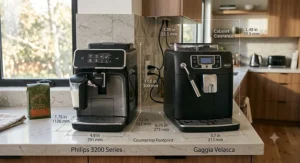
Zoom out from these two specific models and a bigger Philips vs Gaggia bean to cup pattern emerges across both brands’ entire lineups. Philips consistently designs around minimal user friction — fewer buttons, tubeless milk systems, and touchscreens that assume you’ve never used a espresso machine before. Gaggia designs around control — more grind steps, temperature adjustment, and brew groups you’re expected to occasionally handle yourself.
Neither philosophy is objectively correct, but they attract genuinely different buyers. Reviewers who’ve tested both brands’ bean-to-cup lineups back-to-back consistently note that Philips machines feel more “appliance-like” in the best sense — predictable, low-maintenance, forgiving of neglect — while Gaggia machines reward users willing to learn their machine’s quirks with noticeably more shot-to-shot personality. According to one detailed comparison of leading super automatic espresso machines, the machines that impressed testers most consistently were ones offering real customization rather than just convenience — a data point that leans slightly in Gaggia’s favor for serious coffee drinkers, even as Philips wins on sheer ease of ownership.
If your household already owns other Philips or Gaggia small appliances, brand familiarity with the app ecosystem or accessory compatibility can also tip the decision — a minor factor, but a real one for buyers who’ve been burned by proprietary parts before.
Italian vs Dutch Espresso Machine: Engineering Philosophies Compared
The Italian vs Dutch espresso machine debate is really a debate about two different engineering traditions solving the same problem from opposite directions. Italian manufacturers like Gaggia grew directly out of a century of café equipment — brew groups you can remove and rinse, pressure profiles tuned by decades of barista feedback, and steam wands descended from full-size commercial machines shrunk down for home counters. Officially, Gaggia’s own product documentation emphasizes the removable, hand-washable brew group as central to its “authentic espresso, simplified” design philosophy.
Dutch engineering, as expressed through Philips, comes from a broader consumer-electronics background rather than a café heritage — which shows up as tubeless milk systems, touchscreen-first interfaces, and a general obsession with reducing daily friction over maximizing barista-style control. Neither tradition is wrong; they’re optimizing for different outcomes. Italian machines tend to reward users who enjoy some hands-on ritual, while Dutch machines reward users who want coffee to disappear into the background of a busy morning.
Where this gets practical: if you already own — or have used — a full-size Italian espresso machine, a Gaggia super automatic will feel like a natural, familiar downgrade in effort but not in character. If you’ve never touched a portafilter in your life, a Philips machine removes nearly every decision point, which is exactly why it dominates the “first machine ever” recommendation lists across review sites.
Milk Froth Quality: LatteGo vs Pannarello vs Steam Wand
Milk froth quality in automatic machines splits into three real approaches, and picking between them matters more than most buyers realize before they own one.
| Milk System | Cleanup Effort | Froth Control | Best For |
|---|---|---|---|
| LatteGo (tubeless) | Lowest — dishwasher-safe | Fixed, consistent | Philips 3200 / 4300 LatteGo |
| Pannarello wand | Moderate — manual wipe | Adjustable with practice | Gaggia Velasca / Brera |
| Dual-boiler auto wand | Moderate | Highest ceiling | Breville Oracle Touch |
The table above understates one nuance worth spelling out: LatteGo systems win decisively on convenience but cap out at a “good enough for daily lattes” foam texture, while manual wands take longer to master yet ultimately reward practiced users with finer, more restaurant-grade microfoam. The Breville Oracle Touch splits the difference by automating wand positioning while still using true steam-wand physics, which explains why it’s the only machine here capable of anything resembling latte art without manual technique.
If milk drinks are an occasional afterthought in your coffee routine, LatteGo-style convenience will serve you well for years. If milk-based drinks are the entire point — daily cappuccinos, weekend lattes for guests — investing the practice time in a Pannarello or dual-boiler wand pays off in noticeably better texture over the machine’s lifetime.
Budget Super Automatic Espresso Machine Comparison
Not everyone shopping this category has $2,000 to spend, and thankfully the budget super automatic espresso machine comparison field is genuinely strong right now.
| Budget Pick | Price Range | Standout Strength |
|---|---|---|
| Gaggia Brera | $400–$550 | Smallest footprint |
| Philips 3200 LatteGo | $500–$650 | Easiest daily cleanup |
| De’Longhi Magnifica Evo | $600–$800 | Manual wand skill ceiling |
Comparing these three side by side, the Gaggia Brera wins purely on space and price, but sacrifices drink variety to get there. The Philips 3200 LatteGo sits in the sweet spot of the trio — barely pricier than the Brera but with meaningfully better milk convenience and a more capable grinder. The De’Longhi Magnifica Evo costs the most of the three but rewards buyers willing to learn manual steaming with genuinely better milk texture over time.
None of these three machines will out-perform a $2,500 Jura on raw shot consistency, but for the vast majority of home coffee drinkers, that gap matters far less than daily usability — and all three budget picks nail usability at a fraction of the premium price.
Compact Super Automatic Espresso Machines for Small Kitchens
A compact super automatic espresso machine isn’t just about the footprint printed on a spec sheet — clearance above the machine for bean hopper refills, front-loading versus top-loading water tanks, and cabinet clearance for tall mugs all factor into whether a “compact” machine actually fits your kitchen in practice.
The Gaggia Brera and Gaggia Velasca both use front-loading water reservoirs and dreg drawers specifically so they can slide under low-hanging upper cabinets — a detail that matters enormously in older kitchens with standard 18-inch cabinet clearance. The Philips 3200 LatteGo keeps a similarly tight footprint, though its top-loading bean hopper means you’ll want a few extra inches of vertical clearance for refills.
If your kitchen genuinely has less than 15 inches of depth available, prioritize front-loading designs over marginally smaller footprints — a machine that technically fits but requires pulling it out from under the cabinet every time you refill water defeats the purpose of buying compact in the first place.
Gaggia Velasca Review: Is It Still Worth It in 2026?
Stepping back for a focused gaggia velasca review verdict: yes, it remains a genuinely strong mid-range pick in 2026, though its interface hasn’t aged as gracefully as its brewing performance.
The core case for buying it hasn’t changed — 10 grind settings and 5 strength options still outclass most machines under $800, and the removable brew group remains one of the easiest maintenance designs in the category. What has shifted is competitive pressure: touchscreen rivals now exist at similar prices, making the Velasca’s retro LED interface feel more dated by comparison than it did at launch.
Based on the spec comparison against newer entrants, the Velasca still earns its price primarily through grind customization and Italian shot character rather than convenience features — which means the “worth it” answer depends heavily on whether you value control over polish. For coffee drinkers who actually want to tune their shots, few machines at this price offer comparable adjustment range in 2026.
How to Choose a Super Automatic Espresso Machine: 6 Criteria
- Milk system priority — decide whether cleanup speed (LatteGo) or froth control (steam wand) matters more for your actual drink habits, not your aspirational ones.
- Grinder type and settings — more grind steps generally means finer dial-in control, especially important if you rotate between different roast styles.
- Footprint and loading style — measure your actual counter depth and check whether water tanks and dreg drawers load from the front or top.
- Noise tolerance — open-concept kitchens or early risers with sleeping housemates should weight grinder noise levels heavily.
- Maintenance appetite — be honest about whether you’ll actually descale monthly and clean brew groups weekly, or whether you need heavy automation to compensate.
- Budget versus daily volume — a $2,000 machine rarely makes financial sense for someone drinking one cup every other day; reserve premium spend for genuinely daily, multi-cup households.
Working through these six in order — rather than starting with price — tends to produce a shortlist of one or two machines instead of an overwhelming list of seven.
Long-Term Cost & Maintenance: What Super Automatics Really Cost
The sticker price is only the opening bid. Descaling solution, water filters, and occasional gasket replacements add a real ongoing cost that buyers routinely underestimate when comparing options up front.
Budget machines like the Gaggia Brera and De’Longhi Magnifica Evo tend to have cheaper, widely available replacement parts, since both brands sell high volumes across price tiers. Premium machines like the Jura E8 use proprietary filters and components that cost more individually — a fair trade for buyers who value the brand’s automated cleaning cycles, but a real line item worth budgeting for annually.
Cost-per-cup math also favors daily drinkers over occasional ones. A $2,500 machine used twice a day for years amortizes down toward genuinely competitive cost-per-cup versus café prices; the same machine used twice a week barely breaks even against buying coffee out. According to guidance from the Seattle Coffee Gear buying resources, matching machine tier to actual daily coffee volume — rather than aspirational volume — is the single biggest factor in whether a super automatic purchase feels worthwhile a year later.
Frequently Asked Questions
❓ Is the Gaggia Velasca better than the Philips 3200?
❓ Do super automatic espresso machines make real espresso?
❓ How often should I descale a super automatic espresso machine?
❓ Is LatteGo better than a steam wand for milk froth?
❓ What's the most compact super automatic espresso machine for small kitchens?
Conclusion
If this whole philips 3200 vs gaggia velasca comparison boils down to one takeaway, it’s this: both machines are genuinely good at different jobs. The Philips 3200 LatteGo removes friction from your morning almost entirely, trading some shot-tuning depth for a system that practically anyone in the house can operate without instructions. The Gaggia Velasca asks a little more of you — a bit more cleaning ritual, a slightly dated screen — but pays that back in grind range and Italian shot character that budget-conscious espresso enthusiasts genuinely appreciate.
Beyond these two, the five additional machines covered here fill in the rest of the map: the Gaggia Brera for tight kitchens, the De’Longhi Magnifica Evo for wand-curious budget buyers, and the Jura E8 or Breville Oracle Touch for anyone ready to spend real money on daily coffee ritual. None of these seven is a wrong choice — the wrong choice is buying based on price alone rather than matching a machine to how you actually drink coffee every morning.
Whichever direction you land, remember that price ranges shift with retailer promotions, so it’s always worth checking current availability before finalizing a decision — the sweet spot in this category tends to move around throughout the year.
✨ Don’t Miss These Exclusive Deals!
🔍 Take your morning coffee routine to the next level with any of the machines above. Click through to check current pricing and availability before stock shifts again!
Recommended for You
- Philips 3200 Espresso Machine: 7 Real Picks Worth Trusting (2026)
- Super Automatic Espresso Machine Under 500: 7 Best 2026 Picks
- Super Automatic vs Semi Automatic Espresso: 7 Machines Ranked (2026)
Disclaimer: This article contains affiliate links. As an Amazon Associate, I earn from qualifying purchases. If you purchase products through these links, we may earn a small commission at no additional cost to you.
✨ Found this helpful? Share it with your friends! 💬🤗
