In This Article
Somewhere between your third mediocre pod-machine shot and the moment you realize your local café charges six dollars for something you could pull yourself, most people start Googling a high end home espresso machine. It’s a rite of passage. You’ve outgrown the drip carafe. Maybe you’ve already burned through a $300 semi-automatic that taught you the basics and then, frustratingly, showed you exactly where its ceiling was. Now you’re standing at the edge of a much deeper pool, and the water looks expensive.
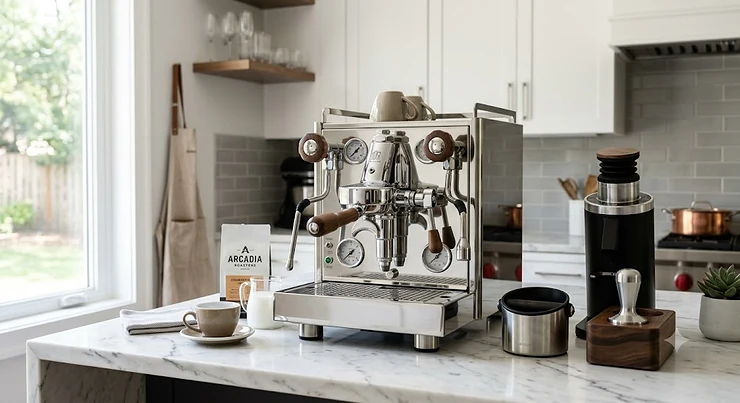
Here’s the honest starting point: a genuine luxury espresso machine for home use isn’t a toy, and it isn’t a scam either. It’s a precision appliance — dual boilers or dual heating systems, PID temperature control, commercial-style 58mm groupheads — built to hold temperature and pressure steady enough that a $22 bag of single-origin beans actually tastes like $22 of single-origin beans. Café quality espresso at home isn’t marketing fluff; it’s a function of thermal stability, and thermal stability is exactly what separates a $300 machine from a $2,000-plus one.
This guide sticks to seven real, currently listed machines you can actually find and buy on Amazon.com — from semi-automatic dual boilers you dial in by hand to fully automatic flagships with dual grinders and touchscreens. We’ll get into what each one actually does differently, who genuinely needs that difference, and where the line sits between “worth it” and “solving a problem you don’t have.” Prices shift constantly on Amazon, so every figure here is a range based on research at time of writing — always check current pricing before you buy.
What Is a High End Home Espresso Machine?
A high end home espresso machine is a prosumer or luxury-tier brewer — typically priced from around $1,700 into the $6,000-plus range — built with dual boilers or equivalent dual-heating systems, precision PID temperature control, and commercial-grade 58mm groupheads. Unlike entry-level machines, these are engineered for shot-to-shot consistency, longevity, and often integrated grinders or touchscreen automation.
“Once you’ve had milk steaming and espresso brewing happen at the same time without either one losing heat, going back to a single-boiler machine feels like a step backward,” is roughly how enthusiast reviewers describe the jump — and it’s less about bragging rights than about the machine simply doing the same thing, shot after shot, without you fighting it.
Quick Comparison Table
| Machine | Price Range | Best For |
|---|---|---|
| Breville Dual Boiler BES920XL | $1,700–$2,000 range | Best hands-on semi-automatic entry point |
| Rancilio Silvia Pro X | $1,800–$2,000 range | Best compact prosumer dual boiler |
| Breville Oracle Jet | Around $2,000 | Best automatic dual boiler with built-in grinder |
| Breville Oracle Touch | $2,800–$3,000 range | Best full touchscreen automation |
| Jura Z10 | $4,000–$4,400 range | Best single-hopper luxury super-automatic |
| Miele CM7750 | $4,000–$5,000+ range | Best multi-bean luxury super-automatic |
| Jura GIGA 10 | $5,500–$6,500 range | Best money-no-object splurge |
Looking at the spread above, notice how much functional territory sits between the cheapest and priciest options — it isn’t a straight line from “less machine” to “more machine.” The Breville Dual Boiler BES920XL and Rancilio Silvia Pro X both sit near $1,800–$2,000 but ask for hands-on grinding and dialing-in, while the Breville Oracle Jet at a similar price automates the grind-dose-tamp sequence entirely. Meanwhile, the jump from Jura Z10 to Jura GIGA 10 is less about better espresso and more about dual-hopper flexibility and genuine multi-drink, back-to-back capacity.
☕ Ready to stop guessing and start comparing real specs? Scroll down to see exactly which flagship fits your kitchen and your coffee habit.
💬 Just one click — help others make better buying decisions too!😊
Top 7 High End Home Espresso Machines: Expert Analysis
1. Breville Dual Boiler BES920XL — the hands-on entry point to real dual-boiler brewing
The Breville Dual Boiler BES920XL is the machine most enthusiasts point to as the cheapest genuine dual-boiler experience you can buy new. Two stainless steel boilers, one dedicated to brewing and one to steam, run independently under digital PID control, so the espresso boiler holds temperature within roughly 2°F while the steam boiler stays ready on its own schedule.
What that means in practice: you get a heated group head on top of the dual boilers, a 58mm commercial-style portafilter, a low-pressure pre-infusion stage that gently expands the puck before full pressure kicks in, and an over-pressure valve that caps extraction pressure to avoid bitterness. Based on the spec comparison, this is the same underlying architecture found in machines costing considerably more — Breville just strips away the built-in grinder and touchscreen automation to hit a lower price.
Here’s what to weigh: there’s no integrated grinder, so budget separately for one with genuine stepless adjustment. Aggregated owner sentiment across coffee forums consistently frames this machine as “the one you keep for a decade,” praising the shot clock and pressure gauge for helping beginners actually learn what a good extraction looks like, while noting the top-fill water tank and manual milk texturing take a little practice.
Pros:
- ✅ Genuine dual boilers with independent PID temperature control
- ✅ Low-pressure pre-infusion plus an over-pressure valve for balance
- ✅ Shot clock and pressure gauge help you learn proper dialing-in
Cons:
- ❌ No built-in grinder — budget separately for one
- ❌ Manual steam wand takes real practice for microfoam
At $1,700–$2,000, the BES920XL is the strongest value entry into true dual-boiler territory — a weak pick only if you specifically want automation over hands-on control.
2. Rancilio Silvia Pro X — the compact prosumer dual boiler with a cult following
The Rancilio Silvia Pro X takes Rancilio’s decades-old Silvia name and, for the first time in the lineup, adds a genuine second boiler — a 1-liter steam boiler paired with a dedicated brew boiler, so you can steam milk and hold brew temperature steady at the same time instead of choosing one or the other.
Under the hood, dual PID controllers manage each boiler independently, a redesigned digital display shows real-time brew temperature, and programmable shot timing lets you lock in a repeatable extraction window once you’ve found one you like. Based on the spec comparison, the compact footprint — still smaller than most dual boilers despite the added steam boiler — is the standout feature here; it fits countertops that would struggle with bulkier flagship machines.
Honest analysis: this is a manual machine through and through, with no built-in grinder and no automated milk texturing, so it rewards someone who genuinely enjoys the dial-in process. Reviewers consistently note the programmable wake-up mode as a small but appreciated touch — the machine is hot and ready before you’ve poured your first sip of water in the morning.
Pros:
- ✅ True dual boiler in a genuinely compact countertop footprint
- ✅ Independent PID control plus programmable shot timing
- ✅ Programmable wake-up mode has the machine ready on schedule
Cons:
- ❌ No integrated grinder or automated milk frothing
- ❌ Larger 15.5-inch depth than earlier single-boiler Silvia models
In the $1,800–$2,000 range, the Silvia Pro X is the pick for buyers who want dual-boiler performance in the smallest possible footprint and don’t mind doing the grinding and steaming by hand.
3. Breville Oracle Jet — automatic dosing without the flagship price tag
Where the first two machines ask you to grind, dose, and tamp by hand, the Breville Oracle Jet automates the whole sequence. A fully integrated conical burr grinder with 45 settings grinds, doses, and tamps 22 grams directly into the 58mm portafilter, and Breville’s ThermoJet heating system gets the machine to brewing temperature in seconds rather than minutes.
What most buyers overlook is the Auto MilQ milk system: it textures microfoam automatically with settings tuned separately for dairy, soy, almond, and oat, and it can queue milk steaming to start the moment extraction finishes. The touchscreen interface also unlocks genuine cold brew and cold espresso modes by slowing extraction and lowering brew temperature — a feature that’s rare even on pricier machines.
Based on the spec comparison against the pricier Oracle Touch, the Jet uses a single ThermoJet heating circuit rather than a full dual-boiler setup, which is the main trade-off for the roughly $800 savings. Reviewers consistently describe the early production run as needing a firmware settle-in period, though later units have reportedly ironed out those early hiccups.
Pros:
- ✅ Fully automated grind, dose, and tamp into a 58mm portafilter
- ✅ Auto MilQ textures milk automatically across four milk types
- ✅ Genuine cold brew and cold espresso modes built in
Cons:
- ❌ Single ThermoJet system rather than true dual boiler
- ❌ Early units reportedly needed a firmware update to settle in
At around $2,000, the Oracle Jet is the strongest value pick for buyers who want automation without stepping up to full dual-boiler flagship pricing.
4. Breville Oracle Touch — the flagship that started Breville’s automated dual-boiler category
The Breville Oracle Touch was Breville’s answer to a genuine question: can a machine deliver true dual-boiler performance and still automate the grind-dose-tamp workflow end to end? The result pairs a professional dual-boiler construction — simultaneous extraction and steaming, each independently PID-controlled — with a fully automatic conical burr grinder and a color touchscreen that lets you swipe and select espresso, latte, flat white, or cappuccino.
Here’s what to weigh: because it runs true dual boilers rather than a single ThermoJet circuit, back-to-back milk drinks for a household don’t compete with brew temperature the way they can on lighter machines. The self-cleaning steam wand automatically textures milk to a saved preference, and you can create and save up to eight personalized drink profiles by name — genuinely useful in a multi-person household with different tastes.
What the spec sheet won’t tell you, but owners consistently mention, is how much longer the warm-up takes compared with the Oracle Jet’s fast ThermoJet — a real trade-off for the extra thermal stability those big boilers provide. Aggregated reviewer sentiment also flags that some owners want more flexibility in the automated drink recipes beyond what’s pre-programmed.
Pros:
- ✅ True dual boiler construction with independent PID control
- ✅ Fully automated grind, dose, and tamp with a touchscreen interface
- ✅ Up to eight personalized, named drink profiles for multiple users
Cons:
- ❌ Long warm-up time versus ThermoJet-based Breville models
- ❌ Some owners want more control over automated drink recipes
In the $2,800–$3,000 range, the Oracle Touch earns its price as the automated dual-boiler flagship for households that want café-style variety without hands-on dialing in.
5. Jura Z10 — full-color luxury automation with genuine pulse extraction
The Jura Z10 is Jura’s flagship single-hopper super-automatic, built around a large full-color touchscreen and Jura’s Pulse Extraction Process (P.E.P.), which pulses water through the grounds in short bursts rather than one continuous stream — a technique designed to extract more flavor compounds from finely ground, high-quality beans.
Based on the spec comparison, what sets the Z10 apart from cheaper single-hopper automatics is precisely that P.E.P. technology paired with a fully adjustable ceramic disc grinder and a professional-style milk system capable of genuine latte art-ready microfoam, not just basic froth. Reviewers consistently describe the touchscreen as one of the most polished interfaces in the automatic category, with smooth animations and an intuitive specialty-drink menu.
Honest analysis: this is a single-bean-hopper machine, so it’s built around one coffee at a time rather than the multi-bean flexibility found on pricier flagships. It’s the right call for someone who wants luxury-tier automation and touchscreen polish without paying for a second hopper or grinder they may never use.
Pros:
- ✅ Pulse Extraction Process pulls more flavor from quality beans
- ✅ Large, genuinely polished full-color touchscreen interface
- ✅ Professional-style milk system built for real latte art texture
Cons:
- ❌ Single bean hopper — no on-the-fly switching between two beans
- ❌ Premium price for buyers who only drink one type of coffee anyway
At $4,000–$4,400, the Z10 is the value pick among true flagship automatics for single-coffee households that prioritize milk quality and interface polish.
6. Miele CM7750 — the only luxury automatic with three separate bean hoppers
The Miele CM7750 solves a problem most automatics don’t even attempt: what if your household actually drinks more than one type of coffee bean? Its CoffeeSelect system holds three separate bean containers, each accessible at the touch of a button, alongside a bypass doser for pre-ground coffee — genuinely useful for a house split between espresso lovers and decaf drinkers.
What that means in practice: a quiet, slanted conical grinder purges residue between hopper switches so beans don’t cross-contaminate, an AutoDescale function runs its own cleaning cycle from an internal cartridge without you lifting a finger, and the CupSensor automatically adjusts spout height to your cup size. Based on the spec comparison, this multi-hopper flexibility is rare even among machines costing considerably more — reviewers note only Jura’s GIGA-series machines match it, and those cost more to get there.
Here’s what to weigh: the touchscreen itself is smaller and less visually polished than rivals like the Jura Z10, and the machine is genuinely large on the counter — Miele built this one to make a statement, not to save space. Aggregated owner sentiment is consistently positive about consistency cup-to-cup, crediting the simplified profile system over more manual expert-mode tinkering.
Pros:
- ✅ Three separate bean hoppers plus a bypass doser for pre-ground coffee
- ✅ Fully automatic descaling from an internal cartridge, no manual steps
- ✅ CupSensor automatically adjusts spout height to your cup
Cons:
- ❌ Touchscreen is smaller and less polished than some flagship rivals
- ❌ Large footprint — this is not a compact-kitchen machine
In the $4,000–$5,000-plus range depending on retailer, the CM7750 is the clear pick for multi-bean households; overkill for anyone who only ever brews one type of coffee.
7. Jura GIGA 10 — the most expensive espresso machine money can buy for home on this list, and it shows
The Jura GIGA 10 sits at the top of Jura’s lineup and, at this writing, the top of what’s realistically available new on Amazon in this category. Two separate bean containers each get their own electronically adjustable ceramic disc grinder, and a dual-thermoblock heating system with two pumps allows genuinely simultaneous preparation — two full specialty drinks brewed and steamed side by side rather than sequentially.
What most buyers overlook is the Cold Brew Extraction Process, unique among machines at this price: cold water is pulsed at high pressure through coarse grounds for a genuine cold brew rather than an over-iced espresso. A 6.7-inch touchscreen Panorama Coffee Panel handles all 35 possible drink specialties, and WiFi connectivity through the J.O.E. app lets you start a drink from your phone before you’ve even reached the kitchen.
Based on the spec comparison, the jump from the Miele CM7750 to the GIGA 10 buys dual simultaneous brewing rather than just multi-bean flexibility — genuinely useful for a household of two people who both want a drink at the same moment, and genuinely unnecessary for a solo drinker.
Pros:
- ✅ Dual grinders and dual thermoblocks brew two drinks simultaneously
- ✅ Genuine Cold Brew Extraction Process, not just iced espresso
- ✅ Large touchscreen access to 35 total drink specialties
Cons:
- ❌ Priced in the $5,500–$6,500 range — true splurge territory
- ❌ Dual-brewing capacity is wasted on single-person households
At this price, the Jura GIGA 10 only makes sense if simultaneous two-person brewing and cold brew capability matter more to you than value-per-dollar.
Getting Started: Your First 30 Days With a High End Home Espresso Machine
The single biggest first-30-days mistake is skipping water filtration on day one. Every machine on this list — from the manual Breville Dual Boiler BES920XL to the automatic Jura GIGA 10 — relies on internal boilers or thermoblocks that scale up fast with hard tap water, and a service call to descale a neglected machine costs far more than a filter would have.
If you bought a semi-automatic like the BES920XL or Rancilio Silvia Pro X, week one should be entirely about heat soak and grind calibration, not flavor chasing. Let the machine run its full warm-up before pulling a real shot, and pair it with a grinder that has genuine stepless or fine adjustment — a $2,000 machine paired with a $150 grinder is, as more than one reviewer bluntly puts it, wasted money, because the grinder becomes the bottleneck. If you bought an automatic like the Oracle Touch, Jura Z10, Miele CM7750, or GIGA 10, week one is about profile setup instead — dial in grind fineness through the machine’s settings, save your household’s preferred drink profiles by name, and register the machine for any included cleaning-tablet or descaling-cartridge subscriptions.
By week two, start a simple maintenance rhythm: wipe manual steam wands after every use, run milk-system auto-clean cycles daily on automatics, and set a recurring reminder to descale on whatever schedule your water hardness demands — monthly in hard-water regions, quarterly in soft ones. By week three or four, you should have two or three repeatable “house drinks” dialed in, whether that’s a manually pulled shot recipe on the Silvia Pro X or a named profile on the GIGA 10, before you start experimenting further.
Who Actually Needs a Flagship Espresso Machine? Real-World Buyer Scenarios
Picture a coffee enthusiast who already owns a decent grinder and genuinely enjoys the ritual of dialing in a shot by hand. They don’t need automation — the Breville Dual Boiler BES920XL or Rancilio Silvia Pro X gives them real dual-boiler thermal stability at the lowest entry price, and the money saved on automation goes toward beans and a better grinder instead.
Now picture a busy household where everyone wants a different drink every morning and nobody has time to grind, dose, and tamp by hand. That’s the household where the Breville Oracle Touch‘s automated workflow and named drink profiles actually get used daily, not just admired — a flagship espresso machine earns its keep here because the variety and convenience are real.
Then there’s the household split between two different coffee preferences — maybe one person drinks dark roast espresso and another wants decaf or a lighter bean for milk drinks. The Miele CM7750‘s three separate bean hoppers solve exactly that problem, something even Breville’s automatics can’t do. And finally, picture a couple who both want a full specialty drink brewed at the same moment, every single morning, with zero waiting — the Jura GIGA 10‘s dual grinders and simultaneous brewing exist specifically for that scenario, and would be overkill for anyone living or drinking solo.
How to Choose a High End Home Espresso Machine
Choosing among machines this capable comes down to fewer variables than you’d think. Here’s the shortlist that actually moves the decision:
- Manual vs. automatic workflow — if you want to grind, dose, and tamp yourself, the BES920XL or Silvia Pro X rewards that; if you want push-button convenience, the Oracle Jet, Oracle Touch, or Jura automatics do the work for you.
- Single bean vs. multiple bean households — a one-coffee household is well served by the Jura Z10; a split household benefits from the Miele CM7750‘s three hoppers.
- Simultaneous brewing needs — if two people need drinks at the exact same moment daily, only the Jura GIGA 10 genuinely brews two specialties in parallel.
- Counter space and footprint — measure your available depth before buying; the Miele CM7750 and Jura GIGA 10 are both genuinely large machines.
- Grinder budget — if you go with a manual machine like the BES920XL, set aside a real budget for a grinder with stepless adjustment, or the machine’s ceiling won’t matter.
- Milk drink volume — households doing back-to-back lattes benefit most from true dual-boiler machines like the Oracle Touch, which don’t have to choose between brewing and steaming.
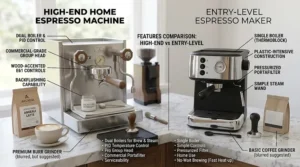
High End Home Espresso Machine vs Prosumer and Budget Alternatives
| Factor | Budget ($300–$800) | High End ($1,700–$6,500) |
|---|---|---|
| Boiler design | Single boiler, thermoblock | Dual boiler or dual thermoblock system |
| Temperature stability | Fluctuates during steaming | Independently controlled, minimal drift |
| Simultaneous brew + steam | Rarely possible | Standard on machines like Breville Oracle Touch |
| Grinder integration | Basic or none | Precision integrated grinders on automatics |
| Best For | Casual, low-volume drinkers | Daily multi-drink households, enthusiasts |
The gap that matters most in that table is temperature stability, not aesthetics. A cheap single-boiler machine has to choose between brewing and steaming; a genuine luxury espresso machine for home use, like the Breville Oracle Touch or Rancilio Silvia Pro X, runs both simultaneously without either function stealing heat from the other. That single engineering difference is why milk drinks and straight shots both improve at once when you upgrade, rather than one getting better at the expense of the other.
Is a High End Espresso Machine Worth It?
The honest answer is: it depends entirely on how often you actually brew. Run the math on a household making two espresso drinks a day, every day, at a café price of roughly $5 each — that’s about $3,650 a year, meaning a machine like the Breville Dual Boiler BES920XL effectively pays for itself in well under a year of daily use, before factoring in beans or a grinder you’d need either way.
Where it stops being worth it is intermittent use. If your realistic pattern is a latte on weekends and drip coffee on weekdays, the payback math stretches out for years, and a simpler $400–$700 machine likely serves you just as well without the maintenance overhead of a genuine dual-boiler system. Reviewers who’ve spent real time across this category tend to agree on one thing: the jump from entry-level to genuinely high end is worth it primarily for households that brew daily and multiple times, where consistency compounds instead of resetting each morning.
✨ Not sure which price tier actually matches your coffee habit? Compare your daily drink count against the machines above before you commit.
The Most Expensive Espresso Machine Money Can Buy for Home: Where’s the Ceiling?
Spend enough time comparing options actually available on Amazon and you’ll notice the realistic ceiling for a home kitchen sits around the Jura GIGA 10, priced in the $5,500–$6,500 range. Past that point on the open market, you’re mostly looking at boutique and direct-order machines sold through specialty coffee retailers rather than general marketplaces — a different shopping experience entirely, with different support and return policies.
What the GIGA 10 demonstrates is that, past roughly $4,000–$4,500, you stop buying meaningfully better-tasting espresso and start buying convenience multipliers: dual grinders, simultaneous brewing, cold brew extraction, and app connectivity. That’s not a criticism — it’s simply where the ceiling actually sits for machines you can order today with standard delivery, and it’s worth knowing before you spend a small fortune chasing a flavor improvement that mostly plateaued a couple thousand dollars earlier.
Premium Home Espresso Investment: Long-Term Cost & Maintenance
Water chemistry is the single biggest hidden cost in any premium home espresso investment, and it’s almost entirely preventable. The Specialty Coffee Association’s water research exists precisely because poor water chemistry directly damages brewing equipment while simultaneously flattening flavor — calcium and magnesium levels far outside the recommended range accelerate scale buildup inside boilers, which is the single most common and most expensive repair across every machine on this list.
Budget realistically for descaling supplies and filtration (roughly $50–$150 a year depending on your water hardness), periodic gasket and seal replacement on manual machines like the BES920XL and Silvia Pro X (inexpensive in parts but worth factoring into ownership cost), and manufacturer cleaning-cartridge subscriptions on automatics like the Miele CM7750 and Jura GIGA 10, which typically run automatically but still need cartridge replacement a few times a year. Total cost of ownership over a decade, including a quality grinder where needed, filtration, and periodic parts, typically runs 20–35% above the sticker price of the machine itself — a number worth having in mind before you check out.
Common Mistakes When Buying a Home Espresso Machine Over $2,000
The most common mistake is buying based on looks or brand prestige rather than daily workflow — the flashiest touchscreen in a lineup, as more than one reviewer has pointed out, doesn’t matter if it doesn’t match how you actually want to make coffee each morning. A close second is overbuying: a single person making one latte each morning doesn’t need the Jura GIGA 10‘s dual simultaneous brewing any more than they need a two-lane espresso bar.
The inverse mistake — underbuying for the household — is just as expensive in the long run. Someone who buys an entry-level machine, outgrows it within six months, and then buys a second, better machine anyway effectively pays twice. A third mistake worth flagging: skipping the grinder line item on manual machines entirely. Pairing any home espresso machine over $2,000, like the BES920XL or Silvia Pro X, with an underpowered grinder means the machine’s ceiling never gets tested, and buyers often blame the espresso machine for flat, inconsistent shots that were actually a grind-consistency problem all along.
Frequently Asked Questions
❓ What's the real difference between a semi-automatic and a super-automatic high end machine?
❓ Is a high end home espresso machine worth it for one person?
❓ Do I need a separate grinder for a high end espresso machine?
❓ How long do high end espresso machines typically last?
❓ What's the most important spec to compare between models?
Recommended for You
- Breville Dual Boiler Review 2026: 7 Machines Compared Honestly
- 7 Best Espresso Machines Under 1000 Dollars in 2026
- 7 Best Prosumer Espresso Machines in 2026: Worth The Upgrade?
Conclusion
There’s no single “best” high end home espresso machine, because the category genuinely splits by workflow rather than just by price. The Breville Dual Boiler BES920XL and Rancilio Silvia Pro X reward people who want to control every variable of a shot by hand; the Breville Oracle Jet and Oracle Touch reward people who want café-style variety without the manual dial-in; the Jura Z10 and Miele CM7750 reward households chasing flagship-grade automation and, in Miele’s case, multi-bean flexibility; and the Jura GIGA 10 exists for the small slice of buyers who want simultaneous dual-drink brewing and don’t mind paying for it.
What all seven genuinely share is the thing that actually justifies the price jump from entry-level gear: real thermal stability, shot after shot, regardless of what you’re doing with the steam wand or second hopper at the same time. Match that capability to your actual daily habit — not your aspirational one — and any of these seven machines, all realistically available to order today, will earn its keep for years to come.
Disclaimer: This article contains affiliate links. As an Amazon Associate, I earn from qualifying purchases.
✨ Found this helpful? Share it with your friends! 💬🤗
