In This Article
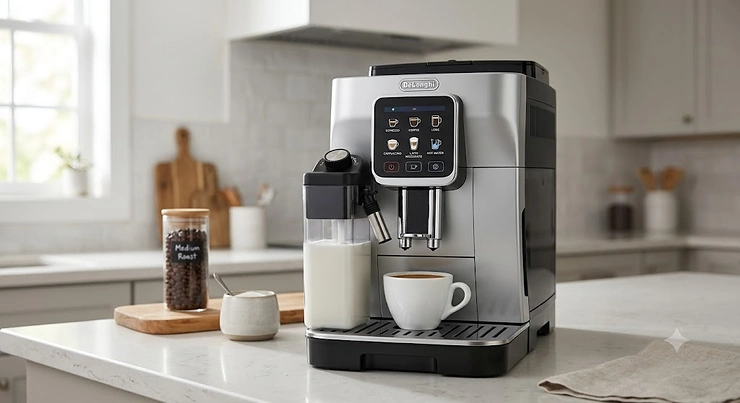
Somewhere between the pod-machine phase of your life and the “I own a espresso tamper” phase sits a strange, comfortable middle ground: the bean to cup machine. You dump in whole beans, press a button, and a small internal factory of grinders, pumps, and thermoblocks does the rest. The DeLonghi Magnifica Evo has become something of a poster child for that middle ground, and for good reason — it grinds fresh, froths milk with almost no effort from you, and doesn’t demand a barista course to operate.
So what is the DeLonghi Magnifica Evo? In plain terms, it’s a fully automatic espresso machine that grinds whole beans on demand, brews at 15-19 bar pressure, and tops drinks with hands-free milk foam via De’Longhi’s LatteCrema Hot system — all through a color touch panel with seven one-touch drink presets.
That sounds simple enough, but “simple” is exactly where the confusion starts. Is it actually better than the cheaper Magnifica Start sitting one shelf down? Does it really beat the Philips 4300 that keeps popping up in your search results? And once you strip away the marketing copy, is the DeLonghi Magnifica Evo actually worth the money in 2026, or is it just a nicely lit product photo?
This guide digs through real specs, real owner feedback, and genuine side-by-side comparisons across seven bean to cup machines — from entry-level workhorses to a semi-automatic curveball for the espresso purists among you. No invented taste-test stories, no fictional five-star reviews. Just what the spec sheets say, what actual owners report, and what that means for your kitchen counter and your wallet. Grab a cup of whatever you’re currently drinking (coffee shop pod, we won’t judge), and let’s sort out which machine actually deserves your counter space.
Quick Comparison Table
Before we dive into the deep-dive product breakdowns, here’s the condensed version for anyone in a hurry — because sometimes you just want the highlights before committing to a 4,000-word coffee odyssey.
| Machine | Milk System | Grind Settings | Best For |
|---|---|---|---|
| DeLonghi Magnifica Evo | LatteCrema Hot (automatic) | 13 | All-round households wanting true one-touch milk |
| DeLonghi Magnifica Start | Manual cappuccinatore | 13 | Budget buyers who don’t mind frothing by hand |
| Philips 4300 Series | LatteGo (automatic, 2-part) | 12 | Fastest cleanup after milk drinks |
| Philips 5400 Series | LatteGo (automatic, 2-part) | 12 | Multi-person households needing 4 user profiles |
| DeLonghi Dinamica | LatteCrema Hot (automatic) | 13 | Buyers who want finer milk-texture control |
| Breville Bambino Plus | Automatic steam wand | Needs separate grinder | Espresso purists chasing café-grade shots |
| DeLonghi Magnifica S | Manual Panarello wand | 13 | Shoppers hunting the lowest legacy price point |
Looking at the table, the pattern that jumps out fastest is the milk-system split: the DeLonghi Magnifica Evo, Philips 4300 Series, Philips 5400 Series, and DeLonghi Dinamica all hand off milk frothing to a motor, while the DeLonghi Magnifica Start and DeLonghi Magnifica S save you $100-200 by asking you to hold a wand under the milk yourself. The Breville Bambino Plus is the odd one out entirely — it isn’t a bean to cup machine in the traditional sense, since it skips the built-in grinder, but it earns its seat at the table for anyone weighing “automatic convenience” against “better-tasting shots.”
☕ Ready to find your match? Compare current listings for all seven machines before prices shift.
Top 7 DeLonghi Bean to Cup Machines: Expert Analysis
1. DeLonghi Magnifica Evo — best all-rounder with true one-touch milk
The standout here is the LatteCrema Hot system, which is the reason the DeLonghi Magnifica Evo gets recommended more than almost any other mid-range machine on this list — it steams and dispenses milk automatically, and its MyLatte function meters out exactly the amount of milk you’ll use, so you’re not dumping the leftover half-cup down the drain every morning.
Under the hood, you’re looking at a 1450W thermoblock heating element, a 1.8-liter water tank, a 250g bean hopper, and 13 grind adjustment settings running through a color touch-icon panel with seven one-touch drink presets. That combination matters in practice: the thermoblock means you’re not waiting through a slow warm-up cycle like older boiler-based machines, and the 13-step grinder gives you enough range to dial in everything from a supermarket medium roast to a slightly oilier specialty bag without the crema disappearing.
Based on the spec comparison against its closest rivals, what most buyers overlook about the DeLonghi Magnifica Evo is the one-touch automatic cleaning cycle paired with a dishwasher-safe milk carafe — small conveniences, but they’re the difference between using the milk function daily and quietly avoiding it because cleanup feels like a chore.
Reviewers consistently report that the machine handles the basics — espresso, cappuccino, and latte macchiato — well right out of the box, with the automatic milk texture landing closer to café-style microfoam than the thinner froth typical of cheaper automatic systems. A recurring theme in aggregated feedback is that the touch panel buttons are sensitive enough that first-time users occasionally trigger the wrong drink before they get used to the layout.
Pros:
- ✅ True hands-free milk with portion control via MyLatte
- ✅ 13-step grinder handles a wide range of bean oiliness
- ✅ One-touch auto-clean keeps the milk system low-maintenance
Cons:
- ❌ Touch panel can be overly sensitive for first-time users
- ❌ 250g bean hopper needs refilling more often than larger rivals
Prices for the DeLonghi Magnifica Evo typically land in the $700-$900 range depending on trim and retailer, and check current price before buying since promotions shift often — at that range, it earns its keep as the machine most households will actually enjoy using every single day.
2. DeLonghi Magnifica Start — best budget entry with manual cappuccinatore
The standout advantage of the DeLonghi Magnifica Start is right there in its name: it strips the Evo’s automatic milk motor back to a manual cappuccinatore, and in doing so knocks the price down by a meaningful margin without touching the espresso quality underneath.
Specs-wise, it shares a lot of DNA with its pricier sibling — a 1.8-liter tank, 250g bean hopper, 15-bar pump pressure, and 13 grind settings — but trims the drink menu to four one-touch presets and swaps the touchscreen for a simpler control layout. What that means in practice is you’re paying for the same grinder and brew group quality while doing the milk-steaming yourself, which some buyers genuinely prefer since a manual cappuccinatore lets you control foam texture more precisely than an automatic system that makes the decision for you.
Here’s what to weigh: the manual wand asks a little more of you every morning, but it also removes an entire category of parts (motorized carafes, milk tubing) that can eventually need cleaning or replacing. If you’re the type who wants texture control over convenience, that trade genuinely favors you rather than penalizing you.
Aggregated review sentiment is notably strong here — one UK retailer’s tracked feedback shows an average rating near the top of the scale from close to 200 owners, with buyers frequently praising the ease of use and coffee quality relative to the price. That’s an unusually high score for an entry-level appliance, and it suggests the Start isn’t just “the cheap one” — it’s genuinely well-liked on its own terms.
Pros:
- ✅ Meaningfully cheaper than the Evo with the same grind range
- ✅ Manual cappuccinatore gives hands-on foam texture control
- ✅ Strong owner satisfaction scores for an entry-level machine
Cons:
- ❌ No touchscreen — fewer one-touch drink presets than the Evo
- ❌ Milk frothing takes practice to get consistent results
Expect the DeLonghi Magnifica Start to sit in the $500-$600 range in the US, or roughly the £250-£300 range in the UK — always check current price, since regional promotions swing it around. For anyone stepping up from a pod machine who doesn’t mind a wand, it’s the strongest value pick on this entire list.
3. Philips 4300 Series — easiest LatteGo cleanup in its class
What immediately sets the Philips 4300 Series apart is the LatteGo milk system — a genuinely clever two-piece carafe with no internal tubing at all, which means it can be rinsed clean in about fifteen seconds under the tap rather than disassembled like a traditional milk frother.
The machine runs a 100% ceramic 12-step grinder rated for roughly 20,000 cups of service life, backed by a 1.8-liter water tank, 275g bean hopper, and an AquaClean filtration system that pushes descaling intervals out to around 5,000 cups when filters are swapped on schedule. On paper this means lower long-term maintenance overhead than machines relying on manual descaling cartridges alone, since you’re not fighting limescale buildup nearly as often.
What most buyers overlook about the ceramic grinder specifically is durability under daily use — ceramic burrs resist wear far better than the metal burrs found in some budget machines, so the grind consistency you get on day one is closer to what you’ll still get three years in. Reviewers note the two-user-profile system (plus a guest mode) as a genuinely useful touch for two-person households who each want their coffee dialed in differently without constantly re-adjusting settings.
The tradeoff, and it’s a real one: US stock has been inconsistent, with this model occasionally showing as unavailable directly through Philips’ own US site, pushing buyers toward third-party or refurbished stock. That’s worth knowing before you fall in love with the spec sheet.
Pros:
- ✅ LatteGo carafe rinses clean in about 15 seconds
- ✅ Ceramic grinder rated for roughly 20,000 cups of use
- ✅ Two user profiles plus guest mode for shared households
Cons:
- ❌ US stock availability can be inconsistent
- ❌ Fewer one-touch drink presets than the Philips 5400
Typical pricing for the Philips 4300 Series runs in the $600-$700 range for new units in markets where it’s reliably stocked, dipping lower on refurbished listings — always check current price given the availability quirks mentioned above.
4. Philips 5400 Series — best for multi-person households
The headline feature on the Philips 5400 Series is its four user profiles, a genuine step up from the 4300’s two, and one that actually matters if more than a couple of people in your house have opinions about how strong their coffee should be.
Spec-wise, it shares the same 246 x 372 x 433mm footprint and roughly 8kg weight as the 4300, but expands the drink menu to twelve one-touch beverages plus dedicated hot water, running through a color TFT display rather than a simpler panel. The LatteGo carafe carries over unchanged — same 0.26-liter capacity, same tool-free rinse — but Philips markets a faster cyclonic frothing stream on this tier, which reviewers describe as producing a notably denser microfoam than the standard LatteGo implementation.
Based on the spec comparison, what justifies the price jump isn’t really the milk system at all — it’s the combination of profile count and drink variety, which turns this from “a machine for one coffee drinker” into “a machine for a whole household.” Here’s what to weigh, though: if you live alone or with one other coffee drinker, you’re paying a premium for profile slots you’ll never use.
One reviewer’s honest take sums up the tension well: at full retail, this is one of the few Philips models that typically breaks the $1,000 mark, which is a steep ask unless the multi-user features genuinely apply to your household.
Pros:
- ✅ Four user profiles suit larger, multi-drinker households
- ✅ Twelve one-touch beverages plus dedicated hot water
- ✅ Same easy-clean LatteGo carafe as the 4300
Cons:
- ❌ Regular retail price is steep relative to the 4300’s near-identical hardware
- ❌ Overkill for single or two-person households
The Philips 5400 Series regularly lists around $800-$1,000 at full retail, though it’s been spotted on promotion closer to $499-$600 — check current price before assuming the sticker figure is final, since this model swings on discounts more than most on this list.
5. DeLonghi Dinamica — best upgrade path for milk-texture control
What sets the DeLonghi Dinamica apart from the Magnifica Evo sitting one tier below it is finer control over both temperature and foam density — the same LatteCrema Hot hardware family, but with more granular adjustment dialed into the software layer.
Running a 1450W heating system similar to the Evo, with a 15-bar pump and an integrated grinder, the Dinamica adds custom user profiles and more programmable recipe options than the standard Magnifica line offers. What that means in practice is you can save a genuinely personalized drink — say, a slightly cooler flat white with denser foam — rather than choosing from fixed presets and hoping the defaults match your taste.
Here’s the honest trade-off worth weighing: one long-time reviewer of the DeLonghi lineup has pointed out that coffee and milk quality across the Magnifica and Dinamica tiers land close enough to each other, and that spending more mainly buys a more premium build and a bigger milk carafe rather than a meaningfully better cup. If you’re chasing “better coffee” specifically, the honest answer is you may be better off saving the difference — the Dinamica earns its price through refinement and flexibility, not a fundamentally different brewing result.
Aggregated owner sentiment does flag one genuine strength: the Dinamica is frequently singled out as unusually good at iced coffee, a use case the flatter Magnifica presets handle less gracefully.
Pros:
- ✅ More granular temperature and foam-density customization
- ✅ Custom user profiles beyond the Magnifica line’s fixed presets
- ✅ Notably strong at brewing iced coffee drinks
Cons:
- ❌ Coffee quality is only marginally better than the cheaper Evo
- ❌ Premium pricing for features casual drinkers may never touch
Budget around $850-$1,050 for the DeLonghi Dinamica in the US, with UK pricing closer to the £650-£750 range — as always, check current price since this tier moves with seasonal promotions.
6. Breville Bambino Plus — best semi-auto for espresso purists
The Breville Bambino Plus earns its spot on this list by breaking the bean to cup formula entirely: no built-in grinder, but a genuinely faster and more precise espresso engine than anything else here, thanks to its 3-second ThermoJet heating element.
Specs that matter: automatic milk frothing with three temperature and three texture presets, adjustable pre-infusion timing to combat channeling, and a compact 7.5-inch by 12-inch by 13-inch footprint that fits counters the bulkier bean to cup machines simply can’t. On paper this means faster warm-up and more consistent shot pulling than a thermoblock system managing both brewing and grinding duties at once — but it comes at the cost of needing a separate grinder, which is a real added expense and an added appliance on your counter.
What most buyers overlook here is the total cost of ownership question: reviewers note that pairing the Bambino Plus with a quality standalone grinder can outperform an all-in-one machine at a comparable total price, once you factor in a grinder in the $200-$250 range. That’s a genuinely different value proposition than anything else on this list — you’re trading convenience for quality, rather than paying more for convenience.
One long-term ownership note worth flagging honestly: the ThermoJet heating coil isn’t a rebuildable component, so realistic lifespan under heavy daily use tends to land in the four-to-five-year range rather than the decade-plus some boiler-based machines can achieve.
Pros:
- ✅ 3-second heat-up beats every thermoblock machine on this list
- ✅ Automatic milk frothing with adjustable temperature and texture
- ✅ Compact footprint fits tight kitchen counters
Cons:
- ❌ Requires a separate grinder — added cost and counter space
- ❌ Non-rebuildable heating element limits long-term lifespan
The Breville Bambino Plus typically runs $400-$500 for the machine alone, meaning realistic total cost with a grinder lands closer to $600-$750 — check current price on both pieces before comparing it directly against an all-in-one bean to cup machine.
7. DeLonghi Magnifica S — best legacy value pick
The draw of the DeLonghi Magnifica S in 2026 is simple: it’s the machine the Magnifica Start was built to replace, which means it’s increasingly easy to find at clearance pricing while still delivering the same fundamental brew quality DeLonghi’s mid-range lineup is known for.
It runs the same core formula — manual Panarello-style steam wand, 15-bar pump, a bean hopper and grinder combination broadly in line with its newer siblings — inside a design that has held its own in the market since roughly 2014. What that means in practice is a genuinely proven brew group and grinder assembly with years of real-world reliability data behind it, rather than a brand-new model still building its reputation.
Based on the spec comparison against the newer Start, what most buyers overlook is that the actual espresso and coffee output between the two is nearly identical — the improvements in the Start are mostly interface polish (a modernized touch panel, a slightly sturdier cup stand) rather than a better shot in the cup. If interface aesthetics don’t matter much to you, chasing down a DeLonghi Magnifica S at a discount can be the single best value move on this entire list.
Reviewers who’ve owned both models describe the transition as evolutionary rather than revolutionary, and note the older unit’s manual wand is functionally equivalent to the Start’s own manual cappuccinatore in daily use.
Pros:
- ✅ Proven brew group with over a decade of reliability data
- ✅ Nearly identical coffee quality to the newer Magnifica Start
- ✅ Frequently available at clearance pricing
Cons:
- ❌ Older, simpler control interface than newer models
- ❌ Increasingly limited new-unit availability as stock ages out
Look for the DeLonghi Magnifica S in the $400-$500 range on remaining new stock, or lower on certified refurbished listings — check current price and condition carefully, since this is the oldest design still circulating on this list.
Practical Usage Guide: Your First 30 Days
Getting a new bean to cup machine right starts before you’ve pulled a single shot. On day one, run at least two full water-only cycles through the machine before brewing anything — this clears manufacturing residue from the internal lines and is a step nearly every manual quietly buries in the setup chapter.
For the first two weeks, resist the urge to max out the grind adjustment in either direction. Start in the middle of the range and nudge one notch at a time; espresso extraction is sensitive enough that jumping from setting 4 to setting 10 will usually just clog the funnel rather than “fix” a weak shot. If you’re using the DeLonghi Magnifica Evo or Dinamica’s LatteCrema system, run the automatic milk cleaning cycle after every session with dairy — skipping even one or two cycles is the single most common reason owners report the automatic milk suddenly tasting sour weeks later.
A common first-30-days mistake worth flagging: many new owners fill the bean hopper to the brim and let beans sit for weeks, which lets natural oils go stale and gradually dulls flavor. Buy beans in smaller bags and refill more often — your 250-275g hopper is meant to be topped up weekly, not stockpiled monthly. Similarly, don’t ignore the descaling prompt when it first appears; water hardness varies enormously by region, and letting scale build even briefly on a thermoblock system shortens its working life meaningfully. The manufacturer’s own maintenance documentation is worth a genuine read-through in week one rather than skimmed once something breaks.
Real-World Scenarios: Who Should Buy Which Machine
Picture a college student sharing an apartment, making one strong coffee before an 8am class and nothing fancier than that most days. For that buyer, the DeLonghi Magnifica S or DeLonghi Magnifica Start makes far more financial sense than anything with a touchscreen — the manual wand is a five-second learning curve, and the money saved covers a semester’s worth of actual coffee beans.
Now picture a family of four sharing one kitchen, where morning coffee orders range from a plain black cup to an elaborate oat-milk latte, and everyone is running late simultaneously. That’s the Philips 5400 Series‘ exact use case — four saved profiles mean nobody has to re-adjust settings mid-rush, and the twelve-beverage menu covers even the pickiest household member’s order.
And picture someone who’s owned a Nespresso machine for years, has started reading about “real espresso,” but isn’t ready to commit to weighing beans on a gram scale every morning. That’s the sweet spot for the DeLonghi Magnifica Evo — genuinely better coffee than a pod machine, automatic milk that doesn’t demand new skills, and a price tag that doesn’t require justifying to a spouse. If that same person instead says “actually, I do want to learn proper technique eventually,” the Breville Bambino Plus paired with a standalone grinder is the more honest long-term answer, even though it asks more of you on day one.
Is the DeLonghi Magnifica Evo Worth It in 2026?
Short answer: for the household described above — someone upgrading from pods or drip coffee who wants real espresso with minimal daily fuss — yes, genuinely. The combination of automatic milk, a wide grind range, and one-touch cleaning solves the actual friction points that make people abandon fancier machines within a year.
Where the “worth it” answer gets murkier is if you’re comparing it purely against its own siblings. Based on the spec comparison, the Dinamica doesn’t brew meaningfully better coffee, which means the Evo is arguably the smarter buy at a lower price point unless you specifically want finer milk-texture customization. Against the Magnifica Start, the honest trade is roughly $150-$200 for automatic milk convenience — worth it if you’ll use the milk function daily, harder to justify if you mostly drink black coffee.
What most buyers overlook when weighing “worth it” is total cost of ownership rather than sticker price alone: the automatic milk system does add a component that can eventually need attention, whereas the manual Start and Magnifica S have fewer moving parts to maintain long-term. If low long-term maintenance risk matters more to you than daily convenience, that shifts the calculation. For most households asking this exact question, though, the daily convenience wins out — which is precisely why the Evo remains one of DeLonghi’s best-reviewed mid-range machines heading into 2026.
DeLonghi Magnifica Evo vs Start: Which Should You Buy?
The core question between these two comes down to one component: the milk system. The Evo’s LatteCrema Hot automates frothing and dispensing; the Start hands you a manual cappuccinatore and asks you to do the work yourself. Everything else — the 1.8-liter tank, 250g hopper, 13-step grinder, 15-bar pump — is close enough to identical that the espresso itself won’t taste meaningfully different between them.
| Factor | DeLonghi Magnifica Evo | DeLonghi Magnifica Start |
|---|---|---|
| Milk system | Automatic LatteCrema Hot | Manual cappuccinatore |
| One-touch drinks | 7 | 4 |
| Control panel | Color touch icons | Simplified panel |
| Typical price range | $700-$900 | $500-$600 |
| Best for | Daily milk-drink households | Budget-conscious, hands-on buyers |
The analysis here is straightforward: if milk drinks are a daily habit rather than an occasional treat, the automatic system on the DeLonghi Magnifica Evo pays for itself in convenience within the first few busy mornings. If you mostly drink straight espresso or Americano and only occasionally want a cappuccino, the DeLonghi Magnifica Start review consistently shows owners are more than satisfied with manual frothing, and the savings are hard to argue with.
DeLonghi Magnifica Evo vs Philips 4300: Head-to-Head
This comparison is less about milk convenience — both machines automate frothing — and more about ecosystem philosophy. The Evo’s LatteCrema system uses a sealed carafe; the Philips 4300’s LatteGo uses a genuinely tubeless two-piece design that some owners find faster to keep clean day to day.
| Factor | DeLonghi Magnifica Evo | Philips 4300 Series |
|---|---|---|
| Milk carafe design | LatteCrema Hot, sealed unit | LatteGo, two-piece tubeless |
| Grinder | 13-step, standard burrs | 12-step, 100% ceramic |
| Descaling interval | Standard cartridge-based | Up to 5,000 cups (AquaClean) |
| US availability | Reliably stocked | Occasionally spotty |
| Best for | One-touch drink variety | Fastest daily milk cleanup |
Interpreting the table, the ceramic grinder gives the Philips 4300 Series a durability edge on paper, and the AquaClean filter system genuinely does stretch out descaling intervals better than a standard cartridge approach. That said, the Evo’s wider one-touch drink menu and more consistent US stock availability tip the scale back toward DeLonghi for buyers who don’t want to gamble on finding their preferred model in stock.
Understanding the LatteCrema System
The LatteCrema system is DeLonghi’s automatic milk-frothing technology, and it’s worth understanding on its own terms rather than as marketing shorthand. At its core, it pulls milk from an external carafe through a small tube, mixes it with steam and air at a calibrated ratio, and dispenses it directly into the cup alongside the espresso shot — no manual pitcher, no separate steaming step.
The “Hot” variant found on the Evo and Dinamica specifically manages the temperature at which milk is heated, aiming for a texture closer to what a trained barista produces by hand than earlier automatic systems achieved. The MyLatte function layered on top solves a genuinely annoying problem: instead of dispensing a fixed portion regardless of cup size, it estimates how much milk you’ll actually use and avoids leaving a half-used carafe of warm milk that then has to be refrigerated or discarded.
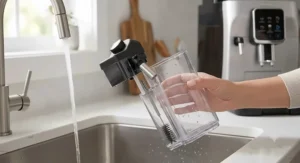
What most buyers overlook about the system is maintenance cadence rather than performance. The carafe and internal tubing need a rinse cycle after every use with dairy milk, and a deeper clean weekly — skip that routine, and the tubing is exactly where sour milk residue accumulates fastest. Owners who stay on top of that schedule report the system holding up well for years; owners who don’t are the ones you’ll find complaining online about “the milk system breaking.”
Manual Cappuccinatore vs Automatic Milk Systems
This is the single biggest decision point across every machine on this list, so it deserves its own honest breakdown rather than a footnote inside a product review.
A manual cappuccinatore — the wand-style attachment found on the DeLonghi Magnifica Start and DeLonghi Magnifica S — requires you to hold a milk pitcher under the nozzle and manually control how long steam runs through it. The upside is genuine control: experienced users can dial in denser or airier foam on demand, and there’s simply less hardware (no motorized pump, no separate carafe) to eventually wear out or need replacing.
An automatic system, like LatteCrema or LatteGo, removes that manual step entirely — you press one button, and steamed milk arrives in the cup without you touching a pitcher. The trade-off is added mechanical complexity: a motor, tubing or a sealed carafe, and a cleaning routine that, if neglected, becomes the most common failure point owners report.
Here’s what to weigh: if you already know how to steam milk, or you’re the sort of person who enjoys the small ritual of it, a manual cappuccinatore saves money and simplifies long-term maintenance. If mornings are rushed and milk drinks are a daily non-negotiable, the extra cost of an automatic system buys back time you’ll actually notice losing otherwise.
How to Choose a DeLonghi Bean to Cup Machine
Picking the right model comes down to answering a handful of questions honestly rather than chasing the longest spec sheet. Here’s a practical framework:
- How often do you drink milk-based coffee? Daily cappuccino or latte drinkers should prioritize an automatic milk system; occasional drinkers can save real money with a manual wand.
- How many people share the machine? Households of three or more benefit meaningfully from multiple user profiles, like those on the Philips 5400.
- What’s your realistic bean budget? A smaller 250g hopper suits buyers who rotate through fresh small-batch bags; a larger hopper suits bulk buyers who don’t mind slightly staler beans.
- Do you want the absolute best-tasting espresso, or the most convenient? If it’s the former, a semi-automatic like the Bambino Plus paired with a standalone grinder will usually out-perform any all-in-one bean to cup machine.
- How much do you want to spend on long-term upkeep? Automatic milk systems and cartridge-based descaling add ongoing maintenance that manual-wand machines mostly avoid.
- Is your regional water notably hard? If so, prioritize a machine with a robust filtration option like AquaClean, since scale buildup is the leading cause of premature machine failure.
- Do you need it to fit a tight counter? The Bambino Plus and Magnifica Start both have noticeably smaller footprints than the Philips and Dinamica lines.
Working through these seven questions in order tends to eliminate four or five machines from this list almost immediately, which makes the final decision far less overwhelming than staring at seven spec sheets side by side.
Common Mistakes When Buying a Bean to Cup Machine
The single most common mistake is buying based on the longest drink menu rather than the two or three drinks you’ll actually make every day. A machine with twelve presets is impressive on a spec sheet, but if you only ever drink espresso and cappuccino, that variety is functionally wasted, and you likely overpaid for it.
A second frequent misstep is underestimating maintenance commitment. Automatic milk systems in particular require consistent cleaning discipline, and buyers who skip that step are the ones who end up disappointed within the first year — not because the hardware failed, but because it wasn’t cared for. A third mistake is ignoring bean hopper size relative to household coffee consumption; a heavy two-person household can burn through a 250g hopper in under a week, making refills feel like a constant chore rather than an occasional task.
Finally, plenty of buyers assume a higher price automatically means better-tasting coffee. As the Evo-versus-Dinamica comparison earlier in this guide illustrates, that’s frequently not true — premium tiers often buy refinement and customization rather than a fundamentally better cup.
Long-Term Cost & Maintenance
The sticker price on any of these seven machines is only part of the real financial picture. Descaling solution, replacement filters, and periodic brew-group cleaning all add modest but recurring costs — typically somewhere in the $30-$60 per year range depending on your water hardness and how diligently you keep up with the maintenance schedule.
Machines with AquaClean-style filtration, like the Philips 4300 and 5400, tend to have lower descaling frequency but a slightly higher ongoing filter cost, since you’re buying replacement cartridges roughly every few months rather than a bottle of descaling solution a few times a year. Machines relying on standard descaling cycles, like the base Magnifica line, cost less per year in consumables but demand more frequent attention to avoid scale damage.
Then there’s the manual-versus-automatic milk question again, this time through a cost lens: automatic systems have more parts that can eventually need servicing or replacing, while a simple steam wand rarely breaks down at all — it’s mechanically about as simple as a component gets. Factoring in a realistic five-year ownership window, the total cost of ownership gap between the cheapest and most expensive machines on this list narrows more than the initial price tags suggest, which is worth remembering before assuming the budget pick is automatically the “cheaper” choice long-term.
Features That Actually Matter (And Those That Don’t)
Grind range and brew group quality matter more than almost anything else on the spec sheet — they’re the foundation of every cup you’ll make for years. A wide, well-calibrated grind range (12-13 steps, as most machines here offer) genuinely affects flavor extraction; a removable, easy-to-rinse brew group genuinely affects long-term hygiene and machine lifespan.
Milk system design matters if — and only if — milk drinks are part of your daily routine; if they’re not, it’s a feature you’re paying for and rarely using. User profiles matter proportionally to household size, and are close to irrelevant for single-person households no matter how many the machine offers.
On the other side of the ledger, drink menu length is frequently oversold. Twelve presets sound impressive, but most are variations on the same four or five base recipes with different water-to-espresso ratios — genuinely nice to have, rarely a deciding factor. Touchscreen aesthetics fall into the same bucket: a color panel looks premium in marketing photos, but a simpler interface with fewer buttons often proves more reliable and less confusing in daily use, particularly for less tech-savvy household members.
Frequently Asked Questions
❓ Is the DeLonghi Magnifica Evo worth it compared to cheaper models?
❓ How does the DeLonghi Magnifica Evo compare to the Philips 4300?
❓ What is the LatteCrema system exactly?
❓ Is a manual cappuccinatore harder to use than an automatic system?
❓ How often does a DeLonghi bean to cup machine need descaling?
Conclusion
Seven machines, one underlying truth: the “right” bean to cup machine has far less to do with spec-sheet bragging rights and much more to do with how you actually drink coffee on an ordinary Tuesday morning. The DeLonghi Magnifica Evo earns its reputation honestly — it’s the machine that solves the real friction points (milk convenience, easy cleaning, a genuinely wide grind range) without asking you to become a hobbyist first.
But it isn’t the universal answer, and this guide was never trying to pretend it was. The DeLonghi Magnifica Start and DeLonghi Magnifica S make more financial sense if you’re comfortable with a manual wand. The Philips 4300 and Philips 5400 Series are worth a serious look if LatteGo’s tubeless cleanup or multi-profile support matters more to your household than DeLonghi’s drink variety. The DeLonghi Dinamica rewards buyers who specifically want finer milk customization rather than a categorically better cup. And the Breville Bambino Plus remains the honest answer for anyone who’s decided convenience matters less than chasing genuinely better espresso.
Whichever you land on, the real lesson from comparing all seven side by side is this: buy for the coffee you actually drink most days, not the coffee you imagine you might drink on a good day. That single mindset shift will save you more money and disappointment than any single spec on this page.
✨ Ready to upgrade your mornings?
Check current pricing on your top pick before this week’s promotions shift — your future well-rested self will thank you. ☕
Recommended for You
- Super Automatic Espresso Machine Under 1000: 7 Picks (2026)
- Philips 3200 vs Gaggia Velasca: 7 Best Super Automatics 2026
- Philips 3200 Espresso Machine: 7 Real Picks Worth Trusting (2026)
Disclaimer: This article contains affiliate links. As an Amazon Associate, I earn from qualifying purchases. If you purchase products through these links, we may earn a small commission at no additional cost to you.
✨ Found this helpful? Share it with your friends! 💬🤗
