
In This Article
Here’s the moment that trips up almost everyone shopping for a heat exchange espresso machine for home use: you finally find a machine that looks the part, brass lever and all, and then someone in a forum mentions a “cooling flush” like you’re supposed to already know what that means. You don’t. Nobody does, the first time. So what is a heat exchange espresso machine for home use? It’s an espresso machine built around a single boiler that heats water for steaming, while a separate internal tube (the heat exchanger) runs brew water through that same hot boiler on its way to the group head — letting you pull a shot and steam milk at the same time, without two boilers to pay for or plug in.
That single-boiler trick is why the category has quietly become the sweet spot for serious home coffee setups. You get roughly 80% of a dual-boiler’s simultaneous brew-and-steam workflow for something closer to half the price, and the classic E61 group head that powers most of these machines has been refined since 1961, which is longer than some of these forum commenters have been alive. If you want the mechanical backstory, the design’s origins are documented in this overview of the E61 group head’s history, and it’s worth a skim before you buy anything with “E61” printed on the box.
This guide covers 7 real, currently available machines spanning genuinely affordable entry points through premium German- and Italian-built units, with honest analysis of who each one actually fits — not just a spec dump. We’ll cover a quick comparison, a deep dive on each machine, how to set one up without scalding your first three shots, and where the category’s common mistakes happen. If you’re building a daily brewing routine around milk drinks, this is the machine type built for exactly that job.
Quick Comparison Table
| Machine | Boiler Size | Group Head | Temp Control | Best For |
|---|---|---|---|---|
| Nuova Simonelli Oscar II | 2.0L | Thermosiphon | Manual, timed dosing | Tightest budget, first-time buyers |
| Quick Mill Andreja Premium Evo | 1.6-1.8L copper | E61 | Manual / PID option | Small counters, milk-drink lovers |
| Lelit Mara X | 1.8L stainless | E61 | Dual-probe PID, 3 presets | Fewer cooling flushes, tech-curious users |
| Diletta Bello+ | 1.8L | E61 | PID + shot timer | Handmade feel on a mid-range budget |
| Rocket Appartamento | 1.8L copper/brass | E61 | Manual pressurestat | Classic Italian design, daily espresso |
| Profitec Pro 500 PID | 2.0L stainless | E61 | PID + shot timer | Multiple back-to-back milk drinks |
| ECM Mechanika Slim PID | 2.2L stainless | E61 | PID + shot timer | Serious daily use, smallest premium footprint |
Looking at the spread above, the gap between the Nuova Simonelli Oscar II and the ECM Mechanika Slim PID isn’t really about whether either one makes good espresso — both can, in the right hands. It’s about temperature-management workload: machines without PID ask you to learn a manual cooling-flush rhythm, while the Lelit Mara X, Diletta Bello+, Profitec Pro 500 PID, and ECM Mechanika Slim PID all take some of that guesswork off your plate. Boiler size also tracks pretty closely with how many milk drinks you can pull back-to-back before steam pressure starts to sag, which matters more than people expect until they’re making a second cappuccino for a guest.
💬 Just one click — help others make better buying decisions too!😊
Top 7 Heat Exchange Espresso Machines: Expert Analysis
1. Nuova Simonelli Oscar II — best budget entry into true HX brewing
The standout here is price: at roughly $1,400-$1,600, the Nuova Simonelli Oscar II is one of the few machines on this list that undercuts the rest of the category by several hundred dollars while still using a genuine heat exchanger. It runs a 68-ounce (2-liter) HX boiler and skips the famous E61 group in favor of a thermosiphon design — a different mechanism that still circulates hot water to stabilize brew temperature, just without the brass lever theatrics. Dosing is programmed through buttons rather than a manual switch, which is either a convenience or a limitation depending on how much you like fiddling with shot timing yourself.
Based on the spec comparison, this is the machine for someone who wants the simultaneous brew-and-steam capability without committing prosumer money to get it, and it’s a sensible upgrade path from a basic single-boiler machine like a Gaggia Classic. What most buyers overlook is that the lack of a manual mode is a minor annoyance at worst — you can simply set the timer to 60 seconds and stop the shot by hand. Reviewers consistently note that the retro-futuristic stainless housing divides opinion aesthetically, but nobody seems to complain about the shot quality or steam power for the price.
Pros:
- ✅ Lowest price point of any true HX machine on this list
- ✅ 2-liter boiler delivers strong, sustained steam pressure
- ✅ Simple button dosing lowers the learning curve
Cons:
- ❌ No manual shot-stop mode without a workaround
- ❌ Thermosiphon group lacks E61’s brand-name upgrade ecosystem
At around $1,400-$1,600, the Oscar II is the strongest value argument on this list if E61 isn’t a non-negotiable for you.
2. Quick Mill Andreja Premium Evo — most compact footprint for tight kitchens
Standing at about 16 inches tall and under a foot wide, the Quick Mill Andreja Premium Evo is built for kitchens where counter real estate is the actual constraint, not the budget. Its 1.6-to-1.8-liter copper boiler carries a T.E.A. coating designed to keep metal from leaching into your brew water, wrapped in insulation for better temperature stability and lower running costs. The 52-watt Ulka vibratory pump is modest by prosumer standards, but paired with the classic E61 group and automatic pre-infusion, it produces the same shot-shaping benefits found on machines twice its price.
Here’s what to weigh: this is a logical step up from a Rancilio Silvia or entry-level Gaggia, and it can even moonlight in a small business setting if you outfit it with accessories, according to long-time reviewers. What the spec sheet won’t tell you, but owners note, is that the compact chassis makes it genuinely easy to reposition on a counter — at roughly 46 pounds, it’s lighter than most machines in its performance class. Long-term owners on enthusiast sites describe it as durable and “buy once, cry once” territory, the kind of machine you don’t have to think about upgrading for years.
Pros:
- ✅ Smallest footprint of any E61 HX machine here
- ✅ T.E.A.-coated copper boiler resists mineral leaching
- ✅ Commercial-grade components at a below-average price
Cons:
- ❌ Vibratory pump is noisier than rotary alternatives
- ❌ No plumb-in option, so refills are manual only
Priced in the $1,400-$1,700 range depending on trim, it’s a strong value pick for anyone tight on space.
3. Lelit Mara X — smartest temperature management on a classic HX
What sets the Lelit Mara X apart from nearly every other machine in this guide is its dual-probe system, which actively monitors and prioritizes brew temperature at the group head rather than leaving you to manage it manually. Inside sits a 1.8-liter stainless boiler paired with the E61 group, and a front-facing switch lets you choose between three preset brew temperatures (197°F, 201°F, 205°F) alongside Xmode Coffee or Xmode Steam priority modes. Two years of internal R&D reportedly went into refining this heat-exchanger logic, and it shows in how the machine behaves during back-to-back drink runs.
Based on the spec comparison, the Mara X is built for intermediate home baristas who make milk drinks daily and want real brew-temperature control without paying dual-boiler prices — households pulling two to six drinks per session are squarely in its target zone. Reviewers consistently mention the quiet vibratory pump as a standout, calling it noticeably quieter than most similarly priced HX machines, and Trustpilot aggregated ratings for the line sit around 4.5 out of 5 across several hundred reviews. What most buyers overlook is that this is still an HX under the hood; after long idle periods in Xmode Steam, a short flush still helps before delicate straight shots.
Pros:
- ✅ Dual-probe PID reduces (but doesn’t eliminate) flush guesswork
- ✅ Quiet vibratory pump praised across multiple retailers
- ✅ Selectable brew-temperature presets add real flexibility
Cons:
- ❌ No numeric PID display, just Warm/Hot/Extra Hot labels
- ❌ Tank-only water feed means no plumb-in convenience
Around $1,700, the Mara X earns its reputation as the benchmark “smart HX” in this price bracket.
4. Diletta Bello+ — best handmade value under $2,000
The headline feature on the Diletta Bello+ is its front-mounted PID display that doubles as a shot timer, a feature that used to be reserved for machines several hundred dollars pricier. Under the hood is a 1.8-liter heat exchanger boiler paired with an all-Italian E61 group, a 3-liter reservoir, and programmable pre-infusion adjustable up to 10 seconds — plus a sub-boiling eco-mode built for faster recovery between shots. It’s handcrafted in Milan, which matters more to some buyers than others, but the fit and finish reflects that heritage.
On paper this means the Bello+ directly challenges the Rocket Appartamento at a similar price, and the PID display genuinely closes some of the gap in temperature stability that a bare E61 machine would otherwise leave you to manage by feel. What the spec sheet won’t tell you is how much the eco-mode timer changes daily behavior — it lets you leave the machine semi-active without the energy draw of full standby, useful for households that brew coffee at scattered times through the day rather than one big morning session. Owner discussion around the Bello+ generally frames its temperature stability as “moderate,” an honest middle ground between a bare E61 and a fully managed dual-boiler.
Pros:
- ✅ PID and shot timer standard, unusual at this price
- ✅ Programmable pre-infusion adds shot-shaping control
- ✅ Handmade Italian build with a 3-liter reservoir
Cons:
- ❌ Manual steam/brew controls still require some technique
- ❌ Newer to the market with a smaller review history
At roughly $1,800-$1,900, it’s a genuine value play against more established competitors.
5. Rocket Appartamento — most iconic Italian design
If you want the espresso machine that looks like it belongs in a design magazine, the Rocket Appartamento is the one people actually buy for that reason — and it happens to back up the looks with a proper 1.8-liter copper or brass heat exchanger boiler. The E61 group includes Rocket’s dual pre-infusion system, a refinement on the standard E61 chamber that gradually increases pressure for a more even extraction. Handbuilt in Milan with an AISI-304 stainless steel case, it’s rated by Rocket’s own materials to last 15-plus years with proper maintenance.
Here’s what to weigh: this is a manual machine through and through, with no PID and a traditional pressurestat managing boiler temperature, so buyers who want digital control should look elsewhere on this list. What most buyers overlook is that copper retains heat more evenly than stainless, which is part of why enthusiast communities on r/espresso repeatedly cite the Appartamento alongside the Mara X and ECM Mechanika as “the sweet spot” for serious home use. A common theme in owner reviews is how little the steam pressure sags even after several consecutive milk drinks, a direct result of that 1.8-liter thermal mass.
Pros:
- ✅ Dual pre-infusion refines extraction beyond stock E61
- ✅ Copper/brass boiler holds heat impressively well
- ✅ 15+ year build quality reputation among enthusiasts
Cons:
- ❌ No PID; temperature management is fully manual
- ❌ Heavier and pricier than comparable HX machines
Typically listed in the $2,000-$2,200 range, the Appartamento asks a premium for its design pedigree, and most owners say it’s earned.
6. Profitec Pro 500 PID — best PID precision for milk-heavy households
The Profitec Pro 500 PID exists for one specific household problem: two 16-ounce lattes back to back without the second one tasting like a compromise. Its 2-liter stainless steel heat-exchanger boiler runs on a 1,400-watt element, and the PID controller (hidden discreetly behind the drip tray on some trims, visible with a shot timer on the Exclusive version) governs boiler temperature with a precision that a bare pressurestat can’t match. The E61 group provides the thermal stability the design is known for, and dual gauges give you real feedback on both boiler and brew pressure.
Based on the spec comparison, this is not a beginner’s first machine — it assumes you already know how to dial in a grinder and manage a cooling flush — but for someone stepping up from a single-boiler machine, it delivers heat-exchanger performance that competes with machines costing well beyond $3,000. What the spec sheet won’t tell you is how the PID actually functions on an HX: it governs the steam boiler’s setpoint rather than directly controlling brew water temperature, so your flush technique still matters, just less than on a non-PID machine. German engineering discussions frequently praise the casework’s tight seams and rattle-free grate, calling it a “tidy box that tolerates daily use” rather than a display piece.
Pros:
- ✅ 2-liter stainless boiler with genuine PID precision
- ✅ Dual gauges for clear boiler and brew feedback
- ✅ German build quality with a quiet vibration pump
Cons:
- ❌ Assumes prior espresso experience, not a beginner’s machine
- ❌ PID governs boiler setpoint, not direct brew temperature
At around $1,999-$2,100, it’s frequently cited as the most capable heat-exchanger machine under $2,000.
7. ECM Mechanika Slim PID — premium pick for serious daily use
The standout on the ECM Mechanika Slim PID is fitting full-size HX performance into a genuinely slim chassis — its 2.2-liter stainless steel boiler and iconic E61 group are built in ECM’s Heidelberg, Germany factory, and the whole unit brews and steams simultaneously with roughly 1.6 bar of steam pressure that holds up through back-to-back lattes. A three-way temperature switch supplements the PID and shot timer, giving intermediate users more brew-temperature flexibility than a standard E61 machine typically allows.
On paper this means households that steam milk for four cappuccinos in a row without a real recovery wait get a machine built specifically for that use case. What most buyers overlook is a practical safety note: as with any external-group machine, the E61 group stays genuinely hot well after shutoff, worth knowing if curious kids or counter-climbing pets share your kitchen. Reviewers on coffee forums describe ECM’s build quality and serviceability as “certainly very good,” pointing to minimal internal solenoid valves as a sign of thoughtful, repairable engineering rather than needless complexity.
Pros:
- ✅ 2.2L boiler is the largest HX capacity on this list
- ✅ PID plus shot timer in a genuinely compact chassis
- ✅ Handbuilt German engineering with strong serviceability
Cons:
- ❌ Steam and hot-water wands sit outside the narrow footprint when deployed
- ❌ No visible water level gauge on the reservoir
Priced around $2,159-$2,200, it’s the machine most enthusiast communities point to when someone asks for the best all-around premium HX for daily brewing.
Practical Usage Guide: Setting Up Your Everyday Heat Exchange Machine
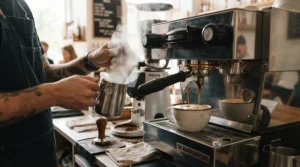
Getting a heat exchange espresso machine for home use dialed in starts before your first shot. Most HX machines need 20 to 25 minutes to reach full thermal stability — not just “hot,” but stable throughout the boiler, group, and thermosiphon loop — so resist the urge to pull a shot the moment the pressure gauge looks ready. In the first 30 days, the most common mistake is skipping the cooling flush on non-PID or lightly-managed machines: run a few seconds of water through the group before pulling a shot if the machine has been idle, since brew water sitting in the group can otherwise run hotter than ideal and scorch light roasts.
Water quality deserves early attention too. Filtered water with total dissolved solids under 150 ppm extends descaling intervals significantly, and most manufacturers recommend backflushing weekly with a blind basket and descaling every 4 to 6 months depending on your local water hardness. Set a recurring reminder now, because scale buildup inside a heat exchanger is gradual and invisible until steam power noticeably drops. One optimization trick worth adopting immediately: weigh your dose and your shot output on a small scale for the first two weeks, since dialing in a new grinder-and-machine pairing by taste alone takes longer and wastes more coffee than most people expect.
Real-World Scenarios: Matching an HX Machine to Your Daily Brewing Routine
Picture three different households, because the “best” machine genuinely depends on which one you are. First: a single-person apartment where one americano and one afternoon latte make up the whole daily brewing routine — here, the compact Quick Mill Andreja Premium Evo or the budget-friendly Nuova Simonelli Oscar II cover the need without paying for capacity nobody uses. Second: a two-adult household serving four milk drinks most mornings before work, the kind of pattern showing up across recent industry survey data on how Americans actually drink coffee at home — this is exactly the Profitec Pro 500 PID or ECM Mechanika Slim PID‘s home turf, where boiler size and steam recovery genuinely matter daily.
Third: the household that hosts often and wants a machine that looks as good as it performs when guests are watching you steam milk for six cappuccinos in a row — the Rocket Appartamento or Diletta Bello+ earn their price here, both on capability and on the fact that people will comment on how the machine looks on your counter. None of these profiles are wrong; they’re just different budgets, different frequencies, and different tolerances for manual technique versus PID hand-holding.
Buyer’s Decision Framework
If you’re still torn, use this simple priority checklist before you commit. If your main goal is spending as little as possible while still getting true HX performance, choose the Nuova Simonelli Oscar II because its 2-liter boiler and lower price outweigh giving up the E61 group’s upgrade ecosystem. If counter space is your hard constraint, choose the Quick Mill Andreja Premium Evo because its sub-foot-wide chassis solves a problem no amount of spec-chasing fixes. If you want the machine to actively manage brew temperature so you think less and pull more consistent shots, choose the Lelit Mara X because its dual-probe system was engineered for exactly that.
If you’re stepping up from a single boiler and steaming milk for two or more people daily, choose the Profitec Pro 500 PID or ECM Mechanika Slim PID, because their larger boilers and PID control were designed around back-to-back milk-drink recovery. If design and long-term brand reputation weigh as heavily as performance for you, choose the Rocket Appartamento. And if you want handmade Italian character with a modern PID display at a fair price, choose the Diletta Bello+.
How to Choose a Heat Exchange Espresso Machine for Home Use
Shopping this category gets easier once you rank what actually matters to your routine, in this order:
- Boiler size — larger boilers (2.0-2.2L) hold thermal mass better across multiple milk drinks; smaller boilers (1.6-1.8L) recover fine for one or two drinks at a time.
- PID vs. manual temperature control — PID machines reduce (not eliminate) the guesswork of cooling flushes, which matters most if you brew at inconsistent times of day.
- Group head type — E61 machines have the largest accessory and upgrade ecosystem; thermosiphon designs like the Oscar II trade that ecosystem for a lower price.
- Footprint and weight — measure your counter and upper-cabinet clearance before falling in love with a machine’s photos.
- Pump type — vibratory pumps are simpler and tank-only; rotary pumps (rare at this price tier) are quieter and can plumb directly to a water line.
- Water tank vs. plumb-in — most machines here are tank-fed only, meaning your water quality discipline directly determines your descaling schedule.
- Brand parts and service network — Italian and German manufacturers on this list generally have strong U.S. importer support, which matters more once something needs a replacement gasket.
Common Mistakes When Buying a Heat Exchange Espresso Machine
The single most frequent mistake is buying based on looks alone and skipping the boiler-size math for your actual drink count — a gorgeous 1.6-liter machine steaming milk for four people every morning will leave someone waiting. The second is assuming “heat exchanger” and “dual boiler” behave identically; they don’t, and expecting zero flush technique from an HX machine sets you up for disappointment on your first light-roast pour. The third is underestimating counter depth: steam and hot water wands often extend well beyond the machine’s stated footprint when deployed, and upper cabinets can clip a lever mid-pull if you don’t measure height with the portafilter attached. The fourth mistake is ignoring water quality until scale becomes visible, which is already too late to prevent internal buildup. The fifth is skipping a decent grinder budget entirely — even the best heat exchanger on this list is limited by inconsistent grind particle size sitting in its portafilter.
Heat Exchange vs. Dual Boiler Espresso Machines
The core trade-off is thermal architecture, not shot quality. A heat exchanger uses one boiler and a clever internal tube to serve both steam and brew functions, which keeps manufacturing costs — and therefore retail prices — meaningfully lower than machines with two fully independent boilers. A dual boiler, by contrast, keeps brew and steam water completely separate, so temperature swings from steaming don’t touch your next shot at all, and PID control (when present) governs both circuits independently rather than just the shared boiler.
In practice, this means an HX machine like the ECM Mechanika Slim PID asks you to learn a small cooling-flush habit after periods of steaming, while a comparably priced dual boiler mostly removes that step. What tips the scale for most home buyers is price-to-performance: you can buy a genuinely excellent HX machine like the Profitec Pro 500 PID for roughly what a basic dual boiler costs, and unless you’re pulling shots for a small crowd daily, the flush habit becomes second nature within a couple of weeks. Enthusiasts moving from HX to dual boiler often describe the change as “less to think about” rather than “better-tasting coffee” — a meaningful distinction if your budget is finite.
What to Expect: Real-World Performance From an HX Machine
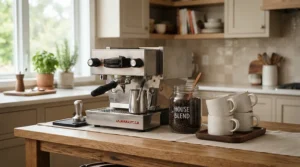
Spec sheets list boiler wattage and liters, but what you’ll actually notice day to day is rhythm. On a well-managed HX machine, your first shot after the 20-minute warm-up tends to run slightly hotter than your third or fourth, which is why a short flush before that very first pull matters more than any other single habit. Steam power on every machine in this guide is genuinely strong — that’s the whole point of the heat-exchanger design — so milk texturing for two or three drinks in a row rarely feels like a compromise versus a dual boiler.
Where you’ll notice differences between machines is recovery consistency: the 2.0-2.2 liter boilers on the Profitec Pro 500 PID and ECM Mechanika Slim PID hold their steam pressure through a fourth or fifth consecutive drink noticeably better than the 1.6-1.8 liter machines. None of that shows up in a spec sheet’s bullet points — it shows up in whether your third cappuccino for guests tastes as good as the first.
Heat Exchange Espresso Machines for Small Kitchens and Home Coffee Setups
Not every home coffee setup has a dedicated espresso corner, and that reality should genuinely shape your shortlist. If your counter depth is under 20 inches or your machine sits beneath upper cabinets, the Quick Mill Andreja Premium Evo and ECM Mechanika Slim PID were both specifically engineered around tight footprints, while the Lelit Mara X and Diletta Bello+ also stay reasonably compact without sacrificing boiler capacity. Wider machines like the Rocket Appartamento reward the counter space they ask for with design presence, but they do ask for it.
Beyond raw dimensions, consider ventilation and heat: HX machines run warm continuously while powered on, so a spot with airflow (not wedged into a deep, enclosed cabinet corner) helps both the machine’s longevity and your kitchen’s comfort. If you’re building a setup around a grinder too, measure combined width before you buy either appliance — grinder-plus-machine footprints add up faster than people expect on a standard 24-inch-deep counter.
Long-Term Cost & Maintenance
The sticker price is just the entry fee; total cost of ownership over five years includes descaling solution, filters, replacement gaskets (E61 groups typically need a gasket swap every 6-12 months of daily use), and eventually a group-head reseal. None of these costs are large individually, but they add up to a meaningful chunk of the machine’s original price over its service life, which enthusiast communities peg at 15-20 years for well-maintained units like the Rocket Appartamento or ECM Mechanika Slim PID.
Water hardness is the single biggest variable in that math. Checking your municipal water report — utilities are required to publish these under the EPA’s secondary water quality guidance — tells you within about 10% accuracy how aggressive scale buildup will be in your specific home, and that number should directly inform how often you descale rather than guessing on a fixed calendar. A household on genuinely soft water might stretch descaling to every 6 months; a household on hard water (common across much of the Southwest and the Midwest) may need it every 8-10 weeks to protect a heat exchanger’s narrow internal passages. Filtered water isn’t optional cost-cutting here — it’s the cheapest insurance policy the machine has.
Features That Actually Matter (And Those That Don’t)
PID temperature control genuinely matters if your daily brewing routine involves inconsistent gaps between drinks — it won’t eliminate flush technique, but it stabilizes the boiler setpoint your flush is working against. Boiler size matters more than wattage; a bigger, slower-heating boiler with strong insulation will out-steam a smaller, faster one on the third or fourth drink of the morning. A shot timer is a small but genuinely useful feature for dialing in a new grinder pairing, since guessing extraction time by feel wastes coffee.
What matters less than marketing suggests: cosmetic finish options (copper vs. stainless panels) affect nothing about shot quality, and a higher wattage number alone doesn’t guarantee faster recovery if the boiler is small. Multiple steam-wand hole counts (3-hole vs. 4-hole tips) matter less for home volumes than grinder consistency does — a great steam wand paired with stale, unevenly ground beans still won’t make a great cappuccino.
Safety Considerations for Home Espresso Machines
Every machine on this list runs at genuine brewing pressure (around 9 bar) and boiler temperatures well above boiling, so basic precautions aren’t optional extras. Plug directly into a grounded, dedicated outlet where possible — these machines draw 1,200 to 1,850 watts, enough to trip a shared circuit with other kitchen appliances running simultaneously. Keep the machine out of reach of young children and pets; as noted with the ECM Mechanika Slim PID above, external E61 groups stay hot to the touch for a meaningful time after shutoff, and steam wands can cause real burns during use.
Descale only with products formulated for espresso machines, never generic acids, and always run several clearing cycles afterward before brewing anything you’ll drink. If you ever notice a hissing sound from the boiler at rest, water pooling under the machine, or a pressurestat that won’t shut off the heating element, unplug it and contact the manufacturer’s service network rather than troubleshooting a pressurized vessel yourself.
Frequently Asked Questions
❓ What's the real difference between a heat exchange espresso machine for home use and a dual boiler?
❓ Do I need to do a cooling flush every single shot?
❓ How often should I descale a home HX espresso machine?
❓ Is an E61 group head necessary, or just tradition?
❓ Can a heat exchange espresso machine handle a busy daily brewing routine for a full household?
Conclusion
A heat exchange espresso machine for home use isn’t a compromise pick squeezed between a basic single boiler and a five-figure dual-boiler dream machine — it’s a genuinely mature, well-engineered category that’s earned its long-standing popularity among home baristas. Whether you land on the budget-friendly Nuova Simonelli Oscar II, the space-saving Quick Mill Andreja Premium Evo, the temperature-smart Lelit Mara X, the value-forward Diletta Bello+, the design-forward Rocket Appartamento, or one of the PID-equipped premium picks in the Profitec Pro 500 PID and ECM Mechanika Slim PID, you’re buying into a machine architecture with a genuine multi-decade track record — one that recent National Coffee Association data suggests fits squarely into how most Americans actually want to drink their coffee: at home, daily, and often espresso-based.
Match your pick to your real household drink count rather than the machine that photographs best, budget honestly for a grinder and water filtration alongside it, and give yourself the full 20-minute warm-up before judging your first shot. Do that, and any machine on this list will genuinely earn its spot on your counter for years.
Recommended for You
- Budget Heat Exchange Espresso Machine: 7 Best Picks for 2026
- Heat Exchange Espresso Machine Under $1500: 7 Real Picks for 2026
- Dual Boiler Espresso Machine Review for Beginners: 7 Top 2026 Picks
Disclaimer: This article contains affiliate links. As an Amazon Associate, I earn from qualifying purchases. If you purchase products through these links, we may earn a small commission at no additional cost to you.
✨ Found this helpful? Share it with your friends! 💬🤗
