
In This Article
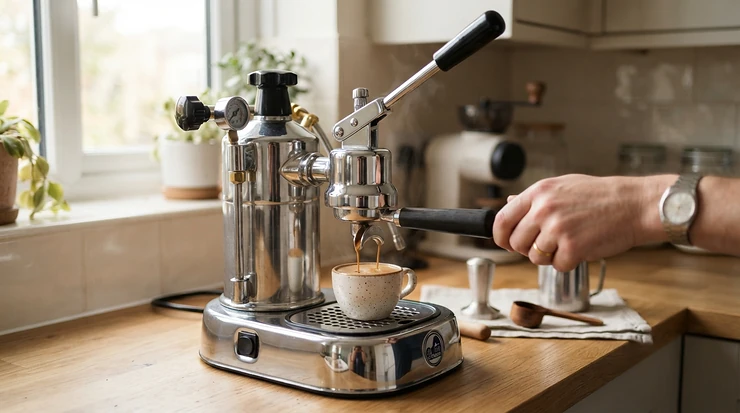
There’s a particular kind of stubbornness required to fall in love with a lever machine. You’re choosing to fight gravity and spring tension for every shot instead of just mashing a button, and somehow that’s the appeal. A heat exchange espresso machine for lever operation is a single-boiler machine that keeps water at steam temperature while routing brew water through an internal heat exchanger, letting you pull a shot by hand while steaming milk at the same time. It’s the design that quietly powers most of Italy’s cafés, and it’s having a genuine renaissance among home baristas who are tired of one-touch automation flattening the ritual out of their mornings.
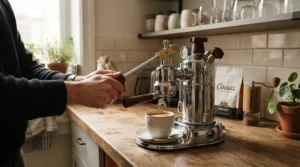
If you’ve spent any time in lever forums, you already know the debate isn’t really about temperature stability anymore — modern HX groups have mostly solved that. It’s about touch. A spring lever gives you a pressure curve that starts strong and tapers as you release, something no rotary pump software fully replicates without expensive add-ons. Add in the fact that HX design lets you brew and steam simultaneously, and you get commercial-grade throughput in a machine that still asks something physical of you every single time.
This guide walks through seven real, currently available machines spanning budget-conscious entries to genuine grail-tier picks, breaks down what actually differs between them in daily use, and gives you a framework for choosing based on your kitchen, your patience, and your coffee. We’ll also flag where a heat exchange espresso machine for lever operation makes more sense than a dual boiler, and where it doesn’t.
Quick Comparison Table
| Machine | Tier | Boiler Type | Pump | Best For |
|---|---|---|---|---|
| Vibiemme Domobar Super HX Manual | Budget | Heat Exchanger (1.8L + 0.2L HX) | Vibratory | Newcomers wanting a real 58mm E61 lever |
| Elektra Micro Casa a Leva | Design Icon | Single boiler (loosely called HX) | None — direct lever | Collectors and ritual-first brewers |
| Londinium Compressa | Mid-Range | Heat Exchanger (2.3L) | Vibratory | Home counters with tight footprints |
| Bezzera Strega | Mid-Upper | Heat Exchanger (2L copper) | Vibratory | Pressure-profiling enthusiasts |
| Profitec Pro 800 | Premium | Heat Exchanger | Vibratory | Buyers who want PID precision with tradition |
| Londinium R24 | Premium | Heat Exchanger (2.3L copper) | Rotary | Serious daily users, app-based pre-infusion |
| Izzo Alex Leva | Flagship | Heat Exchanger (5L) | Rotary | High-volume households, plumbed installs |
Looking at the spread above, the Vibiemme Domobar Super HX Manual is the obvious entry point if you’ve never worked a lever before, while the Izzo Alex Leva‘s oversized 5-liter boiler exists for people who genuinely brew back-to-back all day. If your priority is portability without sacrificing a full 58mm commercial group, the Londinium Compressa threads that needle better than almost anything else on this list.
💬 Just one click — help others make better buying decisions too!😊
Top 7 Heat Exchange Lever Espresso Machines: Expert Analysis
1. Vibiemme Domobar Super HX Manual — best entry point into real E61 lever brewing
The standout here is that it’s a genuine commercial-heritage E61 lever machine at a price that doesn’t require a second mortgage. Under the hood sits a 1.8-liter boiler with an additional 0.2-liter heat exchanger circuit, a configuration Vibiemme’s own technicians confirm after fielding years of conflicting third-party specs. Based on the spec comparison against other entry HX machines, the true Faema-patented E61 group is the differentiator — most sub-$2,000 lever machines use a licensed or simplified group, not the genuine article.
Who should care: this is squarely for someone who’s used a brew-switch E61 machine before and wants to graduate to lever control without also absorbing a jump in price and complexity. Reviewers consistently note that the switchable tank-or-plumbed setup makes it flexible for apartment living, and the manual three-way valve for portafilter removal is a small but appreciated detail that budget machines often skip.
Pros:
- ✅ Genuine E61 lever group at a below-$2,000 price point
- ✅ Switchable reservoir or direct-plumb water source
- ✅ Straightforward maintenance with widely available parts
Cons:
- ❌ Smaller HX volume means more attention to flush timing
- ❌ Vibratory pump is noticeably louder than rotary alternatives
Expect a real-world price in the $1,800–$2,000 range, and honestly, for the E61 lever experience alone, it’s one of the better value propositions in this entire category.
2. Elektra Micro Casa a Leva — most iconic design in home espresso
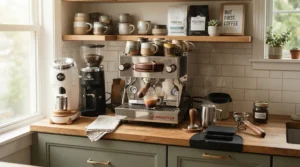
The em dash tells you what to expect before you even read the spec sheet: this is the chrome Art Deco dome that’s shown up in design museums and coffee table books since 1962. Here’s an honesty note worth flagging directly — sources disagree on whether this machine is a true heat exchanger. Some vendors and reviewers describe it that way loosely, while a more careful technical breakdown clarifies it’s closer to a single, steam-pressure boiler where brew water contacts the boiler through the group rather than routing through a separate isolated HX circuit. We’re including it here because it’s constantly discussed alongside true HX levers and shares the “no pump, direct spring action” brewing feel buyers in this category are usually shopping for.
What most buyers overlook about this model is that its 1.5-liter copper boiler and 49mm portafilter mean you’re locked into a narrower ecosystem of grinders and baskets than the 58mm-standard machines on this list. Reviewers consistently note a genuinely tactile pressure curve and a warm-up time of roughly 10-15 minutes, with the boiler pressure gauge as your only real-time feedback — there’s no PID here, no shot timer, just you and a century-old design philosophy.
Pros:
- ✅ Unmistakable design that doubles as kitchen sculpture
- ✅ Fully manual pressure profiling with zero electronics
- ✅ Passive cup warming from the chrome dome itself
Cons:
- ❌ 49mm portafilter limits grinder and basket compatibility
- ❌ No auto-refill; requires attentive manual boiler filling
Reported pricing is unusually wide, from around $1,200 up past $2,200 depending on condition and vendor, so shop carefully and verify what you’re actually getting.
3. Londinium Compressa — most compact true HX lever for small kitchens
The Compressa’s standout is fitting a full 58mm sprung lever group with a genuine cold-fed heat exchanger into a machine that doesn’t dominate your counter. The 2.3-liter copper boiler and vibratory pump combination means you get the thermal stability Londinium built its name on, without needing the direct plumbing that the brand’s higher-end R-series often assumes.
Here’s what the spec sheet won’t tell you: Londinium’s own engineering philosophy holds that a dual boiler brings no real advantage to a lever machine, because the brew chamber isolates from the boiler the instant you release the lever anyway. That’s a deliberate design stance, not a cost-cutting shortcut, and it’s worth understanding before you assume a dual boiler machine is automatically “more advanced.” This machine suits home baristas who want London-built engineering and support without needing a rotary pump’s extra plumbing commitment.
Pros:
- ✅ Full 58mm commercial group in a genuinely compact footprint
- ✅ Cold-fed heat exchanger design improves shot-to-shot consistency
- ✅ Direct manufacturer support with fast global parts turnaround
Cons:
- ❌ Vibratory pump is less refined than the brand’s rotary R24
- ❌ No app-based pre-infusion control found on newer Londinium models
At roughly $2,500–$2,700 at the time of research, it undercuts most 58mm lever competitors while keeping the brand’s engineering pedigree intact.
4. Bezzera Strega — best for hands-on pressure profiling
The Strega’s calling card is a large copper heat exchange boiler paired with a genuine spring-piston lever group, letting you brew and steam at the same time while still shaping the pressure curve by hand. Based on the spec comparison, the two-spring lever mechanism here is designed to deliver a steady pressure supply during the pull rather than a straight declining curve, which changes how it behaves compared to a single-spring design like the Compressa’s.
A common theme in aggregated owner discussion is that the Strega rewards practice — the group runs hot enough that a flush between drinks is genuinely necessary, and the 58mm commercial portafilter (rare at this price point in a home lever machine) means published recipes translate more directly than on smaller-basket machines. This is a machine for someone who already understands basic espresso theory and wants a project, not a plug-and-play upgrade.
Pros:
- ✅ 58mm commercial portafilter simplifies recipe scaling
- ✅ Simultaneous brew-and-steam thanks to true HX design
- ✅ Direct-plumb capability eliminates reservoir refilling
Cons:
- ❌ Requires a deliberate flush routine between shots
- ❌ Steeper learning curve than button-driven E61 machines
Expect pricing roughly in the $2,400–$3,000 band depending on configuration, positioning it as a genuine mid-upper contender against the Pro 800.
5. Profitec Pro 800 — best PID-controlled spring lever for precision seekers
What stands out on the Pro 800 is that it keeps the manual pre-infusion and pressure profiling of a spring lever while adding PID temperature control most direct-lever machines skip entirely. Based on the spec comparison, the 17-pound brass brew group and 3.5-liter steam boiler give it noticeably more thermal mass than the Strega or Compressa, which reviewers and long-term owners consistently describe as steadier through back-to-back pulls.
Clive Coffee’s own positioning is blunt about who this is for: intermediate-to-advanced home baristas who want the ritual without giving up dial-in precision. What most buyers overlook is that a PID on a heat exchange lever machine isn’t redundant — it just controls the boiler set-point, not the brew chamber pressure, so you still do all the pressure-shaping work by hand. The switchable reservoir-or-plumb water supply also makes it more flexible for kitchens without existing water lines.
Pros:
- ✅ PID control adds set-point precision atop manual profiling
- ✅ Heavy 17-lb brass group improves shot-to-shot stability
- ✅ Switchable tank or direct-plumb water supply
Cons:
- ❌ Among the heavier machines here at roughly 78 lbs
- ❌ Premium pricing puts it near dual-boiler alternatives
Current pricing sits around $3,000–$3,400, occasionally higher with walnut accent packages, making it a genuine premium-tier pick.
6. Londinium R24 — best rotary-pump lever with digital pre-infusion control
The R24’s headline feature is pairing a full 58mm sprung lever with a quiet rotary pump and app-based digital pre-infusion, something no other machine on this list offers. The spec sheet explanation matters here: Londinium’s own engineering notes explain that one parameter — pre-infusion pressure — actually governs three variables at once (pre-infusion pressure, brew temperature, and brew volume), so dialing in for a lighter roast versus a darker one becomes a single, deliberate adjustment rather than three separate ones.
This machine is for the buyer who’s already sold on the lever experience and wants commercial-grade plumbing convenience layered on top — no cooling shots, no warming shots, no backflushing routine required according to the manufacturer, just pull and repeat. Reviewers of the earlier L1-P plumbed model reported noticeably more body and shot volume compared to non-cold-fed HX designs, a difference attributed to the cold-fed heat exchanger circuit.
Pros:
- ✅ Rotary pump delivers quieter, more consistent operation
- ✅ App-controlled pre-infusion simplifies roast-level adjustments
- ✅ No plumbed cooling or warming shot routine required
Cons:
- ❌ Direct plumbing installation is effectively mandatory
- ❌ 240V requirement complicates some North American installs
At roughly $3,800–$4,200 converted from UK list pricing at the time of research, it’s a serious investment, but one built around a coherent, well-explained engineering philosophy.
7. Izzo Alex Leva — best for high-volume households and simultaneous multi-drink demand
The Izzo Alex Leva‘s standout is its genuinely oversized 5-liter boiler, roughly double or more the capacity of every other machine on this list, paired with a rotary pump and PID-controlled heat exchanger system. Based on the spec comparison, that extra thermal mass means longer heat-up (commonly cited around 5-15 minutes) but noticeably steadier temperature recovery across multiple drinks in a row — exactly the tradeoff a two-espresso-machine household or a small home café would want.
A recurring theme in long-term owner discussion threads is that the Alex Leva’s dipper-style group design idles differently from thermosiphon groups like Londinium’s, and some owners debate whether it needs a brief warm-up pull before the first shot of the session. It’s plumb-in only, with no reservoir fallback, so this genuinely suits a kitchen that’s already set up (or willing to be set up) for a permanent water line connection.
Pros:
- ✅ Massive 5-liter boiler suited to heavy, back-to-back use
- ✅ Rotary pump plus PID for stable multi-drink sessions
- ✅ Commercial-grade componentry built for daily durability
Cons:
- ❌ Plumb-in only — no water reservoir option at all
- ❌ Among the most expensive machines in this roundup
Pricing runs well north of $4,000, frequently into the $4,500-plus range depending on market and configuration, positioning it as the flagship pick here.
Manual Extraction Control: A Practical Usage Guide
Manual extraction control is the entire point of buying a lever machine, and it rewards a specific first-30-days routine. Start by pulling three or four “throwaway” shots before you trust your palate — you’re calibrating your arm to the machine’s spring tension, not just your grind size. Reviewers consistently note that the most common early mistake is pulling the lever too fast, which shocks the puck and produces sour, thin shots regardless of how good your beans are.
For daily setup, flush the HX group for four to six seconds before your first shot of the session — this clears the superheated water sitting in the exchanger from steam-temperature idle. Skip this step and your first pull will run hot and bitter. After that flush, consecutive shots don’t need re-flushing as long as the machine stays active; only a long idle period resets the clock. A common optimization trick among lever owners is timing the lever pull in phases — a slow initial descent for pre-infusion, a pause, then a fuller pull for the main extraction — rather than one continuous motion.
Maintenance-wise, plan on descaling every one to three months depending on your water hardness, backflushing the group weekly if you steam milk daily, and replacing lever-group gaskets roughly once a year on heavily used machines. Manual extraction control genuinely does become second nature within a few weeks — the muscle memory arrives faster than most first-timers expect.
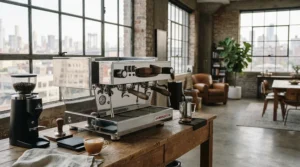
Real-World Scenarios: Who Actually Buys These Machines
Picture Maya, a graphic designer working from home who pulls two to three shots a day and values ritual over speed. She’s not chasing throughput — she wants twenty unhurried seconds with her hands on the lever before her first Zoom call. The Vibiemme Domobar Super HX Manual or the Londinium Compressa fits her budget and her single-cup cadence without asking her to plumb her kitchen.
Now consider Dev and Priya, a couple who host weekend brunches for six to eight guests and need to pull espresso and steam milk in parallel without a queue forming at the machine. Their use case — genuine simultaneous brew-and-steam demand, moderate frequency, a budget north of $3,000 — points squarely at the Profitec Pro 800 or Bezzera Strega, both of which handle back-to-back cappuccinos without breaking a sweat.
Then there’s Tomas, who runs a four-seat micro-café out of a converted garage and needs commercial-grade uptime with minimal daily flushing fuss. His environment already has a water line, his volume is genuinely high, and his budget reflects a business tool rather than a hobby purchase — which is exactly the profile the Izzo Alex Leva‘s 5-liter boiler and rotary pump were built for.
How to Choose a Heat Exchange Espresso Machine for Lever Operation
- Confirm your water setup first. Several machines here, including the Izzo Alex Leva, are plumb-in only — if you don’t have an existing line under your counter, that immediately narrows your options to reservoir-capable models like the Compressa or Domobar Super.
- Decide how much thermal mass you actually need. A single-cup household rarely benefits from a 5-liter boiler; a household steaming milk for four people daily genuinely does.
- Match the portafilter size to your grinder ecosystem. 58mm is the safer long-term bet for recipe portability; 49mm machines like the Elektra require more deliberate accessory sourcing.
- Weigh rotary versus vibratory pump noise tolerance. Rotary pumps (Londinium R24, Izzo Alex Leva) run quieter but usually require plumbing; vibratory pumps are more flexible but audibly buzzier.
- Be honest about your patience for flushing routines. Machines with smaller HX volumes need more attentive flush timing than larger-boiler designs.
- Set a realistic total budget, not just a machine budget. Add a quality grinder, a bottomless portafilter, and a water filtration cartridge — none of these machines perform to spec on an unfiltered municipal line with high mineral content.
- Read owner threads, not just retailer copy. Forums like Home-Barista consistently surface real maintenance quirks that product pages tend to omit entirely.
Lever Espresso Machine With Heat Exchange vs Dual Boiler: Which Wins?
This is the comparison every serious buyer eventually has, and the honest answer is: it depends what you’re actually optimizing for. A lever espresso machine with heat exchange design uses one boiler for both brewing and steaming, relying on an internal exchanger to keep brew water in the right range while steam stays hotter. A dual boiler machine, by contrast, dedicates entirely separate boilers to each task, giving independent PID control over brew and steam temperatures simultaneously.
| Factor | Heat Exchange Lever | Dual Boiler (Non-Lever) |
|---|---|---|
| Simultaneous brew + steam | Yes, standard on HX design | Yes, by design intent |
| Manual pressure profiling | Yes — the entire point of a lever group | No, unless paired with a lever group (rare) |
| Typical price at comparable quality | Bezzera Strega, Profitec Pro 800 ~$2,400–$3,400 | Often $200-$500 more for equivalent build quality |
| Flush routine required | Yes, short flush before first shot | Generally no |
| Best For | Buyers who want manual control plus efficiency | Buyers who want brew-switch convenience with independent temps |
Looking at the table, the core tradeoff isn’t really about temperature stability anymore — both designs handle that competently in 2026. It comes down to whether you want the physical, hands-on pressure shaping a lever demands, or the push-button convenience a dual boiler assumes. Londinium’s own engineering position, notably, argues a dual boiler brings no real advantage once you’re already on a lever group, since the brew chamber isolates the moment you release the handle regardless of how many boilers sit behind it.
Common Mistakes When Buying a Manual Lever HX Machine
The first mistake buyers make with a manual lever HX machine is underestimating the physical learning curve — this isn’t a “read the manual once” appliance, and reviewers across nearly every model here mention a genuine multi-week adjustment period. The spec sheet won’t tell you this, but user reports suggest the biggest early frustration isn’t the lever itself, it’s misjudging flush timing and ending up with scorched, bitter shots for the first week or two.
Second, buyers frequently ignore portafilter diameter until after purchase, then discover their existing grinder’s dosing funnel doesn’t match a 49mm basket like the Elektra’s. Third, plenty of shoppers underestimate physical footprint and weight — several of these machines run 60-80 lbs, which matters if your counter or cart wasn’t built for permanent commercial-grade equipment. Finally, a subtler mistake: assuming every “lever” listing is a true heat exchanger. As we noted honestly above, that’s not always the case, and conflating direct-lever single-boiler designs with true HX circuits can lead to mismatched expectations about simultaneous brew-and-steam capability.
Spring Lever Mechanism Explained: What Every Buyer Should Expect
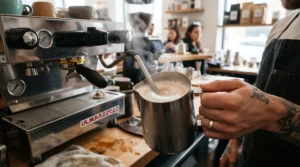
A spring lever mechanism stores mechanical energy in one or two springs as you pull the handle down, then releases that energy as controlled pressure against the puck as the lever returns to rest. This produces a naturally declining pressure curve — high at the start, tapering toward the finish — which is fundamentally different from a pump’s flat, sustained pressure output. Reviewers consistently note that this curve is exactly why lever shots often taste different, sometimes described as having more body and a rounder finish than pump-driven equivalents.
What most buyers overlook about a spring lever mechanism is that spring count and tension genuinely change the shot character. The Bezzera Strega’s two-spring design is engineered to deliver a steadier pressure supply through the pull compared to a single-spring machine, while direct-lever designs like the Elektra offer zero spring assistance at all — every bit of pressure comes from your arm. None of these approaches is objectively “better”; they’re different tools that reward different techniques, and the honest advice is to try before you commit wherever possible, since owner preference here is genuinely split.
Long-Term Cost & Maintenance: The Real Total Cost of Ownership
The purchase price is only the entry fee. Over a five-year window, expect recurring costs from descaling supplies, replacement gaskets (roughly $15-40 annually depending on the machine), and, if your water is hard, more frequent professional descaling. According to Virginia Tech’s household water hardness guidance published through University of Maryland Extension, mineral scaling directly reduces heating efficiency and appliance lifespan — which matters enormously for a copper HX boiler that’s essentially the heart of every machine on this list.
| Cost Category | Budget Tier (Domobar Super HX) | Premium Tier (Londinium R24 / Izzo Alex Leva) |
|---|---|---|
| Upfront machine cost | ~$1,800–$2,000 | ~$3,800–$4,700+ |
| Annual maintenance parts | ~$40–$80 | ~$60–$120 (larger boilers, more O-rings) |
| Water filtration setup | Recommended, ~$60–$150 | Often mandatory for plumbed installs |
| Expected functional lifespan | 8-12+ years with care | 12-20+ years, commercial-grade components |
The analysis here is straightforward: a budget machine costs less upfront but may need part replacements sooner under heavy use, while a premium machine’s higher entry cost is partly offset by commercial-grade components designed for genuinely longer service life. Cost-per-cup over a decade often narrows the gap between tiers more than the sticker price suggests, especially once you factor in that a well-maintained lever machine rarely becomes obsolete the way electronics-heavy machines can.
Safety, Water Quality & Compliance Guide
Every machine on this list runs a pressurized boiler, so basic safety habits matter regardless of price tier: never disassemble a boiler while the machine is powered on or pressurized, always let the pressure gauge read zero before opening any access panel, and keep steam wands pointed away from your body during initial bursts. As the Wikipedia entry on espresso machine history notes, the lever-driven design dates back to Achille Gaggia’s 1945 innovation, and the fundamental pressurized-boiler safety principles from that era still apply to modern HX machines.
Water quality is the other compliance-adjacent issue nobody talks about enough. Hard water accelerates scale buildup inside the heat exchanger, which can eventually restrict flow and stress internal components. Testing your water hardness before your first month of ownership — and installing a basic filtration cartridge if you’re above roughly 120 mg/L — is one of the single highest-ROI decisions you can make for any machine on this list, especially the copper-boiler models.
🔧 Ready to stop guessing and start pulling proper shots? Compare these seven machines side by side before your next coffee order arrives!☕
Featured Snippet: What Actually Happens During a Lever Pull
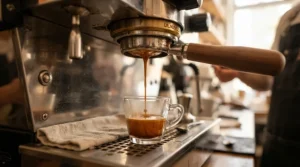
The Specialty Coffee Association’s own research context is useful here. According to SCA-affiliated Barista Guild of America survey research, the average barista-prepared espresso runs an 18-20 gram dose extracted in roughly 25-30 seconds at around 9 bars of pressure. A lever machine doesn’t hold steady at 9 bars throughout — it starts higher and declines, which is precisely the mechanical signature that distinguishes it from pump-driven equivalents.
Interestingly, that “9 bar standard” itself is under fresh scrutiny. Recent fluid dynamics research covered by Gear Patrol suggests the industry’s long-treated 9-bar benchmark may not reflect what’s actually happening during real-world extraction as precisely as the coffee world assumed. For lever owners, this is oddly validating — you were never chasing a flat number anyway; you were shaping a curve by feel.
Frequently Asked Questions
❓ What is the best heat exchange espresso machine for lever operation?
❓ Is a manual lever HX machine harder to use than a pump machine?
❓ How much does a lever espresso machine with heat exchange cost?
❓ Can you steam milk and brew at the same time on a spring lever mechanism?
❓ Do lever espresso machines need special maintenance?
Conclusion
A heat exchange espresso machine for lever operation isn’t the fastest or most convenient way to make coffee at home, and that’s genuinely the point for the people who choose one. Whether you land on the accessible Vibiemme Domobar Super HX Manual, the design-forward Elektra Micro Casa a Leva, or the flagship Izzo Alex Leva, you’re buying into a slower, more physically engaged relationship with your morning cup — one where the machine rewards attention rather than automating it away.
The honest throughline across all seven machines here is that none of them are “set and forget.” They ask for a flush routine, a bit of patience during the first few weeks, and periodic maintenance that pump-driven, app-controlled machines mostly skip. In exchange, you get a pressure curve genuinely shaped by your own hand, simultaneous brew-and-steam efficiency, and — for a specific kind of coffee drinker — the most satisfying ritual in home espresso.
✨ Ready to bring lever espresso home? Check current pricing and availability on the model that fits your kitchen and your coffee habits — your next great shot is one pull away!🚀
Recommended for You
- Heat Exchange Espresso Machine For Small Households: 7 Best 2026 Picks
- 7 Best Heat Exchange Espresso Machines For Home Use In 2026
- Budget Heat Exchange Espresso Machine: 7 Best Picks for 2026
Disclaimer: This article contains affiliate links. As an Amazon Associate, I earn from qualifying purchases. If you purchase products through these links, we may earn a small commission at no additional cost to you.
✨ Found this helpful? Share it with your friends! 💬🤗
