
In This Article
Here’s the thing nobody tells you at the coffee shop counter: the machine pulling your $5 latte probably works on the same basic principle as a $1,400 box you could put on your own kitchen counter. That principle is the heat exchanger, or HX for short, and it’s the reason a budget heat exchange espresso machine can steam milk and pull a shot at the same time without needing two separate boilers. For years, that kind of simultaneous brew-and-steam capability lived exclusively in cafés or in machines priced well north of $3,000. That’s changed. A wave of genuinely affordable prosumer machines — Italian-built, E61-equipped, and priced closer to a nice espresso subscription than a used car — has made HX technology attainable for people who just want consistently good coffee without a commercial kitchen budget.
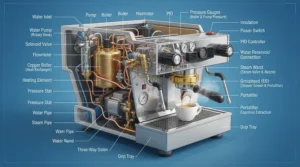
What is a budget heat exchange espresso machine? It’s a home espresso machine with a single insulated boiler that holds water at steam temperature while a separate internal coil flash-heats fresh water for brewing, letting you froth and extract at once — typically priced between roughly $1,300 and $2,300, well under dual-boiler territory.
This guide breaks down seven real machines currently sold in the US, compares them honestly on price-to-performance ratio, and digs into what actually matters — brewing temperature stability, build quality, and the small compromises that separate a low-cost heat exchange machine from a genuinely good value heat exchange espresso machine. No fabricated taste tests, no invented five-star reviews — just spec-grounded analysis and aggregated sentiment from real owners and reviewers, distilled into something you can actually use before you buy.
Quick Comparison Table: Budget Heat Exchange Espresso Machines at a Glance
| Machine | Price Range | Boiler | Standout Feature | Best For |
|---|---|---|---|---|
| Lelit Mara X V2 | Around $1,400–$1,700 | 1.8L HX, PID | Brew-priority mode | First-time HX buyers |
| Turin Gallatin R HX | Around $1,600–$1,700 | HX, PID, rotary pump | Built-in flow control | Tinkerers on a budget |
| Profitec Pro 400 | Around $1,600–$1,700 | 1.6L stainless HX | Three preset PID temps | Small kitchens |
| Quick Mill Andreja Premium Evo | Around $1,800–$1,900 | 1.8L copper HX | No-burn steam wand | Milk-drink households |
| Rocket Appartamento | Around $1,800–$1,900 | 1.8L copper HX | Steam power & styling | Design-conscious buyers |
| Diletta Bello+ | Under $2,500 | HX, active temp management | Eliminates cooling flush | Stability-obsessed users |
| Rocket Appartamento TCA | Around $2,300 | HX, PID | Upgraded temp control | Buyers who want the top of the range |
Looking at the spread above, there’s a real split between machines that hand you a digital PID readout and ones that rely on preset switches or pressure stats — and that split roughly tracks with price. The Lelit Mara X V2 and Turin Gallatin R HX sit at the more accessible end while still offering genuine temperature management, which is exactly the price-to-performance ratio sweet spot most first-time HX buyers are hunting for. Machines like the Diletta Bello+ and Rocket Appartamento TCA cost more, but they’re addressing a specific, well-documented HX complaint — temperature drift between shots — head on.
💬 Found a machine you’re already leaning toward? Bookmark this page and keep comparing — a $1,600 decision deserves five more minutes of research.
Top 7 Budget Heat Exchange Espresso Machines: Expert Analysis
Coverage below spans true entry-level HX machines through the upper edge of what most people would still call “budget” territory, including compact footprints, rotary-pump upgrades, and one machine specifically engineered to solve the classic HX temperature-surfing problem.
1. Lelit Mara X V2 — brew-priority mode ends temperature surfing
The Mara X V2 opens this list because it solves the single biggest complaint about entry-level HX machines: temperature surfing, the ritual of flushing water through the group head to guess your way to the right brew temperature. Specs-wise, you’re getting a 1.8-liter stainless steel HX boiler, dual PID control, an E61 group head, and a notably quiet vibratory pump packed into a machine that measures roughly 9 x 16 x 14.6 inches — genuinely one of the smallest true E61 machines sold today.
What most buyers overlook about this model is that its brew-priority mode isn’t a marketing gimmick; it actively manages which side of the HX loop gets thermal priority, so you get consistent brew temperature without babysitting a flush routine. Based on the spec comparison against similarly priced HX machines, the Mara X V2 punches well above its price class on usability alone. Reviewers consistently report that the compact footprint and simple lever operation make it an approachable first prosumer machine, and one widely cited retailer review holds the model at 4.6 out of 5 stars across roughly 1,400 reviews.
A common theme in owner feedback is praise for the steam power relative to the machine’s size, though several buyers note the stock feet and lack of built-in flow control as the first things they’d upgrade.
Pros:
- ✅ Brew-priority mode largely eliminates the classic HX cooling flush
- ✅ One of the smallest genuine E61 machines currently sold
- ✅ Dual manometer and a notably quiet vibratory pump
Cons:
- ❌ Single boiler capacity can lag during back-to-back milk drinks
- ❌ No flow control or digital PID readout on the base V2 model
Price sits around $1,400 to $1,700 depending on retailer and finish, and for a machine that neutralizes the HX category’s core annoyance, that’s a strong value verdict.
2. Turin Gallatin R HX — most features per dollar with a rotary pump
If price-to-performance ratio is your main filter, the Gallatin R HX deserves a serious look. It pairs a heat exchanger boiler with a rotary pump — a component usually reserved for machines costing hundreds more — plus built-in flow control, PID temperature management, and a switchable tank-or-plumb-in water source. In practice, the rotary pump means quieter operation and the ability to plumb directly into a water line if you want to skip refilling a reservoir altogether.
What the spec sheet won’t tell you, but early adopter reviews note, is that flow control at this price point lets you shape preinfusion for dense light roasts or ramp pressure for medium blends, a level of tactile control usually gated behind $2,000-plus machines. Reviewers describe the prosumer feature set — rotary pump, flow control, E61 group, PID — as punching hard against long-established defaults like the Mara X, particularly for buyers willing to pair it with a capable grinder.
The honest caveat here is brand maturity: Turin is newer to the space than Rocket, Lelit, or Profitec, so long-term parts availability and resale value are less proven, even though the hardware itself reads as genuinely prosumer-grade.
Pros:
- ✅ Rotary pump and flow control rarely appear together under $1,700
- ✅ PID control plus switchable tank or direct-plumb flexibility
- ✅ Per-dose programmable pre-infusion button
Cons:
- ❌ Newer brand with a less established service network
- ❌ Fewer long-term reliability reports than legacy Italian competitors
Priced around $1,600 to $1,700, this is arguably the strongest feature-for-dollar pick on this list if you’re comfortable betting on a newer name.
3. Profitec Pro 400 — the most compact preset-temperature HX
The Profitec Pro 400 is proof that a genuine E61 heat exchanger doesn’t need a large countertop footprint or a five-figure feature list to perform well. Specs include a 1.6-liter stainless steel HX boiler, a vibration pump, and a three-position multifunction switch that toggles between preset PID-controlled temperatures, pre-infusion on or off, and an ECO mode for energy savings.
Here’s what that means in practice: instead of dialing an exact number on a digital display, you’re choosing from three professionally chosen temperature bands, which removes guesswork for buyers who don’t want to fuss with numeric PID settings. Based on the spec comparison with pricier Profitec siblings like the Pro 500, the Pro 400 trades a digital readout for real savings without giving up the fundamentals — the E61 group, the dual pressure gauge, and switchable pre-infusion are all present.
Reviewers consistently frame it as one of the most capable machines under $2,000, citing the build quality and feature set typically found on machines costing noticeably more. The honest trade-off is the vibratory pump, which is audibly louder than the rotary pumps found on pricier alternatives on this list.
Pros:
- ✅ Full E61 group and 1.6L stainless HX boiler in a 9-inch-wide chassis
- ✅ Three PID-controlled preset temperatures cover most roast styles
- ✅ Switchable pre-infusion and ECO mode for energy savings
Cons:
- ❌ No digital PID display, just a preset temperature switch
- ❌ Vibratory pump runs louder than rotary-pump alternatives
At roughly $1,599 to $1,699, the Pro 400 is one of the tightest price-to-performance ratios in true HX hardware.
4. Quick Mill Andreja Premium Evo — best for milk-drink households on a budget
Quick Mill has built heat exchangers since long before “prosumer” was a marketing term, and the Andreja Premium Evo shows that heritage. The 1.8-liter T.E.A.-coated copper boiler, wrapped for insulation, is specifically engineered around steam performance and thermal retention, powered by a 1,400-watt heating element that recovers quickly between drinks. What that copper construction means in real terms is faster, more even heat transfer than the stainless alternatives on this list, at the modest cost of slightly higher limescale sensitivity if your water is hard.
Reviewers consistently highlight the no-burn steam wand with its four-hole tip as genuinely excellent for microfoam, and the compact 16-inch height fits comfortably under most upper cabinets. Aggregated owner sentiment describes this as one of the most dependable HX options for people who make several milk-based drinks daily, though the absence of a PID system is a real and repeated criticism — temperature management here relies on a pressure stat and a three-position switch rather than a digital target.
If you value simultaneous brew-and-steam over precision numerology, this is a legitimate trade to make.
Pros:
- ✅ T.E.A.-coated copper boiler holds heat exceptionally well for milk drinks
- ✅ No-burn steam wand with a four-hole tip for fine microfoam
- ✅ Compact 16-inch height fits under most cabinets
Cons:
- ❌ No PID system — temperature relies on a pressure stat
- ❌ No built-in water filtration, so scale management is on you
Typical pricing lands around $1,800 to $1,900, positioning it as a value heat exchange espresso machine for people whose daily routine is heavier on lattes than straight shots.
5. Rocket Appartamento — best steam power and Italian styling
Few machines in this price range generate the kind of enthusiasm the Rocket Appartamento does, and the specs explain why. A forged E61 group head, a shared 1.8-liter copper HX boiler, and a proper thermosiphon loop combine to deliver steam volume that reviewers repeatedly describe as outperforming machines costing considerably more. In practical terms, that means back-to-back lattes without the steam power visibly tapering off — a genuine advantage for households that entertain or simply drink a lot of milk-based coffee.
What most buyers overlook about the Appartamento is that its reputation for temperature instability, a common forum complaint about earlier units, is largely tied to skipping the recommended 20-to-25-minute full warm-up; give it that time and reviewers report shot quality that rivals machines several hundred dollars pricier. The laser-cut side panels and four available colors add a design dimension that’s rare at this price, and the machine can be customized further with vinyl panel inserts.
The honest downside, flagged specifically in hands-on reviews, is an undersized drip tray relative to the machine’s output — expect to empty it more than once a day in a busy household.
Pros:
- ✅ Forged E61 group and full thermosiphon deliver café-level steam
- ✅ Distinctive laser-cut panels and four color options
- ✅ Large shared boiler handles multiple lattes in a row
Cons:
- ❌ Undersized drip tray needs frequent emptying
- ❌ Full temperature stability requires a 20-to-25-minute warm-up
Priced around $1,800 to $1,900, the Appartamento remains one of the most recognized names in this category for good reason.
6. Diletta Bello+ — best active temperature management for stability
The Diletta Bello+ approaches the category’s oldest problem from a different angle. Rather than asking you to manage a cooling flush before every shot, its active temperature management system is reported by multiple 2026 buying guides to eliminate that step entirely — a meaningful shift for anyone who’s been burned by a too-hot first shot on a traditional HX. Specs include a PID-controlled heat exchanger boiler, programmable preinfusion, an E61 group, and handmade Italian construction.
What that active management means in practice, based on the spec comparison with passive HX designs like the Appartamento, is that the boiler and coil are actively coordinated rather than simply relying on thermosiphon flow and manual flushing, so temperature at the group head stays closer to target from the very first shot of the day. One prominent buying guide names it the top heat exchanger pick for most home baristas in 2026, citing build quality alongside the temperature system.
The realistic trade-off is price — it sits at the upper edge of what most people would call “budget” — and its shorter track record in the US market means fewer long-term ownership reports than Rocket or Lelit.
Pros:
- ✅ Active temperature management reportedly eliminates the cooling flush
- ✅ Handmade Italian E61 construction
- ✅ PID control with programmable preinfusion
Cons:
- ❌ Priced near the top of the budget HX bracket
- ❌ Smaller installed user base than more established brands
At under $2,500, the Diletta Bello+ is the pick for buyers who care more about consistent brewing temperature stability than shaving another few hundred dollars off the price.
7. Rocket Appartamento TCA — the PID upgrade at the top of the budget range
Closing this list is the machine Rocket built specifically in response to criticism of the original Appartamento’s temperature consistency. The Appartamento TCA replaces passive pressure-stat control with a PID and variable temperature control, addressing the exact complaint that shows up repeatedly across home barista forums about the standard Appartamento. Reviewers note the mechanical adjustment style — Low, Medium, High, and Very High settings, corresponding to roughly 91°C, 93°C, 95°C, and 98°C based on independent testing — keeps the classic Rocket tactile feel rather than adding a digital display, which will appeal to buyers who like knobs and dials over menus.
Here’s what most reviews agree on: the rounded corners, added color options, and angular E61 housing genuinely improve on the original’s design, and the switch to PID-based control is a real functional upgrade, not just a cosmetic refresh. The honest downside is price — at roughly $2,300, it’s priced meaningfully above the rest of this list, and the exact degree values for each switch position aren’t printed anywhere on the machine itself, so first-time owners typically need to look them up.
Pros:
- ✅ Upgraded PID and variable temperature control improve real stability
- ✅ Refined design with rounded corners and new color options
- ✅ Mechanical adjustment keeps the tactile Rocket feel
Cons:
- ❌ Priced well above the rest of this list
- ❌ Exact temperature values for each switch setting aren’t labeled
At around $2,300, the Appartamento TCA sits right at the top edge of “budget,” and the value verdict depends heavily on how much you weigh temperature precision against the extra few hundred dollars.
Top 7 Machines: Full Spec Comparison
| Machine | Group Head | Pump Type | PID | Best For |
|---|---|---|---|---|
| Lelit Mara X V2 | E61 | Vibratory | Yes (dual) | First HX purchase |
| Turin Gallatin R HX | E61 | Rotary | Yes | Flow-control tinkerers |
| Profitec Pro 400 | E61 | Vibratory | Preset (3-position) | Compact kitchens |
| Quick Mill Andreja Premium Evo | E61 | Vibratory | No (pressure stat) | Milk-heavy routines |
| Rocket Appartamento | E61 | Vibratory | No (standard model) | Steam power & looks |
| Diletta Bello+ | E61 | Vibratory | Yes, active management | Temperature-obsessed buyers |
| Rocket Appartamento TCA | E61 | Vibratory | Yes | Upgraded stability seekers |
The pattern in this table is worth calling out directly: only three of these seven — the Lelit Mara X V2, the Turin Gallatin R HX, and the Diletta Bello+ — ship with true digital PID control, while the rest rely on preset switches or pressure stats. That doesn’t automatically make them worse; the Profitec Pro 400‘s three-position switch and the Quick Mill Andreja Premium Evo‘s pressure stat are both mature, well-understood systems. But if precise, repeatable brewing temperature stability is your top priority and you don’t want to spend extra time dialing things in manually, the PID-equipped machines deserve first consideration.

Transformation: Practical Usage Guide for Your First HX Machine
Buying the machine is the easy part. The first 30 days determine whether you end up loving it or fighting it, and most of the common mistakes are avoidable with a bit of upfront knowledge that Amazon listings rarely mention.
Start with warm-up discipline. Every machine on this list needs real time to reach thermal equilibrium — not just boiler temperature, but the mass of the E61 group head itself, which takes noticeably longer to stabilize than the water inside the boiler. Give your machine 15 to 25 minutes before pulling your first shot of the day, and treat that window as part of your morning routine rather than a delay to work around. Next, learn your machine’s flush behavior on day one. If you own a passive HX like the Rocket Appartamento or the Quick Mill Andreja Premium Evo, a short 3-to-5-second flush before pulling a shot (especially after steaming) resets the group to brew temperature — skip this and your first shot after a latte will likely run hot and bitter. Machines with active temperature management, like the Diletta Bello+, or brew-priority modes, like the Lelit Mara X V2, need this far less, which is precisely their appeal.
Water quality deserves its own line item. Heat exchangers are more forgiving of moderate mineral content than some digital dual boilers, but scale build-up inside a coil restricts flow and quietly degrades temperature stability over months, not days. Use filtered water from day one, and set a descaling reminder every three to four months depending on your local water hardness rather than waiting for symptoms to appear. Finally, resist the urge to chase every temperature setting change in your first week; dial in a consistent grind and dose first, since inconsistent puck prep causes far more bad shots in month one than a slightly imperfect brew temperature ever will.
☕ Ready to stop guessing and start brewing consistently? Check current pricing on today’s top pick before it changes.
Real-World Scenarios: Who Actually Needs a Heat Exchange Machine
Picture three different buyers, because the “best” machine genuinely depends on which one you are.
The first is a graduate student who drinks two straight espressos on weekday mornings and rarely makes milk drinks. For this person, spending extra for steam-focused features on the Quick Mill Andreja Premium Evo or the Rocket Appartamento doesn’t make financial sense — the compact Profitec Pro 400, with its preset temperature switch and smaller footprint, delivers the E61 experience without paying for steam capacity that would go unused. The second scenario is a household that hosts weekend brunch regularly and needs to make four or five cappuccinos back-to-back without the machine falling apart thermally. Here, the Rocket Appartamento‘s large shared boiler and strong thermosiphon loop, or the Quick Mill Andreja Premium Evo‘s copper boiler and no-burn wand, are worth the investment specifically because of their steam recovery under repeated load. The third buyer is someone who’s read enough forum threads to be genuinely annoyed by the idea of temperature surfing and wants the closest thing to dual-boiler consistency without dual-boiler pricing. That’s the exact profile the Lelit Mara X V2 and Diletta Bello+ were built for — both directly target the cooling-flush problem rather than treating it as an unavoidable HX trade-off.
There’s a fourth, smaller group worth naming: budget-conscious tinkerers who enjoy adjusting flow profiles and don’t mind betting on a newer brand. For that buyer, the Turin Gallatin R HX offers rotary-pump quiet operation and built-in flow control that would otherwise require a costly aftermarket kit on most of the other machines here.
Buyer’s Decision Framework
Use this simple framework if you’re still torn between two or three options on this list.
If temperature stability matters more to you than price, choose the Diletta Bello+ or Lelit Mara X V2, because both are specifically engineered around minimizing or eliminating the cooling flush rather than just managing it better than average.
If milk drinks dominate your routine, choose the Quick Mill Andreja Premium Evo or Rocket Appartamento, because their boiler sizing and steam wand design are built around sustained frothing rather than occasional use.
If counter space is genuinely tight, choose the Profitec Pro 400 or Lelit Mara X V2, since both rank among the most compact true E61 machines currently sold in the US.
If you want the highest feature count for the lowest price and are comfortable with a newer brand, choose the Turin Gallatin R HX, since its rotary pump and flow control are rare below $1,700.
If you’ve already tried a passive HX and specifically want the upgraded PID experience without jumping to a dual boiler, choose the Rocket Appartamento TCA, understanding it sits at the top edge of what most buyers would call “budget.”
How to Choose a Budget Heat Exchange Espresso Machine
Choosing well comes down to weighing seven factors against your actual daily habits, not the spec sheet in isolation.
- Decide how much you value digital PID control. If precise, repeatable brewing temperature stability matters most, prioritize machines like the Lelit Mara X V2 or Turin Gallatin R HX over preset-switch designs.
- Measure your counter space before you fall in love with a machine. The Profitec Pro 400 and Lelit Mara X V2 are both under 10 inches wide, while machines like the Rocket Appartamento need more breathing room.
- Be honest about how often you make milk drinks. Frequent lattes justify paying more for boiler capacity and wand design, as on the Quick Mill Andreja Premium Evo.
- Check whether the machine can be plumbed in. The Turin Gallatin R HX offers switchable tank-or-plumb operation, which matters if you’re setting up a permanent home bar.
- Factor in brand maturity and parts availability. Established names like Rocket, Lelit, and Profitec have long service histories; newer entrants may offer more features per dollar but carry more long-term uncertainty.
- Budget for accessories beyond the machine itself. A quality grinder, a knock box, and a water filter typically add several hundred dollars to the real total cost.
- Read the warm-up time as a lifestyle question, not a spec. A 20-to-25-minute warm-up, as recommended for the Rocket Appartamento, needs to fit realistically into your actual morning, not just your ideal one.
Brewing Temperature Stability: What HX Machines Actually Deliver
Brewing temperature stability is the single most misunderstood spec in this entire category, so it’s worth grounding the discussion in the actual science before comparing machines. According to research on brew water temperature, the coffee industry’s accepted range for proper extraction sits at roughly 90 to 96 degrees Celsius, and deviating meaningfully outside that band shifts extraction toward either sour underdevelopment or bitter over-extraction — a relationship documented in peer-reviewed coffee brewing research. On a heat exchanger, the boiler itself runs far hotter than that, typically 125 to 130 degrees Celsius, because it doubles as the steam source; brew water only reaches proper temperature after passing through the internal coil, which is precisely why cooling flushes exist on passive designs.
What most marketing copy won’t tell you is that “temperature stability” on a budget heat exchange espresso machine isn’t really about hitting one perfect number — it’s about how much that number drifts between the first shot of the morning and the fourth shot after two cappuccinos. This is where the PID-equipped machines on this list, particularly the Lelit Mara X V2 and Diletta Bello+, earn their price premium: both actively manage the temperature relationship between the steam side and brew side rather than relying purely on thermosiphon convection. Machines like the Rocket Appartamento and Quick Mill Andreja Premium Evo achieve genuinely good stability too, but only after the recommended flush routine and full warm-up — skip either step and you’ll taste the drift as a harsh, over-extracted first shot. Reviewers who’ve logged extended testing hours across multiple HX machines consistently point to the thermosiphon loop, explained well by the home barista community’s technical reference, as the unsung hero that keeps the group head hot between shots even on passive designs — it’s the reason a well-maintained HX machine can match dual-boiler consistency for most home routines, just with a bit more operator involvement.
Budget Heat Exchange vs Dual Boiler: Which Should You Buy?
The comparison every prosumer buyer eventually runs into is heat exchanger versus dual boiler, and the honest answer is that dual boilers solve a real problem — independent brew and steam temperature control — at a real cost, both financially and in terms of complexity.
| Factor | Budget HX Machine | Entry Dual Boiler |
|---|---|---|
| Typical Price | ~$1,400–$2,300 | ~$1,400–$2,000+ |
| Simultaneous brew/steam | Yes, with flush routine | Yes, independent control |
| Temperature precision | Good to very good (varies by model) | Excellent, boiler-separated |
| Warm-up time | 15–25 minutes | 10–20 minutes |
| Best for | Most home users | Precision-focused enthusiasts |
Interestingly, the price ranges genuinely overlap — a machine like the Profitec Pro 300 dual boiler competes directly on price with several HX machines on this list, which surprises a lot of first-time buyers. The real differentiator isn’t cost but architecture and daily behavior: a dual boiler eliminates the temperature dependency between brewing and steaming entirely, while even the best heat exchange machines still involve some interaction between the two functions, however minimized by active management systems. For most single or two-person households making one to four drinks a day, a well-chosen budget heat exchange espresso machine like the Lelit Mara X V2 delivers 90 percent of the dual-boiler experience without the added footprint many dual boilers still carry, though buyers who want that final 10 percent of independent control should compare directly against entry dual boilers before committing.
✨ Still deciding between architectures? Compare current prices side by side before your next coffee order costs more than your machine payment.
Low-Cost vs Value Heat Exchange Espresso Machines: What’s the Real Difference?
It’s worth drawing a clear line between a low-cost heat exchange machine and a genuine value heat exchange espresso machine, because the two terms get used interchangeably when they shouldn’t be. A low-cost machine is simply one priced at the bottom of a category, full stop — it tells you nothing about whether the components inside will hold up, whether the PID logic is well-tuned, or whether the manufacturer has a track record of supporting the machine for a decade. A value machine, by contrast, is one where the price and the actual engineering underneath it are proportionate — you’re not overpaying for a badge, but you’re also not sacrificing the core mechanical fundamentals that make HX machines worth choosing over a thermoblock in the first place.
On this list, the Profitec Pro 400 and Lelit Mara X V2 are strong examples of genuine value rather than merely low cost: both come from manufacturers with long prosumer track records, and neither cuts corners on the E61 group or boiler material to hit their price point. The Turin Gallatin R HX, meanwhile, sits in an interesting middle zone — genuinely excellent specs for the price, but with less of a proven track record to lean on, which is a real (if hard-to-quantify) part of long-term value. The lesson for shoppers browsing Amazon listings is straightforward: don’t assume the cheapest heat exchanger in a search results page is automatically the best deal, and don’t assume a higher price on something like the Rocket Appartamento TCA is purely a markup — in that case, it corresponds to a documented functional upgrade over the base model.
Common Mistakes When Buying an Entry-Level HX Machine
Even smart buyers make a handful of predictable mistakes shopping for entry-level HX machines, and most of them are avoidable with a bit of forethought.
The first mistake is buying the machine before budgeting for the grinder. An HX machine paired with a mediocre grinder will consistently underperform a cheaper machine paired with an excellent one — grind consistency affects extraction more than almost any other single variable, and skipping this step is the single most common regret among first-time prosumer buyers. The second mistake is ignoring counter clearance above the machine; several models on this list, including the Rocket Appartamento, need vertical space for water tank refills and lever operation that a low upper cabinet can block entirely. The third mistake is assuming “heat exchanger” automatically means “identical experience” across brands — as this guide has shown, the gap between a preset-switch machine like the Quick Mill Andreja Premium Evo and an actively managed one like the Diletta Bello+ is real and noticeable in daily use, not just on paper.
A fourth mistake worth flagging: underestimating water quality. Buying a $1,700 machine and then running unfiltered hard tap water through it for two years is one of the fastest ways to turn a great investment into an expensive repair bill. Finally, many buyers skip reading return policies closely — some retailers charge restocking fees or require the buyer to cover return shipping on machines this size and weight, which matters given how personal steam wand technique and warm-up patience can feel once you’re actually using the thing daily.
Price-to-Performance Ratio: Long-Term Cost & Value Analysis
Sticker price only tells part of the story on a purchase like this, and calculating a genuine price-to-performance ratio means factoring in a few things Amazon’s product page won’t show you. First, consider cost-per-use: someone making two espresso drinks daily effectively pays down a $1,700 machine at roughly the cost of two to three café visits per week, meaning most of these machines pay for themselves within 8 to 14 months compared to daily café spending, depending on local coffee prices. Second, factor in accessory and maintenance costs — a capable grinder alone commonly costs $200 to $500, and descaling supplies, filters, and the occasional gasket replacement add modest but real ongoing expense across a machine’s lifespan.
Third, and most overlooked, is resale value, which correlates strongly with brand reputation rather than raw feature count. Established names like Lelit, Rocket, and Profitec tend to hold value well on the secondary market specifically because their parts remain available and their reputations are well-documented across years of forum discussion, while newer entrants like Turin carry more resale uncertainty even when the hardware itself is comparable. Looking at the comparison across this list, the Profitec Pro 400 and Lelit Mara X V2 offer arguably the strongest long-term price-to-performance ratio precisely because they combine reasonable upfront cost with strong resale history and low ongoing maintenance complexity, while machines like the Rocket Appartamento TCA ask you to pay more upfront for a temperature-control upgrade whose long-term value will depend on how much you personally prioritize that precision.
Features That Actually Matter (And Those That Don’t)
Marketing copy on espresso machine listings loves to bury the genuinely important specs under a pile of features that sound impressive but rarely change your daily experience. Here’s an honest filter.
Features that actually matter: PID temperature control or a well-designed preset system, boiler material and insulation quality, group head design (E61 remains the gold standard for thermosiphon-driven stability), and pump type, since rotary pumps like the one on the Turin Gallatin R HX run quieter and last longer under heavy use than vibratory alternatives. Water reservoir capacity and plumb-in capability matter more than most buyers expect too, since refilling a small tank multiple times a day gets old fast.
Features that matter far less than their marketing suggests: exact wattage numbers beyond a reasonable threshold (most machines on this list cluster around 1,200 to 1,600 watts, and the difference rarely changes real-world heat-up time meaningfully), cosmetic color options — genuinely nice on machines like the Rocket Appartamento, but irrelevant to shot quality — and multi-language digital displays, which sound advanced but add little for a home user who’ll set the machine once and rarely touch the menu again. The lesson: read past the bullet-point feature list and ask whether each spec changes what happens in your cup, not just what happens on the box.

Frequently Asked Questions
❓ What is the difference between a heat exchange espresso machine and a dual boiler?
❓ Is a budget heat exchange espresso machine good for beginners?
❓ How long does an entry-level HX machine take to warm up?
❓ Do heat exchange machines need special maintenance?
❓ Can a heat exchange machine really match dual boiler temperature stability?
Conclusion
A genuinely good budget heat exchange espresso machine isn’t about finding the cheapest E61 badge on Amazon — it’s about matching real specs and real trade-offs to how you actually make coffee every morning. If temperature stability is your top priority, the Lelit Mara X V2 and Diletta Bello+ directly address the category’s biggest historical complaint. If milk drinks dominate your routine, the Quick Mill Andreja Premium Evo and Rocket Appartamento are built around sustained steam output rather than occasional use. Buyers chasing the strongest price-to-performance ratio should look hard at the Turin Gallatin R HX and Profitec Pro 400, both of which deliver genuine prosumer hardware without genuine prosumer pricing.
None of these seven machines are flawless, and this guide hasn’t pretended otherwise — every pick here comes with honest trade-offs pulled from real specs and aggregated owner sentiment, not manufactured enthusiasm. What they share is a genuine claim to the heat exchanger category’s core promise: café-style simultaneous brewing and steaming, without a café-sized budget. Whichever model fits your kitchen, your routine, and your patience for warm-up time, you’re stepping into a meaningfully better cup than what most countertop machines under $500 can deliver, and that’s a real, measurable upgrade — not a marketing one.
Recommended for You
- Heat Exchange Espresso Machine Under $1500: 7 Real Picks for 2026
- Dual Boiler Espresso Machine Review for Beginners: 7 Top 2026 Picks
- 7 Best Dual Boiler Espresso Machines for Commercial Use (2026)
Disclaimer: This article contains affiliate links. As an Amazon Associate, I earn from qualifying purchases. If you purchase products through these links, we may earn a small commission at no additional cost to you.
✨ Found this helpful? Share it with your friends! 💬🤗
