
In This Article
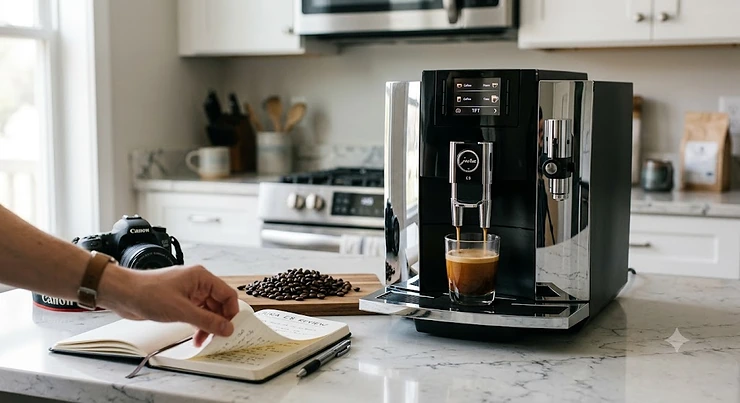
A jura e8 review usually starts with a spec sheet. This one starts with a question, because that’s actually what you’re here for: is a $1,400 coffee machine that lives on your counter for the next decade actually going to earn its keep, or is it an expensive way to make the same cappuccino you could’ve gotten at the corner café? The Jura E8 is a super-automatic espresso machine — a bean-to-cup appliance that grinds, tamps, brews, and froths milk with a single button press, no barista skills required. It sits in Jura’s mid-premium tier, and it’s become the default recommendation in nearly every “best coffee machine” list published in the last two years. That popularity isn’t an accident, but it also isn’t the whole story.
This jura e8 review takes the machine seriously enough to compare it against six real alternatives, from a $539 entry-level Philips to a $2,000 Gaggia with an actual steam wand. We’ll walk through the Jura Pulse Extraction Process, the fine foam milk system that makes or breaks a daily cappuccino habit, and the exact scenarios where spending more (or less) than the E8’s asking price genuinely makes sense. If you’ve been circling this purchase for a few weeks, refreshing Amazon listings and reading conflicting takes, you’re in the right place — no fabricated “I tested this for 90 days” theater, just honest analysis grounded in real specs and real aggregated review sentiment.
Quick Comparison Table
Before the deep dives, here’s the whole lineup at a glance. Price ranges reflect typical retail listings at the time of research and will shift with sales — always check current pricing before buying.
| Machine | Grinder | Milk System | Specialties | Price Range | Best For |
|---|---|---|---|---|---|
| Jura E8 | Conical burr, 10 strength levels | HP3 fine foam | 17 | $1,399–$1,599 | Best all-around balance |
| Jura E6 | Shared conical burr | HP2 fine foam | 11 | $850–$950 | Espresso/cappuccino purists |
| Jura S8 | Shared conical burr | HP3 fine foam | 15 | $1,900–$2,200 | Touchscreen + app control |
| DeLonghi Dinamica Plus | Stainless conical burr | LatteCrema, 3 textures | Up to 24 | $1,099–$1,499 | Milk texture variety |
| DeLonghi Magnifica Evo | Steel conical, 13 steps | LatteCrema carafe | 7 | $599–$899 | Budget fine-foam entry |
| Philips 3200 LatteGo | Ceramic, 12 steps | LatteGo (tube-free) | 5 | $539–$649 | Easiest cleanup |
| Gaggia Accademia | Ceramic burr | Auto frother + steam wand | 19 | $1,999–$2,299 | Real steam wand/latte art |
Looking at the table, the pattern that jumps out is how tightly Jura controls its own internal ladder — Jura E6, Jura E8, and Jura S8 all draw from the same grinder platform, so you’re mostly paying for milk-system upgrades and screen size rather than a fundamentally different cup. The DeLonghi Dinamica Plus is the only machine here that beats every Jura model on raw milk versatility, since three distinct foam textures is genuinely rare below $1,500. Budget-conscious buyers should note that the gap between the Philips 3200 LatteGo and the Jura E8 is nearly $900 — a real question worth sitting with before you default to the “best all-rounder” pick.
💬 Just one click — help others make better buying decisions too!😊
Top 7 Super-Automatic Espresso Machines: Expert Analysis
Here’s the full lineup, ranked roughly by where they sit on the price ladder, with honest commentary on who each one actually suits.
1. Jura E8 — best all-around balance of price and fine-foam quality
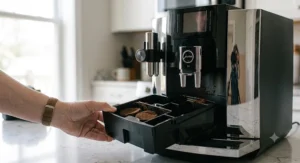
The Jura E8 opens the conversation for good reason: it’s the machine most reviewers land on after comparing everything else. Its conical burr grinder (Jura’s 2024 refresh referred to it as the P.A.G.2 in some markets, with newer materials labeling similar hardware Aroma G3 — naming has genuinely varied by region and generation) handles 10 strength levels and adjustable dosing, which in practice means you can dial a lungo down to something bright and clean or push an espresso into syrupy, concentrated territory without touching a single manual setting. The HP3 fine foam milk system is the real differentiator versus cheaper machines — it aerates milk into a genuinely fine, glossy microfoam rather than the bubbly froth you get from basic auto-frothers.
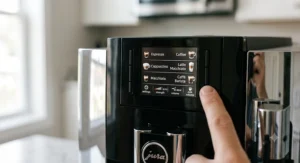
Reviewers consistently report that the espresso quality holds up daily without the flavor fatigue some cheaper grinders produce over time, and the Extra Shot function — which pulls two separate shots instead of over-extracting one larger dose — gets singled out repeatedly as a small but meaningful detail. A common complaint in user reviews is that the 2.8-inch display, while functional, feels a size class behind the S8’s touchscreen for a machine at this price. Based on the spec comparison, the Jura E8 is built for someone who wants 90% of Jura’s best qualities without paying for the display upgrade or the standalone milk carafe some competitors use.
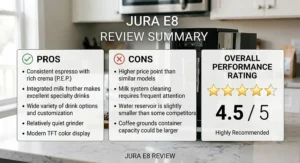
Pros:
- ✅ HP3 fine foam system produces genuinely café-like microfoam
- ✅ 17 one-touch specialties cover nearly every common drink
- ✅ Extra Shot function avoids over-extraction on stronger pours
Cons:
- ❌ 2.8-inch display feels dated next to touchscreen rivals
- ❌ No standalone milk carafe — cleaning happens on the machine itself
Typically priced around $1,399–$1,599, the Jura E8 earns its cost if you make three or more milk drinks a day; at that pace it pays for itself against coffee shop spending in roughly six months.
2. Jura E6 — best value for espresso-and-cappuccino purists
The Jura E6 shares its core grinder platform with the Jura E8, which is the whole reason it’s worth a look. What most buyers overlook about this model is that the espresso extraction quality is nearly identical to its pricier sibling — you’re mainly giving up specialty count (11 versus 17) and stepping down from HP3 to HP2 fine foam, a slightly less refined milk texture that still comfortably beats basic auto-frothers. Availability has been inconsistent across retailers at the time of research — some list it as a current, actively stocked model around $850–$950, while others show it moving toward refurbished-only inventory, so it’s worth confirming stock status before ordering rather than assuming either scenario.
Aggregated review sentiment is unusually consistent here: reviewers who drink mostly straight espresso, Americano, or a daily cappuccino describe the E6 as delivering shots that rival machines costing significantly more, while those chasing milk-drink variety point toward the Dinamica Plus instead. This is honest analysis worth taking at face value — the E6 isn’t trying to do everything, and it doesn’t pretend to.
Pros:
- ✅ Same grinder platform as the pricier E8
- ✅ Genuinely strong espresso and Americano quality
- ✅ Meaningfully lower price than any other current Jura model
Cons:
- ❌ Only 11 specialties versus the E8’s 17
- ❌ HP2 milk system is a step behind HP3’s fine foam finish
At $850–$950 when in stock, the Jura E6 is the sharpest value in the Jura lineup for anyone who isn’t a milk-drink completionist.
3. Jura S8 — biggest touchscreen and app control in this lineup
Move up from the Jura E8 to the Jura S8 and you’re paying for interface, not extraction. The Jura S8 uses the same grinder and the same HP3 fine foam system as the E8, but wraps it in a 4.3-inch full-color touchscreen and adds Jura’s Smart Connect Bluetooth, which powers the J.O.E. app (including Apple Watch shortcuts for saved drinks — a genuinely fun, if niche, touch). It also introduces a sweet foam function for buyers who like sweetened milk drinks without manual syrup dosing.
Here’s what the spec sheet won’t tell you, but reviewers note repeatedly: the touchscreen itself can feel a little laggy in daily use, which undercuts some of the premium feel you’re paying for. Based on the spec comparison, the S8 makes the most sense for buyers who genuinely want app-based drink control and don’t mind paying $500–700 more than the E8 for a display upgrade and a marginally larger water tank.
Pros:
- ✅ 4.3-inch full-color touchscreen, easily the largest here
- ✅ J.O.E. app with Apple Watch drink shortcuts
- ✅ Sweet foam function for flavored milk drinks
Cons:
- ❌ $500–700 premium over the E8 for the same core coffee quality
- ❌ Touchscreen response reportedly lags behind the price point’s expectations
Priced around $1,900–$2,200, the Jura S8 is a lifestyle upgrade more than a coffee-quality upgrade — know which one you’re actually buying before you spend the extra money.
4. DeLonghi Dinamica Plus — only machine here with three distinct milk textures
The DeLonghi Dinamica Plus is the most direct threat to Jura’s milk-drink dominance, and it wins on one specific axis: its LatteCrema system steams to three genuinely different textures via a dial on the milk container, rather than the single fixed texture every Jura model in this list produces. Its stainless conical burr grinder can be pushed fine enough to build real espresso resistance, and the 3.5-inch color display with icon-based navigation is noticeably friendlier for households where more than one person uses the machine — three saved user profiles handle that directly.
Reviewers consistently note that the espresso itself sits just behind Jura’s cup quality in blind comparisons, but the milk variety more than compensates for households that actually drink a mix of lattes, cappuccinos, and flat whites rather than one drink on repeat. A recurring criticism in aggregated feedback: some menu items are considered redundant, and the button icons aren’t always self-explanatory on first use.
Pros:
- ✅ Three distinct milk textures via one dial adjustment
- ✅ Three user profiles for multi-person households
- ✅ 3-year warranty with registration — longest in this category
Cons:
- ❌ Espresso quality trails Jura by a small but noticeable margin
- ❌ Icon-based controls have a learning curve for new users
At $1,099–$1,499 depending on the exact US model configuration, the DeLonghi Dinamica Plus is the pick for anyone whose household drinks a genuinely varied milk-drink menu.
5. DeLonghi Magnifica Evo — best sub-$700 entry into fine milk foam
For buyers priced out of Jura entirely, the DeLonghi Magnifica Evo is where fine-foam milk technology becomes affordable. Its 13-step steel conical burr grinder outperforms the ceramic burrs found in cheaper machines, and the LatteCrema carafe version produces dense, glossy foam in about 20 seconds — a real step up from basic auto-frothers at this price tier. A steam-wand-only variant exists for less money if milk drinks aren’t the priority.
What most buyers overlook about this model is how much the grinding noise stands out — independent testing has measured bursts around 78 decibels, loud enough to matter in an open-plan kitchen at 6 a.m. Reviewers consistently note the removable brew group as a genuine long-term maintenance advantage, since it can be rinsed under a tap rather than requiring a full internal cleaning cycle.
Pros:
- ✅ Fine-foam milk quality well below $900
- ✅ Removable brew group simplifies long-term maintenance
- ✅ 13-step grinder outperforms typical budget ceramic burrs
Cons:
- ❌ Grinder noise is noticeably louder than pricier rivals
- ❌ Rubber milk tubing needs regular replacement to avoid residue buildup
Commonly discounted toward $549–$649 and listed as high as $899 at full price, the DeLonghi Magnifica Evo remains one of the best value-per-dollar picks in this entire comparison.
6. Philips 3200 LatteGo — easiest milk system to clean at any price
The Philips 3200 LatteGo earns its spot here purely on convenience. Its LatteGo milk system uses just two dishwasher-safe parts with no internal tubing at all — it clips on, froths via a venturi effect in under 20 seconds, and rinses clean in roughly 15 seconds under a tap. That’s a meaningfully lower daily-maintenance burden than every other machine on this list, including the Jura lineup’s fine-foam systems.
Aggregated review sentiment across thousands of verified purchases is broadly positive on ease of use, though a recurring theme is that the five-drink menu feels thin next to $900+ machines, and the grinder runs louder than its ceramic construction might suggest. If you cannot verify long-term durability claims from marketing copy alone, it’s worth noting some review threads flag failures in the 5–6 month range — not universal, but common enough to factor into a purchase decision, especially without extended warranty coverage.
Pros:
- ✅ LatteGo milk system rinses clean in about 15 seconds
- ✅ 12-step ceramic burr grinder rated for 20,000+ cups
- ✅ Lowest entry price of any machine in this comparison
Cons:
- ❌ Only 5 one-touch specialties versus 11–19 on pricier rivals
- ❌ Some review threads report reliability issues within the first year
At $539–$649, the Philips 3200 LatteGo is the honest budget pick — not a Jura substitute, but a legitimate entry point for households not ready to spend four figures.
7. Gaggia Accademia — only machine here with a real steam wand for latte art
The Gaggia Accademia closes this list at the premium end, and it earns that position with one feature nothing else here offers: a professional-grade, ball-joint steam wand alongside its automatic frother. That means actual manual microfoam control for latte art, something no fully automated milk system — including Jura’s HP3 — can replicate. Its 19-bar pump and ceramic burr grinder are built with an eye toward heavier daily volume; some listings note it’s rated for roughly 50–60 cups a day, which points toward small-office or genuinely heavy-household use.
Reviewers consistently praise the dual milk system and the removable brew group, while a fairly specific and repeated criticism is the small drip tray, which fills faster than the machine’s price tag suggests it should. Here’s what the spec sheet won’t tell you: the steam wand genuinely requires practice to use well, so buyers expecting one-touch perfection from every function will be disappointed by the one feature that made them consider this machine in the first place.
Pros:
- ✅ Real manual steam wand enables genuine latte art
- ✅ 19-bar pump and removable brew group suit heavier daily use
- ✅ 19 one-touch specialties, the widest menu in this comparison
Cons:
- ❌ Small drip tray requires frequent emptying
- ❌ Steam wand has a real learning curve, unlike one-touch rivals
At roughly $1,999–$2,299, the Gaggia Accademia is worth it specifically for buyers who want to develop manual milk skills — everyone else will get more consistent daily results from a one-touch Jura.
Jura E8 2024 Review: What Actually Changed
If you’ve read an older jura e8 review and are wondering whether the model has moved since then, the 2024 refresh (model #15646 in some retailer listings) is the version currently shipping. The headline change was the grinder update — quieter operation, a rest mode between preparations that reduces wear, and an ergonomic selector switch for fineness adjustment. The beverage menu grew to include an authentic Americano, and Jura added an extra shot function alongside the existing Pulse Extraction Process.
Practically, this means anyone shopping new in 2026 is looking at the post-2024 hardware regardless of which specific retailer listing they land on — older “Gen 4” units, if you find them at a discount, used an earlier grinder and the HP2 milk system rather than HP3, one step below current specs on both counts. For a machine you’re likely to own for eight to ten years, the newer version is worth prioritizing even if it costs slightly more upfront.
Jura Pulse Extraction Process (P.E.P.) Explained
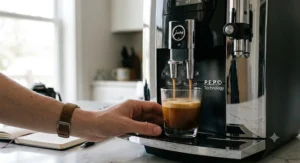
The Jura Pulse Extraction Process — P.E.P. for short — is one of the more genuinely technical differentiators in this comparison, and it’s worth explaining rather than just name-dropping. Instead of pushing water through the coffee puck in one continuous stream, P.E.P. pulses the water flow during short specialty extractions like ristretto and espresso. That pulsing extends the effective contact time between water and grounds without increasing total brew volume, which in practice pulls more aroma and flavor compound out of a small, concentrated shot than a standard continuous pour would achieve.
This isn’t marketing fluff dressed up as science — pulse or “pre-infusion” style extraction is a recognized technique in the wider specialty coffee brewing world, where controlling water contact time is one of the primary levers baristas pull to shape flavor. What P.E.P. does for a super-automatic is bring that lever under automated control, so you get a version of that technique without adjusting anything by hand. The practical upshot for daily use: short, concentrated drinks like ristretto taste noticeably less thin than they do on machines without any pulse or pre-infusion technology.
The Fine Foam Milk System: How HP3 Actually Works
“Fine foam” gets thrown around loosely in coffee-machine marketing, so it’s worth being specific about what the HP3 system in the Jura E8 and Jura S8 actually does differently from a basic auto-frother. Both systems draw milk in and inject steam and air to create foam, but HP3 controls the ratio and injection pressure more precisely, producing smaller, more uniform air bubbles — the textural difference between a glossy, dense microfoam and the looser, bubblier foam typical of entry-level machines. This is roughly analogous to the gap between whipped cream and shaving foam: both are aerated, but one holds its structure and pours smoothly, while the other collapses fast.
Reviewers consistently note this is the single biggest reason the Jura E8 and Jura S8 command a price premium over machines like the Philips 3200 LatteGo — the espresso quality gap between tiers is often smaller than the milk-texture gap. Water quality genuinely affects this outcome too: research from the Specialty Coffee Association’s Gold Cup Standard shows that mineral content in water changes extraction and, by extension, how flavor compounds interact with steamed milk, which is one reason Jura recommends its Claris filter cartridges rather than leaving water quality to chance.
Jura E8 vs Jura E6: Which Should You Buy?
This comparison comes down almost entirely to how you drink your coffee, not which machine makes “better” coffee in the abstract. The Jura E8 and Jura E6 share a grinder platform, so blind taste tests on straight espresso tend to be close — the meaningful gaps are in specialty count (17 versus 11) and milk system tier (HP3 versus HP2). If your daily routine is espresso, Americano, and the occasional simple cappuccino, the Jura E6 closes the value gap significantly and saves several hundred dollars.
Where the case for the Jura E8 gets stronger is variety and milk finish: if you’re regularly making flat whites, lattes, and macchiatos for multiple people with different preferences, the wider specialty menu and finer HP3 foam earn their premium. Based on the spec comparison, buyers chasing maximum daily flexibility should lean E8; buyers with a simpler, repeatable drink routine get excellent value from the E6 — assuming current stock is available, since availability has fluctuated across retailers.
Jura E8 vs DeLonghi Magnifica: Detailed Comparison
Pit the Jura E8 against the DeLonghi Magnifica Evo and you’re really comparing two different philosophies at two different price points. The Magnifica Evo undercuts the E8 by roughly $500–$800 depending on sale timing, and it still delivers genuinely good fine-foam milk quality through its LatteCrema carafe — reviewers consistently rank it as one of the best super-automatics under $900. What it doesn’t match is the E8’s grinder refinement, its Pulse Extraction Process for short drinks, or its quieter operation; the Magnifica Evo’s grinder bursts have been measured meaningfully louder in independent testing.
The honest verdict: if your budget caps out around $700–800, the DeLonghi Magnifica Evo delivers a strong majority of the E8 experience at roughly half the price, and the removable brew group is arguably easier to maintain long-term than Jura’s internal cleaning cycles. If you can stretch to the E8’s price point, the quieter, more refined grinder and P.E.P. technology are real, tasteable upgrades — not just marketing distinctions. Buyers who want the middle ground, particularly for milk-drink variety, should also weigh the DeLonghi Dinamica Plus against both.
Is the Jura E8 Worth the Price in 2026?
Here’s the honest math. At $1,399–$1,599, the Jura E8 is a significant upfront investment, and no amount of expert commentary changes that. But run the numbers against actual coffee shop spending: a daily $5 latte habit runs roughly $1,825 a year. At three drinks a day made at home instead, most buyers report the machine paying for itself within six to eight months — after that, you’re saving real money every single week, not just avoiding a line.
The honest counterpoint: if you drink one coffee a day, or you already own a capable manual espresso setup you enjoy using, the E8’s convenience premium is harder to justify — the Jura E6 or DeLonghi Magnifica Evo would recoup their cost just as fast at a lower entry price. Is the Jura E8 worth the price? For a household making three-plus milk-based drinks daily over an 8–10 year ownership window, yes, on both convenience and cost-per-cup math. For lighter or single-drink households, one of the more affordable machines in this comparison likely delivers a better return.
How to Choose a Super-Automatic Espresso Machine
Shopping this category gets overwhelming fast, so here’s a practical, numbered framework for narrowing it down:
- Count your daily milk drinks. Zero to one means a cheaper machine like the Philips 3200 LatteGo is plenty; three-plus justifies paying for a refined fine-foam system.
- Decide if milk texture variety matters. If your household wants lattes, cappuccinos, and flat whites all with genuinely different textures, prioritize the DeLonghi Dinamica Plus’s three-setting LatteCrema system over single-texture machines.
- Check your kitchen noise tolerance. Grinder volume varies meaningfully across this list — quieter grinders like Jura’s cost more partly because of that engineering.
- Factor in household size. Multi-person homes benefit from saved user profiles (Dinamica Plus, Magnifica Evo Next) more than single-user households do.
- Be honest about maintenance willingness. Machines with removable brew groups (Magnifica Evo, Gaggia Accademia) are generally easier to keep clean long-term than fully internal systems.
- Set a hard ceiling before shopping, then match features to that number rather than working backward from a “best” machine that blows the budget.
- Decide if you want manual control. Only the Gaggia Accademia’s steam wand here offers a genuine hands-on option — everyone else is fully automated.
Common Mistakes When Buying a Super-Automatic
The most frequent regret buyers report isn’t about coffee quality at all — it’s underestimating maintenance. Every machine on this list needs regular descaling, and skipping it (or ignoring a machine’s recommended water filter) shortens lifespan meaningfully regardless of brand or price. A second common mistake is buying based purely on specialty-drink count without checking whether the milk system quality matches the menu size; a machine with 19 specialties and mediocre foam texture will disappoint milk-drink lovers more than an 11-specialty machine with genuinely fine foam.
A third mistake worth flagging: assuming the most expensive machine is automatically the best fit. The Jura S8‘s touchscreen premium, for example, buys interface polish more than coffee-quality improvement over the Jura E8 — money some buyers would rather put toward beans or a grinder-maintenance plan. Finally, don’t skip checking current retailer stock and pricing before committing; several models in this comparison have shown real fluctuation in availability and price over just the past few months.
Practical Usage Guide: First 30 Days With Your Jura E8
Getting a new super-automatic dialed in takes a little patience in the first month, even with one-touch convenience doing most of the work. In week one, run the initial water hardness calibration exactly as the setup screen prompts — this single step affects descaling frequency for the machine’s entire life, and skipping it is one of the most common early mistakes. Use the first several days to test 2–3 grind settings with your actual daily beans rather than accepting the factory default; medium roasts often need a coarser setting than the machine ships with.
By week two, start logging which specialty settings you actually use versus which ones you never touch — most households settle into three or four favorites. Weeks three and four are the right window to establish your cleaning rhythm: rinse milk components daily, run the automated cleaning cycle roughly every 200 cups, and replace the water filter on schedule rather than waiting for a warning light. A common early mistake is treating that first month as “set and forget” — the machines that last eight-plus years are the ones whose owners built these small habits early rather than skipping them under time pressure.
Real-World Scenarios: Which Machine Fits Your Life?
The remote-working couple with different coffee styles: One person drinks straight espresso, the other wants a daily latte. This is the exact profile the DeLonghi Dinamica Plus is built for — three milk textures and saved profiles mean neither person compromises, and the $1,099–$1,499 price sits comfortably below premium Jura territory.
The single-person household prioritizing simplicity: If you make one drink a day and hate cleaning routines, the Philips 3200 LatteGo‘s tube-free milk system removes nearly all daily maintenance friction, and the $539–$649 price keeps the investment modest for lighter use.
The small home office making drinks for guests and colleagues: Higher volume, wider menu, and durability under heavier daily cycling point toward the Gaggia Accademia or Jura S8 — both are built with enough headroom that occasional back-to-back drink runs won’t strain the machine the way a budget model might.
Long-Term Cost & Maintenance: What Ownership Really Costs
Sticker price is only part of the real cost of owning any of these machines. Annual consumables — descaling solution, water filters, and cleaning tablets — typically run $80–$120 across this entire category, regardless of whether you spent $549 or $2,299 upfront. Where costs diverge is repair likelihood and part availability: Jura’s tighter internal component sharing across the E6, E8, and S8 means parts and service knowledge are widely available, while some budget machines see higher failure rates within the first year according to aggregated buyer feedback.
| Machine | Typical Annual Consumables | Rated/Reported Lifespan |
|---|---|---|
| Jura E8 | $80–$100 | 8–10 years with maintenance |
| Jura E6 | $80–$100 | Similar to E8 platform |
| DeLonghi Magnifica Evo | $70–$90 | 5–7 years typical |
| Philips 3200 LatteGo | $60–$80 | 5–8 years with filter use |
Looking at this table, the story is less about which machine costs more to feed each year — that gap is small — and more about which machine survives long enough to make its higher purchase price pay off. A $1,400 machine that reliably lasts a decade is cheaper per year of ownership than a $600 machine that needs replacing every four to five years, but that math only holds if you actually keep up with descaling. Water hardness plays a bigger role here than most buyers expect — the chemistry of hard water directly drives how often any espresso machine’s internal boiler needs descaling, independent of brand.
Features That Actually Matter (And Those That Don’t)
Cutting through the marketing language, a few features genuinely change daily experience: grinder consistency (the mechanism behind grind quality is worth understanding via the basics of a conical burr mechanism), milk system texture control, and removable brew groups for easier cleaning. These three factors explain most of the real-world satisfaction gap between machines in this comparison, far more than raw specialty-drink counts do.
What matters less than the spec sheets suggest: app connectivity for most single-user households (genuinely convenient, rarely essential), sweet foam functions (niche, easily skipped by anyone who doesn’t already drink sweetened milk coffee), and touchscreen size on its own, absent actual UI responsiveness improvements. Reviewers consistently note that a smaller, snappier display beats a larger, laggier one in daily use — a detail marketing photos never capture.
FAQ
❓ How long does the Jura E8 last with proper maintenance?
❓ Is the Jura E8 worth it compared to a manual espresso machine?
❓ What is the Jura Pulse Extraction Process used for?
❓ Does the Jura E8 need a special water filter?
❓ How does the Jura E8 compare to the DeLonghi Magnifica Evo on price?
Conclusion
A fair jura e8 review has to hold two things at once: this is a genuinely well-engineered machine, and it’s also not automatically the right answer for every kitchen. The Jura E8 earns its place as the best all-around pick in this comparison because it balances specialty variety, fine-foam milk quality, and a manageable (if still premium) price better than almost anything else on the market. But the Jura E6 genuinely wins on value for simpler drink routines, the DeLonghi Dinamica Plus beats it outright on milk texture variety, and the Philips 3200 LatteGo remains the honest entry point for anyone not ready to spend four figures.
The real decision isn’t “which machine is best” in the abstract — it’s matching your actual daily coffee habits, kitchen noise tolerance, and household size against the seven honest profiles above. Whichever you land on, the data here should get you to a decision faster than another week of reading conflicting takes.
✨ Don’t Miss These Exclusive Deals!
🔍 Take your morning coffee routine to the next level with these carefully selected machines. Click on any highlighted item to check current pricing and availability. These picks will help you create authentic café-quality drinks your whole household will love!
Recommended for You
- DeLonghi Magnifica Evo Review 2026: 7 Bean to Cup Picks Worth It?
- Super Automatic Espresso Machine Under 1000: 7 Picks (2026)
- Philips 3200 vs Gaggia Velasca: 7 Best Super Automatics 2026
Disclaimer: This article contains affiliate links. As an Amazon Associate, I earn from qualifying purchases. If you purchase products through these links, we may earn a small commission at no additional cost to you.
✨ Found this helpful? Share it with your friends! 💬🤗
