
In This Article
Somewhere between your first wobbly pour-over and the moment you catch yourself Googling “thermosiphon” at 11 p.m., you become the target audience for a prosumer espresso machine. It’s a strange threshold to cross. One day a $50 machine felt luxurious; the next, you’re squinting at boiler diagrams like they’re the Rosetta Stone. That shift isn’t really about caffeine anymore — it’s about control, consistency, and the stubborn refusal to accept a mediocre shot when a better one is mechanically possible.
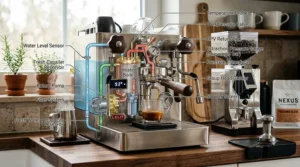
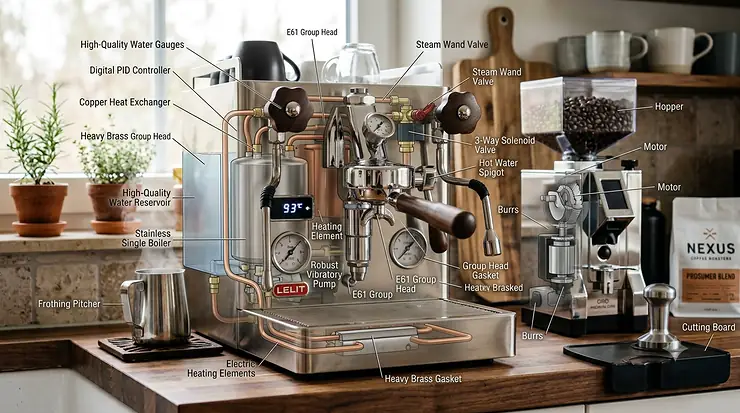
A prosumer espresso machine sits in the gap between disposable home gadgets and genuine commercial equipment: built with real brass and steel, engineered for temperature stability, and priced like a serious hobby rather than a kitchen appliance. This guide walks through seven real machines — from a scrappy $450 workhorse to a German dual-boiler that costs as much as a used car — and explains, honestly, what each dollar actually buys you. We’ll dig into E61 group heads, dual boilers versus heat exchangers, and the unglamorous reality of descaling schedules, because that’s where the actual decision lives.
Reviewers and manufacturer documentation agree on one thing across every price tier here: the difference between a good shot and a forgettable one usually comes down to temperature stability, not marketing copy. Independent long-term testing from outlets like Home-Barista’s equipment reviews backs this up repeatedly — boiler design, not brand prestige, is what predicts consistency in the cup. Keep that in mind as we go, because it’ll save you from overpaying for features you won’t use and underpaying for the one you actually need.
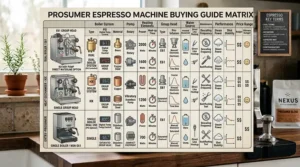
Quick Comparison Table
| Machine | Boiler Type | Price Range | Best For |
|---|---|---|---|
| Gaggia Classic Pro | Single boiler | Around $450-$500 | Budget entry with commercial parts |
| Rancilio Silvia V6 | Single boiler | Around $900-$1,000 | Steam power on a single-boiler budget |
| Breville Dual Boiler BES920XL | Dual boiler | $1,600-$1,800 range | Dual-boiler stability under $2,000 |
| Rocket Appartamento TCA | Heat exchanger (E61) | $2,150-$2,350 range | Italian styling with PID precision |
| Profitec Move | Dual boiler | $2,200-$2,400 range | Fastest heat-up in a compact frame |
| Lelit Bianca V3 | Dual boiler (E61) | $3,000-$3,300 range | Flow-control pressure profiling |
| ECM Synchronika II | Dual boiler (E61) | $3,600-$3,900 range | German build quality, endgame territory |
Look at that spread for a second. There’s nearly $3,500 separating the cheapest and priciest machines on this list, yet all seven are legitimately capable of pulling a shot that would make a café barista nod in approval. What separates them is workflow, not raw shot quality — how fast they heat up, whether you can brew and steam at the same time, and how much manual control you get over the extraction itself. The Gaggia Classic Pro proves that commercial-grade parts don’t require a commercial-grade budget, while the ECM Synchronika II shows what happens when temperature stability becomes an obsession rather than a feature. Budget-conscious buyers should note that the jump from single boiler to dual boiler is where the real workflow transformation happens, not the jump from mid-tier to premium within the dual-boiler category itself.
💬 Already know which boiler type fits your morning? Scroll down to the product that matches — or keep reading for the full breakdown.
💬 Just one click — help others make better buying decisions too!😊
Top 7 Prosumer Espresso Machines: Expert Analysis
1. Gaggia Classic Pro — commercial 58mm portafilter on a beginner budget
The standout here isn’t glamorous, but it’s the reason this machine has a cult following three decades running: a genuine 58mm commercial portafilter on a machine priced like an appliance. That single decision unlocks an entire ecosystem of upgraded baskets, bottomless portafilters, and pro-grade accessories that most budget machines simply lock you out of.
Under the hood sits a single boiler with a three-way solenoid valve — the part that vents residual pressure after your shot so the puck doesn’t “sneeze” grounds across your counter. Reviewers consistently report that the stock over-pressure valve ships set higher than ideal, and that dialing it down toward 9 bar is the first mod most owners make, particularly for lighter roasts. The trade-off for that low price is a single boiler doing double duty for brewing and steaming, so you can’t do both at once — a real limitation if you’re making back-to-back milk drinks for a household.
Based on the spec comparison against similarly priced machines, the Gaggia Classic Pro earns its reputation through repairability rather than convenience: it has no PID out of the box, no auto-on timer, and no fancy display. What most buyers overlook about this model is that its all-metal construction and widely available replacement parts mean a well-maintained unit can realistically outlast several generations of plastic thermoblock machines. Aggregated reviewer sentiment across multiple independent write-ups consistently flags the steam wand as underpowered compared to pricier machines, though most agree it’s more than workable with practice.
Pros:
- ✅ Genuine 58mm commercial portafilter and accessory ecosystem
- ✅ Fully serviceable metal construction built to last a decade-plus
- ✅ Three-way solenoid valve for cleaner puck removal
Cons:
- ❌ Underpowered steam wand versus heat exchanger competitors
- ❌ No PID or temperature display out of the box
Priced around $450-$500 before you factor in a dedicated burr grinder, the Gaggia Classic Pro delivers the highest quality ceiling of any machine at this price point — provided you’re willing to learn temperature surfing and invest in proper puck prep.
2. Rancilio Silvia V6 — largest single-boiler steam power in its class
The Rancilio Silvia V6 has been the default “graduate to a real machine” recommendation since 1997, and the reason keeps coming back to one number: boiler volume. Its single boiler is oversized relative to most competitors in the same bracket, which translates directly into stronger steam pressure and faster recovery between drinks — something the spec sheet won’t tell you outright, but which shows up the moment you steam a pitcher of milk back-to-back with a shot.
The commercial-grade group head, built from forged marine brass, is designed for the kind of heat retention that keeps extraction consistent shot after shot, even in a home kitchen where usage is sporadic rather than constant. A patented 58mm portafilter — shared with Rancilio’s commercial line — means the same accessory compatibility story as the Gaggia above, just wrapped in a heavier, more industrial-feeling chassis. Reviewers consistently note the four rocker switches and utilitarian control layout feel closer to a mini café unit than a domestic appliance, which is exactly the point.
What most buyers overlook here is that the single boiler still means no simultaneous brew-and-steam, so if milk drinks are your daily ritual rather than an occasional treat, this isn’t the ceiling — it’s a very solid floor. Aggregated review sentiment repeatedly highlights that the Silvia requires a fairly fine, consistent grind to show its best side, making a quality grinder practically mandatory rather than optional.
Pros:
- ✅ Largest single-boiler steam capacity in its price bracket
- ✅ Forged marine brass group head built for decades of use
- ✅ Available in multiple finishes to match any kitchen
Cons:
- ❌ No simultaneous brew-and-steam capability
- ❌ Requires a fine, consistent grind to perform well
At around $900-$1,000, the Rancilio Silvia V6 is the machine for someone who wants a genuine step up from entry-level without yet committing to dual-boiler money.
3. Breville Dual Boiler BES920XL — true dual boiler under $2,000
Here’s where the category shifts. The Breville Dual Boiler BES920XL is the most affordable way to own genuine dual-boiler architecture — two completely separate stainless-steel boilers, one for brewing and one for steaming, each independently PID-controlled. That means you can pull a shot and steam a pitcher of milk in the same thirty seconds, something neither machine above this one on the list can do.
A third heating element embedded in the group head keeps the entire water path thermally stable, and reviewers testing the machine over extended use measured shot-to-shot temperature variance within roughly two degrees Fahrenheit — genuinely impressive stability for the price. The 84-ounce water tank is large enough that a busy household won’t be refilling constantly, and programmable pre-infusion by time or volume lets you fine-tune extraction without needing an aftermarket mod.
Here’s what the spec sheet won’t tell you: this isn’t an E61 machine, and it lacks the classic Italian lever aesthetic entirely. What you get instead is a more appliance-like interface with an LCD screen and a big analog pressure gauge — a genuinely different design philosophy that some enthusiasts love for its convenience and others find less romantic than a brass lever group. User reports flag long-term reliability as the real question mark; several owners note steam valve or seal issues appearing after several years of heavy use, which is worth weighing against the machine’s otherwise strong feature set.
Pros:
- ✅ True independent dual boilers for simultaneous brew and steam
- ✅ Programmable pre-infusion by time or volume
- ✅ Large 84-ounce tank refillable from front or back
Cons:
- ❌ Reported long-term reliability concerns after years of heavy use
- ❌ Lacks the E61 lever aesthetic some enthusiasts specifically want
Sitting in the $1,600-$1,800 range, the Breville Dual Boiler BES920XL is the clearest answer to anyone asking whether dual-boiler performance requires a five-figure kitchen renovation. It doesn’t.
4. Rocket Appartamento TCA — Italian heat exchanger with real PID precision
The Rocket Appartamento TCA takes one of the most photogenic compact machines on the market and finally gives it the temperature control enthusiasts had been requesting for years. Four preset brew temperatures, selected through the brew lever itself rather than a cluttered digital display, eliminate the “temperature surfing” ritual that heat exchanger machines are traditionally famous for.
Inside sits a 1.8-liter copper heat exchanger boiler — now insulated, unlike the original Appartamento — paired with the classic E61 group head and its dual pre-infusion system. Based on the spec comparison, that insulation matters more than it sounds: an uninsulated HX boiler bleeds heat into the group constantly, forcing cooling flushes before nearly every shot, while the insulated TCA version reduces that dependency meaningfully. Reviewers who’ve used both versions back to back describe the TCA’s shot-to-shot consistency as a genuine, not marginal, improvement.
What most buyers overlook about this machine is that it’s still fundamentally a heat exchanger, not a dual boiler — steam and brew water share the same boiler, so hosting a dinner party with five consecutive cappuccinos will eventually show a dip in steam pressure that a true dual boiler wouldn’t exhibit. For two-to-four drinks in a sitting, though, aggregated user feedback describes the steam performance as strong, with roughly 20 seconds to properly texture a small pitcher of milk.
Pros:
- ✅ Four-position PID eliminates manual temperature surfing
- ✅ Insulated copper HX boiler improves shot-to-shot consistency
- ✅ Iconic Italian design with signature cutout side panels
Cons:
- ❌ Steam power tapers during long back-to-back milk sessions
- ❌ Requires a proper grinder investment to match its capability
Priced around $2,150-$2,350, the Rocket Appartamento TCA is the machine for someone who wants E61 heritage and genuine temperature precision without the size or price of a full dual boiler.
5. Profitec Move — fastest heat-up in a compact dual-boiler frame
If waiting is the one part of espresso you’ve never enjoyed, the Profitec Move was engineered specifically for you. Its fast heat-up mode brings both independently controlled boilers to operating temperature in roughly nine to thirteen minutes depending on mode — dramatically faster than the twenty-to-thirty-minute warm-up traditional E61 dual boilers typically demand.
Rather than the classic E61 group, the Move uses a ring-style brew group similar in spirit to boutique machines costing far more. Reviewers note this design choice cuts heat-up time further and removes the burn risk that comes with a traditionally hot E61 lever — a genuine ergonomic upgrade for households with kids in the kitchen. An OLED PID display handles both boilers’ temperature settings, pre-infusion timing, and a built-in shot timer, all navigable without opening the machine’s casing.
Here’s what the spec sheet won’t spell out clearly: because the Move skips the E61 group, it also skips the enormous aftermarket accessory ecosystem that decades of E61 dominance have built up. If you’re the type who wants flow-control paddles, upgraded shower screens, and a dozen forum threads of modification ideas, this machine’s newer, proprietary design won’t have quite the same depth of third-party support yet. What most buyers overlook is that the modular bottomless portafilter, which converts between spouted and bottomless with a silicone insert, is a genuinely clever solution that reviewers who were initially skeptical came around on quickly.
Pros:
- ✅ Fastest dual-boiler heat-up time in this roundup
- ✅ Auto on/off scheduling for zero-wait mornings
- ✅ Modular portafilter switches between spouted and bottomless
Cons:
- ❌ Smaller aftermarket accessory ecosystem than E61 machines
- ❌ Only ships with a single portafilter handle
At $2,200-$2,400, the Profitec Move rewards buyers who value daily workflow speed over classic Italian lever theatrics.
6. Lelit Bianca V3 — flow-control paddle for real pressure profiling
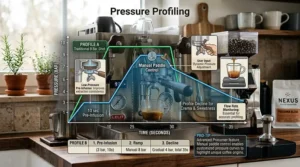
The Lelit Bianca V3 is the machine that made pressure profiling accessible to home baristas who aren’t willing to spend five figures on a La Marzocco GS3 or a Slayer. A wooden paddle sits atop the E61 group and lets you manually restrict or open water flow in real time during extraction — meaning you control brew pressure shot by shot rather than accepting whatever the pump delivers.
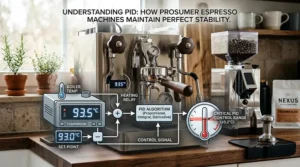
Two independently insulated stainless boilers (0.8 liter brew, 1.5 liter steam) handle temperature duties, each adjustable from roughly 176°F to 239°F in single-degree increments through the external PID. What most buyers overlook about flow control is that it isn’t just a party trick for showing off on Instagram — reviewers who work with challenging, delicate light roasts describe genuinely being able to tame excess acidity or soften a harsh dark roast by adjusting the flow profile mid-shot, something no fixed-pressure machine on this list can replicate.
The trade-off, and it’s a real one, is the learning curve. Aggregated user feedback repeatedly mentions that mastering the Lelit Control Center — the system for saving and recalling custom pre-infusion and flow profiles — takes real time, and the machine’s roughly 24-minute heat-up (with no auto-on scheduling) tests patience on rushed mornings. The moveable external water reservoir, which can be relocated to either side or the rear of the machine, is a small but genuinely thoughtful touch for tight kitchen counters.
Pros:
- ✅ Manual flow-control paddle for real pressure profiling
- ✅ Independently adjustable dual boilers with fine PID control
- ✅ Rotary pump keeps operation noticeably quiet
Cons:
- ❌ Roughly 24-minute heat-up with no auto-on scheduling
- ❌ Genuine learning curve for the profiling controls
Landing around $3,000-$3,300, the Lelit Bianca V3 is worth the premium specifically for buyers who want to actively shape extraction, not just monitor it.
7. ECM Synchronika II — German dual-boiler benchmark, endgame territory
At the top of this roundup sits the ECM Synchronika II, a machine reviewers repeatedly describe as the benchmark against which other E61 dual boilers get measured. Its standout feature is a heat-up time of roughly 6.5 minutes in fast mode, achieved through cartridge heaters built directly into the E61 brew group — first in class among E61-equipped machines, according to independent testing.
Dual stainless boilers (0.75 liter brew, 2.0 liter steam) each run independent PID loops, and the quiet rotary pump means the machine can be plumbed directly into a water line for essentially unlimited operation, ideal for households that go through serious volume. An OLED display with a tactile rotary knob centralizes active and passive pre-infusion settings, auto on/off scheduling, and a shot counter into one menu — a meaningfully more intuitive control scheme than older ECM machines that scattered these settings across multiple dip switches.
Based on the spec comparison against the Lelit Bianca V3 above, the trade-off here is philosophical rather than technical: the standard ECM Synchronika II ships without flow control, prioritizing refinement, build quality, and German manufacturing tolerances over manual pressure profiling. An official flow-control accessory exists for buyers who want both, though it adds meaningfully to an already premium price. Reviewers who’ve owned both heat exchangers and dual boilers describe the jump to the Synchronika’s temperature stability as immediately obvious in the cup — less variance shot to shot, and steam power strong enough to comfortably serve a small home café’s worth of drinks.
Pros:
- ✅ Fastest E61 dual-boiler heat-up available (about 6.5 minutes)
- ✅ Plumb-in capable rotary pump for unlimited daily volume
- ✅ German build quality with long-term parts support
Cons:
- ❌ No flow control standard (available as a paid add-on)
- ❌ The priciest machine in this roundup by a meaningful margin
Priced around $3,600-$3,900, the ECM Synchronika II is the machine buyers choose when they’ve decided this is genuinely the last espresso machine they intend to purchase.
What Is a Prosumer Espresso Machine?
A prosumer espresso machine is a home espresso maker built with commercial-grade components — brass or steel group heads, real boilers instead of thermoblocks, and 58mm portafilters — designed to close the gap between café equipment and consumer appliances. Prices typically range from roughly $400 to $4,000 depending on boiler configuration and control features.
The term itself is a mashup of “professional” and “consumer,” and it earns that label through hardware choices rather than marketing. Many prosumer machines, including several on this list, use the E-61 group head, a design dating back to 1961 that remains one of the most widely used brewing mechanisms in the espresso world. What separates a prosumer machine from a $150 pod-compatible appliance isn’t really about how good the very first shot tastes — cheap machines can occasionally surprise you there — it’s about consistency across the fiftieth shot, the five-hundredth shot, and the machine still running a decade later.
How to Choose a Prosumer Espresso Machine
Picking the right machine comes down to matching hardware to your actual daily habits, not to a spec sheet you’ll skim once and forget.
- Count your daily drinks realistically. One or two shots a day rarely justifies dual-boiler money; four-plus drinks, especially milk-based ones, change the math fast.
- Decide if simultaneous brew-and-steam actually matters to you. If you’re single or a straight-black-coffee drinker, a single boiler like the Gaggia Classic Pro may be plenty.
- Set a total budget that includes a grinder. Reviewers across every price tier agree: an underpowered grinder is the single most common reason a good machine produces bad espresso.
- Decide how much you want to tinker. E61 machines like the Rocket Appartamento TCA and Lelit Bianca V3 reward hands-on adjustment; the Profitec Move and Breville Dual Boiler BES920XL trend toward set-and-forget precision.
- Check your counter space and water setup. Plumb-in capable machines like the ECM Synchronika II need a nearby water line to realize their full potential; reservoir-only kitchens should weigh that limitation honestly.
- Weigh heat-up time against your morning routine. If you’re out the door in fifteen minutes, a 24-minute warm-up on the Lelit Bianca V3 without auto-scheduling is a real daily friction point.
- Read aggregated long-term ownership feedback, not just first impressions. Reliability patterns — like the steam valve concerns some Breville Dual Boiler BES920XL owners report after years of use — usually only surface in reviews written well after purchase.
Prosumer Espresso Machine for Home: What Actually Changes Once It’s Not a Café
Buying a prosumer espresso machine for home use means accepting a few realities that commercial kitchens never have to think about: intermittent use, hard tap water, and a single person doing all the maintenance instead of a rotating staff.
Commercial machines run for ten-plus hours daily, which actually helps thermal stability — the boiler never fully cools. A home machine, by contrast, might sit off for eighteen hours between two short bursts of use, which is exactly why insulated boilers and fast heat-up modes (like the Profitec Move‘s nine-minute warm-up) matter so much more in a residential setting than a commercial one. Home water is also rarely filtered to café standards, meaning descaling frequency becomes a personal responsibility rather than a service contract. What most buyers overlook when shopping for a prosumer espresso machine for home use is portafilter clearance under standard kitchen cabinets — machines like the compact Rocket Appartamento TCA were specifically designed with cabinet clearance in mind, while taller units may require repositioning or a dedicated nook.
The honest verdict: home use doesn’t require less capable equipment, but it does require different priorities — insulation, water management, and realistic daily volume — than a commercial buying guide would emphasize.
✨ Not sure which boiler type fits your routine yet? Keep scrolling — the dual boiler versus heat exchanger breakdown below settles it.
Home Espresso Machine Under $1,500: What You Actually Get
At the sub-$1,500 mark, you’re shopping almost exclusively single-boiler territory, and understanding that trade-off honestly will save you disappointment.
Both the Gaggia Classic Pro (around $450-$500) and the Rancilio Silvia V6 (around $900-$1,000) live comfortably in this bracket, and both share the same core limitation: one boiler handling both brew and steam duties means no simultaneous operation. What you gain in exchange is real commercial-grade hardware — proper 58mm portafilters, forged brass groups, three-way solenoid valves — at a price that doesn’t require financing. Reviewers consistently note that a home espresso machine under $1,500 rewards buyers who pair it with a genuinely good grinder; skimping there undermines everything the machine itself does well. This price bracket is also where DIY modification culture thrives — PID kits, OPV adjustments, and flow-control mods are widely documented for machines like the Gaggia specifically because so many enthusiasts started exactly here.
The honest ceiling: shot quality at this price can rival much pricier machines in the cup, but workflow — how many drinks you can make back-to-back, how fast you’re ready to brew — is where the money above $1,500 actually gets spent.
Espresso Machine Under $2,000: The Sweet Spot for Serious Upgraders
This is arguably the most interesting bracket on the entire list, because it’s exactly where dual-boiler technology becomes affordable for the first time. The Breville Dual Boiler BES920XL, priced in the $1,600-$1,800 range, delivers genuine independent brew and steam boilers — a feature that cost multiples more just a few years ago.
An espresso machine under $2,000 in this category asks you to make a real trade-off: the Breville Dual Boiler BES920XL gives you dual-boiler performance but skips the classic E61 lever aesthetic and its accessory ecosystem, while a heat exchanger like an entry Rocket or Profitec model in the same range keeps the E61 heritage but sacrifices some steam headroom during heavy back-to-back use. What most buyers overlook when shopping under $2,000 is long-term reliability data — a handful of aggregated owner reports on the Breville flag steam valve wear after several years, which is worth factoring into a total cost of ownership calculation rather than dismissing outright.
For buyers who’ve outgrown a single boiler but aren’t ready to spend prosumer-flagship money, this bracket is genuinely the best value-per-dollar on the entire list.
Dual Boiler Home Espresso vs Heat Exchanger Machine: Which Wins Your Kitchen?
This comparison decides more buying decisions in the prosumer category than any other single factor, so it deserves a proper, honest breakdown rather than a marketing summary.
A dual boiler home espresso setup — like the Profitec Move, Lelit Bianca V3, or ECM Synchronika II — uses two completely separate, independently controlled boilers for brewing and steaming. That isolation means adjusting your steam pressure has zero effect on your brew temperature, and you can pull a shot and froth milk in the same thirty seconds without any workaround. A heat exchanger machine, like the Rocket Appartamento TCA, instead uses one larger boiler kept near steam temperature, with a tube running fresh brew water through it to arrive at roughly the correct extraction temperature. It’s an elegant, decades-proven design, but it means brew and steam share a finite pool of thermal energy.
In practice, for two to four drinks in a sitting, both architectures perform beautifully, and aggregated reviewer sentiment across both camps confirms straight-shot quality is nearly indistinguishable to most palates. The heat exchanger machine’s advantage is usually price and often a smaller footprint; the dual boiler’s advantage is total independence between functions, which matters most when you’re hosting or running through five-plus milk drinks consecutively. Here’s what most spec sheets won’t tell you directly: heat exchanger machines generally need a “cooling flush” — running a bit of water through the group before pulling a shot — to avoid a too-hot first extraction, an extra ten-second ritual that dual boilers skip entirely.
🔍 Ready to see exactly which of these seven fits your kitchen? Compare the full specs table above one more time before you decide.
The E61 Group Head Explained: Why a 1961 Design Still Rules
Understanding the E61 group head is essential to understanding half the machines on this list, because it’s the single most influential piece of espresso hardware ever designed.
Invented in 1961 by Italian engineer Ernesto Valente for the original Faema E61 machine, the design’s breakthrough was a thermosiphon system — a continuous, passive loop that circulates hot water between the boiler and the group head even when you’re not actively pulling a shot. Combined with roughly four kilograms of chrome-plated brass, that constant circulation gives the group enormous thermal inertia, meaning it resists rapid temperature swings far better than a simple valve ever could. The original patent also introduced automatic pre-infusion — gently saturating the coffee puck at low pressure before ramping to full extraction pressure — a feature Valente considered crucial to good espresso and one that’s still marketed today as a premium feature on machines costing a fraction of what dual-boiler flagships cost.
What most buyers overlook is that the E61’s thermal mass is a double-edged sword: it takes twenty to thirty minutes to properly stabilize on a traditional HX machine, which is exactly why manufacturers like Rocket and ECM have spent recent years engineering workarounds — insulated boilers, cartridge heaters, ring groups — to cut that wait without abandoning the design’s temperature stability entirely. Machines from Bezzera, Profitec, ECM, Rocket Espresso, and Lelit all license or build variations of this same fundamental group head, which is why you’ll see near-identical portafilter compatibility across brands that otherwise look nothing alike.
Is a Prosumer Espresso Machine Worth It?
The honest answer depends entirely on how many shots you actually pull per week, not on how much you enjoy reading espresso machine reviews (though if you’ve read this far, that’s clearly part of it).
Run the math conservatively: a daily café habit at $5-6 per drink adds up to roughly $150-180 a month, or $1,800-2,160 a year. Against that backdrop, even the priciest machine on this list — the ECM Synchronika II at $3,600-$3,900 — pays for itself in under two years for a genuine daily drinker, before even factoring in the freedom to make exactly the drink you want, exactly when you want it. For someone who drinks coffee only occasionally, though, that same math falls apart fast, and a simpler, cheaper machine (or an occasional café visit) remains the more rational choice.
Beyond the spreadsheet argument, aggregated owner sentiment across every machine in this guide points to something less quantifiable: the process itself becomes part of the appeal. Reviewers repeatedly describe dialing in a new bag of beans, adjusting grind and dose, and slowly closing in on a great shot as genuinely satisfying in a way that a push-button machine simply doesn’t replicate. Whether that’s worth $450 or $3,900 to you is a personal call this article can’t make for you — but it’s a real, documented pattern across the enthusiast community, not just marketing spin.
Your First 30 Days: A Practical Usage Guide
The first month with a new prosumer espresso machine is where most of the frustration — and most of the learning — happens, so a little structure goes a long way.
Week one is about water and warm-up discipline. Test your tap water hardness with basic strips before your first shot; both the Specialty Coffee Association and most manufacturers recommend keeping hardness in a moderate range to protect your boiler from premature scale buildup. Let single-boiler machines like the Gaggia Classic Pro run a full 10-15 minutes before pulling your first shot, even if the ready light comes on sooner — the light indicates the boiler is at temperature, not that the group head and portafilter have caught up. Week two shifts focus to grind and dose consistency: weigh your dose every single time rather than eyeballing a scoop, and expect to make small grind adjustments daily as ambient humidity shifts.
By week three, most owners have found a baseline recipe and start experimenting with single variables — temperature on machines with adjustable PID, or flow on the Lelit Bianca V3‘s paddle — one change at a time rather than several at once. Week four is when maintenance habits should solidify: backflushing every few days with a proper cleaning detergent, wiping the steam wand immediately after every use, and setting a calendar reminder for your first descale based on your water hardness reading. The single most common first-month mistake, reported consistently across owner forums, is skipping the cooling flush on heat exchanger machines like the Rocket Appartamento TCA, which reliably produces an overheated, bitter first shot of the day.
Real-World Scenarios: Matching the Machine to Your Life
The solo apartment dweller. One shot most mornings, occasional weekend cappuccino, tight counter space. The Gaggia Classic Pro or Rancilio Silvia V6 covers this comfortably — the single-boiler limitation barely registers when you’re only making one drink at a time, and the smaller footprint fits a studio kitchen without a fight.
The two-person household with a milk habit. Both partners want lattes before work, at the same time, on a schedule that doesn’t allow for waiting between drinks. This is precisely the scenario the Breville Dual Boiler BES920XL or Profitec Move solves — genuine simultaneous brew-and-steam means neither person is standing around waiting on the other’s drink.
The weekend entertainer. Occasional dinner parties where four or five guests all want espresso drinks in a short window, but daily use is modest. A heat exchanger like the Rocket Appartamento TCA works fine for two-to-three consecutive drinks, but if entertaining happens often enough, the steam headroom of a true dual boiler like the ECM Synchronika II removes the taper-off entirely.
The dedicated hobbyist chasing the “perfect shot.” Daily single-origin light roasts, careful dose weighing, genuine interest in pressure profiling and extraction theory. The Lelit Bianca V3‘s flow-control paddle exists specifically for this person — nowhere else on this list can you manually reshape a shot’s pressure curve in real time.
Buyer’s Decision Framework: If This, Choose That
- If you drink one or two shots a day and rarely make milk drinks, choose a single boiler like the Gaggia Classic Pro, because you’ll never notice the lack of simultaneous steaming.
- If you and a partner both want milk drinks on a tight morning schedule, choose a true dual boiler like the Breville Dual Boiler BES920XL or Profitec Move, because simultaneous brewing and steaming eliminates the wait entirely.
- If you want the classic Italian E61 lever experience with real temperature control, choose the Rocket Appartamento TCA, because its four-position PID solves the temperature-surfing problem HX machines are known for.
- If you’re chasing pressure profiling and light-roast precision, choose the Lelit Bianca V3, because its flow-control paddle is the only manual profiling tool in this lineup.
- If budget is genuinely no object and you want the most refined, plumb-capable machine available, choose the ECM Synchronika II, because its build quality and fast heat-up set the category benchmark.
Common Mistakes When Buying a Prosumer Espresso Machine
The single most common and expensive mistake, repeated across nearly every review cited in this guide, is buying the machine before budgeting for the grinder. A $3,000 dual boiler paired with a $50 blade grinder will underperform a $500 machine paired with a genuinely good burr grinder — grind consistency matters more than boiler architecture for shot quality.
The second common mistake is underestimating water chemistry. Buyers routinely descale on a fixed schedule without ever testing their actual tap water hardness, which means hard-water households under-descale and damage boilers, while soft-water households over-descale unnecessarily. A third frequent misstep is buying based on heat-up time alone without considering daily volume — a blazing-fast warm-up matters little if the machine’s steam power tapers during your actual usage pattern. Finally, many first-time buyers skip reading aggregated long-term ownership threads entirely, focusing only on out-of-box review videos, and miss reliability patterns — like reported steam valve wear on certain dual-boiler models — that only surface after years of real use.
Long-Term Cost & Maintenance
Total cost of ownership for a prosumer espresso machine extends well past the sticker price, and honest buyers should budget accordingly.
Expect to spend $150-$300 upfront on a dedicated burr grinder if you don’t already own one — reviewers across every price bracket in this guide agree this isn’t optional. Annual maintenance supplies (backflush detergent, descaling solution, replacement gaskets) typically run $40-$80 depending on your water hardness and usage frequency. Speaking of water, the Specialty Coffee Association’s water standards recommend keeping total hardness in a moderate range specifically to protect brewing equipment from scale-related damage, and following that guidance meaningfully extends boiler lifespan across every machine on this list. Descaling frequency ranges from every two to three months in hard-water regions to every six months with properly filtered or softened water.
Where the real cost divergence shows up is in repairability. E61 machines like the Rocket Appartamento TCA, Lelit Bianca V3, and ECM Synchronika II benefit from a mature, decades-old parts ecosystem — gaskets, shower screens, and valves are widely available and often user-replaceable. Newer proprietary designs like the Profitec Move‘s ring group, while excellent performers, currently have a thinner aftermarket parts and modification community simply because the design is younger. Run the numbers over a decade of ownership, and the machines with the strongest parts availability — regardless of purchase price — tend to have the lowest realistic total cost of ownership.
✨ Don’t Miss These Exclusive Deals!
🔍 Whichever machine matches your morning, now’s the time to lock in current pricing before it shifts. Click through to check availability on any model above — your future self, mid-pour, will thank you.
Frequently Asked Questions
❓ Is a prosumer espresso machine hard to use for a total beginner?
❓ What's the difference between a heat exchanger and a dual boiler?
❓ Do I really need an E61 group head?
❓ How often should I descale a prosumer espresso machine?
❓ Can a prosumer espresso machine last more than ten years?
Conclusion
Seven machines, one honest conclusion: there’s no single “best” prosumer espresso machine, only the best match for how you actually make coffee. The Gaggia Classic Pro proves commercial-grade parts don’t require commercial-grade money. The Rancilio Silvia V6 adds steam muscle without crossing into dual-boiler pricing. The Breville Dual Boiler BES920XL and Profitec Move make true dual-boiler workflow accessible to households that need it. The Rocket Appartamento TCA keeps the Italian E61 soul alive with modern temperature control, while the Lelit Bianca V3 hands you manual control over the extraction itself. And the ECM Synchronika II sits at the top for buyers who’ve decided this is genuinely their last purchase in this category.
Whichever direction you go, the single biggest lever for better espresso isn’t the machine at all — it’s pairing whatever you choose with a grinder that can actually keep up, fresh beans, and a water setup that protects your investment for the long haul. Get those three things right, and even the most modest machine on this list will humble a mediocre café pour.
✨ Don’t Miss These Exclusive Deals!
🔍 Take your home espresso setup to the next level with any of the seven machines above. Click through to check current pricing and availability, and start pulling shots that make the morning commute feel unnecessary.
Recommended for You
- 7 Best Espresso Machine Under 800 Picks (2026): Worth the Money?
- Gaggia Classic Pro Review 2026: 7 Espresso Machines Tested
- Breville Barista Express vs Pro: 7 Machines Compared (2026)
Disclaimer: This article contains affiliate links. As an Amazon Associate, I earn from qualifying purchases. If you purchase products through these links, we may earn a small commission at no additional cost to you.
✨ Found this helpful? Share it with your friends! 💬🤗
