
In This Article
A PID-controlled espresso machine is a home or prosumer espresso maker that uses a proportional-integral-derivative controller to hold brew water within roughly one degree of a target temperature, instead of letting a simple thermostat swing several degrees above and below it. That tiny electronic loop is the difference between a shot that tastes sharp and sour one morning and syrupy-bitter the next, and one that tastes the same every single time you pull it.
If you’ve ever pulled a shot that tasted great on Tuesday and burnt on Wednesday using the exact same beans, grind, and dose, you already understand the problem PID temperature control was built to solve. Cheap thermostats cycle on and off in a wide band — sometimes 15-20°F wide — which means your “extraction temperature” is really more of a guess. A properly tuned PID loop narrows that band dramatically, and that stability is what separates a real home espresso setup from a countertop pod machine wearing a portafilter as a costume.
This guide breaks down seven real, currently available PID-controlled espresso machines spanning entry-level single-boiler units under $250 to prosumer dual-boiler and heat-exchanger machines north of $2,000. We’ll walk through what the PID actually buys you at each price tier, how to weigh price-to-feature ratio instead of just sticker price, and which machine fits which kind of coffee drinker. Prices shift constantly, so treat every figure here as a range — always check the current price before buying.
Quick Comparison Table
| Machine | Price Range | Boiler Type | Best For |
|---|---|---|---|
| Gevi EzBru 1000C | under $250 | Single boiler (PID + NTC) | Tightest budget, first real espresso machine |
| Tuni E2 Gen3 | under $250 | Dual boiler | Budget buyers who want steam-while-brewing |
| Breville Bambino Plus | $450-$650 range | Single boiler (ThermoJet) | Small kitchens, fast mornings |
| Breville Barista Express | $650-$800 range | Single boiler | All-in-one with built-in grinder |
| Lelit MaraX | $1,600-$1,800 range | Heat exchanger, E61, dual PID | Enthusiasts who want café-style workflow |
| Rancilio Silvia Pro X | $1,900-$2,200 range | Dual boiler, dual PID | Milk-drink households, simultaneous brew/steam |
| Ascaso Steel DUO Plus | $2,300-$2,700 range | Dual thermoblock, PID | Design-focused buyers who want volumetric dosing |
Looking at the spread above, the jump from the sub-$250 tier to the Breville Bambino Plus buys you a faster heat-up and a more refined automatic steam wand, while the leap past $1,500 buys you dual boilers, simultaneous brew-and-steam capability, and finer-grained PID adjustment. The middle of the table — the two Breville machines — is where most home baristas actually land, because it balances real PID stability against a price that doesn’t require justifying to a spouse.
💬 Found a comparison you didn’t expect? Save this guide and share it with a friend who’s still using a pod machine!
Top 7 PID-Controlled Espresso Machines: Expert Analysis
1. Gevi EzBru 1000C — cheapest genuine PID on the market
What actually stands out about the Gevi EzBru 1000C is that it pairs an NTC sensor with a real PID loop at a price point where most competitors are still using a simple bimetallic thermostat.
Specs-wise, it runs a 58mm portafilter (the café-standard size, not the smaller 51mm or 54mm baskets many budget machines use), a 1350W heating element, and four adjustable shot-temperature presets. In practice, the 58mm basket means better heat retention during extraction and access to a huge secondhand market of commercial baskets and bottomless portafilters if you want to upgrade later — something the smaller-format budget machines simply can’t offer.
Based on the spec comparison with other sub-$250 machines, the Gevi EzBru 1000C is aimed squarely at someone buying their first “real” espresso machine after outgrowing a pod system, not someone chasing competition-grade consistency. Reviewers consistently note that the knob-based interface has a learning curve, and that the stock steam wand is serviceable but not powerful enough for latte art.
Aggregated buyer feedback across major retail listings points to strong value sentiment relative to price, with a review average in the high 4-star range, though the sample size on any single storefront is still moderate compared to legacy brands.
Pros:
- ✅ True PID + NTC control at an entry-level price
- ✅ 58mm commercial-standard portafilter
- ✅ Four adjustable temperature presets
Cons:
- ❌ Steam wand underpowered for serious milk texturing
- ❌ Plastic components reduce long-term durability
At around $170-$210, the Gevi EzBru 1000C is one of the strongest price-to-feature ratios in this entire lineup for straight black espresso drinkers.
2. Tuni E2 Gen3 — dual boiler under $400
The standout feature here is that the Tuni E2 Gen3 packs a true dual-boiler architecture — not a single boiler with a heat exchanger tube — into a price bracket normally reserved for single-boiler machines.
The machine runs a 58mm brew head, a 20-bar Italian ULKA pump, a visual pressure gauge, and separate PID-controlled boilers for brewing and steaming, which means you can pull a shot and steam milk at the same moment instead of waiting through a warm-up cycle. It also includes a cold-extraction mode aimed at iced-coffee drinkers, a feature that’s rare below the $1,000 mark.
What most buyers overlook about a dual-boiler budget machine like this is that simultaneous brew-and-steam isn’t just a convenience feature — it directly protects temperature stability, since the brew boiler never has to divert energy toward steam production mid-shot. For a household making back-to-back lattes on a weekday morning, that matters more than almost any other spec on the sheet.
Because this is a newer entrant to the market, verified long-term review data is still thinner than on established brands like Breville or Rancilio; early buyer sentiment skews positive on build quality and value, but durability over several years of daily use isn’t yet established the way it is for decade-old product lines.
Pros:
- ✅ Dual boiler design at a single-boiler price
- ✅ Simultaneous brewing and steaming
- ✅ 58mm portafilter with visual pressure gauge
Cons:
- ❌ Limited long-term reliability track record
- ❌ Smaller accessory and community ecosystem than legacy brands
At roughly $170-$250, the Tuni E2 Gen3 is the machine to watch if you want dual-boiler behavior without a dual-boiler price tag.
3. Breville Bambino Plus — fastest heat-up in this lineup
The Breville Bambino Plus leads with its ThermoJet heating system, which brings the machine to brewing temperature in about three seconds instead of the 10-15 minutes a traditional boiler needs.
Under the hood, that speed comes from a 1560W thermocoil-style heater paired with a genuine PID loop holding temperature to within roughly plus or minus two degrees Celsius, a 54mm portafilter, and Breville’s automatic “Auto MilQ” milk texturing system that adjusts steam based on selected milk temperature and texture level. The tradeoff for that speed is a smaller 54mm basket rather than the 58mm standard, which slightly limits dose flexibility.
Here’s what the spec sheet won’t tell you: because the ThermoJet has almost no thermal mass compared to a boiler, it responds to the PID’s corrections almost instantly, which is part of why Breville can advertise such a tight temperature tolerance despite the machine’s compact size. This makes the Bambino Plus a genuinely strong performer for a household that wants speed on a weekday morning without sacrificing shot consistency.
Aggregated reviews across major retailers consistently cite the automatic steam wand as the standout feature for people who don’t want to learn manual milk texturing, while a recurring complaint in user reviews involves the smaller water tank needing frequent refills in high-volume households.
Pros:
- ✅ 3-second ThermoJet heat-up, no warm-up wait
- ✅ Automatic hands-free milk texturing
- ✅ Compact footprint fits small kitchens
Cons:
- ❌ 54mm portafilter limits basket/dose options
- ❌ 1.9L water tank needs frequent refilling
At around $450-$650 depending on retailer and finish, the Breville Bambino Plus delivers some of the best PID temperature precision for the footprint of any machine on this list.
4. Breville Barista Express — built-in grinder, one machine to buy
The Breville Barista Express stands out because it folds a conical burr grinder directly into the same chassis as the PID-controlled brew group, which eliminates the separate $150-300 grinder purchase most other machines on this list require.
Specs include a 54mm portafilter, a 1600W heating system, low-pressure pre-infusion, and Breville’s Precise Espresso dial-in system. In practice, the built-in grinder doses straight into the portafilter, cutting a genuine step out of the morning routine compared to any two-piece grinder-and-machine setup.
Based on the spec comparison with grinder-plus-machine combos costing similar money, the Barista Express’s real advantage is workflow simplicity for someone who doesn’t want two separate appliances cluttering the counter, not raw grind quality — the conical burrs here are solid for the price but won’t match a dedicated $300 single-dose grinder. Reviewers consistently note that the PID keeps shots consistent once the grind is dialed in, and that dialing in itself is the main learning curve for newcomers.
A common complaint in user reviews centers on the shallow single-dose hopper design requiring attention when switching bean types, and on periodic descaling being non-negotiable to keep the PID sensor reading accurately over time.
Pros:
- ✅ Integrated grinder removes a separate purchase
- ✅ Stable PID-controlled brew temperature
- ✅ Low-pressure pre-infusion for balanced extraction
Cons:
- ❌ Grinder burrs are good, not exceptional
- ❌ Bean hopper needs cleanout between roasts
In the $650-$800 range, the Breville Barista Express remains the benchmark all-in-one for someone starting serious home espresso without wanting to shop for two machines.
5. Lelit MaraX — dual PID sensors on an E61 heat exchanger
The Lelit MaraX is built around a genuine E61 group head — the same commercial-grade grouphead design used on La Marzocco and Nuova Simonelli café machines — paired with dual PID sensors monitoring both the boiler and the heat exchanger simultaneously.
Under the hood sits a 1.8L AISI 316L stainless-steel boiler, a virtually silent vibration pump, and physical switches for choosing among three preset brew temperatures plus a steam/brew priority toggle. What most buyers overlook about heat-exchanger machines in general is that they tend to run hot right after steaming — the dual-sensor PID here specifically addresses that overheating tendency, which is the single biggest complaint about older, non-PID heat exchangers.
The spec sheet won’t tell you that the E61 group itself also acts as a passive thermal stabilizer through thermosiphon circulation, so the Lelit MaraX effectively layers active PID control on top of a design that was already reasonably stable — a genuine belt-and-suspenders approach to temperature precision. That combination is why it shows up repeatedly in independent comparisons of machines under $1,500-$1,800.
Reviewers consistently praise the compact footprint for an E61 machine and the noticeably quiet pump; a recurring theme in user feedback is that first-time E61 owners need a short adjustment period to understand the temperature-surfing habits E61 machines traditionally require, even though the PID here reduces how much surfing is actually necessary.
Pros:
- ✅ Genuine E61 commercial grouphead design
- ✅ Dual PID sensors reduce post-steam overheating
- ✅ Steam-or-brew priority switch adds flexibility
Cons:
- ❌ Compact size means a learning curve on workflow
- ❌ Vibration pump is quiet but not silent like rotary pumps
Typically priced around $1,600-$1,800, the Lelit MaraX is the machine enthusiasts point to when they want café-grade thermal engineering without stepping into full dual-boiler territory.
6. Rancilio Silvia Pro X — dual boiler, dual PID, simultaneous everything
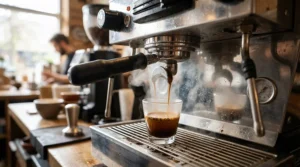
The Rancilio Silvia Pro X takes Rancilio’s decades-old Silvia platform and rebuilds it around two fully independent PID-controlled boilers — one dedicated to brewing, one to steam — so you can pull a shot and froth milk at the exact same time with zero temperature compromise on either side.
Key specs include a 0.3L brass brew boiler, a 1L stainless steam boiler, a built-in pressure gauge showing real-time brew pressure, and a “Variable Soft Infusion” mode that gently pre-soaks the puck for up to six seconds before ramping to full pressure. In practice, that pressure gauge is a genuine diagnostic tool: it lets you see immediately whether your grind, dose, or tamp needs adjusting instead of guessing from taste alone.
What the spec sheet won’t spell out is what dual independent boilers mean for a busy household: no more choosing between “wait for steam to be ready” and “wait for the boiler to cool back down after steaming.” For two-or-more-lattes-a-morning households, this single architectural choice is the biggest quality-of-life upgrade over every heat-exchanger machine on this list, including the MaraX.
Aggregated reviewer sentiment across major retailers sits consistently in the mid-to-high 4-star range, with owners frequently citing the pressure gauge and dual-PID stability as the reasons they’d buy it again; a recurring critique involves the still-manual dosing requiring a scale for repeatable results.
Pros:
- ✅ Fully independent brew and steam boilers
- ✅ Built-in pressure gauge for real-time diagnostics
- ✅ Variable soft pre-infusion reduces channeling
Cons:
- ❌ Manual dosing means a scale is essentially required
- ❌ Premium price puts it out of casual-buyer territory
Running roughly $1,900-$2,200, the Rancilio Silvia Pro X is the pick for anyone whose household coffee habit genuinely justifies simultaneous dual-boiler performance.
7. Ascaso Steel DUO Plus — volumetric dosing meets dual thermoblocks
The Ascaso Steel DUO Plus stands apart from every other machine here by pairing dual PID-controlled thermoblocks with volumetric dosing electronics, letting you program exact shot volumes instead of eyeballing extraction by time.
Its spec sheet includes a 58mm competition shower screen for more even water distribution, an adjustable OPV for pump pressure, a joystick steam valve, a hot-water tap, and a full stainless-steel body handmade in Barcelona with a five-year warranty on the thermoblocks specifically. In practice, the competition shower screen matters more than it sounds — it spreads water evenly across the puck surface, which reduces the channeling that causes uneven, sour-and-bitter shots.
Based on the spec comparison with the dual-boiler Rancilio Silvia Pro X, the Ascaso trades a traditional boiler for faster-heating, more energy-efficient dual thermoblocks, while adding volumetric programmability neither the Rancilio nor the Lelit offers out of the box. That’s the kind of precision usually reserved for small commercial setups, now sitting on a home countertop.
Reviewers consistently highlight the joystick steam control as more ergonomic than a traditional knob, and Ascaso’s claim of a 25-point factory inspection process shows up repeatedly in buyer feedback as a trust signal; a common critique is that the machine requires a dedicated 20-amp circuit in some configurations, which isn’t standard in every kitchen.
Pros:
- ✅ Volumetric dosing for programmable shot size
- ✅ Competition shower screen improves extraction evenness
- ✅ Five-year thermoblock warranty
Cons:
- ❌ May require a dedicated 20-amp outlet
- ❌ Highest price point in this lineup
At approximately $2,300-$2,700, the Ascaso Steel DUO Plus is the machine for buyers who want commercial-style programmability without stepping up to a true commercial machine.
Setting Up and Dialing In Your PID-Controlled Espresso Machine
Getting a new PID-controlled espresso machine dialed in during the first 30 days is where most of the disappointment (and most of the returns) happens — not because the machines are flawed, but because people expect café results before they’ve adjusted grind, dose, and PID temperature together as one system.
Start with a fresh, filtered water fill and run at least two full tank cycles through the group head with no coffee before your first shot; this flushes manufacturing residue and lets the PID sensor read a stable, representative temperature. Next, set your grinder noticeably coarser than you’d expect for the first few shots — most people over-grind out of the box and end up chasing a “broken” machine that’s actually just choked with fines. From there, adjust in small increments: grind size first, dose second, and PID temperature setting last, changing only one variable at a time so you can actually tell what moved the needle.
A common mistake in the first month is descaling too rarely because the shots still taste fine — but mineral buildup on the PID’s temperature sensor causes drift long before it causes a bad-tasting shot, so stick to a descaling schedule based on your water hardness, not on taste. If you’re building a broader home espresso setup around one of these machines, budget for a decent scale (for dosing) and a basic tamper before you budget for a fancier portafilter; those two cheap tools do more for consistency than almost any upgrade accessory. According to the U.S. Department of Energy, small kitchen appliances left in standby or idle heating modes are a meaningful contributor to daily household energy use, so machines with eco or standby modes — several on this list, including the Ascaso Steel DUO Plus and Lelit MaraX — are worth using if you’re not pulling shots back-to-back.
Real-World Scenarios: Which PID Espresso Machine Fits Your Life
If you’re a college student or young professional making one or two coffees a day in a small apartment, the Gevi EzBru 1000C or Tuni E2 Gen3 covers the fundamentals — real PID temperature control, a proper 58mm portafilter, and a price that doesn’t compete with rent. Neither machine will win a barista competition, but both will outperform a pod machine on every metric that matters for a daily cup.
If you’re a two-income household making three or four milk-based drinks every weekday morning before work, the calculus changes entirely. The Rancilio Silvia Pro X or Tuni E2 Gen3‘s dual-boiler design stops being a luxury and starts being the feature that saves you real time, since nobody’s standing around waiting for the machine to switch modes between the third and fourth latte.
If you’re an enthusiast who reads coffee forums for fun and wants to understand the “why” behind every shot — pressure, pre-infusion, temperature — the Lelit MaraX or Ascaso Steel DUO Plus rewards that curiosity with genuine adjustability, at the cost of a steeper learning curve and a much higher price tag than a casual drinker needs.
Common Espresso Problems a PID Controller Solves
Sour, underextracted shots that taste thin. This is frequently a temperature problem disguised as a grind problem — water running too cool under-extracts the sugars responsible for body and sweetness. A stable PID loop, like the one on the Breville Bambino Plus or Gevi EzBru 1000C, removes temperature as a variable so you can isolate grind and dose instead.
Bitter, harsh shots after steaming milk. On older non-PID heat exchangers, pulling a shot right after steaming often means brewing with water that’s overheated from the steam cycle. The dual-sensor system on the Lelit MaraX and the fully separate boilers on the Rancilio Silvia Pro X both directly target this failure mode.
Inconsistent results from the exact same recipe. If your dose, grind, and tamp are genuinely identical shot to shot but the taste still varies, drift in the temperature sensor from mineral scale buildup is a common culprit — regular descaling, discussed above, is the fix.
Long wait times before the first shot of the day. The Breville Bambino Plus‘s ThermoJet system exists specifically to solve this, cutting heat-up from minutes to seconds without sacrificing the PID’s tolerance.
Overwhelm from too many adjustable settings. If a machine like the Ascaso Steel DUO Plus feels like too much control too soon, start with the factory presets and change one variable at a time — the volumetric dosing and PID temperature settings are there to be grown into, not mastered on day one.
How to Choose a PID-Controlled Espresso Machine
- Decide your daily drink volume first. A single-boiler machine like the Gevi EzBru 1000C is fine for one or two drinks a day; a household making four-plus milk drinks benefits from a dual-boiler design like the Rancilio Silvia Pro X.
- Check the portafilter size before anything else. A 58mm basket, found on the Gevi EzBru 1000C, Tuni E2 Gen3, and Lelit MaraX, gives you better heat retention and a bigger accessory ecosystem than the 54mm baskets on the two Breville machines.
- Decide whether you want an integrated grinder. The Breville Barista Express is the only machine here that grinds and brews in one unit; every other pick assumes you already own, or will buy, a separate grinder.
- Weigh heat-up time against your morning routine. If you can’t wait 10-15 minutes before coffee, the ThermoJet-equipped Breville Bambino Plus is built specifically for that constraint.
- Match boiler architecture to your milk habits. Heat exchangers like the Lelit MaraX handle occasional milk drinks well; true dual-boiler machines like the Rancilio Silvia Pro X are built for frequent, back-to-back milk drinks.
- Set a total budget, not just a machine budget. A quality grinder typically adds $150-$400 on top of any machine here except the Barista Express, so price the whole home espresso setup, not just the box with “espresso machine” printed on it.
- Read the electrical requirements before you buy. Some prosumer machines, including certain Ascaso Steel DUO Plus configurations, need a dedicated 20-amp circuit — worth confirming against your kitchen wiring before checkout.
PID vs Non-PID Espresso Machines: What Temperature Precision Actually Changes
The core mechanism behind PID temperature control is described in detail on Wikipedia’s PID controller entry: a proportional-integral-derivative loop continuously measures error against a target and adjusts output — in this case, boiler power — to correct it smoothly rather than simply switching fully on or fully off. A basic thermostat, by contrast, is a binary switch: it lets the boiler overshoot the target before shutting off, then undershoot before switching back on, creating a wide temperature swing.
| Feature | Non-PID (thermostat) machine | PID-controlled machine |
|---|---|---|
| Temperature swing | Often 10-20°F around target | Often within 1-3°F of target |
| Shot-to-shot consistency | Variable, depends on cycle timing | Highly repeatable |
| Post-steam recovery | Frequently overheats | Actively corrected |
| Typical price tier | Under $150 | $170 and up |
The table makes the practical stakes clear: a wider temperature swing on a thermostat machine means your shot quality partly depends on where in the on/off cycle you happen to pull, which is exactly the inconsistency that drives people to seek out a PID-controlled espresso machine in the first place. As the Specialty Coffee Association and independent brewing research both emphasize, extraction temperature is one of the primary variables affecting sweetness and acidity balance in the cup — meaning the temperature precision a PID buys you isn’t a marketing bullet point, it’s one of the few controllable inputs directly tied to how espresso actually tastes.
Affordable PID Espresso Machine Picks: Getting Real Features Without the Premium Price
An affordable PID espresso machine no longer means a stripped-down toy. Both the Gevi EzBru 1000C and Tuni E2 Gen3 ship with genuine PID loops, 58mm portafilters, and adjustable temperature presets — specs that would have required spending well over $500 just a few years ago. What most buyers overlook is that the biggest gap between a $200 PID machine and a $2,000 one isn’t temperature accuracy at idle; it’s how the machine behaves under real-world stress, like recovering temperature after steaming milk or holding steady across ten consecutive shots.
Budget-friendly PID temperature control has trickled down largely because NTC thermistors and basic PID chips became commodity electronics — the same underlying technology now shows up in machines a fraction of the price of the E61 heat exchangers that popularized home PID control a decade ago. The tradeoff at the affordable end tends to show up in steam power, build materials, and long-term component durability rather than in the core temperature-holding ability itself, which is genuinely solid across every machine on this list, including the cheapest ones.
Price-to-Feature Ratio: Long-Term Cost & Maintenance Across the Lineup
Price-to-feature ratio matters more than sticker price alone, because a $200 machine needing a $150 grinder and frequent descaling solution can end up costing nearly as much over three years as a $700 all-in-one like the Breville Barista Express. Factor in descaling solution (roughly $10-15 every one to three months depending on water hardness), replacement gaskets every one to two years, and the grinder most machines here don’t include, and the real total cost of ownership shifts meaningfully.
On pure price-to-feature terms, the Gevi EzBru 1000C and Tuni E2 Gen3 deliver the most PID-controlled functionality per dollar spent, while the Breville Barista Express delivers the most total functionality per dollar once you account for the built-in grinder replacing a separate purchase. The premium machines — Lelit MaraX, Rancilio Silvia Pro X, and Ascaso Steel DUO Plus — justify their price not through daily running costs, which are similar across the board, but through component longevity: brass boilers and commercial-grade grippers are generally built to outlast the thermoblocks and plastic housings common at the entry level by five to ten years.
Common Mistakes When Buying a PID-Controlled Espresso Machine
The most frequent mistake is buying the machine before pricing the grinder, then discovering the “budget” purchase actually needs another $150-300 to perform as advertised. A close second is ignoring portafilter size — a 54mm basket on the Breville Bambino Plus isn’t worse than the 58mm on the Lelit MaraX, but it does limit which aftermarket baskets and bottomless portafilters will fit down the road.
Buyers also commonly underestimate electrical requirements on prosumer machines, skip reading whether a dedicated circuit is needed, and assume any standard outlet will do. Finally, a subtle but costly mistake is skipping the first-30-days water-quality setup described earlier in this guide — using unfiltered hard water from day one accelerates scale buildup on the exact PID sensor you bought the machine for in the first place.
FAQ
❓ Does a PID espresso machine really make a taste difference?
❓ Is a PID-controlled espresso machine worth it for beginners?
❓ What temperature should a PID espresso machine be set to?
❓ Do all PID espresso machines have a 58mm portafilter?
❓ How much should I budget for a home espresso setup beyond the machine?
Conclusion
A PID-controlled espresso machine isn’t a luxury feature anymore — it’s the baseline for anyone who wants repeatable shots instead of a coin flip every morning. What’s changed dramatically over the past few years is how far down the price ladder real PID performance has traveled: the Gevi EzBru 1000C and Tuni E2 Gen3 now deliver genuine temperature stability for under $250, while machines like the Rancilio Silvia Pro X and Ascaso Steel DUO Plus push that same core technology into dual-boiler, volumetric-dosing territory for households and enthusiasts who need more.
The right pick isn’t about buying the most expensive machine on this list — it’s about matching boiler architecture, portafilter size, and price-to-feature ratio to how you actually drink coffee. A single-person apartment doesn’t need dual boilers any more than a four-latte-a-morning household needs to wait on a single thermoblock. Use the comparison table, the buyer scenarios, and the how-to-choose checklist above to land on the machine that fits your actual routine, not just your wish list.
Recommended for You
- Heat Exchange Espresso Machine: 7 Powerful Picks For 2026
- Heat Exchange Espresso Machine For Lever Operation: 7 Picks (2026)
- Heat Exchange Espresso Machine For Small Households: 7 Best 2026 Picks
Disclaimer: This article contains affiliate links. As an Amazon Associate, I earn from qualifying purchases. If you purchase products through these links, we may earn a small commission at no additional cost to you.
✨ Found this helpful? Share it with your friends! 💬🤗
