
In This Article
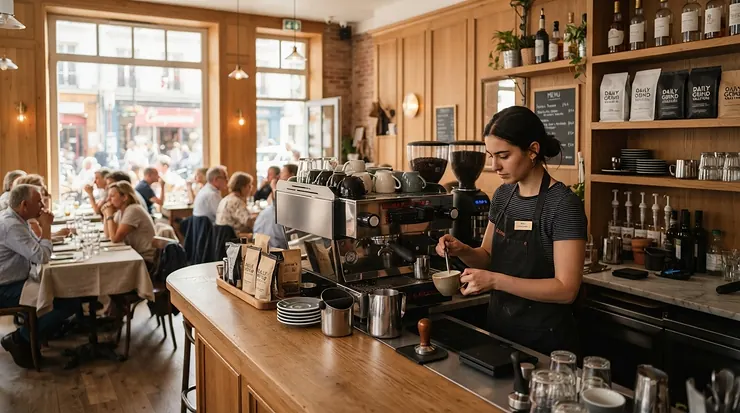
Here’s a scene that plays out in coffee shops everywhere around 8:47 on a Tuesday: the line is six deep, someone just ordered two oat milk lattes and a flat white in the same breath, and the machine behind the counter has to pull a shot and steam milk at the exact same moment without throwing a tantrum. That’s the whole job description for a dual boiler espresso machine for commercial use — one boiler locked onto brew temperature, a second boiler locked onto steam pressure, both running independently so neither task steals heat from the other. It sounds simple. It is not simple, and that’s exactly why so many shop owners get it wrong.
This guide skips the marketing fluff and gets into the specifics: seven real machines spanning true budget entry points to genuine multi-group commercial workhorses, what their spec sheets actually mean once you’re 40 drinks into a rush, and where the durability claims hold up versus where they don’t. Whether you’re outfitting a two-seat espresso bar, an office break room, or a growing café doing 300 drinks a day, you’ll find the right category here — along with the honest trade-offs nobody puts in the product photos.
What Is a Dual Boiler Espresso Machine for Commercial Use?
A dual boiler espresso machine for commercial use is a professional-grade brewer with two independently controlled boilers — one dedicated to heating brew water to roughly 195-205°F, the other generating steam at higher pressure for milk texturing. Because the boilers never compete for heat, staff can pull shots and steam milk simultaneously without waiting or sacrificing quality. As most home baristas start with single-boiler machines and quickly hit a frustrating wall, pulling a shot, waiting for the boiler to recover, then steaming, then waiting again, the commercial version of that same problem is worse: a line of customers watching the clock. That’s the practical reason dual boiler architecture became the defining standard behind specialty coffee’s most recognizable machines.
Quick Comparison Table
| Machine | Best For | Price Range |
|---|---|---|
| Rancilio Silvia Pro X | Tightest budget entry | Around $2,000-$2,300 |
| Breville Dual Boiler BES920XL | Office break rooms | Around $1,600-$1,900 |
| Izzo Alex Duetto IV Plus | Low-volume shop workhorse | Around $2,800-$3,300 |
| ECM Synchronika II | Small café, boutique feel | Around $3,500-$4,000 |
| Rocket Espresso R58 Tune | Pressure-profile control | Around $4,500-$5,500 |
| La Marzocco Linea Mini R | Compact commercial internals | Around $5,000-$8,000 |
| La Marzocco Linea PB 2 Group AV | High-volume, multi-barista | Around $17,000-$22,000 |
Look at the spread here and a pattern jumps out immediately: price climbs almost in lockstep with how many simultaneous customers the machine is built to serve, not just how “premium” it feels. The Rancilio Silvia Pro X and Breville Dual Boiler BES920XL get you real dual boiler thermal stability at single-group, low-volume prices, but neither one is rated to survive a genuine café duty cycle. Once you cross into the Izzo Alex Duetto IV Plus and ECM Synchronika II tier, you’re paying for components pulled from actual commercial lineups, and by the time you reach the La Marzocco Linea PB 2 Group AV, you’re not buying a fancier home machine — you’re buying an entirely different category of equipment built for hundreds of drinks a day.
Found a machine that fits your budget already? Bookmark this guide and keep comparing — the details below could save you a very expensive mistake.
Top 7 Commercial-Grade Dual Boiler Espresso Machines: Expert Analysis
Coverage below runs budget to high-volume commercial, with real specs, honest use-case advice, and aggregated review sentiment pulled from verified retailer and expert-review sources — never invented quotes.
1. Rancilio Silvia Pro X — cheapest true dual boiler on the market
The standout here is simple: Rancilio squeezed genuine dual boiler architecture into a price bracket that used to be reserved for heat exchangers. Under the hood sits a 300ml brass brew boiler paired with a 1-liter stainless steam boiler, each with its own PID, which in practice means you can hold a rock-steady brew temperature while the steam side runs its own independent program. That matters more than it sounds — most machines this cheap force you to compromise one function to protect the other.
Based on the spec comparison against similarly priced heat exchangers, the Pro X’s dual-PID setup gives it a real edge in shot-to-shot consistency during back-to-back orders, which is exactly the scenario a small office kitchen or two-person espresso cart runs into daily. Reviewers consistently report that the steam wand punches well above the machine’s price class, with one long-term test finding it heated a shot of milk to proper texturing temperature in about 15 seconds.
This is a machine built for someone stepping up from a prosumer single-boiler unit who needs commercial-adjacent thermal stability without commercial-adjacent spending — not a heavy multi-barista bar.
Pros:
- ✅ Genuine dual PID control at an unusually low price point
- ✅ Strong, fast steam recovery for a single-group machine
- ✅ Commercial-derived RS1 portafilter improves grip and ergonomics
Cons:
- ❌ Single group limits it to low-volume, single-barista service
- ❌ Not rated for sustained high-volume café duty cycles
Expect this one around $2,000-$2,300 — for the thermal stability it delivers, that’s genuinely strong value for a low-volume setup.
2. Breville Dual Boiler BES920XL — most accessible for office break rooms
What most buyers overlook about the BES920XL is that it was never designed to compete with Italian or German prosumer machines on build longevity — it was designed to make dual boiler performance approachable, and on that goal it delivers. The dual boiler system heats up in roughly 5 to 15 minutes depending on which boiler you’re prioritizing, and the 2.5-liter reservoir means fewer refill trips during a busy office morning rush.
Here’s what to weigh: the electronics and PID-style temperature management are genuinely capable, giving you simultaneous brew-and-steam functionality that plenty of pricier machines can’t match feature-for-feature. Aggregated review sentiment across major retailers consistently flags this as an easy machine to hand to less-experienced staff, since the guided workflow doesn’t demand barista-level technique.
The trade-off is componentry — this is a machine built from consumer-grade parts wearing commercial-style clothing, so it suits an office kitchen making 20-40 drinks a day far better than a walk-up café.
Pros:
- ✅ Fastest, most beginner-friendly workflow on this list
- ✅ Genuine simultaneous brew-and-steam dual boiler function
- ✅ Lowest price point for real dual boiler architecture
Cons:
- ❌ Componentry not built for sustained commercial duty cycles
- ❌ Shorter expected service life than Italian or German alternatives
Typically listed around $1,600-$1,900, this is the office espresso machine dual boiler pick for teams that want café-quality drinks without café-level investment.
3. Izzo Alex Duetto IV Plus — most commercial-capable prosumer workhorse
The Duetto IV Plus is the machine that keeps showing up in the “quietly excellent” conversation, and the standout feature is right there in the spec sheet: a professional E61 group head paired with dual copper boilers built with brass end plates, the same combination Izzo uses on its actual commercial line in Milan. Copper holds heat more efficiently than stainless steel, so the practical result is a heat-up time around 20 minutes rather than 30-plus, and quicker recovery between back-to-back drinks.
On paper this means a shop pulling steady but modest volume — a bakery counter, a small breakfast spot — can run this machine all morning without the thermal drift that plagues cheaper heat exchangers. Reviewers consistently describe the build quality as “commercial-capable,” and Izzo’s own engineering changes (reinforced front panel, relocated motor, accessible pump adjustment) were specifically aimed at reducing long-term repair costs.
What most buyers overlook, though, is that this still isn’t rated for a genuine multi-barista bar — it’s a single-group machine, so throughput has a hard ceiling no matter how well-built the internals are.
Pros:
- ✅ Commercial E61 group head with copper dual boilers
- ✅ Engineering changes specifically targeting long-term reliability
- ✅ Fast heat-up and recovery relative to its price tier
Cons:
- ❌ Single group caps throughput for genuinely busy service
- ❌ Heavier and larger footprint than most home-tier machines
Prices commonly land around $2,800-$3,300, a fair ask for dual-boiler equipment this close to true commercial spec.
4. ECM Synchronika II — best German engineering for a small café
What stands out immediately is the heat-up time: 6.5 minutes, achieved through cartridge heaters built directly into the E61 group, which is unusually fast for an E61-based machine and matters a lot on mornings when the shop opens late. The dual boiler configuration pairs a 0.75-liter brew boiler with a 2-liter steam boiler and a 2.8-liter reservoir, and the rotary pump can be plumbed directly into a water line for uninterrupted service.
Based on the spec comparison against other E61 dual boilers in this price tier, the Synchronika II’s OLED PID interface is genuinely more intuitive, consolidating temperature offsets, pre-infusion modes, and scheduling into one menu instead of scattered dip switches. Reviewers and retailers alike position this as suitable for light commercial use — specifically small cafés or offices serving up to roughly 50 cups a day — while cautioning that sustained back-to-back service beyond that volume calls for a machine built around a true commercial duty cycle instead.
That’s an honest limit worth internalizing before you buy: gorgeous engineering doesn’t automatically mean unlimited throughput.
Pros:
- ✅ Fastest heat-up time among E61 dual boilers in its class
- ✅ Centralized OLED menu simplifies scheduling and PID control
- ✅ Plumb-in ready for continuous water supply
Cons:
- ❌ Rated for light commercial use, not sustained high-volume runs
- ❌ Optional flow control adds meaningfully to the total price
Expect a range around $3,500-$4,000 — a legitimate small café equipment pick if your daily volume stays moderate.
5. Rocket Espresso R58 Tune — most control for craft-focused shops
The Tune Programming feature is what separates this machine from the rest of the Rocket lineup, and it’s a genuinely useful standout: baristas can program three-bar pre-infusion and post-infusion pressures directly through a detachable color touchscreen PID, rather than eyeballing extraction by feel. The dual boiler setup — a 0.58-liter brew boiler alongside a 1.8-liter steam boiler — means simultaneous brewing and steaming without the temperature drop that plagues lesser machines.
Here’s what to weigh: this is a single-group machine engineered for craft-focused boutique cafés and specialty bars that prioritize extraction quality over raw throughput, not a high-volume production tool. Reviewers who tested the pressure-profiling functions found the programmable pre/post-infusion pressures gave meaningfully more control over extraction than a stock E61 machine offers out of the box.
The rotary pump configuration supports either direct plumbing or reservoir operation, and the 120V setup is a practical plus for U.S. shops without 240V service already run. The stainless build is heavy enough that most installers recommend two people and a sturdy counter for setup.
Pros:
- ✅ Programmable pre- and post-infusion pressure profiling
- ✅ Detachable touchscreen PID simplifies temperature adjustments
- ✅ 120V operation avoids costly electrical upgrades for many shops
Cons:
- ❌ Single group limits it to boutique, lower-volume service
- ❌ Heavy stainless build complicates delivery and installation
Typically priced around $4,500-$5,500, this suits owners who obsess over extraction profiles more than they obsess over ticket speed.
6. La Marzocco Linea Mini R — most commercial DNA in a compact shell
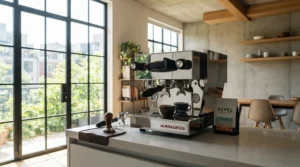
This is the machine people mean when they say “the same one your favorite café uses, just smaller.” The Linea Mini R shares its saturated group head, dual boiler architecture, and PID-controlled temperature stability directly with the Linea Classic, the commercial workhorse that helped establish La Marzocco as the specialty coffee standard.
A 0.75-liter brew boiler and a genuinely oversized 3-liter steam boiler mean zero recovery time between drinks — you can pull a double shot and texture milk simultaneously without either function stealing heat from the other. Based on the spec comparison, that saturated group head is the real differentiator: it holds temperature more consistently than the thermosiphon-based E61 groups used on several machines above it in price.
What most buyers overlook is that this consistency translates directly into flavor — reviewers describe the shots as tasting indistinguishable from a full-size commercial La Marzocco, because the internal architecture genuinely is the same, just scaled down. It’s compatible with standard 58mm commercial accessories, scales, and baskets, and fits small cafés, bakeries, and coffee carts needing commercial reliability in a tight footprint.
Pros:
- ✅ Saturated group head shared with full-size commercial machines
- ✅ Oversized 3L steam boiler eliminates recovery lag entirely
- ✅ Accepts standard 58mm commercial accessories and baskets
Cons:
- ❌ Single group still limits it against genuine multi-barista volume
- ❌ Premium pricing puts it out of reach for tight startup budgets
Commonly listed in the $5,000-$8,000 range, and for shops that want commercial-grade internals without a commercial-sized machine, this is the clearest option on the list.
7. La Marzocco Linea PB 2 Group AV — built for genuine high-volume brewing
Everything about this machine is scaled for one purpose: keeping two baristas working simultaneously without either one waiting on the other. The dual boiler system runs independent, PID-controlled brew and steam circuits per the manufacturer’s specification, and the saturated group heads maintain thermal stability “from the first shot to the five-hundredth” — a claim that matters enormously once you’re doing actual volume.
Auto-volumetric dosing lets owners program shot buttons per group, so consistency doesn’t depend on which barista is on shift, which is a genuine advantage during staff turnover. Industry guidance consistently places a 2-group configuration like this one as suitable for specialty cafés and restaurants serving 150 to 300 drinks daily — a volume tier that would grind a single-group prosumer machine into an early grave.
What most buyers overlook when they first see the price tag is the math on total cost per drink: spread across hundreds of daily transactions over a decade of service life, the premium narrows considerably compared to replacing a cheaper machine every few years.
Pros:
- ✅ Two independent groups sustain genuine high-volume brewing
- ✅ Auto-volumetric dosing standardizes quality across shifts
- ✅ Commercial-grade duty cycle built for years of daily service
Cons:
- ❌ Substantial upfront investment and professional installation required
- ❌ Overkill footprint and cost for anything under roughly 100 drinks daily
Typically running $17,000-$22,000 for two groups, this is the category owners step into once volume — not preference — makes the decision for them.
Practical Usage Guide: Setup, Break-In & Maintenance
Getting a commercial-grade dual boiler espresso machine wrong usually happens in the first 30 days, not the first year. Start with water: hard water is the single fastest way to shorten a boiler’s life, so install a dedicated filtration or reverse osmosis system before the first shot, not after scale buildup shows up on a service call. During break-in, run the machine through several warm-up cycles without pulling shots — most dual boilers need 15 to 30 minutes to fully stabilize both boilers, and skipping that step produces inconsistent early shots that owners sometimes wrongly blame on the machine itself. Backflushing daily with a proper cleaning powder keeps the group head free of coffee oils that otherwise bake onto gaskets and degrade seals faster than normal wear would. A common first-month mistake is neglecting steam wand purging between drinks — milk residue left to dry inside the tip is one of the quickest ways to choke steam pressure and force an early service visit. Finally, log your descaling schedule based on your water hardness rather than a generic calendar reminder; a machine running hard well water needs attention far sooner than one on a filtered municipal line.
Real-World Scenarios: Which Machine Fits Your Business
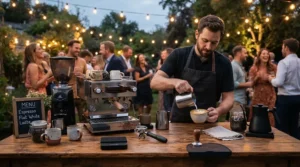
Picture three very different mornings. First, a two-person marketing agency wants better coffee than a pod machine without hiring a barista — the Breville Dual Boiler BES920XL or Rancilio Silvia Pro X covers that need at a fraction of café-level spending, since daily volume rarely tops 30 drinks. Second, a bakery owner doing steady but not overwhelming counter service, maybe 60-90 drinks across a morning rush, needs something that won’t fall over by 10 a.m.; that’s exactly the lane the Izzo Alex Duetto IV Plus or ECM Synchronika II occupies, with commercial-grade components sized for one hardworking barista. Third, a growing specialty café doing 200-plus drinks a day with two staff working the bar simultaneously has genuinely outgrown single-group machines entirely — that’s a La Marzocco Linea PB 2 Group AV situation, where the cost of downtime during a rush far outweighs the higher upfront price. Matching the machine to the actual ticket count, not the aspirational one, is the single biggest factor separating owners who love their equipment from owners who resent it within a year.
Buyer’s Decision Framework
If you’re serving fewer than 40 drinks a day with one person behind the counter, choose a single-group entry dual boiler because sustained multi-barista throughput would be wasted capacity you’re paying for and never using. If you’re running 50-150 drinks daily with one skilled barista, choose a prosumer-to-light-commercial single group because you need commercial-grade thermal recovery without the footprint or cost of a multi-group unit. If you’re doing 150 drinks or more with two or more staff working simultaneously, choose a genuine multi-group commercial machine because a single group physically cannot keep two baristas moving without one waiting on the other. And if uptime during service is non-negotiable — a hospital café, an airport kiosk — prioritize service network and parts availability over raw spec sheet numbers, because the best machine on paper is worthless during a three-day repair wait.
How to Choose a Commercial-Grade Dual Boiler Espresso Machine
- Match capacity to real daily volume, not your five-year growth projection — buying for volume you don’t have yet just means overpaying today.
- Check group head type. Saturated groups hold temperature more precisely than thermosiphon E61 designs, which matters more as volume climbs.
- Confirm voltage and plumbing requirements early — a 240V, hardwired machine can add thousands in electrical work most owners don’t budget for upfront.
- Prioritize water filtration compatibility, since water hardness protocols directly affect boiler longevity regardless of how well-built the machine is.
- Weigh service network availability in your region — a stunning machine with no local technician is a liability during a busy season.
- Compare boiler capacity, not just wattage, since a larger steam boiler recovers faster during back-to-back milk drinks.
- Read aggregated owner reviews for maintenance patterns, not just initial impressions, since long-term reliability rarely shows up in a first-week review.
Office Espresso Machine Dual Boiler: Is It Right for Your Workplace?
An office espresso machine dual boiler setup sits in an odd middle ground — most workplaces don’t need commercial-grade throughput, but a decent single-serve pod machine leaves a lot of coffee lovers unimpressed. The sweet spot tends to be a single-group dual boiler like the Breville Dual Boiler BES920XL or Rancilio Silvia Pro X, both of which deliver genuine simultaneous brew-and-steam performance without demanding a trained barista on staff. What most facilities managers overlook is water quality planning: office buildings often run on harder municipal water than a filtered café setup, so a basic inline filter becomes non-negotiable rather than optional. The other overlooked factor is training — even an intuitive machine benefits from a 15-minute onboarding session for whoever ends up as the unofficial office barista, since improper tamping or a dirty steam wand will make any machine look worse than it actually is. For companies weighing the investment, the math is straightforward: a $1,800 machine amortized over three years of daily use costs less per cup than a mid-tier coffee subscription service, while noticeably improving the office coffee experience.
Commercial Dual Boiler vs Heat Exchange Machines
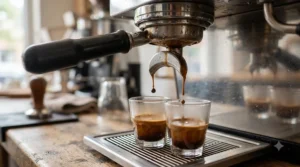
The comparison that trips up more first-time buyers than any other is dual boiler versus heat exchanger, and the difference comes down to one design choice: heat exchangers pull brew water through a pipe that runs inside the single steam boiler, while dual boilers use two fully separate, independently controlled boilers.
| Factor | Dual Boiler | Heat Exchanger |
|---|---|---|
| Simultaneous brew + steam | Full independent control | Possible, but with slight temperature drift |
| Temperature stability | Excellent, PID per boiler | Good, but shot-to-shot fluctuation more common |
| Typical price | Higher | Generally lower |
| Best For | Small café equipment and multi-barista bars | Budget-conscious startups and lower-volume counters |
Looking at the table above, dual boiler machines like the ECM Synchronika II or La Marzocco Linea Mini R justify their premium mainly through consistency under pressure — the kind of stability that matters when a barista is slammed and can’t babysit temperature drift shot by shot. Heat exchangers remain a completely legitimate choice for lower-volume operations where the price difference matters more than shaving a few degrees of thermal variance. The honest takeaway is that neither design is objectively “better” — the right choice depends entirely on how many drinks you’re pulling and how much temperature precision your menu actually demands.
Common Mistakes When Buying a Commercial Dual Boiler Espresso Machine
The most expensive mistake owners make is buying based on brand prestige rather than actual daily ticket count, ending up with a $20,000 multi-group machine running at 15% of its capacity — money that could have funded a grinder upgrade or staff training instead. A close second is skipping water filtration planning entirely; scale buildup inside an unfiltered boiler is one of the few problems that voids manufacturer warranties outright, and it’s entirely preventable. Owners also frequently underestimate voltage requirements, discovering mid-installation that their space needs an electrician before the machine can even power on. Another recurring issue involves NSF and local health code certification — commercial kitchens generally require NSF-certified equipment for health inspections, and buying an uncertified prosumer machine for a licensed commercial space can create compliance headaches down the line. Finally, plenty of buyers skip a service contract or local technician relationship entirely, only to discover during their first breakdown that the closest qualified repair tech is three states away.
Durability Under Heavy Use: Problems & Solutions
Problem: Inconsistent shot temperature during rushes. This usually traces back to insufficient boiler recovery time or a machine simply undersized for the volume it’s running — the fix is either upgrading boiler capacity or, more often, admitting the machine has outgrown the shop. Problem: Steam wand losing pressure over time. Mineral buildup inside the wand tip is the usual culprit, and daily purging plus scheduled descaling based on water hardness solves it before it becomes a service call. Problem: Group head seals wearing prematurely. Skipped backflushing lets coffee oils bake onto gaskets; a consistent daily cleaning routine extends seal life dramatically. Problem: Unexpected downtime during peak hours. This almost always traces back to deferred maintenance rather than manufacturing defects — machines maintained on a strict schedule rarely fail without warning signs first. Problem: Water quality complaints affecting flavor. Nine times out of ten this is a filtration issue upstream of the machine entirely, not a flaw in the espresso equipment itself.
Long-Term Cost & Maintenance
The sticker price is only the opening bid in what a commercial dual boiler espresso machine actually costs over its service life. Filtration cartridges, routine descaling, gasket replacement, and periodic professional servicing add up to a meaningful annual figure that owners frequently forget to budget for during the initial purchase decision. Energy consumption matters too, especially on machines left running through slow afternoon hours — commercial food service equipment efficiency standards exist precisely because idle heating costs accumulate faster than most owners expect across a full year.
| Cost Category | Single-Group Dual Boiler | Multi-Group Commercial |
|---|---|---|
| Annual maintenance | Roughly $200-$500 | Roughly $600-$1,200 |
| Expected service life | 8-12 years with care | 12-20+ years with care |
| Best For | Lower daily volume operations | High-volume brewing environments |
The math above tells an important story: a multi-group commercial machine costs more to maintain annually, but its longer service life and higher throughput capacity often produce a lower true cost per drink over a decade than repeatedly replacing an undersized machine that’s been pushed past its design limits.
High-Volume Brewing: What to Expect in Real-World Performance
Spec sheets describe potential; actual service reveals what a machine is really built for. In genuine high-volume brewing conditions — sustained rushes, back-to-back milk drinks, multiple baristas working simultaneously — the gap between a single-group prosumer machine and a true multi-group commercial unit becomes obvious within the first busy week. A single-group dual boiler, even an excellent one like the La Marzocco Linea Mini R, will start showing recovery lag once ticket volume consistently exceeds what one group head can physically cycle through. A properly sized multi-group machine like the La Marzocco Linea PB 2 Group AV, by contrast, is engineered specifically so that thermal stability holds steady from the first shot of the morning through the five-hundredth shot of a brutal Saturday. The practical lesson for owners is that “rated for commercial use” and “rated for your specific volume” are two very different claims, and confusing them is how otherwise excellent machines end up limping through rushes they were never sized to handle.
Small Café Equipment: Features That Actually Matter (And Those That Don’t)
Marketing copy loves to highlight flashy touchscreens and app connectivity, but for small café equipment, a handful of unglamorous features matter far more to daily operations. Boiler capacity and PID precision genuinely matter, since they determine whether your third latte in five minutes tastes the same as your first. Plumb-in capability genuinely matters too, eliminating the operational drag of constantly refilling a reservoir during a rush. What matters far less than marketing suggests is raw wattage — a bigger number doesn’t automatically mean faster recovery if boiler capacity and insulation aren’t equally strong. Aesthetic finish options are lovely but functionally irrelevant to how a shot tastes, and app connectivity, while convenient for remote monitoring, has never once rescued a machine from a genuinely undersized boiler. Focus the budget on thermal architecture first, appearance a distant second.
Frequently Asked Questions
❓ Can a dual boiler espresso machine handle a busy coffee shop?
❓ How much does a commercial dual boiler espresso machine cost?
❓ What's the difference between a dual boiler and a heat exchanger machine?
❓ Is a dual boiler espresso machine worth it for a small office?
❓ How long do commercial dual boiler espresso machines last?
Conclusion
Choosing the right dual boiler espresso machine for commercial use really comes down to one honest question: how many drinks are you actually pulling, today, not in some hoped-for future? The Rancilio Silvia Pro X and Breville Dual Boiler BES920XL cover low-volume needs affordably; the Izzo Alex Duetto IV Plus and ECM Synchronika II bridge into serious single-barista commercial territory; the Rocket Espresso R58 Tune and La Marzocco Linea Mini R deliver craft-level control and commercial DNA in compact footprints; and the La Marzocco Linea PB 2 Group AV exists for the moment your ticket count makes a multi-group machine not a luxury but a necessity. None of these machines are inherently “best” — they’re each correct for a specific volume and budget reality, and matching yours honestly is worth more than any spec sheet comparison. Whichever tier fits, prioritize water filtration and a maintenance routine from day one; even the finest boiler in the world can’t outrun neglect. Do that, and any machine on this list will reward you with years of consistent, genuinely café-quality espresso.
Recommended for You
- 7 Best Compact Dual Boiler Espresso Machines for Apartments (2026)
- Dual Boiler Espresso Machine for Milk Steaming: 7 Best Picks (2026)
- Dual Boiler Espresso Machine for Home Baristas: 7 Picks (2026)
Disclaimer: This article contains affiliate links. As an Amazon Associate, I earn from qualifying purchases. If you purchase products through these links, we may earn a small commission at no additional cost to you.
✨ Found this helpful? Share it with your friends! 💬🤗
