In This Article
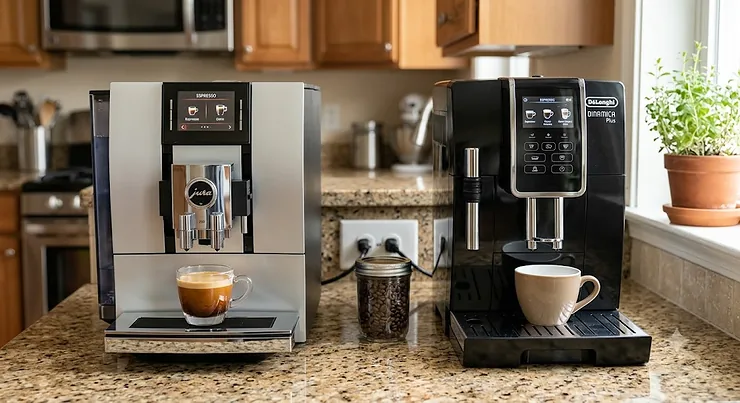
Somewhere around your third week of $6 oat-milk lattes, the math starts to feel personal. That’s usually the moment jura vs delonghi super automatic espresso machine searches spike, and for good reason — these two brands own the countertop bean-to-cup category more thoroughly than almost any other rivalry in small appliances. A super automatic espresso machine is a bean-to-cup device that grinds, doses, tamps, brews, and often froths milk with a single button press, requiring none of the manual technique a traditional espresso machine demands. Jura, the Swiss engineering house, builds toward quiet precision and long-haul durability. DeLonghi, the Italian volume leader, builds toward drink variety and accessible pricing. Neither approach is objectively “correct,” which is exactly why this comparison keeps getting more complicated the deeper you look.
Espresso as a brewing method traces back to Italian inventors experimenting with steam-driven extraction in the late 1800s, and that lineage still shapes how DeLonghi designs machines today — fast, flavor-forward, unapologetically Italian. Jura took a different road, applying Swiss watchmaking-adjacent precision engineering to the same basic problem starting in the 1980s. Both philosophies now compete for the same kitchen counter, and the “better” brand genuinely depends on your household’s coffee habits, not on marketing copy.
This guide breaks down seven real, currently-available machines spanning budget, mid-range, and premium tiers from both brands. You’ll get honest spec interpretation, aggregated review sentiment, side-by-side comparisons, and practical buying frameworks — not a rewritten spec sheet. Every price mentioned is a range, since actual Amazon and retailer pricing shifts weekly; always check current pricing before you buy. Affiliate disclosure: this article contains affiliate links, and we may earn a commission on qualifying purchases at no additional cost to you.
Quick Comparison: Jura vs Delonghi Super Automatic at a Glance
Before diving into full reviews, here’s the fast version for readers comparing a jura vs delonghi super automatic purchase side by side.
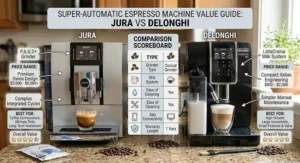
| Machine | Brand | Price Range | Grinder | Best For |
|---|---|---|---|---|
| DeLonghi Magnifica Evo | DeLonghi | $650–$900 | Steel conical, 13 settings | Budget buyers who still want milk automation |
| Jura A1 | Jura | $1,050–$1,300 | Aroma G3 | Espresso purists who skip milk entirely |
| DeLonghi Dinamica Plus | DeLonghi | $1,300–$1,650 | Steel conical, 13 settings | Multi-user households wanting profiles |
| Jura ENA 8 | Jura | $1,700–$2,000 | Aroma G3 | Tight counters that still want fine foam |
| DeLonghi Eletta Explore | DeLonghi | $1,200–$1,700 | Conical, 13 settings | Iced coffee and cold brew fans |
| Jura E8 | Jura | $1,999–$2,599 | Aroma G3 / P.A.G. | The all-around Swiss sweet spot |
| Jura Z10 | Jura | $3,299–$4,499 | P.R.G. adaptive | Buyers who want true cold extraction |
Looking at this lineup, the split is intuitive once you see it laid out: DeLonghi wins on entry-to-mid pricing and drink-menu breadth, while Jura wins on grinder sophistication and long-service reputation at every tier it competes in. The Magnifica Evo and Jura A1 effectively define the two brands’ philosophies in miniature — one prioritizes milk-drink accessibility on a budget, the other prioritizes pure espresso quality with almost nothing else. If you’re deciding between a jura vs delonghi which is better question in the abstract, the honest answer is that it collapses into “which of these seven machines matches my actual coffee habits,” which is what the rest of this guide is built to answer.
☕ Ready to compare prices? Check current availability on the models above before they sell out of your preferred color.
Top 7 Jura and Delonghi Super Automatic Espresso Machines: Expert Analysis
1. DeLonghi Magnifica Evo — best budget entry into automatic milk drinks
The DeLonghi Magnifica Evo proves you don’t need to spend four figures to get a genuinely automated milk workflow, and that alone makes it the most-searched budget super automatic on the market right now. Its steel conical burr grinder offers 13 grind settings, and reviewers note it warms up in roughly 80 seconds from cold — fast enough that “one more minute” excuses evaporate before your first sip. Based on the spec comparison, the LatteCrema automatic frother is the real differentiator here: at this price point, most competitors still hand you a manual steam wand and expect you to practice.
Who should care: anyone setting up their first bean-to-cup machine, renters who don’t want to commit thousands to a kitchen appliance, or households where one person wants lattes and nobody wants to learn latte art. Independent testing describes the Evo as sitting above entry Magnifica models in milk convenience and daily usability, while staying below the pricier Magnifica Plus in screen size and recipe count — in plain terms, it’s the practical middle child of DeLonghi’s budget tier, not the cheapest possible option.
Reviewers consistently report that the Evo’s thermoblock heating supports quick back-to-back drinks without the boiler-wait delay some steam-boiler machines impose, and multiple sources highlight the grinder’s stepped adjustability as unusually generous for the price. A common complaint centers on the plastic-forward build feeling less premium than Jura’s metal-heavy construction, though nobody disputes that the coffee quality punches above its price class.
Pros:
- ✅ Automatic milk frother rare at this price tier
- ✅ Fast thermoblock heat-up under 90 seconds
- ✅ 13-setting grinder allows real extraction tuning
Cons:
- ❌ Plastic-heavy build feels less premium
- ❌ Only 7 one-touch drink presets total
Typically priced in the $650–$900 range, the Magnifica Evo represents the strongest dollar-for-dollar entry point in this whole comparison — check current pricing since it occasionally dips further during retailer promotions.
2. Jura A1 — most minimalist Swiss espresso purist’s choice
The Jura A1 strips the super automatic concept down to its studs: no milk frother, no touchscreen, just Jura’s Aroma G3 grinder and Pulse Extraction Process aimed squarely at people who drink espresso, ristretto, and long coffee and nothing else. What most buyers overlook about this model is that removing the milk system isn’t a compromise for its target user — it’s the entire point, since fewer moving parts historically means fewer failure modes over a decade of daily use.
Key specs translate into real behavior quickly: the P.E.P. pre-infusion process pulses water through the puck before full extraction, producing noticeably thicker crema than single-pass brewing, and the compact bean hopper and water tank keep the footprint smaller than almost anything else in Jura’s lineup. Reviewers note the symbol-only display (no full color screen) as the machine’s most polarizing choice — some appreciate the simplicity, others find it a strange omission at this price versus DeLonghi’s touch interfaces.
Aggregated review sentiment is split roughly down the middle. Reviewers consistently praise its quiet grinding and consistent shot quality, while a recurring theme in critical reviews is that the A1 costs meaningfully more than similarly specced machines from other brands, with the premium justified mainly by Jura’s build reputation and Swiss engineering pedigree rather than any single standout feature.
Pros:
- ✅ Thick, consistent crema via P.E.P. pre-infusion
- ✅ Genuinely compact footprint for tight kitchens
- ✅ Quiet grinder even at fine settings
Cons:
- ❌ No milk frothing system included at all
- ❌ Symbol-only display feels dated for the price
Priced around $1,050–$1,300, the A1 only makes sense if milk drinks are truly off your daily menu — otherwise your money stretches further elsewhere in this list.
3. DeLonghi Dinamica Plus — best all-rounder for multi-person households
The DeLonghi Dinamica Plus is the machine that made “Jura-esque features at DeLonghi pricing” a real marketing claim, and on paper it mostly delivers. Its 3.5-inch full-color touchscreen anchors a menu of 16 one-touch specialty drinks, and the Smart-One-Touch feature learns which drinks each household member selects most, surfacing favorites first — genuinely useful in a two-or-more-person kitchen.
In extended testing, a grind setting of 5 and strength setting of 4 produced a shot testers rated around 7.5 out of 10, with amber crema and a 40-plus-second hold time — solid, if not flagship-tier, espresso quality. Here’s what to weigh: the standout feature isn’t raw shot quality but the three-profile system, which lets each household member save their own drink, grind, strength, and milk texture preferences and recall them with one tap. For a household negotiating over the “right” cappuccino recipe every morning, that’s worth more than a marginal espresso-quality bump.
Reviewers note the TrueBrew Over Ice function as a genuine value-add for iced coffee season, brewing at reduced temperature and pressure specifically so ice doesn’t dilute the drink into weak, lukewarm coffee. A common complaint in user reviews is that the plastic-dominant exterior undercuts the premium feel the touchscreen and profile system otherwise suggest.
Pros:
- ✅ Three saved user profiles for shared households
- ✅ TrueBrew Over Ice avoids diluted iced coffee
- ✅ Full-color touchscreen with app connectivity
Cons:
- ❌ Exterior build feels less premium than the tech inside
- ❌ Frequent auto-rinse cycles use noticeable water
Typically running $1,300–$1,650, with occasional promotional pricing closer to $1,100, the Dinamica Plus earns its spot as the strongest multi-user value pick in the DeLonghi lineup.
4. Jura ENA 8 — most compact fine-foam machine in Jura’s range
The Jura ENA 8 exists to solve one specific counter-space problem: you want Jura’s HP3 fine-foam milk technology, but the larger E8 simply won’t fit your kitchen. Aggregated review sentiment on this one is genuinely divided in a way worth flagging honestly rather than smoothing over.
The compact form factor (roughly 19 x 25 x 34 centimeters) is real and meaningful for small-kitchen buyers, and the Aroma G3 grinder carries over Jura’s reputation for quiet, consistent grinding. Based on the spec comparison, the touchscreen upgrade to 2.8 inches and the added two-cup function address two of the most common complaints about older Jura compact models. What most buyers overlook is that the milk system here offers only a single foam texture rather than the dual hot/cold or multi-density options found on pricier machines — fine for lattes and cappuccinos, limiting if you want precise foam control across drink types.
Here’s the honest tension in the review landscape: some reviewers call the ENA 8 overpriced relative to the nearly-identical Jura E6, arguing the compact footprint doesn’t justify a meaningful price premium, while others frame it as the correct buy specifically when counter space is the binding constraint. Both positions are defensible — this is a machine you buy for its dimensions, not despite them.
Pros:
- ✅ Genuinely tiny footprint without losing HP3 foam
- ✅ Quiet Aroma G3 grinder, Jura’s proven workhorse
- ✅ New two-cup function speeds up multi-drink mornings
Cons:
- ❌ Single milk texture limits drink versatility
- ❌ Priced close to the larger, more capable E8
Priced around $1,700–$2,000, the ENA 8 is a measure-your-counter-first purchase — if the larger E8 physically fits your kitchen, it typically delivers more machine for similar money.
5. DeLonghi Eletta Explore — best for cold brew and iced drink variety
The DeLonghi Eletta Explore was the first DeLonghi super automatic to introduce genuine Cold Extraction Technology, and reviewers treat that feature as a real innovation rather than a marketing footnote. The system runs room-temperature water through the grounds at low pressure specifically to produce cold brew in under three minutes, rather than simply brewing hot and dumping the result over ice — the difference shows up clearly in flavor, since heat-then-cool brewing tends to dilute and flatten what should be a bright, low-acid cup.
Key specs interpret well in practice: the 13-setting conical burr grinder pairs with DeLonghi’s Bean Adapt Technology, which automatically adjusts dosing based on the bean variety loaded into the hopper — a genuinely useful automation layer for households that rotate between light and dark roasts. The dual LatteCrema Hot and Cool systems mean hot lattes and iced lattes both get proper milk texturing rather than one drink type feeling like an afterthought, and the recipe menu spans more than 50 preset drinks.
Testing that directly compared the Eletta Explore against the Magnifica Evo describes the Explore as the larger, more feature-rich machine built for enthusiasts who enjoy technology and flexibility, while the Evo targets simplicity and value instead — that framing holds up well across most independent reviews. A recurring theme in aggregated feedback is that Jura’s E8 edges ahead specifically on long-term reliability data and authorized-service coverage, even though the Eletta Explore wins outright on price and cold-drink versatility.
Pros:
- ✅ Genuine cold brew extraction, not just iced hot coffee
- ✅ Bean Adapt Technology tunes dosing automatically
- ✅ Over 50 one-touch hot and cold recipes
Cons:
- ❌ Larger footprint than most DeLonghi competitors
- ❌ Service network less extensive than Jura’s
Priced roughly $1,200–$1,700 depending on retailer and bundle, the Eletta Explore is the clearest pick for anyone whose coffee habit skews toward iced and cold drinks for a meaningful part of the year.
6. Jura E8 — the Swiss sweet spot for most households
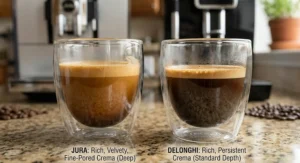
The Jura E8 shows up in more “best super automatic” roundups than almost any other single machine, and the reasoning holds together under scrutiny. Its Aroma G3 grinder (upgraded to the Professional Aroma Grinder, P.A.G., on the newest revisions) grinds roughly twice as fast as conventional burr setups while staying meaningfully quieter, and the Pulse Extraction Process fires water through the coffee bed in pulses rather than one continuous stream — the practical result is thicker crema and fuller body than single-pass extraction typically produces.
The 17-specialty menu covers the realistic range of what most households actually drink — espresso, ristretto, cappuccino, flat white, latte macchiato — without padding the number with redundant variations the way some spec sheets do. What most buyers overlook is the Fine Foam Frother’s adjustable dial, which lets you dial milk density up or down before or during brewing, making the line between a cappuccino and a latte macchiato a genuine one-touch adjustment rather than a guessing game.
Reviewers who have tracked the E8 across its generational updates describe it as one of the safest, highest-confidence choices in its price range, combining espresso quality, milk versatility, and daily practicality better than nearly anything else in its bracket. Reviewers consistently note that Jura’s automated maintenance prompts and descaling cycles genuinely extend usable machine life, which matters given how much more this machine costs upfront than the DeLonghi options above it.
Pros:
- ✅ P.E.P. extraction delivers noticeably fuller-bodied shots
- ✅ Adjustable fine-foam dial across all milk drinks
- ✅ Strong reputation for multi-year reliability
Cons:
- ❌ Meaningfully pricier than DeLonghi’s comparable tier
- ❌ Drink menu narrower than the Eletta Explore’s 50+
Typically priced $1,999–$2,599 depending on generation and color, the E8 is the machine most reviewers point to when someone asks for a single, low-regret Jura recommendation.
7. Jura Z10 — flagship performance with true cold extraction
The Jura Z10 sits at the top of this comparison for a reason that has nothing to do with marketing gloss: it’s the only machine on this list with a genuine Cold Extraction Process built into a flagship-grade bean-to-cup platform, alongside the Product Recognizing Grinder (P.R.G.) that automatically adjusts grind parameters based on the bean and drink selected. On paper, this means the Z10 is attempting something DeLonghi’s Eletta Explore also targets — cold brew from a super automatic — but with Jura’s typically more conservative, precision-first engineering approach layered on top.
The 32-to-51 specialty drink range (depending on generation) is the widest in this entire lineup, and the 8th-generation brew unit plus 2.4-liter water tank both reflect genuine flagship engineering rather than incremental spec bumps. Independent testing frames the Cold Extraction Process as the most meaningful super automatic feature innovation seen in years, producing a cold-coffee output that no rival at any price currently matches, for households that drink cold coffee multiple times weekly.
Here’s the honest caveat: for hot-only households, reviewers are blunt that the Z10 is overpriced and the Jura E8 is the smarter buy, and the value math only closes if cold brew is a real, recurring part of your routine rather than an occasional novelty.
Pros:
- ✅ Only true cold-extraction flagship in this comparison
- ✅ P.R.G. grinder adapts automatically per drink
- ✅ Widest specialty drink menu of any machine here
Cons:
- ❌ Substantial price premium over the E8
- ❌ Overkill for households that rarely drink cold coffee
Priced $3,299–$4,499 depending on generation, the Z10 only earns its premium for cold-brew-committed households — everyone else should stop at the E8.
Jura E8 vs DeLonghi Eletta Explore: Head-to-Head
This single matchup generates more direct searches than almost any other pairing in the category, and it’s a genuinely close call rather than a runaway win for either side. On price, the Eletta Explore wins clearly, typically landing $500–$900 below the Jura E8 depending on sales timing. On drink menu breadth, the Explore also wins outright — 50-plus recipes against the E8’s 17, driven mostly by the Explore’s extensive cold and iced drink presets that the E8 simply doesn’t attempt.
The E8 claws back ground on two fronts that matter more over a five-to-ten-year ownership horizon: documented long-term reliability and authorized service network coverage. Jura’s brand reputation for multi-year consistency is backed by a denser network of certified repair technicians in most U.S. metro areas, while DeLonghi’s service experience varies more by region. The E8’s Pulse Extraction Process also produces a noticeably thicker, more textured crema than the Explore’s Bean Adapt system, a difference espresso-focused drinkers notice within the first few shots.
The practical verdict: if cold drinks and iced coffee make up a real share of your weekly consumption, the Explore’s value proposition is difficult to beat. If your household drinks espresso, cappuccino, and lattes almost exclusively and plans to keep the machine for a decade, the E8’s reliability track record and richer extraction justify its higher price for most buyers.
Jura vs DeLonghi: Which Brand Is Actually Better for Home Use?
Asking which brand super automatic espresso machine wins outright misses the more useful question, since Jura and DeLonghi aren’t really competing for the same buyer at every price point. Jura’s entire lineup, from the entry-level A1 through the flagship Z10, leans on the same core philosophy: fewer drink options, more engineering precision, and a price premium that reflects Swiss manufacturing and a denser authorized-service network. DeLonghi’s lineup leans the opposite direction — broader drink menus, more accessible pricing at every tier, and features like cold extraction that reached DeLonghi’s mid-tier machines before Jura brought equivalent technology downmarket from its flagship.
On raw espresso quality, aggregated review sentiment across enthusiast coffee sites tends to give Jura a narrow but consistent edge, largely attributed to the Pulse Extraction Process’s pre-infusion approach. On value and versatility, DeLonghi wins clearly — you can get automatic milk frothing, iced drink presets, and app connectivity for roughly half of Jura’s typical entry price. On long-term durability, the picture favors Jura marginally, though this is where honesty matters most: reliable side-by-side, multi-year failure-rate data comparing the two brands head-to-head is not something either brand publishes, and third-party service statistics remain fragmented across independent repair shops rather than centralized in one verifiable dataset. Treat any confident “brand X lasts twice as long” claim you encounter elsewhere with real skepticism.
For most home buyers weighing an espresso machine brand comparison in isolation, the honest framework is this: choose DeLonghi if budget and drink variety matter most; choose Jura if you’re willing to pay a premium for marginally better extraction and a stronger service safety net. Neither choice is a mistake — the wrong choice is picking based on brand prestige alone rather than matching the machine to your actual daily habits.
How to Choose a Jura or DeLonghi Super Automatic Espresso Machine
Shopping this category effectively comes down to answering a handful of concrete questions before you compare a single spec sheet. Here’s the framework that actually predicts satisfaction:
- Count your milk drinks per week. If milk-based drinks make up most of your consumption, prioritize LatteCrema (DeLonghi) or Fine Foam (Jura) quality over grinder specs — milk texture is where budget machines cut corners first.
- Measure your counter space before falling in love with a flagship. The Z10 and Eletta Explore both run larger than their mid-tier siblings; the ENA 8 exists specifically because the E8 doesn’t fit everywhere.
- Decide whether cold brew is a real habit or a summer novelty. If it’s genuinely weekly, the Explore or Z10 justify their premiums; if it’s occasional, that money is better spent elsewhere.
- Set a five-year budget, not just a purchase price. Descaling solution, water filters, and occasional service calls add real annual cost — factor roughly $80–$150 per year across either brand.
- Match household size to profile features. Multi-person homes benefit disproportionately from the Dinamica Plus’s saved profiles or Jura’s app-based recipe memory.
- Weigh grinder noise if your kitchen is open to a living space. Jura’s Aroma G3 and P.A.G. grinders consistently test quieter than DeLonghi’s conical burr units in side-by-side comparisons.
- Confirm local service availability before buying flagship-tier. A $3,000+ machine is a different proposition if the nearest authorized technician is three states away.
Common Mistakes When Buying a Super Automatic Espresso Machine
The most expensive mistake buyers make is sizing the machine to their aspirational coffee habits rather than their actual ones — paying flagship prices for cold extraction or 50-drink menus they use twice a year. A close second is skipping water hardness testing entirely; coffee industry water standards generally recommend staying within roughly 75 to 250 ppm total dissolved solids and 50 to 175 ppm total hardness, and ignoring this accelerates limescale buildup regardless of which brand you buy.
Another common misstep is assuming higher price always means better espresso — it doesn’t. The Dinamica Plus and Eletta Explore both produce genuinely solid shots at a fraction of the Z10’s price; the Z10’s premium is justified by cold extraction and drink breadth, not by dramatically superior hot espresso. Buyers also frequently underestimate maintenance discipline: skipping regular cleaning cycles and descaling on schedule is the single most common cause of premature milk-system and brew-unit failure across both brands, regardless of how much the machine originally cost.
Finally, many buyers overlook return and warranty terms until after unboxing. Both brands typically offer one-to-two-year manufacturer warranties, and checking whether your specific retailer extends that window before committing can meaningfully change the risk calculation on a four-figure purchase.
What to Expect: Real-World Performance
Spec sheets rarely translate directly into lived experience, so here’s what daily use actually looks like across this lineup. Morning startup on thermoblock machines like the Magnifica Evo and Dinamica Plus typically completes in 60–90 seconds from cold, while Jura’s boiler-based systems on the E8 and Z10 run closer to 30–45 seconds for first-shot readiness, a genuinely noticeable difference during a rushed weekday morning.
Grinder noise varies more than most buyers expect. Independent decibel testing found Jura’s older Aroma G3 grinder producing around 71.7 decibels with a higher-pitched tone, while the newer P.A.G. grinder measured closer to 69.9 decibels with a noticeably calmer sound profile — a small numeric difference that translates into a meaningfully less jarring experience for early risers in shared living spaces. DeLonghi’s conical burr grinders test in a broadly similar range but with less documented generational improvement data available.
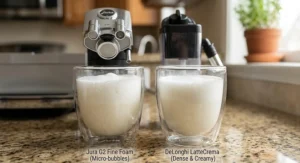
Milk drink turnaround, once a machine is warmed up, runs 30–90 seconds across nearly every model here, with fine-foam systems (Jura’s HP3, DeLonghi’s LatteCrema) both producing latte-shop-quality microfoam once dialed in correctly — the learning curve is mostly in finding your preferred milk-density setting during the first week, not in any fundamental quality gap between brands.
Long-Term Reliability and Total Cost of Ownership
The long-term reliability super automatic question is where brand reputation and hard data diverge most noticeably. Reviewers and repair-shop anecdotes consistently describe Jura machines as lasting seven to ten years with disciplined maintenance, dropping to three to four years without it — and the same maintenance-dependency pattern almost certainly applies to DeLonghi machines, even though comparably specific longevity figures are harder to find published for that brand.
Water hardness plays a larger role in machine longevity than most owners realize, since harder water accelerates limescale buildup inside the boiler and brewing components, and this affects both brands equally regardless of country of origin. Annual consumable costs — descaling solution, water filters, and occasional cleaning tablets — run roughly $80–$150 per year on either brand, meaning the five-year cost-of-ownership gap between a $700 Magnifica Evo and a $2,300 Jura E8 stays close to the initial purchase-price difference rather than closing significantly through maintenance costs.
Where the two brands genuinely diverge is service infrastructure. Jura maintains a more centralized authorized-repair network in most U.S. metro areas, which can matter enormously if your machine needs board-level repair outside the warranty period. DeLonghi’s service experience is more retailer-dependent, meaning where you bought the machine can matter as much as which model you chose. For buyers treating this as a decade-long purchase, weighing service access alongside sticker price is not optional — it’s part of the actual total cost.
What “Swiss Made” Actually Means for Your Espresso Machine
Jura leans heavily on its Swiss heritage in marketing, and the term carries more legal weight than most shoppers realize. Under Swiss law, industrial products must generate at least 60% of their manufacturing costs within Switzerland, with the single most essential manufacturing step also occurring on Swiss soil, to legally use a Swiss-made designation. That’s a meaningfully lower bar than “100% built in Switzerland,” and it’s worth understanding before that label alone drives a purchase decision.
In practice, this means components inside a Jura machine can be sourced internationally while final assembly, quality control, and the machine’s defining engineering steps remain genuinely Swiss — which is closer to how most premium manufacturing actually works globally, DeLonghi’s Italian assembly included. Neither brand is misrepresenting anything here; the regulatory framework simply allows more international sourcing flexibility than the marketing language implies at first glance.
For buyers specifically drawn to a Swiss made espresso machine for reasons of engineering philosophy rather than pure origin-country symbolism, Jura’s premium is arguably justified by its documented approach to grinder precision, pre-infusion extraction, and long-cycle reliability testing — the things Swiss engineering culture is genuinely known for — rather than by the label itself.
Practical Setup and Maintenance Guide
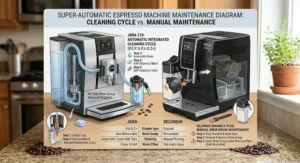
Getting a new super automatic dialed in correctly during the first 30 days prevents most of the frustration owners report later. Start by running the initial rinse cycle before your first drink, then insert the water filter cartridge (Clearyl for Jura, standard DeLonghi filters for that brand) immediately — skipping this step is the single most common first-week mistake, since machines calibrate their descaling countdown against filter presence from day one.
Set your grind fineness two to three clicks coarser than the factory default for your first week, then adjust finer only if shots run too fast — going straight to the finest setting risks choking the grinder before you’ve learned how your specific beans behave in it. Weekly, run the automatic milk-system cleaning cycle even if you haven’t noticed buildup; residual milk protein degrades faster than most owners expect and is the leading cause of frothing quality complaints. Monthly, wipe down the bean hopper lid and check for oil residue if you’re using darker roasts, which leave more oil than lighter roasts and can affect grinder consistency over time.
Descale on the machine’s prompted schedule, not on a calendar you set yourself — both brands’ internal water-usage tracking is more accurate than a fixed monthly assumption, since actual descaling need depends on your local water hardness and daily volume, not elapsed time alone.
Real-World Scenarios: Which Machine Fits Your Life
The apartment-dwelling remote worker: Making four to five drinks daily from a small kitchen with limited counter space, minimal cold-drink habit, and a budget under $1,000. The DeLonghi Magnifica Evo covers this use case almost perfectly — automatic milk, compact enough footprint, and a price that doesn’t strain a one-income household budget.
The dual-income household negotiating morning routines: Two adults with different drink preferences, moderate milk consumption, and a genuine desire to stop arguing about grind settings every morning. The DeLonghi Dinamica Plus, with its three saved user profiles, directly solves this exact friction point — each person taps their name-equivalent profile and gets their exact preferred drink without renegotiating settings.
The iced-coffee household through six warm months of the year: If cold brew, iced lattes, and iced cappuccinos genuinely make up a third or more of weekly consumption, the DeLonghi Eletta Explore or Jura Z10 are the only two machines on this list built specifically for that pattern — everything else treats cold drinks as an afterthought at best.
Problem → Solution: Fixing Common Super Automatic Frustrations
Problem: Espresso tastes weak or sour. This is almost always a grind-size issue rather than a machine defect — try one click finer and confirm your beans aren’t stale (use within 3–4 weeks of roast date). Problem: Milk foam is inconsistent day to day. Run the milk-system cleaning cycle more frequently; residual protein buildup is the most common cause, and it affects the Dinamica Plus‘s LatteCrema and the E8‘s Fine Foam system equally if neglected. Problem: Machine feels louder than expected. Grinder noise is largely fixed by design, but placing the machine away from hard-wall corners and on a slightly cushioned mat reduces perceived vibration noise noticeably. Problem: Descaling alerts appear too frequently. Test your local water hardness and consider a dedicated water filter pitcher upstream of the machine if your municipal water runs above 175 ppm hardness. Problem: Buyer’s remorse over an underused feature set. If you bought a flagship for features you’re not using — cold brew on the Z10, for instance — most authorized retailers offer 30-day return windows; check yours before that window closes.
FAQ: Jura vs Delonghi Super Automatic Espresso Machines
❓ Is Jura or Delonghi better for home use?
❓ Which is more reliable long-term, Jura or Delonghi?
❓ Is the Jura E8 worth it over cheaper Delonghi models?
❓ How often do super automatic espresso machines need descaling?
❓ Does 'Swiss made' mean a Jura machine is entirely built in Switzerland?
Conclusion
At-home brewing keeps climbing as America’s coffee habits continue evolving, which is exactly why the super automatic category keeps growing alongside it. The jura vs delonghi super automatic decision ultimately isn’t a brand-loyalty question — it’s a household-habits question wearing a brand-loyalty costume. DeLonghi wins decisively on entry pricing, drink-menu breadth, and cold-brew innovation reaching mid-tier machines first. Jura wins on grinder precision, pre-infusion extraction quality, and a documented reputation for multi-year durability that justifies its price for buyers planning to keep a machine for the long haul.
If you’re outfitting a first kitchen on a real budget, the DeLonghi Magnifica Evo remains the smartest entry point in this entire comparison. If you want the single lowest-regret mid-premium purchase, the Jura E8 earns that reputation for good reason. And if cold brew is a genuine, weekly habit rather than a summer novelty, the DeLonghi Eletta Explore or Jura Z10 are the only two machines here actually built for that use case. Whichever you choose, match the machine to your actual coffee week, not to the one you imagine having.
✨ Found the right match? Check current pricing and availability before making your final decision!
Recommended for You
- Jura E8 Review 2026: Is the Price Tag Actually Worth It?
- DeLonghi Magnifica Evo Review 2026: 7 Bean to Cup Picks Worth It?
- Super Automatic Espresso Machine Under 1000: 7 Picks (2026)
Disclaimer: This article contains affiliate links. As an Amazon Associate, I earn from qualifying purchases. If you purchase products through these links, we may earn a small commission at no additional cost to you.
✨ Found this helpful? Share it with your friends! 💬🤗
