
In This Article
If you have spent any time down the home-espresso rabbit hole, you already know the name. A breville dual boiler review shows up in nearly every “best espresso machine” list published in the last decade, and for good reason — it is one of the few machines under two grand that lets you brew and steam at the same time without playing temperature roulette. But “popular” and “right for you” are two different questions, and that is exactly the gap this guide is built to close. What is a dual boiler espresso machine, in plain terms? It is a machine with two separate, independently heated water tanks — one dedicated to brewing espresso at a stable temperature, the other dedicated to steam — so you are never forced to choose between a good shot and good milk foam.
Over the following few thousand words, you are going to get a straight-shooting breakdown of the Breville BES920XL alongside six real competitors — from a $500 single-boiler upstart to a $3,000 Italian flow-profiling monster — pulled from real specs, real owner feedback, and honest side-by-side reasoning. You will see exactly where the Dual Boiler wins, where it gets outclassed, and where your money is better spent elsewhere. There is no invented testing lab here and no fabricated five-star quotes; every claim about performance is either a manufacturer spec with practical context attached or aggregated sentiment pulled from real reviewers, clearly labeled as such. What you will not get is a rewritten spec sheet dressed up as a review — every product below comes with commentary on who it actually suits, because a machine that is “the best” on paper can still be the wrong choice for your kitchen, your budget, or your patience level.
By the end, you will know whether the Dual Boiler is worth the price for your situation, how it stacks up against the Breville Oracle and the Lelit Bianca specifically, and what PID temperature control and volumetric dosing actually change in the cup. Let’s get into it.
Quick Comparison Table: 7 Dual Boiler & Prosumer Espresso Machines at a Glance
| Machine | Boiler Type | Price Range | Best For |
|---|---|---|---|
| Breville Dual Boiler (BES920XL) | True dual boiler, PID | $1,500-$1,700 | Best all-round manual dual boiler |
| Breville Oracle Jet | Dual boiler, auto grind/tamp | $1,400-$1,600 | Beginners who want automation |
| Breville Oracle Dual Boiler | Dual boiler, touchscreen auto | $2,800-$3,000 | Full hands-off café experience |
| Rancilio Silvia Pro X | Dual boiler, dual PID | $1,900-$2,000 | Compact dual boiler on a budget |
| Lelit Bianca V3 | Dual boiler, flow-profiling | $3,000-$3,400 | Advanced pressure/flow control |
| Profitec Pro 700 | Dual boiler, E61, rotary pump | $2,600-$2,900 | Classic plumbed-in workhorse |
| Gaggia Classic Pro | Single boiler | $450-$550 | Budget entry point, no dual boiler |
Looking at the spread above, the price gap between the cheapest and most expensive machine here is more than $2,800, yet they are all aimed at roughly the same buyer: someone who has outgrown a pod machine and wants real control over their espresso. The Gaggia Classic Pro sits apart from the rest as the only true single-boiler design, included specifically so you can see what you give up — and what you save — by skipping the dual boiler category entirely. Meanwhile, the Breville Dual Boiler and Rancilio Silvia Pro X occupy a genuinely competitive middle tier where feature-for-feature comparisons actually matter, which is why we will circle back to that pairing later in this guide.
💬 Already leaning toward one? Scroll down to the full breakdown for the model that matches your budget and workflow.
💬 Just one click — help others make better buying decisions too!😊
Top 7 Dual Boiler Espresso Machines: Expert Analysis
1. Breville Dual Boiler (BES920XL) — best all-round manual dual boiler for the money
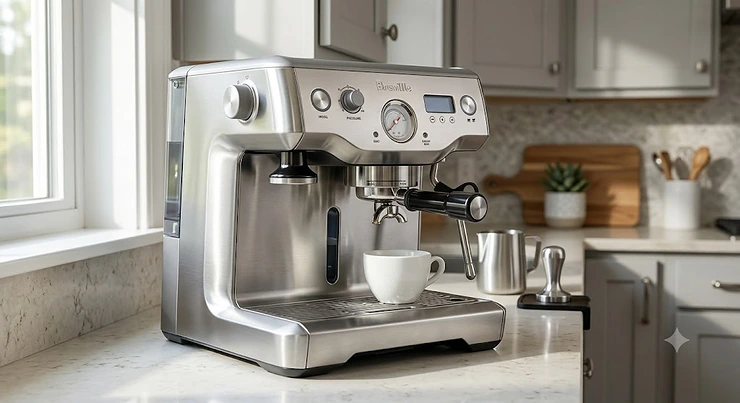
The Breville Dual Boiler earns its reputation by packing genuinely commercial-grade engineering — dual stainless steel boilers, dual PID control, and a 58mm commercial portafilter — into a machine that costs less than half of most Italian dual boiler rivals. The espresso boiler runs on precise PID digital temperature control while a second boiler handles steam, and both are backed by a 15-bar Italian pump with an over-pressure valve limiting extraction to roughly 9 bars, which curbs the bitterness that comes from over-pressured shots. Breville’s design philosophy centers on four elements: limiting maximum extraction pressure, low-pressure pre-infusion, consistent extraction temperature, and simultaneous extraction with steaming, and the BES920XL checks every one of those boxes without the four-figure premium that usually comes attached. Based on the spec comparison with rivals twice its price, the standout here is value density: you are paying for the engineering, not the badge.
Where this machine earns its keep for real households is in programmable shot volumes — it offers preset single and double cup volumes with manual override and the ability to reprogram shot volumes — paired with adjustable pre-infusion and a pressure gauge that turns dial-in from guesswork into a repeatable process. This is a machine built for people who want to actually learn espresso, not just push a button and hope, which is why it consistently gets recommended over automated machines to buyers who plan to stick with the hobby for years.
Reviewers consistently note that the ergonomics stand out even among prosumer machines: the BES920XL sits on retractable wheels, includes a lockable front-wheel lever, and lets you refill the water reservoir from either the front or back of the machine. On the milk side, aggregated feedback is more mixed — testers found the steam produces easy latte-art-quality microfoam but noted the process is comparatively slow, taking 25-30 seconds to steam 4 ounces of milk, which is a real trade-off against faster commercial-style steam wands.
Pros:
- ✅ True dual boiler with dual PID for stable brew and steam temps
- ✅ Commercial 58mm portafilter and programmable shot volumes
- ✅ Roughly half the price of comparable Italian dual boilers
Cons:
- ❌ No included grinder — budget separately for one
- ❌ Steam is slower than rotary-pump commercial-style machines
At around $1,500-$1,700, the Breville Dual Boiler remains one of the strongest value propositions in the category, especially once you factor in what you would spend to match its feature set on a comparably priced rival.
2. Breville Oracle Jet — most approachable automated dual boiler for grinder-shy beginners
The Breville Oracle Jet takes the Dual Boiler’s core engineering and wraps it in automation, aimed squarely at buyers who love café-quality espresso but do not want to learn grind calibration, dosing, or tamping from scratch. It pairs dual PID-controlled boilers with an integrated Baratza-derived burr grinder offering 45 grind settings, plus Breville’s Auto MilQ system, which uses an air pump with different profiles for each milk type to automatically froth dairy and plant-based milks. What most buyers overlook about this model is that it is positioned specifically as the lower-cost, simpler sibling in Breville’s automated dual boiler lineup, distinguishing it from the pricier, more feature-dense Oracle Dual Boiler covered next.
Practically speaking, the water delivery design differs subtly from its siblings — the Oracle Jet uses a slimmer spray nozzle for hot water rather than the “pouring” spout on the original Oracle, a detail that matters if you make a lot of Americanos, since the spray pattern can splash more than the older pour-style spout. Reviewers frame this as a minor quirk rather than a dealbreaker, and one worth knowing before you commit.
Aggregated owner sentiment on Breville’s automated milk system has improved meaningfully since launch: early complaints about plant-milk texturing were addressed through a firmware update, and current feedback treats the auto-frothing as reliable rather than experimental. For someone graduating from a super-automatic bean-to-cup machine who still wants some hands-on control, the Oracle Jet threads that needle better than a fully manual dual boiler would.
Pros:
- ✅ Integrated grinder removes the “buy a separate grinder” cost
- ✅ Auto MilQ handles dairy and plant milk without manual steaming
- ✅ Meaningfully cheaper than the full Oracle Dual Boiler
Cons:
- ❌ Less manual control than the BES920XL for espresso purists
- ❌ Hot water spout can splash more than pour-style designs
Priced around $1,400-$1,600, the Oracle Jet is best for buyers who value consistency and convenience over the tinkering process itself.
3. Breville Oracle Dual Boiler — the closest thing to a barista in a box
The Breville Oracle Dual Boiler sits at the top of Breville’s lineup and is essentially a fully automated version of the BES920XL with a built-in grinder, automatic dosing, and — in Touch trim — automatic tamping. It brews using up to 21 grams of coffee per double shot and is built entirely around a traditional dual boiler, 58mm portafilter espresso system, which is the detail that separates it from cheaper super-automatics running thermoblocks instead of real boilers. Here’s what the spec sheet won’t tell you outright: the temperature control setup uses one PID on the brew boiler for precise water temperature, and a second PID-controlled heating element on the grouphead itself, while the steam boiler runs on a more conventional thermostat — a nuance that still delivers excellent thermal stability in practice, even if it is not “dual PID on both boilers” in the strictest sense.
The trade-off for all that automation is size, heat-up time, and grind quality expectations. The machine measures roughly 15 inches wide, 14 inches deep, and 17 inches tall, and reviewers note the built-in grinder — believed to share burrs with Baratza’s mid-tier ESP line — struggles with very fine grinding needed for some light-roasted beans, which is a legitimate limitation for anyone chasing third-wave light-roast espresso rather than darker, more forgiving profiles. On paper this means the Oracle Dual Boiler is less a specialty-coffee purist’s tool and more a “consistently excellent daily driver” for people who want minimal fuss.
Reviewers also flag genuinely useful details that do not always make it into marketing copy: you can steam manually if you prefer, and you can adjust the dose the automatic system grinds, doses, and tamps, so it is not purely a black box — you retain meaningful override control when you want it.
Pros:
- ✅ True dual boiler architecture with commercial 58mm portafilter
- ✅ Automatic grind, dose, and tamp for consistent daily use
- ✅ Manual override available for brewing and steaming
Cons:
- ❌ Built-in grinder can struggle with very fine, light-roast grinds
- ❌ Large footprint and roughly double the BES920XL’s price
Expect to pay in the $2,800-$3,000 range, positioning this machine as a premium convenience purchase rather than a value pick.
4. Rancilio Silvia Pro X — the compact dual boiler that undercuts almost everyone
The Rancilio Silvia Pro X is proof that “dual boiler” does not have to mean “Italian E61 and a four-figure price premium.” It retails for just under $2,000, making it one of the least expensive true dual boiler espresso machines on the market, and reviewers note you would struggle to find a quality heat-exchanger machine for meaningfully less. The machine pairs a 0.3-liter brass brew boiler with a 1.0-liter steam boiler, each with independent PID temperature regulation, plus a newer feature called variable soft infusion that gradually ramps water pressure into the puck for gentler, more even extraction.
Here’s what most spec sheets skip: build quality testing backs up the marketing. In thermal-stability testing, the group-head temperature stayed within about 1°F of the set PID temperature over a 30-second brew cycle, which is genuinely impressive stability for a machine at this price point, and the steam boiler heated 5 ounces of fridge-temperature milk to 140°F in roughly 15 seconds during testing — noticeably quicker than the Breville’s steam performance. Reviewers describe the Silvia Pro X’s personality bluntly: reliable, easy to use, and affordable, evoking a utilitarian rather than showy aesthetic, which will appeal to buyers who want substance over styling.
The honest downside shows up in direct comparisons with the Breville Dual Boiler. The Breville has volumetric control allowing programmed automatic shots by volume or time and offers more overall shot customization, and it even includes brew pressure adjustment that is easier to access than on the Pro X. If programmable dosing matters to your workflow, that is a real point in Breville’s favor even at a similar price.
Pros:
- ✅ True dual boiler under $2,000 — rare in this category
- ✅ Excellent measured thermal stability and fast steam recovery
- ✅ Variable soft infusion for gentler, more even extraction
Cons:
- ❌ No volumetric/programmable shot dosing like the Breville offers
- ❌ Utilitarian design won’t appeal to buyers who want showpiece styling
At roughly $1,900-$2,000, the Silvia Pro X is the machine to compare directly against the BES920XL if brew-pressure adjustability matters less to you than raw thermal consistency.
5. Lelit Bianca V3 — the flow-profiling powerhouse for hands-on tinkerers
The Lelit Bianca V3 is where this list shifts from “great value dual boiler” to “serious enthusiast tool.” Built in Italy around a classic E61 group, it adds Lelit’s signature rotating flow-control paddle directly above the group head, letting you manipulate water flow — and therefore extraction pressure — in real time as the shot pulls. The 1.5-liter steam boiler and 800mL brew boiler are both insulated stainless steel, built for stable temperatures, rapid heat-up, and true simultaneous brewing and steaming. Reviewers who have spent years with the platform are unambiguous about where it sits competitively: it holds its own against machines including the La Marzocco GS3, Slayer, and Rocket R Nine One — models costing anywhere from roughly 2.5 to 6 times more.
What most buyers overlook about flow profiling is that it is a skill, not a setting. The Bianca V3 has a notably slow heat-up time of roughly 24 minutes and no auto-on functionality, and there is a genuine learning curve around adjusting temperatures, saving profiles, and dialing in pre-infusion times. This is not a machine you buy to save time in the morning — it is a machine you buy because you want to actively shape every second of the extraction, which is a fundamentally different value proposition than the Breville Dual Boiler’s “set it, forget it” PID stability.
Aggregated owner sentiment is enthusiastic once past the learning curve: owners consistently cite the true dual boiler for precise temperature control, excellent build quality, and the paddle-based manual flow profiling as the standout combination, while the most common complaints center on price and the adjustment period for new flow-profiling users rather than reliability.
Pros:
- ✅ Real-time flow-control paddle for manual pressure profiling
- ✅ Performance competitive with machines 2.5-6x the price
- ✅ Insulated dual boilers with genuinely fast simultaneous brew/steam
Cons:
- ❌ Roughly 24-minute heat-up with no auto-on scheduling
- ❌ Steep learning curve for profiling, temperature, and pre-infusion settings
Priced around $3,000-$3,400 in the US, the Bianca V3 rewards patience and practice far more than the push-button convenience buyer will appreciate.
6. Profitec Pro 700 — the classic rotary-pump workhorse for plumbed-in setups
The Profitec Pro 700 is the machine to consider if you want the traditional E61 dual boiler experience without chasing flow-profiling paddles or touchscreens. It runs dual PID temperature control across a 2-liter steam boiler and a 0.75-liter brew boiler, and can be plumbed directly into a water line or run from a reservoir using a smooth, quiet rotary pump. Steam performance is a genuine differentiator here: the steam boiler produces up to roughly 2 bars of pressure for best-in-class steaming power, taking about 20 seconds to steam 6 ounces of milk from 45°F to a 140°F finish temperature — output that comfortably outpaces both the Breville Dual Boiler and the Rancilio Silvia Pro X.
Based on multi-year ownership reports rather than first-impression reviews, the Pro 700 holds up well over time. One long-term owner cited quiet rotary-pump operation, substantial steaming power, dual boiler simultaneous brewing and steaming, an intuitive front-mounted PID with automatic shot timer, and genuine temperature stability as the machine’s core strengths after three years of near-daily use. The one honest caveat that shows up consistently: flow control is not standard equipment. The Pro 700 does not include a stock flow-control paddle, though it supports an optional ECM/Profitec flow-control kit for buyers who want to add manual profiling later — so factor that add-on cost in if pressure profiling is a priority from day one.
Reviewers directly comparing the Pro 700 to rivals in its price bracket single out its integration as the deciding factor: if you want all the controls built into one unit with an onboard shot timer rather than an external PID box, the Pro 700 makes the cleaner case over machines like the Rocket R58.
Pros:
- ✅ Best-in-class steam power among machines in this list
- ✅ Plumb-in or reservoir operation with quiet rotary pump
- ✅ Strong long-term reliability reports from multi-year owners
Cons:
- ❌ No stock flow control — it’s an optional add-on kit
- ❌ Among the largest, heaviest machines in this comparison
Typically priced in the $2,600-$2,900 range, the Pro 700 suits buyers who entertain often and want steam power that never runs out of steam.
7. Gaggia Classic Pro — the honest budget alternative for a real learning curve
The Gaggia Classic Pro — sold currently as the Classic Evo Pro (model E24) — is the one machine on this list that is not a dual boiler at all, and it is included specifically to give budget-conscious readers an honest baseline. It brings a commercial-spec 58mm portafilter, a solenoid valve, and a chrome-plated brass group head to a machine priced at roughly $450-$550, components you would typically expect on machines costing twice as much. What the spec sheet won’t tell you is that this affordability comes with real workflow trade-offs: as a single-boiler design, it requires manual temperature surfing between brewing and steaming, and reviewers note it is not ideal for anyone regularly pulling four or more milk drinks back-to-back, since the boiler cannot hold brew and steam temperature simultaneously the way a true dual boiler can.
Reviewers consistently frame the Classic Pro as a craft purchase rather than a convenience one. It has no built-in grinder, no LCD display, no shot timer, and no guided setup wizard — what you get instead is genuine commercial-spec hardware paired with a mature modification community that can add a PID controller, precision baskets, and other upgrades over time. That last point matters for the “worth the price” conversation later in this article: once you add a precision basket, an aftermarket PID controller, and basic accessories, a modded total often lands around $700-$850 — which starts to close the gap with entry-level dual boilers, just without ever gaining the simultaneous brew-and-steam capability that defines the category.
Aggregated review sentiment across owner forums is largely positive on build quality and shot quality relative to price, with the most common criticism being the learning curve itself rather than any hardware shortfall — a fair trade for buyers who genuinely want to learn the craft rather than have a machine handle it for them.
Pros:
- ✅ Commercial 58mm portafilter at a genuinely entry-level price
- ✅ Large modification community and easy parts availability
- ✅ Legitimate stepping stone into real manual espresso technique
Cons:
- ❌ Single boiler — no simultaneous brewing and steaming
- ❌ Requires temperature surfing and a real learning curve
At $450-$550 stock, the Classic Pro is the machine to buy if you are not yet convinced you will use a dual boiler’s simultaneous-brew advantage often enough to justify the price jump.
Top 7 Products: Full Spec Comparison
| Machine | Portafilter | Boiler Setup | Grinder Included | Price Range |
|---|---|---|---|---|
| Breville Dual Boiler | 58mm | Dual, PID | No | $1,500-$1,700 |
| Breville Oracle Jet | 58mm | Dual, PID | Yes | $1,400-$1,600 |
| Breville Oracle Dual Boiler | 58mm | Dual, PID + thermostat | Yes | $2,800-$3,000 |
| Rancilio Silvia Pro X | 58mm | Dual, PID | No | $1,900-$2,000 |
| Lelit Bianca V3 | 58mm | Dual, PID + flow paddle | No | $3,000-$3,400 |
| Profitec Pro 700 | 58mm | Dual, PID, rotary pump | No | $2,600-$2,900 |
| Gaggia Classic Pro | 58mm | Single | No | $450-$550 |
Read across this table and a clear pattern emerges: every genuine dual boiler here converges on a 58mm commercial portafilter and independent PID control, which tells you those two specs have effectively become the price of entry to the category rather than a differentiator. The real decisions buyers face are about automation level (Oracle models), manual control depth (Lelit Bianca V3‘s flow paddle), and steam power headroom (Profitec Pro 700), not about whether PID exists at all. If you are trying to decide purely on “how much dual boiler can I get for my budget,” the Rancilio Silvia Pro X and Breville Dual Boiler remain the two most defensible value picks in this table.
Practical Usage Guide: Setting Up and Dialing In Your Dual Boiler
Getting a dual boiler machine like the Breville Dual Boiler or Rancilio Silvia Pro X running well is less about the machine and more about the first 30 days of habits you build around it. Start with water: every machine in this guide performs better and lasts longer on filtered water within the mineral ranges the manufacturer recommends, and skipping this step is the single most common cause of premature scale buildup and PID sensor issues down the line. Next, resist the urge to skip your grinder budget — a $1,600 dual boiler paired with a mediocre grinder will underperform a $500 machine paired with a great one, because grind consistency, not boiler technology, is what most directly controls extraction evenness.
During the first week, focus on dialing in a single bean rather than chasing every roast in your cabinet. Pull shots at a 1:2 ratio (18g in, 36g out) as a starting point, adjusting grind size in small increments and giving the machine two to three minutes to stabilize after any brew-temperature change — dual boilers recover fast, but the group head itself still needs to catch up thermally. Set a maintenance rhythm early: backflush weekly with a blind basket and cleaning detergent, wipe the steam wand immediately after every use before milk dries, and follow the manufacturer’s descale schedule based on your local water hardness rather than a generic calendar reminder. The single most common first-month mistake buyers report is neglecting descale alerts because “the coffee still tastes fine” — by the time flavor changes, scale has often already affected the PID’s accuracy.
Real-World Scenarios: Who Actually Needs a Dual Boiler?
Picture a household of four adults who all drink a milk-based coffee before work on a tight schedule. This is the textbook case for a true dual boiler — simultaneous brewing and steaming turns a 20-minute multi-drink morning into something closer to 8 minutes, and a machine like the Breville Dual Boiler or Rancilio Silvia Pro X earns back its price difference over a single-boiler machine in pure time saved within the first few months of ownership. Contrast that with a solo drinker who has one espresso a day and rarely touches the steam wand — for that person, the Gaggia Classic Pro‘s single boiler is not a limitation at all, since there is no queue of drinks competing for the same boiler’s attention.
Now consider a small home office that hosts client meetings and occasional coffee for guests. Here, automation starts to matter as much as dual-boiler speed: the Breville Oracle Jet or full Oracle Dual Boiler removes the risk of an inconsistent shot when someone other than the household’s dedicated barista has to make a drink under time pressure. Finally, picture the enthusiast who already owns a great grinder, understands extraction theory, and wants to chase specific flavor outcomes shot to shot — that is precisely the buyer the Lelit Bianca V3‘s flow-control paddle was designed for, and arguably the only buyer who will use that feature enough to justify its premium over a fixed-profile dual boiler.
✨ Don’t Miss These Exclusive Deals!
🔍 Compare Live Prices Before You Buy
Take your morning espresso routine to the next level with a machine that’s genuinely built for how you actually drink coffee. Click through on any highlighted model above to check current pricing and availability — these picks will help you create authentic café-quality drinks your whole household will actually look forward to. ☕
Breville Dual Boiler vs Oracle: Which Should You Buy?
The breville dual boiler vs oracle decision really comes down to one question: do you want to be the barista, or do you want a barista built into your countertop? The Breville Dual Boiler is fully manual — you grind separately, dose by hand, tamp yourself, and control every variable in the shot. Both machines share a stainless steel boiler material, vibration pump type, and a 2.5-liter water reservoir, but the Oracle Touch’s steam boiler capacity sits at 1.8 liters versus the Dual Boiler’s smaller 0.95 liters, and the Oracle’s heat-up time runs 15 to 30 minutes compared to the Dual Boiler’s quicker 5 to 15 minutes. That heat-up gap alone is worth weighing seriously if your household needs coffee ready fast on weekday mornings.
The bigger practical difference is the built-in grinder and automated dosing on the Oracle models, which comes at roughly double the Dual Boiler’s price for the Touch variant and, per reviewers cited earlier, a grinder that can struggle with the finest grind settings light roasts sometimes need. Here’s what most buyers overlook: paying for the Oracle is really paying to remove decision fatigue from your morning, not to get better espresso — a well-dialed-in Dual Boiler paired with a quality standalone grinder can match or beat an Oracle’s cup quality, it just asks more of you in exchange. If you already enjoy the process of grinding, dosing, and tamping, the Dual Boiler is the better value; if you want that process handled for you every single time, the Oracle lineup earns its premium.
Breville Dual Boiler vs Lelit Bianca: Manual Control vs Flow Profiling
The breville dual boiler vs lelit bianca comparison is really a question about how much control you want over the shape of the pressure curve during extraction, not just the temperature. The Breville Dual Boiler gives you a fixed, well-executed pre-infusion and a pressure gauge you can read but not actively steer mid-shot. The Lelit Bianca V3 hands you a physical paddle sitting above the E61 group that lets you open, hold, or taper water flow in real time as the shot pulls — a completely different level of hands-on control that costs roughly double the Breville’s price.
Based on the spec comparison, the Bianca’s larger 1.5-liter steam boiler and insulated dual-boiler design also out-muscle the Breville on raw steam capacity and thermal buffer for back-to-back milk drinks, while its roughly 24-minute heat-up is meaningfully slower than the Breville’s 5-15 minute warm-up. What most buyers overlook about flow profiling specifically is that it changes very little for darker, more forgiving roasts and matters most with light, delicate single-origin coffees where a gentler pressure ramp can visibly improve sweetness and reduce sourness. If your bean rotation leans toward medium and dark roasts, the extra control the Bianca offers may go largely unused — in which case the Dual Boiler’s PID stability alone gets you most of the way to the same cup quality for a lot less money.
Is the Breville Dual Boiler Worth the Price?
Answering is breville dual boiler worth the price honestly requires separating two different questions: is it good engineering for the money, and is a dual boiler the right category for you at all? On the first question, the answer is close to unambiguous — the combination of triple heating architecture, dual PID control, a 58mm commercial group, programmable pre-infusion, and an over-pressure valve tuned to 9-10 bar is engineering reality most rivals in this price bracket cannot fully match, and independent reviewers have scored it highly across espresso quality, milk performance, and workflow specifically because that engineering delivers in daily use, not just on a spec sheet.
The second question is more personal. If you make one drink a day and rarely steam milk, the simultaneous-brew advantage this machine is built around will go mostly unused, and a single-boiler machine like the Gaggia Classic Pro will save you over a thousand dollars while delivering comparably good espresso. If your household regularly needs two or three milk drinks back-to-back on a schedule, the math flips fast — the time saved every single morning compounds into real value within months, not years. One point worth flagging honestly: the automatic descaling cycle on earlier production units could damage steam boiler water level sensors, with repairs reaching roughly $600 — nearly 40% of the purchase price — though post-2022 units fixed this vulnerability. If you are shopping secondhand, checking the manufacture date in the serial number is a genuinely important step before you buy, not an optional precaution.
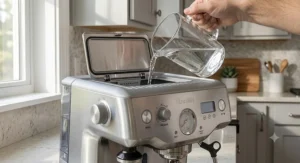
How Dual Boiler Simultaneous Brewing Actually Works
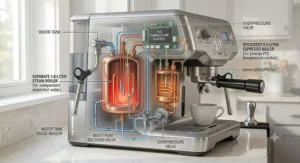
Understanding dual boiler simultaneous brewing starts with recognizing what a single-boiler machine has to compromise on. In a single-boiler design, one tank of water has to serve two very different jobs — hovering around 200°F for brewing and climbing past 250°F for steam — which means switching between them requires either waiting for the boiler to cool or heat, or “temperature surfing” with quick flushes to force a faster transition. A true dual boiler machine sidesteps that compromise entirely by running two independently heated, independently controlled tanks: the brew boiler stays locked at its extraction temperature via PID control while a separate boiler simultaneously holds steam pressure, so you can pull a shot and froth milk at the exact same moment without either process robbing heat from the other.
The practical payoff shows up most clearly in multi-drink mornings. On a single-boiler machine, making two lattes back-to-back can genuinely take twice as long because each drink has to wait through a full temperature transition. On a dual boiler, that wait largely disappears — you pull the shot and steam the milk concurrently, then move straight to the next drink. This is exactly the mechanism reviewers point to when explaining why dual boilers command a price premium: the upgrade from single-boiler or heat-exchanger machines to a true dual boiler is immediate and obvious, removing both the waiting and the temperature-juggling that single-boiler ownership requires. If your daily routine rarely involves more than one drink, this mechanism matters far less to you in practice than it does to a busy household.
PID Temperature Control Explained: Why It Matters More Than Marketing Hype
What is PID temperature control? PID stands for proportional-integral-derivative — a feedback-loop algorithm that continuously measures boiler temperature and makes small, constant adjustments to heating output to hold a precise setpoint, rather than simply switching a heating element fully on or fully off around a rough target.
That distinction matters more than it sounds. A basic thermostat-controlled boiler swings temperature up and down in a wide band as it cycles on and off, which means the water hitting your coffee puck can vary by several degrees depending on exactly when in that cycle you pull the shot. A true dual PID setup, by contrast, allows independent regulation of different temperatures for coffee extraction and steam delivery, managed precisely via display controls rather than a fixed factory thermostat. In real testing this translates to measurable consistency: as cited earlier, the Rancilio Silvia Pro X‘s group-head temperature held within about 1°F of its PID setpoint across a full 30-second extraction — a level of repeatability that thermostat-only machines simply cannot match shot to shot.
Reviewers consistently note that PID control is also what unlocks meaningful experimentation. With PID, a heated group, and adjustable pre-infusion, you gain the ability to fine-tune shots and, once dialed in for a particular coffee, repeat that result reliably — which is the entire point of temperature precision. Without it, changing beans means re-learning your machine’s quirks from scratch every time; with it, you are adjusting one variable at a time against a stable baseline. This is precisely why every genuine dual boiler in this guide, from the $1,500 Breville to the $3,400 Lelit Bianca, treats PID as non-negotiable core hardware rather than a premium add-on.
Volumetric Dosing: The Feature Most Reviews Get Wrong
Volumetric dosing gets mentioned constantly in spec sheets and explained rarely, which is a shame because it is one of the more genuinely useful conveniences a dual boiler like the Breville Dual Boiler offers over its rivals. In practice, it means the machine can measure water delivery by volume or time rather than requiring you to manually watch and stop each shot — you get preset 1- and 2-cup volumes, a manual override, and the ability to reprogram those shot volumes to your own preference. Once you have dialed in a ratio you like for a given bean, you press a button and the machine stops the shot at exactly that point every time, removing one more variable from the “why did today’s shot taste different” troubleshooting list.
The honest limitation is that volumetric dosing controls output, not the extraction itself — it will faithfully repeat a bad dial-in just as precisely as a good one. Reviewers directly comparing volumetric-equipped machines against non-volumetric rivals frame this accurately: the Breville’s volumetric control allowing programmed shots by volume or time gives it more overall shot customization than machines that require manual stopping every time, but that customization only pays off once your grind, dose, and temperature are already correct. Think of volumetric dosing as a consistency multiplier rather than a quality generator — it takes a good process and makes it repeatable, which is genuinely valuable for households where more than one person pulls shots, since it removes technique variance between users.
How to Choose a Dual Boiler Espresso Machine
Picking the right machine from a category this crowded gets much easier with a clear framework. Here is the process worth working through in order:
- Decide how many milk drinks you actually make daily. One or fewer means a single boiler like the Gaggia Classic Pro may serve you just as well for a fraction of the price.
- Set a real budget ceiling, then work backward. The jump from $1,500 to $3,000 buys meaningfully more control, but only if you will actually use that control.
- Decide between manual and automated. If grinding, dosing, and tamping sound tedious rather than enjoyable, an Oracle-style automated machine will serve you better long-term than a manual dual boiler you resent using.
- Weigh flow profiling honestly. It rewards light-roast enthusiasts chasing specific flavor curves; it adds little for buyers who mostly drink medium or dark roasts.
- Check plumb-in versus reservoir needs. If your kitchen layout allows a water line, plumbable machines like the Profitec Pro 700 remove daily refilling entirely.
- Budget for a grinder separately if the machine doesn’t include one. A dual boiler paired with a mediocre grinder underperforms a modest machine paired with a great one.
- Confirm return policy and local service support before buying premium Italian machines, since parts and repairs can be slower to source than for mainstream brands.
Common Mistakes When Buying a Dual Boiler Espresso Machine
The most common mistake buyers make is treating boiler size as the only spec that matters while ignoring the grinder budget entirely — a genuinely excellent dual boiler fed inconsistent grounds will produce inconsistent shots regardless of PID precision. The second frequent misstep is underestimating counter depth and clearance: several machines in this guide, particularly the Profitec Pro 700 and Lelit Bianca V3, need meaningful depth for hoses, wands, and portafilter clearance that a quick glance at width and height specs won’t reveal.
A third mistake is buying based purely on brand recognition rather than matching features to actual habits — paying a premium for flow-profiling control you will rarely engage with is money better spent on a quality grinder or a stock of good beans instead. Finally, many first-time dual boiler buyers skip researching water requirements entirely, then face early scale buildup or PID sensor issues that a simple filtration setup would have prevented from day one.
Long-Term Cost & Maintenance: The Real Cost of Owning a Dual Boiler
The sticker price is only the opening bid in dual boiler ownership. Budget for a quality burr grinder if your machine does not include one — this typically adds $150-$700 depending on how far you want to go, and it is not an optional accessory, it is core to shot quality. Factor in a water filtration setup or remineralized bottled water, descaling solution on a schedule matched to your local water hardness, and periodic gasket or seal replacement every one to two years of regular use, particularly on E61 group machines like the Bianca and Pro 700 where the group head sees more mechanical wear.
Where dual boilers actually save money over time is energy efficiency during multi-drink sessions and reduced coffee waste from failed extractions once the machine is properly dialed in — a stable PID setpoint means fewer sour or bitter “learning” shots than a temperature-surfing single boiler produces during the same period. Total cost of ownership over five years, including a mid-range grinder, typically lands the Breville Dual Boiler and Rancilio Silvia Pro X in a similar bracket, while premium Italian machines like the Lelit Bianca V3 and Profitec Pro 700 carry higher upfront and part-replacement costs that only make sense if you are using their extra control regularly enough to justify it.
Safety, Warranty & Regulations Guide
All seven machines in this guide are UL-listed or equivalent for US electrical safety standards, but warranty terms vary meaningfully and are worth checking before purchase rather than after. Breville backs the BES920XL with a 2-year limited product warranty, which is fairly standard across the mainstream brands here, while premium Italian imports sometimes carry shorter standard coverage with paid extended-warranty options available through specialty retailers. If you are buying a plumbed-in machine like the Profitec Pro 700, confirm local plumbing code compliance for backflow prevention before hard-plumbing it into your home’s water line — this is a step DIY installers sometimes skip.
Espresso machines in this category also draw meaningful current during heat-up, so dedicating a circuit rather than sharing with other high-draw kitchen appliances reduces breaker-trip risk. Buyers who want an objective performance benchmark beyond marketing claims can reference the Specialty Coffee Association’s published equipment testing standards, which cover home and semi-automatic espresso machine specifications independently of any single manufacturer’s claims.
📊 Ready to compare specs side-by-side one more time before deciding? Jump back to the full comparison table above.
Frequently Asked Questions
❓ Does the Breville Dual Boiler come with a grinder?
❓ Is a dual boiler better than a heat exchanger machine?
❓ How long does the Breville Dual Boiler take to heat up?
❓ Can you use pods in a dual boiler espresso machine?
❓ Do dual boiler machines need to be plumbed into a water line?
Conclusion
Choosing among these seven machines really comes down to matching the category’s core promise — simultaneous, stable brewing and steaming — to how often you will actually use it. The Breville Dual Boiler remains the strongest all-round value in this guide because it delivers genuine commercial engineering without the four-figure premium Italian rivals demand, and it is the machine most buyers moving up from a basic single-boiler setup will find easiest to grow into. If automation matters more to you than manual control, the Breville Oracle lineup removes the grinding-and-dosing learning curve entirely, at a real cost premium. If you already know you want to chase specific flavor profiles shot by shot, the Lelit Bianca V3‘s flow paddle is worth its price tag — but only for that specific buyer.
For budget-conscious readers still unsure whether they need a dual boiler at all, the Gaggia Classic Pro remains a legitimate, honest starting point that will teach you more about espresso fundamentals per dollar than any machine on this list, even without the simultaneous-brew convenience. Whichever direction you go, the honest throughline across every product here is the same: a great grinder and consistent technique will always matter more to your final cup than the badge on the machine, so budget for both before you commit to either end of this price range.
☕ Ready to Upgrade Your Morning Routine?
Compare current pricing and availability on the model that fits your budget and workflow best — a genuinely great espresso machine pays for itself in skipped café runs faster than most people expect.
Recommended for You
- 7 Best Espresso Machines Under 1000 Dollars in 2026
- 7 Best Prosumer Espresso Machines in 2026: Worth The Upgrade?
- 7 Best Espresso Machine Under 800 Picks (2026): Worth the Money?
Disclaimer: This article contains affiliate links. As an Amazon Associate, I earn from qualifying purchases. If you purchase products through these links, we may earn a small commission at no additional cost to you.
✨ Found this helpful? Share it with your friends! 💬🤗
