
In This Article
Here’s a confession every home barista eventually makes: the machine isn’t the problem, the thermostat is. You dial in a gorgeous shot on Tuesday — syrupy, balanced, a little citrusy — and by Thursday the same beans, same grind, same everything taste flat and sour. Nine times out of ten, that’s not you losing your touch. That’s a mechanical thermostat swinging 10-15°F above and below your target while it clicks on and off like an old furnace. A PID-controlled espresso machine for consistency fixes exactly this problem by replacing that lazy on/off switch with a controller that reads your boiler temperature dozens of times a second and makes tiny, continuous corrections instead of big, sloppy ones.
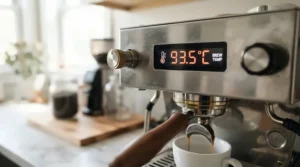
This matters more than most spec sheets let on. Espresso is brutally sensitive to water temperature — a few degrees off and you shift from syrupy-sweet to either sour and thin or bitter and flat. That’s the whole game with shot consistency temperature control: hold the number steady, and the rest of your technique finally gets to matter. Below, you’ll find seven real, currently sold machines spanning budget to premium, each broken down for what its PID actually does in practice — not just what the spec sheet claims.
What Is a PID-Controlled Espresso Machine?
A PID-controlled espresso machine is a coffee maker that uses a feedback-based control loop that automatically compares a desired target temperature with the boiler’s actual temperature and makes constant micro-adjustments to hold that number steady, instead of letting the boiler swing wide between an on-off thermostat’s high and low points.
The concept isn’t unique to coffee. This same PID controller logic runs cruise control in your car, industrial ovens, and 3D printer hot ends. What changes is the stakes: in a car, a little overshoot means you speed up slightly on a hill. In an espresso machine, a little overshoot means your shot goes from balanced to burnt in the space of about four degrees.
Quick Comparison: 7 PID Espresso Machines at a Glance
| Machine | Boiler Type | PID Precision | Price Range | Best For |
|---|---|---|---|---|
| Breville Bambino Plus | Thermocoil (ThermoJet) | ±2°C | Under $500 | Speed in a tiny footprint |
| Breville Barista Pro | Thermocoil + built-in grinder | ±2°C | $700-$900 | Beginners who want one box |
| Lelit MaraX | Heat exchanger (E61) | ±1°F | $1,600-$1,800 | Enthusiasts wanting manual control |
| Diletta Bello+ | Active heat exchanger | ±1°F | $1,900-$2,100 | No-cooling-flush convenience |
| Profitec Pro 500 | Heat exchanger (E61) | Adjustable, visible display | $1,899-$2,099 | German build + shot timer |
| Rancilio Silvia Pro X | Dual boiler, dual PID | Independent brew/steam | $2,195-$2,395 | Simultaneous brew + steam |
| Ascaso Steel DUO PLUS | Dual thermoblock | 1°F increments | $2,400-$2,700 | Volumetric programmability |
Looking at the table above, the split really comes down to boiler architecture, not just the PID itself: Breville Bambino Plus and Breville Barista Pro use fast-heating thermocoils that hit temperature quickly but rely more heavily on the PID to hold steady under continuous use. The heat exchanger and dual-boiler machines — Lelit MaraX, Diletta Bello+, Profitec Pro 500, Rancilio Silvia Pro X, and Ascaso Steel DUO PLUS — use thermal mass plus PID correction together, which is why they tend to show tighter shot-to-shot consistency during back-to-back cappuccino runs.
💬 Found a machine you’re eyeing already? Scroll down for the full breakdown before you commit.
Top 7 PID-Controlled Espresso Machines for Consistency: Expert Analysis
Real specs, real trade-offs — here’s what stands out about each of these seven machines once you get past the marketing copy.
1. Breville Bambino Plus — fastest heat-up in a compact PID machine
The standout here is speed: this thing reaches brew temperature in about three seconds flat, thanks to its ThermoJet heating element. That’s not a typo — most machines in this price range make you wait 15-20 minutes for the boiler to stabilize. The Breville Bambino Plus pairs that instant heat-up with digital PID temperature control, holding water within about ±2°C of target — tighter than the swings you’d see on a purely mechanical thermostat. Its 19-gram dose basket and 54mm portafilter are sized for a proper double shot rather than the anemic single-shot baskets some entry machines ship with.
Based on the spec comparison, this is the machine for someone who wants their morning shot before they’ve finished putting on shoes, not someone chasing café-grade pressure profiling. Reviewers consistently note that the automatic milk texturing takes the guesswork out of steaming, though a few mention the compact steam wand takes practice for latte art. Breville Bambino Plus pros and cons, based on real specs and review themes:
Pros:
- ✅ Reaches brew temperature in about 3 seconds
- ✅ Digital PID keeps water within roughly ±2°C
- ✅ Small enough footprint for tight kitchen counters
Cons:
- ❌ No built-in grinder, so budget for one separately
- ❌ Steam wand is less powerful than dual-boiler rivals
At around $400-$500 depending on color and retailer, the Breville Bambino Plus is arguably the best value entry point into PID-controlled consistency without spending four figures.
2. Breville Barista Pro — built-in grinder with PID for total beginners
What most buyers overlook about this model is that the grinder integration matters just as much as the PID. Grind consistency and temperature consistency are two halves of the same equation — nail one without the other and you’re still guessing. The Breville Barista Pro pairs its ThermoJet PID heating system (same 3-second heat-up as the Bambino) with a 30-setting conical burr grinder built into the housing, versus the 16 settings on Breville’s entry-level Barista Express.
Owner reports consistently cite café-quality shots once the grind is dialed in, which tells you the PID is doing its job — it’s removing temperature as a variable so grind size becomes the thing you actually need to tune. This is the machine for someone who wants one box that grinds, doses, and brews without assembling a separate grinder purchase.
Pros:
- ✅ Built-in 30-setting grinder removes a second purchase
- ✅ Same 3-second PID heat-up as the Bambino Plus
- ✅ Digital display makes temperature and dose easy to read
Cons:
- ❌ Larger footprint than grinder-less thermocoil machines
- ❌ Burrs need periodic cleaning to maintain grind consistency
Expect to pay in the $700-$900 range, and the value verdict holds up well: you’re getting the grinder and the PID stability in one purchase instead of two.
3. Lelit MaraX — compact E61 heat exchanger for hands-on enthusiasts
The Lelit MaraX occupies a specific niche: it’s a heat exchanger machine — meaning a single boiler heats both brew and steam water via a heat-exchange tube — but it adds active PID regulation on top of the classic E61 group head design that commercial machines have used for decades. James Hoffmann’s own testing praised its build quality and noted it has the smallest footprint among comparable machines he reviewed in that price bracket, without sacrificing the interface.
Here’s what to weigh: the E61’s thermosiphon circulation already does a decent job of passive temperature stability on its own, and the added PID refines that further rather than replacing a broken system. Hoffmann’s review also flagged that the default overpressure valve setting on this line ran higher than ideal, meaning enthusiasts should expect to make a manual pressure adjustment out of the box.
Pros:
- ✅ Genuine E61 group head — the same design in commercial machines
- ✅ Compact footprint relative to other HX machines
- ✅ Accurate pressure gauge readings, praised in independent testing
Cons:
- ❌ Requires manual OPV adjustment for ideal brew pressure
- ❌ No built-in grinder or auto-dosing features
In the $1,600-$1,800 range, the MaraX rewards someone who wants to learn manual technique on genuinely commercial-grade hardware rather than an automated experience.
4. Diletta Bello+ — PID heat exchanger that skips the cooling flush
What most heat exchanger machines make you do — running a “cooling flush” of water through the group before every shot to knock the temperature down from steam-hot to brew-hot — the Diletta Bello+ eliminates through what the manufacturer calls active temperature management layered onto its PID. Independent testers who spent three months comparing it against Lelit, Rocket, and Profitec machines found the Bello+ combines Italian build quality, PID control, and active temperature management in a way that changes the daily ritual, not just the spec sheet.
Reviewers who tested it for milk-drink-heavy mornings noted they measured its footprint at 11 inches wide, small enough to fit their smallest test counter, and that it handled two lattes plus an espresso back-to-back in under 12 minutes without a recovery wait. On the spec sheet won’t tell you this, but user reports suggest it’s a poor fit for total beginners: there’s no automatic mode, no beginner-friendly pressure profile, and no app connectivity, so you’re buying a tool that rewards someone who already understands pressure profiling basics.
Pros:
- ✅ No cooling flush needed between steam and brew
- ✅ Compact 11-inch-wide footprint for an HX machine
- ✅ Handles multiple milk drinks with fast recovery
Cons:
- ❌ No guided presets — steep learning curve for newcomers
- ❌ Factory smell requires a thorough initial flush
Priced around $1,900-$2,100, the Diletta Bello+ earns its premium over cheaper HX machines through the no-flush convenience alone — a meaningful quality-of-life upgrade if you make more than one drink per session.
5. Profitec Pro 500 — German-engineered heat exchanger with a visible shot timer
The Profitec Pro 500 takes a different angle on the same HX-plus-PID formula: German engineering discipline over Italian flair. Its 2L stainless boiler and 1400W heating element pair with a relocated, clearly visible PID display and integrated shot timer, a deliberate 2022 redesign that moved the controller out of a hidden internal panel so you can actually watch and time your extraction in real time.
What most buyers overlook about this model is how the thermosiphon circulation in its E61 group interacts with the PID: together they largely eliminate the need for cooling flushes that plague older HX designs, a point several retailers highlight as the real differentiator over cheaper heat exchangers. Based on the spec comparison, this is a machine built for someone hosting multiple guests — brewing and steaming simultaneously without a queue.
Pros:
- ✅ Visible PID display with integrated shot timer
- ✅ 2L boiler supports simultaneous brew and steam
- ✅ Commercial-grade parts at a below-commercial price
Cons:
- ❌ Heavier and larger than compact HX alternatives
- ❌ No grinder included — factor that into your total budget
Pricing generally lands between $1,899 and $2,099 depending on the accent finish, putting it squarely against the MaraX and Bello+ as a mid-premium HX contender.
6. Rancilio Silvia Pro X — dual boiler, dual PID for brewing and steaming at once
Where the heat exchanger machines above use one boiler for both functions, the Rancilio Silvia Pro X dedicates a separate 300ml brew boiler and 1-liter steam boiler to each task — with dedicated PID controls for both circuits, adjustable to the degree for optimal extraction. That’s the real advantage of dual-boiler architecture: you’re not managing one thermal mass trying to serve two very different jobs (200°F-ish brewing versus 250°F+ steaming).
Here’s what to weigh: reviewers who ran it alongside heat exchanger machines for two weeks reported it produced more consistent shot times and extraction ratios across 30 consecutive shots, and noted that for anyone measuring espresso success in standard deviations rather than vibes, the dual boiler wins outright. New users, however, should expect a learning curve — one first-time buyer’s own account mentioned it took a few attempts before shots started tasting “nearly darn good.”
Pros:
- ✅ Independent PID control for brew and steam circuits
- ✅ True simultaneous brewing and steaming, no compromise
- ✅ Adjustable low-pressure preinfusion reduces channeling
Cons:
- ❌ Manual programmability only — no volumetric presets
- ❌ Steeper learning curve for first-time espresso owners
Expect a price around $2,195-$2,395, positioning the Rancilio Silvia Pro X as the dual-boiler entry point before jumping into four-figure-plus commercial-adjacent gear.
7. Ascaso Steel DUO PLUS — digital PID with one-degree precision and volumetric control
At the top of this lineup, the Ascaso Steel DUO PLUS brings dual thermoblocks — one dedicated to coffee, one to steam — each governed by a digital PID that adjusts in one-degree increments, a level of granularity most machines below it simply don’t offer. Add an adjustable OPV, volumetric programmable settings for preinfusion and shot volume, and a competition shower screen for even water distribution, and you’ve got a machine built to remove variables one at a time.
What the spec sheet won’t tell you, but the accessory list hints at, is how seriously Ascaso treats consistency as a full system rather than a single feature: the walnut joystick steam control, programmable auto-standby, and automatic cleaning mode are all aimed at making the “boring” parts of daily use repeatable too, not just the shot itself. This is the pick for someone who has already outgrown manual OPV fiddling and wants programmable repeatability baked in.
Pros:
- ✅ PID adjustable in precise one-degree increments
- ✅ Volumetric programming for consistent shot volumes
- ✅ Dual thermoblocks isolate coffee and steam circuits
Cons:
- ❌ Highest price point in this roundup
- ❌ Requires a dedicated 15-20 amp circuit on some models
Pricing runs from roughly $2,400 up past $2,700 depending on accents and retailer, placing the Ascaso Steel DUO PLUS as the premium, feature-complete option in this group.
Setting Up Your Machine for Day-One Shot Consistency
Getting a PID-controlled espresso machine for consistency out of the box is only half the job — the first 30 days determine whether you actually experience that consistency or fight your new machine the whole time. Start with water: every machine on this list performs worse with hard tap water, since mineral buildup on the boiler’s heating element insulates the sensor from the actual water temperature, quietly defeating the PID’s accuracy over time. Use filtered or soft water in the 75-150ppm range from day one.
Next, resist the urge to skip the warm-up window. Even thermocoil machines like the Breville Bambino Plus benefit from a few idle minutes before your first shot, since the portafilter and group head themselves need to reach temperature — the PID controls water temperature, not metal temperature. A common first-month mistake is dialing in grind size before the machine has fully thermally stabilized, which leads to a frustrating chase where you’re adjusting grind to compensate for a machine that’s still warming up.
Finally, set a maintenance rhythm early: backflush weekly with a cleaning detergent if your portafilter is bottomless-compatible, descale on the schedule your manual recommends (typically every 1-3 months depending on water hardness), and replace group head gaskets annually. Machines with visible PID displays, like the Profitec Pro 500, make it easy to spot when a scaled boiler is struggling to hold temperature — watch for wider swings on the display as an early warning sign.
Real-World Scenarios: Matching a Consistent PID Espresso Machine to Your Life
If you’re a solo remote worker making two shots a day in a studio apartment, the Breville Bambino Plus or Breville Barista Pro make the most sense — fast heat-up means you’re not waiting around, and the compact footprint respects small counters. Your priority is speed and simplicity, not simultaneous brew-and-steam capacity you’ll rarely use solo.
If you’re hosting a household of three coffee drinkers every weekend morning, simultaneous brewing and steaming stops being a nice-to-have. The Rancilio Silvia Pro X or Profitec Pro 500 let you pull a shot and steam milk at the same time without one task waiting on the other’s boiler recovery — a real time-saver when four cappuccinos need to happen before everyone leaves for the day.
If you’re an enthusiast who already owns a good grinder and wants to develop manual skill on genuinely commercial hardware, the Lelit MaraX or Diletta Bello+ reward the learning curve with E61 group performance most home machines can’t match. And if you’ve been running a mid-range machine for two years and know exactly what you want next — volumetric dosing, one-degree PID precision, dual thermoblocks — the Ascaso Steel DUO PLUS is the logical upgrade path.
Common Extraction Problems and Their PID-Powered Solutions
Problem: Shots taste great first thing, then drift sour by the third cup. This is classic thermostat drift on machines without active PID correction. Any of the seven machines above address it directly, since continuous PID correction — rather than a wide on/off swing — keeps the boiler near setpoint through back-to-back shots.
Problem: Milk steaming ruins your next espresso’s temperature. Heat exchanger machines without active management, like older HX designs, need a cooling flush before the next shot. The Diletta Bello+‘s active temperature management and the dual-boiler Rancilio Silvia Pro X both solve this structurally rather than through a workaround step.
Problem: You can’t tell whether a bad shot is temperature, grind, or dose. Machines with visible PID readouts and shot timers, like the Profitec Pro 500, let you rule temperature in or out at a glance instead of guessing — isolating variables is the entire point of repeatable extraction.
Problem: Inconsistent shot volume from pull to pull. This isn’t a temperature issue at all — it’s a timing and technique issue. The Ascaso Steel DUO PLUS‘s volumetric programming solves it by controlling stop volume automatically rather than relying on your reaction time with the brew switch.
Problem: Long idle periods between shots mean re-heating every time. Auto-standby with quick recovery, available on the Ascaso Steel DUO PLUS and built into the Breville thermocoil line, keeps the machine near-ready without running the heater continuously all day.
How to Choose a PID-Controlled Espresso Machine for Consistency
- Decide your boiler architecture first. Thermocoil machines heat fastest but rely most heavily on the PID doing continuous work; heat exchangers and dual boilers add thermal mass that makes the PID’s job easier during sustained use.
- Check whether the PID display is visible or hidden. A visible readout, like on the Profitec Pro 500, lets you diagnose problems instead of guessing blind.
- Match steam capacity to your household’s milk-drink habits. If you’re making two or more milk drinks per session, prioritize dual boiler or active-management HX designs over single-thermoblock units.
- Consider whether you want manual or volumetric control. Manual machines like the Lelit MaraX reward developing technique; volumetric machines like the Ascaso Steel DUO PLUS reward wanting hands-off repeatability.
- Budget for a grinder separately unless the machine includes one. Only the Breville Barista Pro on this list has a built-in grinder — everyone else needs a $200-$500 separate purchase for fresh, consistent grinding.
- Factor in your electrical setup. Some premium dual-thermoblock and dual-boiler machines require a dedicated 15-20 amp circuit, which older homes may not have in the kitchen.
- Read the maintenance commitment honestly. Machines without auto-cleaning modes need more manual backflushing discipline — be honest about whether you’ll actually keep up with it.
Common Mistakes When Buying a PID Espresso Machine
The single most common mistake is assuming “has a PID” means “identical temperature performance” across machines. A cheap thermoblock with a basic PID chip and a well-insulated dual-boiler system with a properly tuned PID are not remotely the same experience, even though both technically qualify for the label. Read past the marketing bullet point to how the boiler itself is built.
A second mistake: buying based on price alone and ignoring grinder costs. A $400 machine that needs a $300 grinder isn’t actually cheaper than a $700 machine with one built in, like the Breville Barista Pro — do the full-system math before comparing sticker prices.
A third mistake is underestimating steam demand. Buyers who make milk drinks daily but choose a single-boiler thermocoil machine to save money often end up frustrated by cooling-flush waits or steam recovery time — a problem the Rancilio Silvia Pro X and Diletta Bello+ are specifically built to avoid.
PID vs Traditional Thermostat: Why Brew Stability Depends on the Controller
A traditional thermostat is a blunt instrument: it’s either fully on or fully off, snapping shut once temperature crosses a threshold and reopening once it drops below another. That creates a sawtooth pattern — temperature constantly overshooting and undershooting your target, sometimes by 10°F or more on cheap machines. Since a commonly recommended brewing temperature for coffee is between roughly 195-202°F, which facilitates full extraction of desired compounds, a sawtooth swing that big can push a shot from perfectly balanced into sour or bitter territory without you changing a single thing about your technique.
A PID, by contrast, continuously calculates how far off target you are and applies proportional, integral, and derivative correction terms rather than a binary on/off signal — the same feedback-loop principle used to keep cruise control smooth on a hilly highway. In espresso terms, that means smaller, more frequent corrections instead of big swings, which is precisely why repeatable extraction is possible at all across dozens of shots rather than just the first one out of a freshly warmed machine.
Shot Consistency & Temperature Control: The Physics of Repeatable Extraction
Temperature control isn’t the only variable in a consistent shot, but it’s the one hardest to feel with your senses in the moment — you can taste a bad shot, but you can’t taste “my boiler was 4°F cooler than yesterday.” That invisibility is exactly why it derails so many home setups. Industry brewing standards define coffee and brewer temperature tolerances tightly — around 20±3°C for ambient and brew equipment conditions in professional testing protocols, underlining just how narrow the acceptable window really is when consistency is the goal.
Repeatable extraction, then, is really about controlling everything that affects contact time and temperature at the puck: water temperature stability (the PID’s job), grind consistency (the burr grinder’s job), and dose/tamp consistency (your technique, or volumetric programming on machines like the Ascaso Steel DUO PLUS). Nail the PID and you’ve removed one entire axis of daily variability — the axis most home baristas don’t even realize is moving.
What to Expect: Real-World Performance Day to Day
In practice, a well-tuned PID machine feels almost boring — which is exactly the point. Your morning shot tastes like your evening shot, and your Saturday shot tastes like your Tuesday shot, because the boiler isn’t swinging wildly between cups. On thermocoil machines like the Breville Bambino Plus, that consistency shows up as near-instant readiness with minimal warm-up drama. On dual-boiler machines like the Rancilio Silvia Pro X, it shows up as being able to steam a full pitcher of milk without your next shot tasting scorched from a hot boiler.
What doesn’t change, no matter which machine you buy, is your responsibility for grind freshness and dose accuracy. A perfect PID paired with stale, pre-ground coffee will still taste mediocre — the controller only fixes the temperature half of the equation.
Features That Actually Matter (And Those That Don’t)
Matters: boiler architecture (thermocoil vs HX vs dual boiler), visible temperature/shot-timer displays, adjustable preinfusion, and water filtration compatibility. These directly affect the consistency you actually taste.
Doesn’t matter as much: cosmetic finishes like wood accents or colored panels, cup-warmer plates (nice but rarely decisive), and marketing terms like “professional-grade” that aren’t backed by a specific spec. A joystick steam control, like on the Ascaso Steel DUO PLUS, is genuinely nice for ergonomics but won’t move your extraction consistency the way boiler architecture will.
Long-Term Cost & Maintenance for Consistent Espresso
Cheaper thermocoil machines like the Breville Bambino Plus have lower upfront cost but shorter typical service life on heating elements under heavy daily use, and repairs on sealed thermocoil units are often less practical than component-level fixes on HX or dual-boiler machines. Mid-range HX machines like the Lelit MaraX and Profitec Pro 500 use more serviceable commercial-style parts — E61 groups, replaceable gaskets, standard pump designs — which tend to extend usable lifespan well past a decade with basic maintenance.
Descaling frequency scales with water hardness rather than machine price: budget for filtered water and a descaling routine every 1-3 months regardless of which of these seven machines you choose, since scale buildup is the single fastest way to degrade PID accuracy over time by insulating the temperature sensor from the water it’s supposed to be reading.
Buyer’s Decision Framework: Choosing Your Consistent PID Espresso Machine
If you’re short on space and patience, choose a thermocoil machine because instant heat-up matters more to you than steam capacity — the Breville Bambino Plus or Breville Barista Pro. If you host regularly and need simultaneous brew-and-steam, choose a dual boiler because thermal independence beats thermal mass tricks — the Rancilio Silvia Pro X. If you want to learn manual technique on genuine commercial architecture, choose an E61 heat exchanger — the Lelit MaraX or Diletta Bello+. If you’ve outgrown manual fiddling and want programmable, one-degree precision, choose the top-tier option — the Ascaso Steel DUO PLUS.
Frequently Asked Questions
❓ Does a PID really make that much difference in a home espresso machine?
❓ Is a heat exchanger or dual boiler better for consistent PID temperature control?
❓ Can I add a PID to a cheap non-PID espresso machine?
❓ What temperature should a PID espresso machine be set to?
❓ Do digital thermostat espresso machines need special water?
Conclusion
A PID-controlled espresso machine for consistency isn’t really about a single feature — it’s about removing the one variable you can’t taste happening in real time. Whether that’s the near-instant, budget-friendly stability of the Breville Bambino Plus, the simultaneous brew-and-steam confidence of the Rancilio Silvia Pro X, or the one-degree precision of the Ascaso Steel DUO PLUS, all seven machines above solve the same core problem in different ways and at different price points.
The right pick genuinely does depend on how you actually drink coffee day to day — solo and fast, or hosting and steaming, or slow and hands-on with manual technique. Whichever direction you lean, prioritizing genuine PID performance over marketing language will save you from the sour-then-bitter drift that sends so many home baristas back to their local café.
Recommended for You
- PID Espresso Machine For Beginners: 7 Picks That Won’t Punish You (2026)
- PID-Controlled Espresso Machine: 7 Real Picks Tested & Ranked For 2026
- Heat Exchange Espresso Machine: 7 Powerful Picks For 2026
Disclaimer: This article contains affiliate links. As an Amazon Associate, I earn from qualifying purchases. If you purchase products through these links, we may earn a small commission at no additional cost to you.
✨ Found this helpful? Share it with your friends! 💬🤗
